Saturday, January 21, 2006

Time to re-direct ...
and AlterNet provided the perfect means to do just that.
This morning they're running a fascinating article about biologist Rupert Sheldrake, originally of Australia but now living in London. His was the controversial theory of morphic resonance,
"-- a complicated framework of ideas proposing that nature relies upon its own set of memories, which are transmitted through time and space via "morphic fields". The theory holds that these fields, which operate much like electrical or magnetic fields, shape our entire world. A panda bear is a panda bear because it naturally tunes into morphic fields containing storehouses of information that define and govern panda bears. The same with pigeons, platinum atoms, and the oak trees on Hampstead Heath, not to mention human beings. This theory, if widely accepted, would turn our understanding of the universe inside out -- which is why Sheldrake has so often felt the wrath of orthodox scientists.
For the past 20 years, he has pursued further research on morphic fields even though no university or scientific institute would dare hire him. Much of his empirical explorations focus on unsolved phenomenon such as how pigeons and other animals find their way home from great distances, why people experience feelings in amputated limbs, why some people and animals can sense that someone is staring at them. He believes morphic resonance may offer answers to these questions."
the most memorable was the "100 Monkey's theory" so widely discussed during the period of the Human Potential Movement of the 80's. Sheldrake posited that -- in an experiment conducted in the south pacific involving a tipping point where, when a particular number of monkeys on separated islands were introduced to a process of a kind -- the monkeys on the neighboring island adopted it as well -- without contact of any kind, once a critical number had been reached (i.e. the hundredth monkey).
Sheldrake was one of the "heretic" scientists associated with John Lilly and his dolphin studies and others who were intrigued by Zen and Tibetan Buddhism. There was a coming together of physicists, biologists, Buddhists, psychologists, writers like Isaac Asimov and Fritjof Capra and Loren Eisley -- through astronaut Ed Mitchell's Noetic Institute at Stanford and the Nyingma Institute in Berkeley. It was a world I drifted around the edges of while married to the university and to Bill who was deeply involved in all things esoteric and edgy (in its time).
Reading today's article (more to be found at www.sheldrake.org) served as a reminder of a life I tend to forget about in the dailyness of the past 20-30 years. It all feels very far away now -- like a fine film I once watched, with players so much larger than life. It was a period that lasted only ten years of my marriage -- until Bill's death -- and it changed the direction of my life for all time.
That Betty would hardly be squashed by little things like hayfever; not knowing how to deal with a pilot light on the furnace that blew out when she tried to change the filter; finding herself again chained to a child-woman who has returned home needing tending and chauffering and patience (oh the patience!) after being seduced into believing that the time of caretaking was ending ... and that life might finally be all interesting work, art galleries, time to muse, concerts, fine dining, and feeling womanly again. At least a few of yesterday's tears were certainly related to disappointment, a dash of self-pity, and at least a wee bit of guilt at feeling so.
That's what I need; a new infusion of thought by those wonderful daring dreamers -- or today's counterparts -- who knew no limits and who believed in themselves and in all the rest of us as well. Those learned men (and they tended to be all male at that time) saw wonder in everything around them. They were the antithesis of today's scientific leaders who are all bound by the bottom line instead of the upper limits of the universe of the mind.
Today I'll read some Rupert Sheldrake and try to recapture some of that dreamdust.
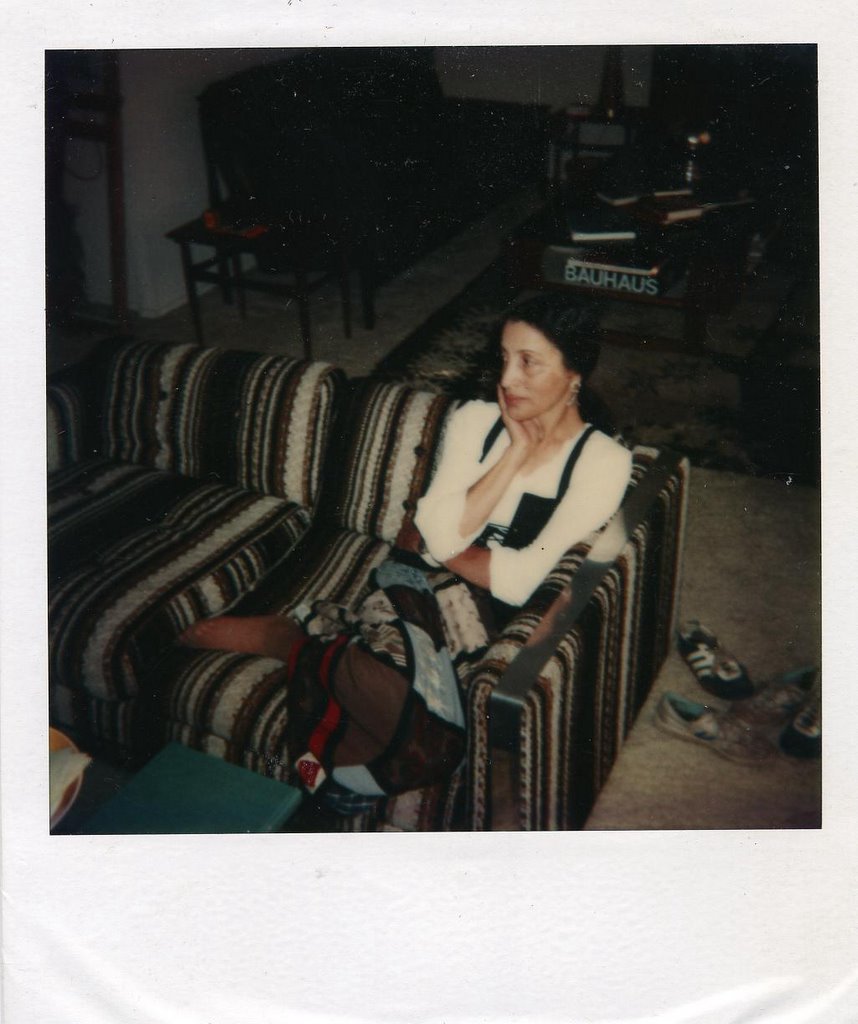
Photo: Taken in the livingroom of Deacon John Weaver of the Northern California Episcopal Diocese -- listening to a discussion in preparation for the Vallombrosa Conference at Stanford (circa 1976).
Friday, January 20, 2006

Where is my brownskinned heart to hurry?
The title of a song written long ago ... and that has been playing in the back of my mind since yesterday. This morning I woke sobbing into my pillow. Why on earth ...? No meaning came -- only the music -- as if coming from another voice -- as if in a dream ... but muffled so that Dorian wouldn't wake and find me distressed. I could never have explained to her dimmed mind the cause of the tears -- I couldn't even explain them to myself. Last night I went to bed so elated! But I had spent much of the past two weeks swinging wildly between highs and lows -- the executions at San Quentin, the Martin Luther King celebration, and the honors being bestowed soon by the NWHP. Was this then what it means to be manic-depressive? Surely not, since these were all larger than life events and my feelings appropriate to each. I'd surely never had such a diagnosis, but could this be? More sobs. I lay still for a long time quieting myself in preparation for climbing out of bed and into my clothes for work. Surely this would pass soon. But I'm still here ... .
It was in those few moments of quiet that the lyrics began to come together with the music -- and the ephiphany!
I was late twenty-something and living in Walnut Creek. The racial hostility was at its worst and one of my little boys had been stoned by some teens shouting "nigger!" from a passing car as he was returning on our country road from Sam's market -- across the creek and a few blocks away. He wasn't badly hurt and came to me looking puzzled and frightened to ask why? There was no answer. He was so young. I couldn't tell him that I just didn't know. The feeling of helplessness is one that I recognize as being always there playing softly in the background of my life as mother -- over all the years -- freshening unexpectedly from time to time. Maybe that's true for every parent, but perhaps not quite to this extent.
Later that day, after hours of torment and doubt, I wrote this:
Where is my brownskinned heart to hurry?
Where will I find my song?
Why must my mind be just for worry?
To whom does my dream belong?
What are my hands to hold this morning?
Where is my place in the sun?
With what shall I fill this time of longing?
Whose will shall be done?
The fruit of my labor will tumble in soon
in search of my love and my lead
Gave all I had when they left this mornin'
Why can't they know how little souls bleed?
Where is my brownskinned heart to hurry?
To whom does my dream belong?
Why must my mind be just for worry?
Who will hear ...
my ...
song ......?
I recognized that same feeling of helplessness on the day, years later, when my now grownup son, Rick, asked tearfully why his partner, Gordon, was lying dead on a slab at the county morgue because his northeastern family would neither claim his body nor release it to us for burial? Gordon was white and Rick was not. They were a committed gay couple who'd been together for 18 years. We lived with that gruesome reality for the 30 days required by law before we could claim Gordon's remains and memorialize him. Rick was dead a little more than a year later.
All of that rushed into my mind this morning -- replacing the giddiness I'd experienced last night as I dropped off to blissful sleep with the honors front row and center.
The sobbing that wracked my body this morning suggests that I may finally be willing to give up my self-assigned role of being "...the only grownup in the room." That I cannot possibly change the basic wrongs of the world no matter how hard I try. That I never could. That no one of us can and that it may be time now to set the world back down on its axis and allow it to find its own way toward redemption.
But you know what?
There is unspeakable relief in knowing that someone may have finally heard my song! The recognition being bestowed in March will symbolize this for me. Makes me wonder about the journeys taken by the other women with whom this honor will be shared. I so look forward to learning more about each of them.
Perhaps the tears were some indication of the power of releasing all that unspent pain.
Maybe I've finally exhaled.
Where will I find my song?
Why must my mind be just for worry?
To whom does my dream belong?
What are my hands to hold this morning?
Where is my place in the sun?
With what shall I fill this time of longing?
Whose will shall be done?
The fruit of my labor will tumble in soon
in search of my love and my lead
Gave all I had when they left this mornin'
Why can't they know how little souls bleed?
Where is my brownskinned heart to hurry?
To whom does my dream belong?
Why must my mind be just for worry?
Who will hear ...
my ...
song ......?
I recognized that same feeling of helplessness on the day, years later, when my now grownup son, Rick, asked tearfully why his partner, Gordon, was lying dead on a slab at the county morgue because his northeastern family would neither claim his body nor release it to us for burial? Gordon was white and Rick was not. They were a committed gay couple who'd been together for 18 years. We lived with that gruesome reality for the 30 days required by law before we could claim Gordon's remains and memorialize him. Rick was dead a little more than a year later.
All of that rushed into my mind this morning -- replacing the giddiness I'd experienced last night as I dropped off to blissful sleep with the honors front row and center.
The sobbing that wracked my body this morning suggests that I may finally be willing to give up my self-assigned role of being "...the only grownup in the room." That I cannot possibly change the basic wrongs of the world no matter how hard I try. That I never could. That no one of us can and that it may be time now to set the world back down on its axis and allow it to find its own way toward redemption.
But you know what?
There is unspeakable relief in knowing that someone may have finally heard my song! The recognition being bestowed in March will symbolize this for me. Makes me wonder about the journeys taken by the other women with whom this honor will be shared. I so look forward to learning more about each of them.
Perhaps the tears were some indication of the power of releasing all that unspent pain.
Maybe I've finally exhaled.