Tuesday, July 26, 2011

Humboldt State University -- a conversation across the generations ... (continuing)

10.  Working as a ranger for the National Park Service you get to share counter-narrative stories about the war effort.  Do you feel that the government is making a concentrated effort to air these stories or that it takes the efforts of knowledgeable individuals such as yourself?

Answer:  My experience with the National Park Service has led me to believe that the nation is finally ready to face the conflicting truths that have remained hidden for so long.  History tends to slip into the "generic" when left without the complexities that occur naturally in life. 
The mission of the NPS is to conserve and protect the nation's artifacts, natural resources, and stories -- and fortunately the home front era provides us with a rich store of women's changing roles, remarkable industrial feats, examples of conservation and reclamation, black history, dramatically shifting demographics, the shameful internment of Americans of Japanese descent, and much more -- but also that of average Americans struggling to move into a more equitable society while having to do so under an antiquated social system based upon white privilege that resisted change -- in stark contradiction to the very meaning of democracy.  I'm not in this alone, but with an enlightened Department of Interior and an Executive Branch which supports and encourages that work.
11.  Do you feel that living in the Bay Area gave you an advantage in defying the dominant narrative and in witnessing the full extent of social change over the years?

Answer:  One must understand that before WWII, the Bay Area wasn't much different from the rest of the country, politically.  It was in the cauldron of social change produced by the clash of conflicting values, attitudes, and customs brought into the Greater Bay Area with those who came to do the work that accelerated change and has continued to do so ever since.  Living in the Bay Area -- at the very edge of the continent; in the place that witnessed the birth of the atom bomb as well as the creation of the United Nations; and at the onset of monumental social change that would dominate the next two decades -- living among those who arrived daily by the tens of thousands over the succeeding decades believing this to be the most liberal place in the nation - and by so believing, made it so.  The Greater Bay Area is my definition of the ultimate self-fulfilling prophecy, and I'm so happy to have been a part of it as it evolved, taking me with it.  The Greater Bay Area's greatest gift may be that we lured the world through the seduction of the possible.

12.  How important do you feel storytelling is in changing social structures and giving people of all races and genders a voice?

Answer:  Storytelling provides models from the past that make possible a less precarious future by allowing us to preview systems and pathways from those who preceded us throughout the generations.  I'm constantly surprised in these later years at how often those innocent childhood conversations with Papa George while gathering berries or tying string beans to their slim poles in the kitchen garden -- rise up to inform the course of my life.  His mother and my great-grandmother, Leontine, known to all as "MammÃ¥" was often the star of those stories, and to the extent that my life uncannily reflects hers in some important ways, -- and though she died eons ago -- her life is still having an impact on the present state of the union through the living of mine.  Maybe that's the power of storytelling as I know it.

13.  In the novel "Assata," Assata Shakur discusses various political groups, mainly the Black Panther Party.  How important do you think political groups are in advocating and encouraging social change?

Answer:  I cannot imagine the circumstances in which joining with others of like mind in pursuit of a common goal is not a good and proper thing to do.  It is in the best tradition of our democracy to do so.  To magnify one's voice by raising it in unison with those of like mind should be invigorating to the political process.  However, lending power to ideas by acting collaboratively can be perceived as a threat to competing interests when there is an imbalance in political power; which has happened in the past with disastrous results.  We saw that in the persecution of the Black Panther Party by CoInTelPro during the 60's.  The disruption of young lives, the tragic loss of many through state-sanctioned violence from an agency out of the control of the people -- poisoned the political environment by consciously creating disunity from within and havoc from without.
I do not believe that this negates the need to advocate and encourage social change, but reinforces the need to be ever vigilant, and to expose and eliminate injustice wherever it may be found.  But it might have been the high cost of attempting to do so in a nation not yet ready for meaningful change, and a reluctance to give up on the status quo.

14.  In a video we watched entitled "2010 Women of Achievement, Vision and Excellence awardee" you stated that it was very important to tell the complicated stories and history that was behind Rosie the Riveter Park.  How were you able to compile stories from all of the different areas of the park?

Answer:  I once believed that there was a grand conspiracy to deliberately eliminate everyone but men from history.  I've come to believe that what is remembered is dependent upon who's in the room doing the remembering.  To the extent that women's history, black history, and that of "the poor and the powerless," are absent from those conversations where it is determined what is significant, important, or, "of worth"  in a world dominated by male concerns -- each has been omitted from the record.  History of the home front is rife with glaring omissions.  Once I ceased to need to place blame, and saw the problem for what it was, it was relatively easy to begin to make the corrections.  Once I found myself in the room "doing the remembering" and discovered that the supporting materials were easily accessible, and that all it took was to reach into my own truths and  bring them forth in the belief that most were universal (I don't consider myself all that unique).  Then I learned to speak in declarative sentences with clarity and authority that invited challenges from those whose views of that history varied from my own.  (Out-living most of those whose memories differ from mine helped a lot!)  Once I learned to trust my own judgment, my voice gradually became stronger and others began to listen with increasing interest.
Research also revealed that there has always been -- throughout history -- those who were trying to get it right, and that history has been largely written by those who didn't.  Yet the patterns are clearly evident by the direction that our national compass has taken us in this, the 21st century.  We have been ever trending toward fairness and equality -- freedom and justice for all, and, over time, the nation is gradually fulfilling the destiny set forth in those revered founding documents.
(continued... )

Sunday, July 24, 2011

More questions ... .

7.  I read through your blog and got hooked from the start with all the rich language and moments of humor.  There was one particular line in the post about the jury summons which said, "I know that this is one of the rights guaranteed by the constitution to any American accused of a crime.  The only way those rights can be guaranteed is if ordinary people like me participate in the process.  I have never, and I would never opt out," and I was really struck by that being most people I think are rebelling against the system -- want those rights but not want to participate to get those rights.

And I would love to hear her talk about that the aspects of life where one might have to put aside say whether you think the justice system is doing good or say whether you think you are just too busy because you know that to get other rights doing the things like jury duty are necessary even if you don't support the system whatever it may be.
Answer:  I understand the questioner's cynicism about the justice system.  I share it to a large extent, but to not participate for me is not an option.  It is the one in place, and, unless we play our part within it -- we may not develop the skills with which to make the much-needed corrections,  You can't make them from outside the system.  Somewhere along the line I lost the sense that there exists some evil "they," and began to see an active (or inactive) "we" instead.  From that point on, it became "my" imperfect justice system with need of my input.
8.  After working as a ranger and being a role model and leading people on tours around the park which has so much to share and seeing today's teenagers, what do you think is the best way  that we students can make a difference, and what do you see that has changed in the way students view the history that you lived through?

Answer:  I'm not sure when I began to see myself in context -- as an American with a citizen's responsibility for the maintenance of the Democracy -- but it happened somewhere along the way.  I would have wished that this had happened at some earlier time in my own history.  When it dawned on me that Democracy is not a fixed thing  created for all time by some "paternalistic old dead white guy slaveholders" who gathered together in Constitution Hall in Philadelphia to write the Constitution and the Bill of Rights, but, that it's dynamic; a living breathing thing.
What they created were only the blueprints of the ideal they willed into being -- and in order to survive the rigors of a constantly changing and growing nation -- Democracy must be re-created by each succeeding generation, and modified only after much deliberation by the representatives of the people, the Congress of the United States; by the Executive Branch; and by the Supreme Court.  It is this that my education failed to communicate adequately.  Once realized, I found myself empowered by the knowledge that the Democracy was dependent upon each one of us, and what we do or fail to do, individually, shapes our collective future as a nation.
 Looked at this way, the country and the world could not afford for me to sit around on my haunches doing nothing!  My greatest fear is that your generation will not understand its individual responsibility of citizenship to not only learn to live with, but to be constantly creating positive change by participating in the most effective political system the world has yet produced.  People of the developing nations are risking their lives daily in order to replicate what we have as a birthright.
We don't need to know which direction is "right," the secret is that the correct pathway is found in the balances between opposing political forces.  Should the system yield to my wishes (of the moment) at any one time, it might not continue to serve my interests subsequently -- when I've become better informed and developed a different mindset. The greatest tragedy to befall our system of governance may be the gradual degradation of the multiparty system.  The need is for more voices and varieties of opinion to be expressed not fewer, and more of us leaning in the direction of what we believe to be positive change with faith that unseen others are leaning with us -- all that, plus the swinging pendulum with the power to self-correct.

9.  Why would the African American community volunteer to assist in the war effort (both as riveters and soldiers) for a country that has a history of exploiting them?
Answer:  Beats me!  But we did, perhaps in the hope that doing so might bring about greater respect from the nation.  Instead, the horrible abuses went on and the disappointment and resistance to change produced the Civil Rights revolution of the Sixties.  It was such an outrage to human dignity for black people to be asked to work, fight, and die to defend rights that we would not share in for another 20 years, but this produced a resistance movement that would change the nation -- not only for ourselves, but for all of those marginalized -- women, gays and lesbians, the physically and mentally handicapped -- and led to greater freedoms for many over the succeeding decades and into the present by forcing the country to confront it's hypocrisy and inequities -- it's brokenness. 

(Continued ...)
Humboldt State University questionnaire (continued) ... .

5.  Are you pleased with the current situation of women and equality or do  you believe there are major social and/or political changes that need to occur?  If so, what are those changes?

Answer:  I  think we're still in the middle of the movement to empower women in the home, the workplace, and in society at large.  We've gained in many ways,  but there is still work to be done.  In  many ways the struggle resembles that of the battle to eliminate white privilege.  No one gives up power willingly, and society still tends to favor males overall. It took a while to figure out whether woman's equality was a step up or a step down, since public relations campaigns have continued to confuse the issue for a significant number of women. 

The trade-offs were unclear at first since, as an African American woman, I didn't perceive my oppression as coming from the men in my life (who were experiencing the same oppression as I) but from whites -- and largely from white women.  In my youth, black women were employed as unskilled domestic servants in homes of white women who held the power over our economic lives -- and in many cases -- the same white feminists who now needed us to run their homes and care for their children so that they could realize their dreams for careers in corporate boardrooms!  (Since that time they've by-and-large turned to the undocumented for such needs.)  A whole lot of confusion reigned in those early days of the fight for gender equality.
 African American women were slow to join the cause of feminism for those reasons, but as educational opportunities became more available; as doors began to open to women of color, it has been easier to join with other women to struggle for equality for all.  Since we've begun to re-define roles, both genders have had to adjust to new expectations of one another and of ourselves.  I think those hopes are slowly being realized, and, despite some casualties, I think we're making progress.  I see it in the attitudes of my sons which falls light years away from those of the last generation.
I sometimes wonder, though, if the real casualties of the gender wars have not been the children?   But that's a discussion for another time.


6.  Which women (living or dead) inspires you the most?  Which man?
Answer:  The answer to this question has changed frequently, and in the early days could  most easily be answered by the movie star whom I adored as a teen -- Kathryn Hepburn, of course.  Then the darling dare-devil of the thirties, the ill-fated Amelia Earhart.  But Eleanor Roosevelt's political and social leadership during WWII stands out as the heroine of most young women I knew.   The spirit each of those mentioned separated them from the rest, but in looking back, each seems almost gender-neutral, don't they?  I've never thought of that before writing those words -- maybe representing the perfect balance between Ying and Yang?  Not sure.
 It's also interesting that none is African American, but as a child -- I was "American," and made little distinction between races, except those that were cultural, I suppose.  Those 3 women were universal in their appeal -- enjoying the admiration of most of the young women of my time.
My gutsy irreverent Aunt Vivian Allen Jernigan became my idol at some point - the most honest, compassionate, and generous person in my world as I approached young adulthood.  Currently, Law Professor Lani Guinere and First Lady Michelle Obama would be hands-down my idols and exemplars.  And, still, my ancestor and enduring family matriarch of those who remember, my great-grandmother, Leontine Breaux Allen (1846-1948).  She survived the horrific shame of slavery with grace to produce succeeding generations of extraordinary people who've made impressive contributions to American life in the fields of education, arts and literature, in medicine,  journalism, and the sciences.
The most admired man in my young life was my paternal grandfather, Louis Charbonnet, whose portrait hung in a battered gilded frame on the wall of our dining room.  Though I was only 3 years-old when he died, his aura dominated life in the home of my childhood.  He was an ironworker, millwright, engineer, and community leader, who left now-fading photographs of works in New Orleans that were monuments to his abilities, and to his generosity of spirit that caused the grownups in my life to speak of him in hushed tones. 
(continued ... )
A few questions we, the students of
WS 107: Women, History, Culture at
Humboldt State University,
gratefully and curiously submit for
Ms. Betty Reid Soskin's
consideration on this Wednesday, March 23rd, 2011


1.  I heard about the New Orleans flood in a sociology class last semester.  To my understanding the government chose to bomb the levees in order to sacrifice one part of town and save the other from damage. What are your thoughts on the racial/socioeconomic injustice of this?
 Answer:  I'm sure that it was far easier for such decisions to be made arbitrarily in those days without reference to the lives and property that would be sacrificed than it would be today.  Though that varies still depending upon how much participation occurs in the public life of cities and townships by representatives from all races, ages, cultures, and economic classes.  In 1927 a few powerful men made decisions based upon the threat that the Mississippi's rising was having on those parts of the city which they controlled and protected.
Hurricane Katrina brought into focus the corruption and misuse of power that still remains in many places, despite the greater representation from a broader segment of the community, so that many of the problems of access to power have resisted remediation, and many of my relatives who fled the floods  -- as our family did in 1927 -- have not yet returned to New Orleans.  
2.  Beside the future generations of your family, do you have anyone else that you're specifically targeting with your blog?
 
Answer:  Not particularly.  It would have been hard to believe that anyone but those close to me would have any interest in my thoughts in the year 2003 when I started this journal.  After awhile it was clear that at least a few total strangers were following my blog, but it has never attracted more than limited interest to my knowledge.  I would never have dreamed that university classes would be using these thoughts hastily posted at the end of my day in the quiet of my home as content for study!  I've never received more than about 2 dozen comments over all the years since all this began, so it was not hard to believe that my "audience" was limited to my own family and a few friends.  
3.  In a YouTube video you appear in, you mention having not listened to yourself up until your midlife.  I was curious about what made you listen--was it a growing/learning process, or a radical shift in your life that immediately changed your perspective?

Answer:  It was a gradual thing that is only apparent in retrospect.  I'm not sure when I noticed that others were listening -- and that I might be worth listening to.  Maybe it was when I first was elected to serve on a board of some sort and my self-worth took a leap. At some point I became more inner-directed and ceased to be totally led by external forces.  That came fairly late in life, though.  Some of it came earlier from becoming a parent and needing to "know" for the sake of my children as they were depending upon my guidance.  That can make one grow up in a hurry.  At first I was not nearly as impressed by what I knew, but with how little was known by those around me compared to how much there was to be known.  As these things came into balance -- as I started to mature, my own inner voice became louder and more insistent.
4.  I read that in the 1960's you wrote and performed songs, many dealing with civil rights; what was that like and what role does music play in your life now?

Answer:  When my daughter, Dorian, was born brain-damaged in 1957 -- and as she slowly began to develop cognitive skills, I noticed that she retained what I sang to her more effectively than what I said to her.  I made up songs to match the rituals of washing hands, taking baths, putting on pajamas, and discovered an innate ability to compose.  This coincided with what was happening throughout the country and with the advent of folk music, coffee houses, and civil rights marches -- all expressed in song.  It was an easy transition into those movements at an age where composing and singing my songs provided a way for me to "travel" in my imagination without leaving home where I was needed by 3 growing young sons, two aging parents, the growing realization that my little girl would never reach adulthood, and a failing marriage.  Through creating my songs it was possible to leave it all with Dorrie holding onto the hem of my dress; it was pure escapism at first, but when I listen to those tapes (never published), I'm impressed with how fine some of that music was. 
 And, no, I left "Betty the Artist" somewhere in the early 70's and began to live out of other parts of myself.  My interest and enjoyment of all forms of music is still strong, but only as a member of the audience.  I suspect that -- though there were opportunities to pursue life as an entertainer at the time -- it would not have in any way matched the satisfaction I found in living off my other "edges."
(continued next post)
I recently ran across a sheaf of papers brought back last spring from the trip north for a stint as guest lecturer ... .

There was little time to answer  during my talks, but in the event that some of those students are still reading here -- maybe I could respond in the hope that by so doing it may answer questions others may have had over time.

Besides, it helps to keep my mind off the Norwegian tragedy, and the 9th fatal shooting of the week here in the place where I live --

It's difficult to think of anything else ... .

Sunday, July 17, 2011

Richmond’s Betty Reid Soskin makes the Sunday funnies in the latest of a series of honors

Richmond’s Betty Reid Soskin makes the Sunday funnies in the latest of a series of honors
One would think it impossible to forget the upcoming publishing of my debut in a Sunday comic strip, right?

... yet, that's precisely what happened.  The West County Times columnist, Chris Treadway, ran a complete recap of "Life with Betty" over the past unbelievable months of honors.  (Has it really been 8 weeks since the Morrie Turner tour?) It reads like a fairy tale for seniors!    The whole story appears in Facebook, and came up on the newspaper's online edition when I clicked the mouse.  Now I need to put on my shoes, turn down the oven temperature on the pork chops, and hit the newsstand for copies for my grandkids. 

Had "Life with Dorian" not taken priority over "Life with Betty," this would never have happened, but there isn't always room for both.

... and maybe that's at least a part of the problem.

I'll have to thank Morrie Turner tomorrow; maybe send him a DVD of my songs ... and add him to the list of new friends acquired over this past year.  Then I'll send a copy to our cultural resources staff for adding to a growing collection of "All Things Betty." 

Whoever would have ever guessed?

(Someone needs to do a study of time as it manifests after one reaches the age of eighty.  It's in the 8th decade that Christmas begins to recur every 6 weeks.)
The level of intensity shown by that last entry is unsustainable ... .

Soon after re-reading Friday's writings (and feeling the catharsis which was almost an electrical impulse), I shut down the computer and eased all the synapses back into place and got ready to pick Dorrie up for our usual Saturday shopping trip.

Of course, with my new-found sensitivity to be alert for signs of residual trauma, I searched her face as she neared my car, but all I saw was a beaming smile as she busied herself with packing her walker into the backseat and depositing the cloth bag of whatever that accompanies her everywhere.

We first went to her bank where I parked outside to wait as she went in to make a small deposit to insure that she wouldn't be overdrawn (she'd received a warning in the mail).  And, yes, her mother provided the "small deposit" to avoid the $35/penalty that would result if ignored.

We spent the next few hours in the supermarket as I noted how expertly she managed to make her way around the aisles to gather up the items from our list -- and though totally illiterate -- she has apparently memorized shapes, colors, and sizes of letters of her favorite brands, and though we were in a store we don't visit very often, the locations of products posed no problems for her.  She apparently had through osmosis learned the categories of items that are displayed together.

Last night we drove down the hill to the community college where a musical, "Rivets," was being staged.  It's based on the WWII Rosie the Riveter stories, and I'd promised to deliver 250 brochures from the park for distribution with the programs.

Dorian sat as if enchanted for two hours; and followed the proceedings on stage well enough to ask at one point whether I had been a "belder,"  (welder).  She has a way of coming up with newly discovered words, but seems to have figured out the function associated with it, and only needs confirmation from me.  Her vocabulary is sometimes more extensive than that of some of her caretakers.  Dorian also has a flair for making up or adapting new words, and often they're an improvement over the original.  For instance, her "disastrophe" is a case in point, and she uses it appropriately to describe awfulness that can't be described in any other way.

As we were preparing for bed on return from the college, as I was feeling for quarters left in the pocket of the trousers I'd worn to San Francisco on Thursday, my hand fell upon the 3 little cassette tapes that had been used by Dr. Smith during Dorrie's interviews.  Our attorney had requested that I take a tape recorder to both examinations, but, being of another era, the one I took required tapes -- I didn't realize that there are now digital recorders.  The first day with Dr. Becker, mine had stalled and resisted all attempts to make it work.  He assured me that he would be recording everything anyway, and that he would send our attorney a WAV file of every word, electronically.  I saw no reason not to trust him.  My intuition has rarely failed me, and I had no reason to expect it to now.

However, during the 7-hour psychological examination the following day, my little hand-held model seemed to be working well, so Dr. Smith positioned it to catch every word, but had to interrupt his work each time to call me from the reception room to reset it as it clicked off, and after a couple of times it seemed wiser to not use it at all, but to trust that he would follow Dr. Becker's procedure. The two men share a suite of offices.  He assured me that he would be sending his tapes along as well.

That meant that my hand had fallen upon the little tapes that held the partial recordings of Dorian's interviews.  Oddly enough, I felt no wish to listen to them.  What could I possibly learn that was not already known?  She is, after all, a fully-mature adult woman (okay, so maybe not), but nonetheless - certainly with a right to confidentiality.  Maybe even this late in life, there is need to reinforce the concept.  She has no way to listen to them, I suppose, but she surely might like to know that no one else will.  I gave them to her zipped into a small plastic bag this morning.  Her attorney will understand.

If I'm lucky, I may be given a copy of their findings, and that might be helpful to getting us back on track to whatever level of independence may be needed in our somewhat limited future.

It's after noontime, and she's still asleep on the futon next to my bed ... that nagging suspicion returns that this is a symptom of residual trauma (clinical depression?), but all-in-all, I just may not ever see the forest for the trees.  She will sometimes remain in deep sleep until 3 o'clock, then drop off at 8:30 or 9:00 and still sleep through the night.  Still, on Monday, Wednesday, and Friday, alone in her apartment without an alarm clock -- she wakes and gets herself ready for the Para-transit bus to take her to NIAD for her arts program.  Not sure how to read this.  It's new.  Though I've tended to see it as extraordinary fatigue due to the stress placed on her body due to reduced mobility.  I've tended to allow the new behavior, in the belief that this, too, will pass as her healing progresses ... .

Friday, July 15, 2011

Throughout my workday, the image of Sr. Corita Kent's colorful poster from the Sixties -- "Don't just DO something, Stand there!" kept flashing from somewhere deep inside ... .

Yesterday in Dr. Smith's reception room was my "Stand there!" moment, and I was helpless to resist.

For just a few moments while Dorian was with the medical assistant undergoing a 500 item true/false test (being read to her), the psychologist invited me into his inner office for some clarification of conflicting facts in Dorrie's interview -- nothing especially noteworthy, just some confusion around dates and times.  But it was his questions about any signs of changes in her mental states that I may have noticed in the months after the accident.  My hesitancy in answering his question puzzled me.  I could feel the hesitation and mumbled something almost incoherent (or so it felt).

Her life had surely changed unalterably, and there had been traumatic injury, but why were the signs not obvious to me?  After all, she'd been moved out of a group home, been through 2 rounds of surgery, been relocated 5 times (counting her move back home); before moving eventually into her own apartment; had lost her peer group; and had she really weathered all that without any visible effect?  I consider myself an observant mother, but couldn't point out what must be quite obvious to others.  Why was that?

Well into my reception room " 7-hour retreat" it began to dawn that I had done the thing I've spent an entire life trying to avoid; I'd filled in all of the "holes" in Dorian's life with huge chunks of my own!  Because this has been an unusually productive period with many honors and rewards and meaningful work to do, I've been blinded by the reality that since November 27, 2009, I've given up the one friendship (with Tom) which provided a peer relationship.  Those occasional lovely weekends at the ocean in Mendocino have ended; those occasional celebratory dinners at Tadich; visits to the DeYoung, the San Francisco Museum of Modern Art; the occasional concert and/or play; walking the headlands, and wandering through the Mendocino and Fort Bragg art galleries; had all abruptly and unceremoniously ceased.  I miss riding up and down the Coast Highway in Tom's little red Citroen
Duex Cheveaux - the "Geezermobile" and sitting around in the evenings arguing politics while looking up through the skylights at the incoming fog bank... .

For the first six months of last year I worked my regular hours and visited Dorian in various facilities every day -- sometimes twice -- bringing her yarn for her various projects and picking up soiled laundry or returning clean clothing.  In June, she moved into my condo (returning to the group home was not an option - or was it?) where she remained for several months.  Since moving into her own apartment about 5 minutes away from mine, she has no life except for NIAD and the time shared with me.  Her weekends are all spent at my apartment.  Her income is limited to SSA so I pay for a part of her rent and most of her groceries, and I've given up both cable service and my house phone augmented by liquidating some limited Roth IRA shares in order to do so.   After all is said and done, could this not be the emergency I'd always been saving for?  I've made my daughter dependent in ways that are new and really not healthy for either of us.

I've been anticipating every bump in the road, and providing cushioning against a world I no longer could trust with her life.  Small wonder that I can't find signs of trauma in my daughter -- I've absorbed most of that into my own.  Had I not been there to catch her as she fell, she would have had to use that social system that we've spent so much time preparing her for.  She has more of me and my time than ever before in her life.  I'm completely dominated by her needs, and I've failed her in that -- after granting her autonomy I've snatched it away to ease my own guilt at being off scene when she was struck in the streets -- guilty because she'd lain in a hospital bed beyond the reach of anyone; unidentified because she was carrying 5 different identification cards -- none of them current, and in a hospital in a strange town because her medical coverage had been allowed to lapse for 6 months prior to the accident!  (All the responsibilities of her supervisors from the vendor operator, social worker, and assigned case manager.  The accident laid bare a badly degraded system designed to serve the developmentally disabled.)  I was out of cell phone range, 3 hours away, until Monday morning 3 days after the accident, when on the drive home my cell phone came alive with an urgent call from a strange voice of a male nurse, " ... does anyone at this number know Dorian Reid?, if so, please call Eden Medical Center and ask for Zack."  Her group home supervisor did not know where she was because she'd been visiting friends in a nearby town for the weekend.  She hadn't been missed until I notified the house of her whereabouts on Monday morning. The friends she was visiting with were also mentally disabled and living independently in an apartment in a neighboring town.  They did not report her missing, but continued to try desperately to reach her when she failed to return.  Her cell phone was lost at the scene of the accident.  This I learned when calling her number to find the voice mailbox filled to its capacity with frantic messages  ("Dorrie, Dorrie, where are you?  Dorrie, call  us, please!") a few days later.  The phone was never recovered to my knowledge.  It was her lifeline, had she had it she would surely have called me when she woke after the surgery.  It was her connection to everyone in her life, and that connection was now hopelessly broken.
If Dorian hasn't displayed the trauma that surely she experiences, it's because of the regression that I've
gone through.  She is still productive and is back in her arts program at NIAD (a Godsend!), but her mobility is now curtailed by a weight gain (25-30 lbs) and a less responsive body from having to use a walker and wear a leg brace, the chronic headaches, and losing her physical activities as a year-round Special Olympics athlete has reduced her social life to nil.  (Could her excessive sleeping pattern be symptomatic of depression?)  There are always weekends with Mom to look forward to, of course.  And Mom can be so engaging; so resourceful; fun!

With a conscientious "Mom" anticipating her every wish, who's to worry?

So, now that I've "stood there," Sister Corita, what on earth do I do now?  Dorian hasn't the mental capacity to know what is missing from her own life and little reason to want more independence or autonomy, but her mother needs her own life back, I think, and the sooner I can regain what little there is left of that -- the better, right?

I used to say that keeping distance between us and allowing Dorian her autonomy gave me the luxury during my lifetime of seeing how she would fare in the world after I'm gone.  Told myself since she was a toddler that my job was to teach her to use systems, find her way through bureaucracies; social workers, case managers; that it was of far greater value to her for me not to provide answers but to direct her to others out in the community who could supply them in my absence.  I created myself a role as "Mother as best friend."  It worked, I thought.  She surely fulfilled her part, and I truly believe she uses everything that she has and has been "maximized" as much as possible.  She clearly has developed enough skills to get her basic needs met.  I believe we've done all the right things, until now.

How on earth do I step back now, and trust the world with her life; yet that is precisely what I will need to re-learn, even knowing that she may not make it.  She must continue to have the chance to try.

Maybe now that I've had that precious 7 hours to face up to the truths that I've masked all these months, maybe I'll be able to see the signs of trauma that she surely must experience.  I've so needed to believe that she is alright, and my own world has provided so much distraction, a blessing, really ... .  

Fortunately, I have my work, and - though barely adequate in these times -- my fiercely-guarded financial independence -- but we just may need to consider professional help to resume the direction toward that separation that is now eluding us, and that is so essential if I'm not to abandon her to impending "natural causes."  I have so few answers at this point, and little confidence that anyone has. 

There is so little time left to correct our course ... .
Just hit the proverbial brick wall ... and I'm not sure what to do about it ... .

On Wednesday Dorian and I met with the orthopedist who was assigned to do an evaluation for the pending litigation having to do with her 11/27/2009 auto/pedestrian accident.  I'm not sure what I expected, due to the fact that the only experience I've had over a lifetime having to do with attorneys had to do with my divorce which was amicable.  It seemed logical to follow the advice of those professionally involved in such matters, and there were certainly enough existing records to draw from and the only confirmation of claims lay with examination of the one involved; Dorian.  I could be of little help in this matter except as support for her, but only if needed.

I waited until about two days before to tell her about the two appointments (Wednesday orthopedic, and Wednesday, psychological) so that she would not be needlessly apprehensive.  The truth as she could recall it and whatever impressions they could illicit through their meeting with her was really all she needed to provide.  Ten years of marriage to a psychologist had perhaps prepared her mother, so it felt about right.  I picked her up from her apartment on Tuesday night so that we would be ready for the drive to San Francisco early in the morning.  She asked few questions, and seemed comfortable with the arrangements.  On the drive over in heavy commute traffic, she was in charge of the GPS system and aided the robotic voice by repeating the prompts at each highway change.

Wednesday went well.  The physician was warm and welcoming, and seemed well-prepared to receive her.  In about 4 hours we were on our way home, and the only threat was the drive across the S.F./Oakland Bay bridge, which we navigated successfully (this had been the only threat I've felt in the days leading up to these appointments).

Yesterday's appointment turned out to have some hidden landmines:

The psychologist let us know -- even before we left the reception room to enter his inner office  -- that this session would last for at least 7 hours!  (He told us, as an aside, that the procedure normally takes 8 hours, but that we were starting an hour later than usual in order to accommodate our wishes.)  We'd had no warning of this, and my minimal preparation of Dorian provided no hint of what this might entail.  Actually, she's never  undergone such intensive testing before in her life, so neither of us knew what this meant.  It also meant that I'd not come prepared with a book to read or crossword puzzles to solve, and would be forced to do something completely foreign -- sit and think for 7 whole hours --uninterrupted!  This is called "hitting the wall," and it would prove to be sobering, indeed.


But now I have to leave for work, and the revelations brought on by my enforced stoppage will have to wait until I get home this evening ... but I think the insights were profound;  maybe even life-altering.

More later,

Saturday, July 02, 2011


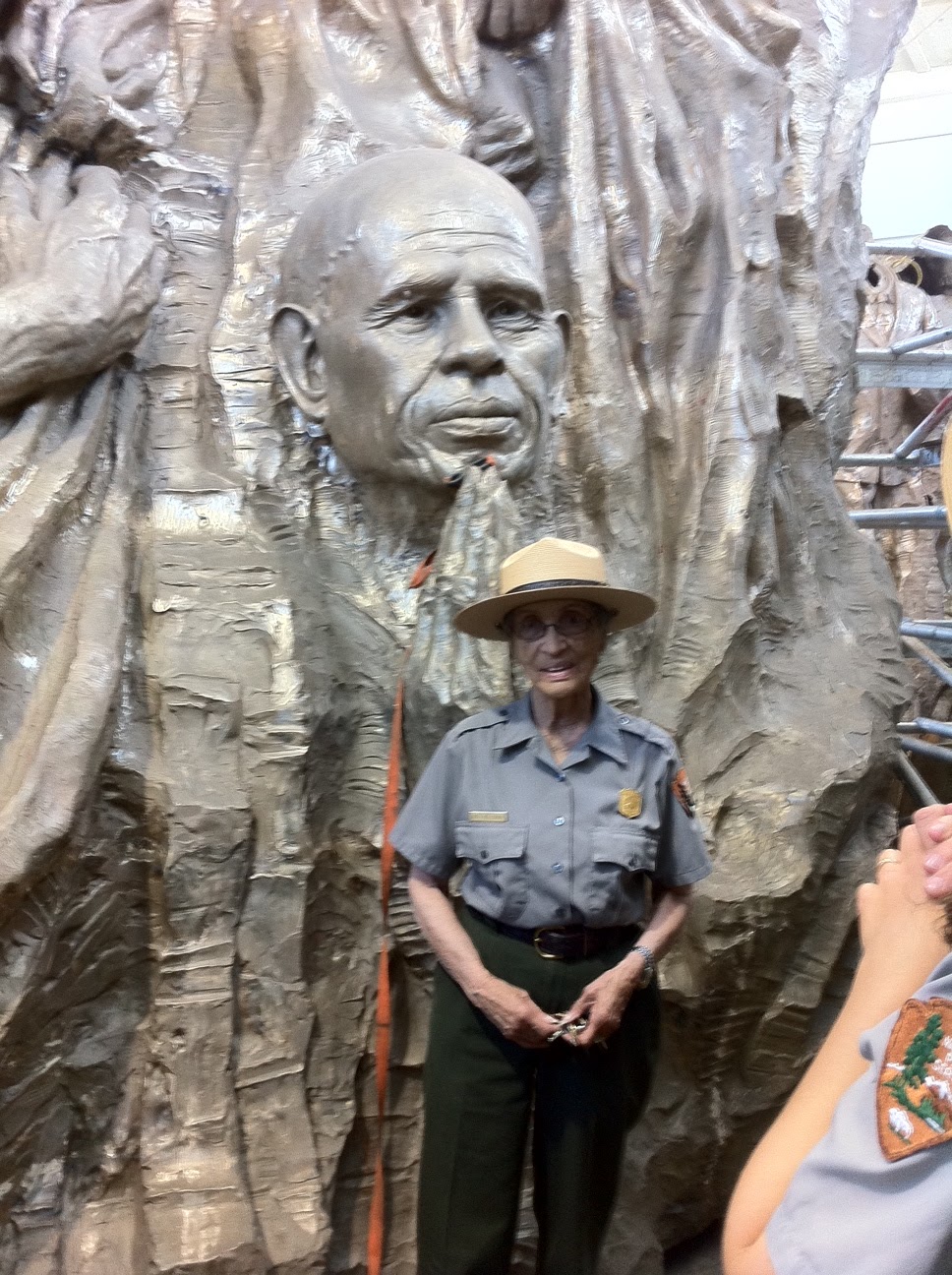
The sculptor's name is Mario Chiodo, and his work is breathtaking  ... !

 ... a visit to his Oakland studio on Thursday proved to be absolutely awe-inspiring.  The figure shown here is the head of Thich Nhat Hanh, Buddhist Monk, and but one of the many figures who, together, make up the elements in this magnificent sculpture to be installed in Henry J. Kaiser Park in downtown Oakland on September 6th.  This work has been ten years in the making, and the first phase is now nearing completion.

It stands 30' tall, and we were able to see the first of the four elements in the final stages of creation; being cast in bronze.  This was a visit to the foundry where that work is in progress.

Another of the elements is a depiction of Maya Angelou (below), with little Ruby Bridges of the New Orleans school desegregation struggles standing below at the edge of this photo on the far left.

Standing in the presence of these imposing figures was overwhelming.  There are -- at this stage, 25 in all, and another ring of local "extraordinary ordinary" people (not yet created) will accompany those shown in the original piece.  Among the rest of the original cast are Gandhi, Nelson Mandela, Chief Joseph, Mother Teresa, Winston Churchill, Martin Luther and Coretta Scott King, Rosa Parks, Franklin Delano Roosevelt, Cesar Chavez, Helen Keller, Harvey Milk, Henry J. Kaiser, Ansel Hall, Abraham Lincoln, Malcolm X, and others.  Chiodo's concept posits that these were ordinary people of every race and ethnicity who rose to make extraordinary contributions to serve all of humanity, and there is resonance in this year's Home Front Festival -- where -- coincidentally, we'd quite independently fashioned the concept of "Extraordinary Ordinary People" to serve as the theme of this year's mid-October festival.  It's almost too good to be true, though obviously an idea whose time has come.  But how do we make the connections?  Which is why we visited Mario's studio, to meet him, and to try to figure out just how that might be ... .

What an amazing day of discovery and awe in the presence of genius!

Note:  For more information, visit Mario Chiodo's website, or that of "Remember Them, Champions for Humanity."

Thursday, June 30, 2011

Not to worry ... .

I just may be -- not only the oldest national park ranger in the country -- but the only ranger yet hired into infinity!

My stay with the park service has been extended into the unknown future.  I've been rehired, and this time it's not a "term" appointment, but designated as "permanent."  And, the  competing applicant was also hired.  How cool is that?

Over the past days I've become aware of how uncertain I've been about my future.  The fear that I would overstay my usefulness to this work that has become so central to my existence -- was causing me to distance myself from any notion that there was even the faintest possibility that my work has also been important to the development of this park.

Got caught  up in strange conversations with my colleagues having to do with how I really could find alternative ways to spend my time; that there were still job opportunities waiting, and that they needn't worry about me; that the decisions-makers should really give full attention to the other applicant without feeling the weight of "taking care" of me.  I never once felt confident that these were bright young people who are dedicated to the mission of the National Park Service and that the decision to keep me interpreting that mission was best for the park.  I should have known.  ... but I was so afraid that it might be time to leave and that my zest for this exciting work would prevent me from seeing it.

In my heart, now that the decision has been made -- I would agree.  This has been a remarkable year in a long life that seems to have been preparing me for precisely this role -- how incredible!  What a miracle that fate has placed me on the planet among those with whom I can now expand beyond even the limitations of age!

To hell with the tango lessons and chuck the kazoo!

I've been given new edges from which to carve out the rest of life!

Saturday, June 25, 2011

Recently found myself observing that -- as I listened to my favorite jazz station on the car radio ... .

that I hadn't heard an African American jazz singer for a very long time.  Also, that black jazz musicians have virtually disappeared from the airways, or is it simply that I can no longer distinguish them from their emulators?  I don't think so.   Josh Redman still stands out as having an identifiable black sound.  And, it doesn't take many notes into a song to be able to tell a black from a white voice -- no matter how hip or laid back the performer.  There's a kind of quiet pride when -- alone in car --  Aha! I pounce on the imitators.  And, yes, even Diana Krall and the inimitable Mark Murphy fail my test of the melaninian sound (and I know that's not an actual word - but it'll do for the purpose of discussion).

Somehow great American popular music gave way to overwhelming decibel levels, elaborate costuming, general messiness masquerading as costume, mosh pits, dramatic clown-like theatrical makeup and fright wigs; partial and whole nudity on stage, the smashing of guitars, etc., and over time, both the music and my finely-tuned ear got lost in the carnage of Rock and Roll!

While watching Lee Williams, traditional gospel singer from Mississippi in a gospel concert -- almost motionless and dignified -- dressed in a fine dark brown suit, white shirt, and handsome silk tie standing at the mike before a fervent black evangelical congregation, I was reminded of how far the general music world has moved from complex sound to appearance and marketing ploys to attract sales and new audiences.  And today's white derivative musicians are working frantically to produce that wildly passionate 'call and response' still so natural and alive in the black church.  It was exploding all around us as we swayed to the insistent rhythms at Parks Chapel that day.  What I was hearing (and fighting the urge to dance in the aisle) was the age-old fundamentalist roots of jazz,  the legacy that I've almost lost in the course of becoming acculturated into the American whole. 

With Lester Young it was a simple pork pie hat; with Duke it was either a continental casual look or those formal tails swinging from the back of that piano bench, and Nat "King" Cole was the very essence of good taste -- right up to his time- and date-stamped patent-leather "processed" hairdo.  Physical appearance didn't compete with the music, even for the women of jazz, the signature was buried deep in the individual sound of their music.  I like to think that their style of dress was in keeping with respect for their audiences and their art.  I also believe that a cultural marker was set by the style created in the jazz world that is still visible in today's black church where one would never be seen in torn Levi's and  T-shirts in the House of the Lord, and where hats are elevated to "crowns" by the "saints" of the congregation.  Traces of the jazz world are still reflected in both the sound from the choir loft and in the pews through the "call and response" and "the beat" of sung gospel.  Black music has been powerful enough to stand alone with little need of enhancement beyond the artist's ability to deliver its message. Think the always well-tailored Wynton Marsalis for a contemporary example, and you'll gain some sense of the sacredness of jazz, and that this is, indeed, the black world's classical music.

The distortions emanated not only from the Rolling Stones and Kiss, but Cindy Lauper and now Lady Gaga in her infamous meat dress.  It seems foolish to hear both Lauper in her day and Lady Gaga, currently, complain that their outrageous look is merely attention-seeking, and that when they're performing -- we should only pay attention to their art.  

They've all been "commodified"  (okay, so according to the spellchecker, I'm making up words again) to the extent that artists have for the past few decades been sold as packages, a package that must include a "look," so that the quality of the music has disintegrated almost beyond recognition.  It's now almost impossible to comprehend either lyrics, or the intent of whatever they're offering to audiences beyond the sensational.  At best, most groups are playing mediocre music -- all different in an identical way, except for those still writing and performing simple original music on acoustic instruments in a genre other than jazz or blues -- but those more clearly associated with the individual artist's life, and within the context of their own experience.  I continue to find indescribable beauty in authenticity wherever it might be found.


But today Sonny Buxton has reminded me that all that good stuff is still available if I just tune in to a time when Jazz at the Philharmonic sessions were recorded for posterity.  I've now lived into that posterity -- and can draw on all those musical treasures for the good of my soul.  I've spent the past several hours just listening and remembering, and oh so many years have been tossed off in the process!


I find myself wondering when we're going to discover that those young black kids who might have become the Nat Coles, Lester Youngs, Mile Davises, the Charles Minguses, the Ella Fitzgeralds and Sarah Vaughns, are probably languishing in the prisons of the nation, completely unaware of the loss of the legacy that was theirs; while their imitators, the well-intentioned "derivatives," have filled in the vacuum left by their absence from the schools, the studios, and the sound stages of the country and the world?  And there's an innocence about it all since I have the feeling that fine white musicians have expropriated black music to the point where it is now they who are defining the genre, and all without any awareness of what role they've unwittingly played in the process.  Don't blame them, they were just "integratin'," and God knows that was the name of the game, was it not? 

... and are we all not the poorer for the loss?

Top right photo: Billie Holiday with Duke Ellington at lower left.
Thinking about jazz today as it plays in the background.  It's Sonny Buxton's Mid-day Jazz ... .

Sat down at the computer this morning wondering just how I could possibly write about yesterday's bus tour and do it justice?  It had been on my schedule for weeks though I'd paid as little attention to its approaching as possible without admitting to myself that there was some concern lurking in a corner of my consciousness that I might not be adequate to the telling of this history?  Would they guess that I might be insecure in this time of such high public acclaim ... acclaim that I still question ... in those minutes just before sleep each night? 

The teachers from Placer County school district under the leadership of the Department of Education (history?) at Sacramento State had arranged as a part of their week-long Bay Area experience, a day at Rosie the Riveter WWII/Home Front National Historical Park; a trip to Angel Island; one to Golden Gate National Regional Park at Fort Mason; and among them would be Professor Shirley Ann Moore of the black history department of Sacramento State.  Dr. Moore was to give a talk following lunch that would prove to be an extension of my own presentation earlier in the day.  Our work dove-tailed as if it were planned. We'd met once before as participants in a seminar sponsored by the University of California, but not where I had any kind of primary role to fulfill, so we were virtually strangers.

Also in yesterday's group would be recently-retired former journalist Tom Debley, historian from the Heritage Department at Kaiser Permanente corporate headquarters in Oakland.  We will be working together on a project involving the Pullman story involving Ethel Dotson's little International Hotel over on South Street in Richmond.  This would be the first time he would experience Betty the Tour Guide and self-proclaimed "historian."  Wow!  Two professional historians before whom I would be conducting 3-hour bus tour based on WWII history -- an era I'd surely lived through as a naive 20 year-old, but certainly not studied.  As I've said, I'm not working from an acquired store of knowledge, only personal remembrances of the era of WWII; my personal oral history.

Early in our 30-minute orientation before boarding the bus I opened with, "you will be experiencing through me, a very subjective presentation of one who lived the experience, but in no way do I claim to be an historian."  That being said, I almost immediately lost all self-consciousness or feeling of being inadequate to the task before me -- which meant almost 3 hours of being "on" with microphone before 50 passengers on a huge bus -- who magically were transformed into 50 pairs of eyes set in faces that expressed an avid interest and mirrored back to me expressions that assured me that it mattered not what labels were used, these were eager listeners to the stories -- and as such gave me more than polite attention.  They were involved.  As always, I felt the excitement of sharing those stories and, as always, they came alive for me as well.


But these thoughts are competing with the music of the jazz station, KCSM out of San Mateo, playing in the background.  Maybe I need to stop and write them out of mind while they're fresh and clear ... .

The music also brings to mind, Dmitri and the fact that I've not yet had a chance to hear him again; maybe this summer he'll be coming to one of the jazz festivals; there's one at Stanford university tomorrow at 2:30 featuring a Tribute to Nat Cole, just maybe ... .Skipping over to the website I learned that the great Brazilian composer/musician Milton Nasciamento will appear some time during the festival ... .The only time I wish to be young again -- the music I'd love to live over again.

Maybe there is comfort in being reminded that there are at least two tracks to my mind, and that I can still entertain more than one interest at a time even at this age without losing it!

(Now I'm listening to a Slam Stewart solo with Slam humming along with his acoustic bass in a fantastic improvisation on Hoagy Carmichael's Stardust -- with solos by trumpeter Willie Smith, Lester Young on alto sax, and Lionel Hampton on vibes from a concert produced by Gene Norman in Los Angeles in 1947.) 

I need to give this full attention, guys, sorry!

Wednesday, June 22, 2011

If I ever wondered how it would feel to be 'cartooned,' the answer is in ... .

As I understand it, in the Sunday edition as published this will appear in full color and that day the little child characters will be talking about the figure featured in the Soul Corner.

Received a call today from the office of the city manager announcing that the mayor of Richmond's sister city, Shimada, Japan, is arriving soon with his entourage of about 16 visitors, and that they would like to schedule a bus tour for July 5th.  That means working through an interpreter, of course, but that is far less daunting than you might assume.

I'm looking forward to another adventure in international relations -- and by that time I will surely have had some word about whether my contract is being renewed or if I should get out the kazoo and start humming!


In a few short weeks we'll be observing another Day of Remembrance at the Port Chicago site of the July 17, 1944 tragic explosion during WWII.  That night 320 young American lives were lost.   Everyone is deep into the planning of this second such event since the site became the 392nd unit of the National Park Service in March of 2010.  It now has assigned staff and is developing programming that is bringing to light the little-known history of the mutiny trials that eventually resulted in the desegregation of our armed forces.  (Enter "Port Chicago" into the search bar at the top left side of the screen - above the banner - for the full story.)  The process took 5 years to complete, but it was a watershed in our history of social change that forever changed the nation.

But, for now, I'm needing to reacquaint myself with the stories of Japanese internment (120,000 taken from their homes and sent to relocation camps -- 70,000 of whom were American citizens), so that I feel competent to handle any questions that may arise on the July 5th tour.  But, if I recall, last year when I conducted a tour at the Rosie Memorial for visiting students from Japan -- their professor told me that the internment is not taught in their schools -- so maybe I'm being overly sensitive.  We'll see.  But I'd want to be sensitive to the possibility that someone will remember ... .

I still do.

Sunday, June 19, 2011

Can you imagine ... ?

.., I was asked to serve as interpreter for a bus tour of the scattered sites that make up Rosie the Riveter WWII/Home Front Historical National Park.  It was to accommodate a request from the director of California State Department of Parks and Recreation in Sacramento.  The special guest was award-winning Morrie Turner, nationally-syndicated cartoonist (featured in over 100 newspapers), the creator of Wee Pals.  He had been following stories about me and wanted to know more about my work and that of the National Park Service.  Occasionally, he does a Soul Corner in which some person of interest is featured -- and it seems that I've come to his attention.   

We spent 3 hours wending our way through the city while I told the stories of the WWII era and what was happening on the home front at that time.  During the course of the tour I discovered that he'd grown up in Berkeley, that he knew my husband, Mel Reid, and that we'd crossed paths many times over the decades.  He was wonderfully warm and engaging, and as our visit came to a close he presented me with his original draft of the pen and ink original sketch on Betty Reid Soskin that will be featured in full color in about 8 weeks in the Sunday comic sections!

Can you imagine being presented with an honorary doctorate and appearing as a cartoon character in the same summer -- or even the same lifetime?

Next thing you know I'll be dancing on coffee tables and playing my kazoo (which I'm practicing just in case my position comes to a close in a few weeks as my current contract ends)!

Saturday, June 11, 2011

...and i just had to say:


Regarding the lost inkiness of the night sky that you wrote of so thoughtfully on 11/2/07, I recalled an account of an old woman whose first reaction to a room lit up with an incandescent bulb was to exclaim “But what about the darkness?  Where has the darkness gone?”
Some might think she was trying to comprehend the science of artificial illumination.  But it struck me that she was really expressing a sense of loss.
She is not alone.
Diane
Richmond, CA

Every now and then souls touch, as may be the case in this exchange with an online reader who felt obliged to respond to something I'd written.  In this instance, it was musings long since forgotten -- written on November 2, 2007 about the visit to my granddaughter's fifth grade class at Arts Magnet School in Berkeley.  I was -- for the day, "Show and Tell."

This beautiful passage caused me to search the archives for the post referenced, and I found myself lost in space for the next hour or so; remembering those young faces and the feelings evoked by the experience of standing  before that class for the Q&A.  Those feelings were well-captured in the writing, and powerful enough to bring the experience into the present for an encore.

Rarely do I hear from readers, only a few times a year, and I tend to forget anyone is "out there."  Odd, because I sometimes have the feeling that I do leave openings for dialogue, but then maybe not.  I normally tend to be "uploading" into my own reality without any idea that anyone is listening.

Not so, apparently.  Diane was on the same wave length -- even crossing time -- which allowed me to revisit something truly meaningful.

Upon reading her message and re-reading my 11/2/2007 post, I recalled that I'd never shared those feelings with Tamaya -- who is entering high school this fall.

I will send her to this post.

Wednesday, June 08, 2011

Taking a breather ... but I'm glad it may not be permanent ... .

Learned last week that I've made the cut with Human Resources and am still in the running for an extension of my contract with the NPS.  This means that -- at the resumé level -- where only the facts are being dealt with in assessing one's qualifications for a position (nothing about age or race involved), I'm still competitive.  That, in itself, is a minor miracle.  Next steps will be for the local staff to determine which of the remaining applicants from the national pool will best serve the needs of our park.  One can only hope, but I've decided that I can live comfortably with whatever the final choice is.  If another applicant can match or surpass my resumé, and have the added advantage of youth -- then the choice is obvious. But my record is a formidable one to measure up to -- and I say that with full confidence in those making the decision to have taken experience into account. 


Took a week off to come down from the high of commencement and the lows of anticipated legal actions having to do with Dorian's auto/pedestrian accident of 11/27/2009 (and, yes, the case is finally working its way through the legal system).  Our attorney has been working diligently on the case over the past months and, come July, Dorian has her first depositions with the examiners (orthopedic and psychiatric) to determine whether our claims are legitimate and just in a court of law.  Fortunately for us, the accident didn't involve an uninsured driver, but in this case she was struck by an auto operated by the police department of a neighboring city.   

She has unquestionably sustained permanent physical injuries (both legs fractured and two rounds of surgery - 4 nursing homes then rehabilitation that is on-going).  The damages are more obvious with each day.  The psychological damage in terms of increasing dependence and regression on both our parts is almost impossible to assess at this point, and I'm not sure that we can ever make up for what has been lost.  And, after a lifetime of working toward leaving her equipped to live beyond my lifetime; those losses are devastating.

So, having meaningful work to do as this unfolds has been most important.  I'm not sure that I'd have made it this far without having this amazingly worthwhile career in the National Park Service in a position where I'm confident that I'm making a difference.  Helping to shape a new national park feels vitally important -- and to honestly believe that I'm performing a role that few people are as fit for as I -- well, that's about the best one can ever expect to achieve.  It may not be superior qualifications, but that I'm one of the few left with the experience, physical strength, and who can still tie her own shoes!  I've outlived all those whose memories differ from mine, so I've become an authority of sorts.  Who's to argue with a dinosaur?

So, I'm tossing papers and stopping to update photo albums and re-reading old letters and articles and vegetating gloriously!  But I wouldn't want too much of this idleness.  I've got a world to save and a park to create ... and that takes staying in the arena at least until something better turns up, or, until the National Park Service decides to send me to the dugout, or into retirement, and/or Lawrence Welk Land where old folks go to dance and play kazoos!


Bottom photo:  If there are no more days ahead, I'll always have the memory of being included in this mural by students at NIAD which hangs on the walls of the Chief of Police of Richmond, California, with that clearly identifiable park ranger right in the middle of it -- the one with the cigar extending from her left ear (that's my pony tail, actually). 

Sunday, May 29, 2011

The sounds of revelry are beginning to fade ... banners stored away... and life is back to what passes as normal ... .

One would hardly think that so recently we were in the throes of celebrations that rival Mardi Gras and New Year's Eve rolled into one.  Tossed the fading bouquets out of their temporary places on tables and desktops around our offices, and finally ... gradually ... life has become breathable again.

Monday morning I checked into my week's schedule to find that I was booked to give a talk for the womens's group at Downs Memorial United Methodist Church in South Berkeley on Saturday (that was yesterday).  Actually I've been looking forward to this engagement since the church is in my old neighborhood and has an African American congregation.  Its pastor at one time was an old friend, the late Rev. Roy Nichols, whom I remember most fondly.  This was a rare opportunity to share my work for the National Park Service with an all-black audience, and that feels good.  On Tuesday, 5/31, I'm scheduled to be the luncheon speaker for the Mill Valley Rotary Club in affluent Marin County.  The audience will probably be mostly male and white.  That  provides an interesting challenge to deliver the messages of the era of the Home Front before vastly differing audiences without compromising the truth.  

Also, in the interest of another personal project, I was scheduled to finally meet with Tom Debley, recently retired Kaiser Permanente journalist/historian/archivist, who will lead me through the process of researching a tiny 20-room hotel in Richmond that figures in the Pullman Company history. The International Hotel was a "Jim Crow" facility where porters stayed while the luxury sleeping cars were being serviced and stocked in the huge terminal on Carlson Boulevard and South Street before heading back across country.  The Pullman Company served as a major employer of African Americans as laborers during the 20's through the 40's. The main Pullman hotel, where white employees were housed (a short distance away at the corner of Carlson), has been long since torn down with no sign that it ever existed.  The International, on the other hand, still stands isolated and abandoned in a state of decay that is heartbreaking.

Fortunately, I've found someone willing and anxious, and who has the financial resources to purchase it for purposes of restoration, and since it falls well within the interpretive areas of my work (related to WWII housing for blacks), there is hope that we'll bring it back from the edge.  It was formerly owned and furiously protected by the late Ethel Dotson.  It was left to her son and only heir with whom we're negotiating its fate. 


"... foremost of Ethel's concerns was an obsessive dedication to the restoration of the tiny International Hotel that housed black railroad men on their layovers prior to and during the decades preceding WWII. She continually called out for whatever action might be necessary to save this important landmark. My ranger partner, Lucy, and I visited her there one day and were treated to a tour of the 20 tiny upstairs single-occupancy rooms and the cluttered large reception room on the ground floor that reflected her personal taste for the flamboyant. She proudly showed us her collection of newspaper articles and vintage photographs that spelled out the history of her struggle to protect the building for posterity -- for the telling of this important Black migration story that preceded that of World War II. The stories of black waiters, cooks, and Pullman porters who discovered the West Coast and the Bay Area (as did the men of my own family) at the far western end of their railroad runs on the Acheson, Topeka & Santa Fe and Southern and Western Pacific rail lines -- decades before World War II."
(for the complete post see the entry for 11/4/2007)
If our work is successful, we'll provide justification for its restoration in order to be able to interpret the Pullman story.  It is of value to the black migration story as it is one of the few remaining structures -- not destroyed by redevelopment agencies and/or loss of institutional memory.

On a related mission, I drove in on Wednesday evening to a meeting where members of the A.I.A. were doing a series of PowerPoint presentations from a list of endangered historic sites for re-consideration.  Our little hotel is on that list.  I sat through them all believing that it would come up, but they didn't get around to it at this meeting, but I've been invited to return in the very near future to make a case for its restoration.

Meanwhile, Debley and I have had our first meeting and I've received from the Redevelopment Agency a study of the Pullman Company that is fascinating as much for a profile on Bay Area labor history as it is specific to the story of the little hotel. 

Now, would you believe that my 4-year contract (what's called a term position) with the National Park Service comes to an end in July?  My job has been posted -- I've applied for it, again, of course -- but stay tuned.  This all may fall to someone else to complete.  As it works in the system, the decision is made elsewhere in the country from a national pool of applicants, and only if my application is in the final selection among those who are being seriously considered for the position, will I be re-hired. 

If only the job had been posted with the proviso that "no one under 85 need apply."  Or, "must hold honorary doctorate with a degree in the Fine Arts"! But that may be asking too much; do you suppose?

It may just be that I'll have to leave in the middle of this movie ... but ... in all fairness, I'm not certain that I'll ever know when it's time to leave ... .

It would be terribly sad if I stayed beyond my capacity to serve ... and how on earth will I recognize the signs?

Saturday, May 28, 2011

About my commencement speech ... .


Words actually do fail.  In this case I was so overwhelmed by the size of that audience that I instantly froze!  The plan was to thank a list of people starting with President Beal, Sanjit Sethi, the Board of Trustees, faculty, my family and friends, the students and Class of Spring 2011, and by that time the nervousness was (theoretically) to have subsided.  Instead, I remember mentioning President Beal and then everything became a jumble!

I managed to give a speech -- and from the silence in that huge hall -- it must have reached the audience, but for the life of me, I couldn't remember a word of it!  I must have uttered a reasonable series of words of some sort in a logical sequence, but everything seemed scrambled. After a reasonable length of time (maybe 10 minutes that seemed an eternity) I heard myself ending with best wishes to the Class of 2011 before returning to my seat (forgetting my folder on the lectern).  At that point I found myself distracted by a parade of interesting, outrageous, wildly inventive, highly-varied, shoes on the feet of the graduates as over 400 of them paraded within 8 feet of my chair in the ceremony of acceptance of diplomas and stoles not unlike my own.  (I'd leave the self-criticism until later.)

It felt as if I'd failed, totally, but as the grand recessional ended, I could see that the audience was not sharing my sense of failure.  They were smiling and reaching out to me as I marched by.  Somehow the words must have all come out in some coherent form - or surely it would have been evident in those smiling faces.

The later blow-up with Dorrie meant that there was no time to re-live those moments, or, to sort out those negative impressions, and I'm sure that the residual feelings of that failure to live up to my own expectations became confused with her accusations and added to my sense of being profoundly undeserving of this great honor; obviously bestowed in error!  Yet, my family and friends had been glowing in their pride when we met after the program; I could feel it.  Those balancing good feelings were lost in the melt-down -- but have since returned, and for that, I'm grateful.

It may interest you to learn that I've since "edited" that speech (having had it return in bits and pieces just before dropping off to sleep each night since), and it's now nearly perfect.  Wish that had happened before the last time to have my say before the world had passed by; but maybe there were enough fragments in whatever came forth in those moments, and they'll have to suffice.

None of it makes any sense, but at the feeling level, there is fulfillment of a kind that few of us mortals ever experience; I'm certain of that.  Maybe it's at this exalted level that life makes about as much sense as is possible to achieve -- but only if we stay on a spiritual emotional plane.  It's fragile, and tends to fall apart until we go beyond the rational.  But once there, the epiphany generates its own light and the brightness is blinding -- so much so that one can only hold on with a steadying and stunning parade of shoes ... .


On Friday I gathered up six original songs (written over 40 years ago) and burned them onto a CD ; enclosed them in cards of thanks -- and mailed one each to President Beal and to my friend, Sanjit.  I'm hoping that these bits of myself which contain words of meaning carried by a really lovely young voice I barely identify with now, will communicate the gratitude that will follow me for the rest of this remarkable life.

Photos by Liz Fisher except for
Bottom left;  Professor of Community Arts, and my friend, Sanjit Sethi, who introduced me to the audience and held my hand in the days leading up to the big event (the first of those taken by the assigned photographer).