Tuesday, June 20, 2006

History of Juneteenth


Juneteenth is Ourstory!What is Juneteenth? Juneteenth is the oldest known celebration of the ending of slavery. Dating back to 1865, it was on June 19th that the Union soldiers, led by Major General Gordon Granger, landed at Galveston, Texas with news that the war had ended and that all slaves were now free. Note that this was two and a half years after President Lincoln's Emancipation Proclamation - which had become official January 1, 1863. The Emancipation Proclamation had little impact on the Texans due to the minimal number of Union troops to enforce the new Executive order. However, with the surrender of General Lee in April of 1865, and the arrival of General Granger's regiment, the forces were finally strong enough to influence and overcome the resistance.

Later attempts to explain this two and a half year delay in the receipt of this important news have yielded several versions that have been handed down through the years. Often told is the story of a messenger who was murdered on his way to Texas with the news of freedom. Another, is that the news was deliberately withheld by the slave masters to maintain the labor force on the plantations. And still another, is that federal troops actually waited for the slave owners to reap the benefits of one last cotton harvest before going to Texas to enforce the Emancipation Proclamation. All or neither could be true. For whatever the reason, conditions in Texas remained status quo well beyond what was statutory.

Interesting?


Having grown up in the San Francisco Bay Area, I knew nothing of this history until the arrival of southern homefront workers who migrated from Texas during World War II. I'm sure that many know nothing about it, even now. Just one of the ways that our collective memories of the past -- as represented in history books -- has failed to truly educate us in ways that might illustrate the heroism of ordinary black people who have remained the conscience of the nation and the carriers of the American Dream -- even when we were denied the realization of it.

Thursday, June 15, 2006

The day of divine madness and a blinding epiphany!

Today's trip brought us past infamous, trash-ridden, needle-infested Fourth Street park on lower Macdonald Avenue. It's a carbon copy of areas in many parts of the country where those lost to the system find fellowship and the next fix or -- on a lucky day -- divine guidance from some itinerant street preacher. It's the kind of an area that the "good folks" avoid if at all possible - and that (I suspect) most city's tolerate and rarely rehabilitate since they are a dependable magnet for state and federal grants -- money that finds its way into the city's general fund to be used for other pressing civic needs. Such a magnet serves the general good, I suppose, since they tend to serve as make-work for a steady stream of professionals; social workers, drug counselors, grants writers, and a host of others whose career path is secured so long as we continue to see those tragic lives as criminal rather than needing to be looked at as problems of public health or a failed system of public education. So much for the sermon.

What lower Macdonald Avenue reminded me of today was the area of South Berkeley in the 70s and 80s when this might well have described Sacramento Street -- the location of Reid's, our small music store. The street was alive day and night with drug dealers on every corner using bus stops as offices; hookers and gamblers using easily detectible floating games working out of parked vans and trailers along the street. There was surely life on the streets, and we were right in the middle of it. The area was considered so risky that no company would insure our building or its contents.

It was during that time that I was working part time in the shop while also holding a job as the Aide for a member of the Berkeley City Council.

My friend, Joan, had recently returned from Washington, D.C., where she had served as the director of the African Institute -- after serving as head of the State Department Reception Center at the Federal Building in San Francisco -- appointed by President Jimmy Carter. Joan grew up in Berkeley -- her stepmother, Zola, and I worked together at Boilmaker's A-36 during the war.

It was Joan who originated the "Just Say No" campaign with the support of First Lady Nancy Reagan. She'd been hailed as a leader in drug prevention from the nation's capital, and was now going to open a small program in South Berkeley. That program would be housed in a corner office in my Sacramento Street building and would serve the at-risk children of the community.

The little office was painted and spruced up with new office furniture and a small staff hired. We planned a Grand Opening to be held on a Saturday afternoon, and I placed all of the information in my talking windows announcing the event.

I knew that (just as the "good folks" avoid Macdonald Avenue these days for the same reasons), the city dignitaries would surely feel insecure coming to South Berkeley where the streets were so filled with poor, troubled, young and not so young, sinners and idlers with little to do and nowhere else to go.

Answer: With the help of some neighbor children, I made up and personally signed colorful hand-crafted construction paper invitations and went out along a five block commercial strip where the street people socialized on the corners and in the doorways. I handed out invitations to everybody on the street, telling them about the party and warmly inviting each to be sure to come! That was midweek. I'd had a slow start, but by that time I'd become very much a business leader in the community and lived under the protection of the street people and the young drug dealers.

When Saturday morning came the street was strangely quiet. Shortly after noon Joan's office staff began to prepare the cookies and punch, inflate the balloons, and drape the streamers. The party was set for two o'clock. At about that time the "uptown" guests began to arrive. The streets were still absolutely empty. No one stood on the usually busy corners. Nobody lay in the doorways or gathered tossing pennies for gain. Street-trading had come to a standstill. The entire community was at home getting ready for the party! And by 2:30 as the mayor and councilmembers and other dignitaries began to arrive, the community began to pour into our little offices. They were dressed for church with kids with starched dresses and shirts -- little girls with lace-topped bobbysox over black patent leather shoes, with neatly-braided hairdos and faces shining from the last minute rub-on of Vaseline. There were ladies in hats and young men in suits and ... no one on the streets! Even the most derelict had sobered and gussied up for the party!

It was clear that someone had appointed him or herself the organizer and word had spread that Miss Betty was having a party and everybody better damned well get off the street!

At one point during the festivities -- I brought Mayor Loni Hancock out to the curb for a look up and down the street. It was a miracle. Nothing we'd seen or heard at those frequent meetings of community leaders and police -- nothing we'd suffered through while seeking answers to the social problems of South Berkeley -- nothing had prepared us for this deceptively simplistic answer to the dilemma of crime and "street loitering."

Was it simply that no one had ever thought to invite everybody to the party?

It couldn't be that easy, but doesn't it make you wonder?

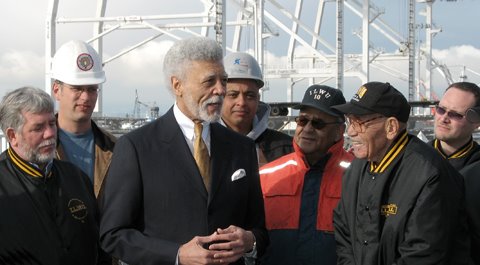
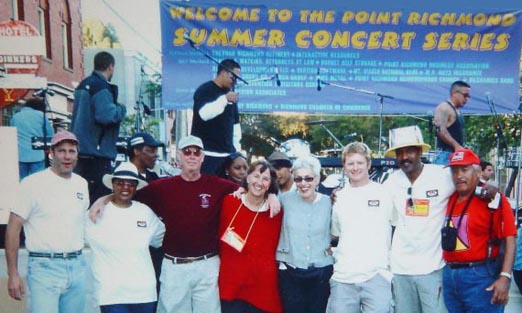
Photo: on Saturday we celebrated "Juneteenth," (a Texas holiday) with a parade down Macdonald Avenue and a picnic in Nicholl Park. There were many months before news of the Emancipation Proclamation reached Texas -- June 19th, 1865, was that day. This holiday is celebrated across the nation, now, in African American communities everywhere. Made me wonder why there has never been a national holiday declared for the Emancipation Proclamation, anyway? Maybe it wouldn't past muster in the southern states, I suppose. Right.
Settling into a new role of luncheon speaker ...
Today I met with a group of about ten civic leaders as the speaker for their monthly Chamber of Commerce Leadership meeting. I'd been invited to make a presentation on the park's programs -- to show the "Lost Conversations and Untold Stories" dvd, then to spend about 90 minutes aboard the Chamber's 15-passenger van on an improvised tour of historic sites.

Our park tours have caught on, and both individuals and groups have begun to request our guided trips around this small city that they all know so intimately, but are beginning to truly see in new ways. It's really a fascinating process. The next tour -- scheduled for July 21st -- is already oversubscribed and a wait-list is forming even as we speak.

As before, we have only to hand out one-page maps with the historic structures numbered and the fun begins. After the very first stop at Ethel Dotson's old International Hotel (stopping place for all black Pullman porters while those Pullman cars were being serviced) the "tourists" took over the tour. Everyone had memories and -- sometimes -- conflicting memories of these structures. That makes for lively discussions that never fail to add reams to what I know about this city and its people, and, slowly -- this oddly troubled industrial town has begun to feel like home.

That's fortunate, too, because next Wednesday I'm being interviewed by a production team from PBS for a segment in a major 4-hour documentary being presented in one-hour segments, nationwide -- on "The Saving of San Francisco Bay." The special will trace the Bay from geologic time to the present. As a critical change factor in the story, World War II and Henry J. Kaiser are major contributors. I will be one of several homefront workers from that era being featured along with some impressive talking heads, Environmentalist Stewart Udall; State Historian Kevin Starr; plus, scientists, economists, engineers, etc. Having seen the 12 minute promotional dvd describing this blockbuster -- I'm more than a little intimidated. My interview is scheduled for 3 o'clock next Wednesday afternoon, and today's Chamber experience helped considerably to prepare me for the experience.

I found myself seeing the city differently today than before. It may have had to do with the fact that almost every one in the van has spent their entire lives here in Richmond, and I am a kind of a "summer person" having only lived here since the mid-nineties. Except -- that I did serve the war effort as a file clerk in a Jim Crow segregated union auxiliary during those fateful years of World War II. And I remember ... and I've learned ... and the sting of segregation lies, still, very near the surface of my consciousness and still colors my days and helps to define who I am in today's world.

Maybe the fact that I've learned to use the pain well, and to articulate it in ways that help to bring change for the sake of the young -- is reason enough to justify sitting before those cameras and talking my truth into the ether.

Awareness of the upcoming interview was ever-present all along the tour, and I could feel myself grabbing at new facts as they spilled into the air as we traveled along the historic path through Atchison Village, The SS Red Oak Victory, the old rusted Whirley Crane, past the Kaiser Field Hospital, etc., and I could imagine the ghosts of the past standing huddled along this now more and more familiar route through a city struggling to re-define itself.

... and my work is -- in a small way -- is facilitating that process.

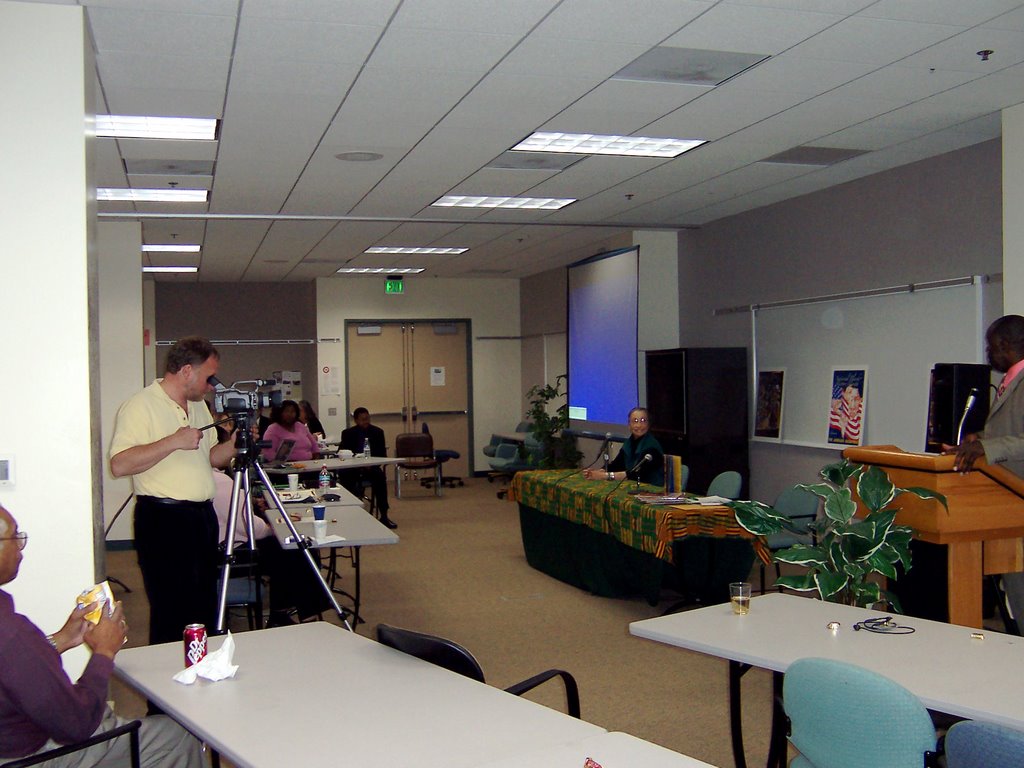
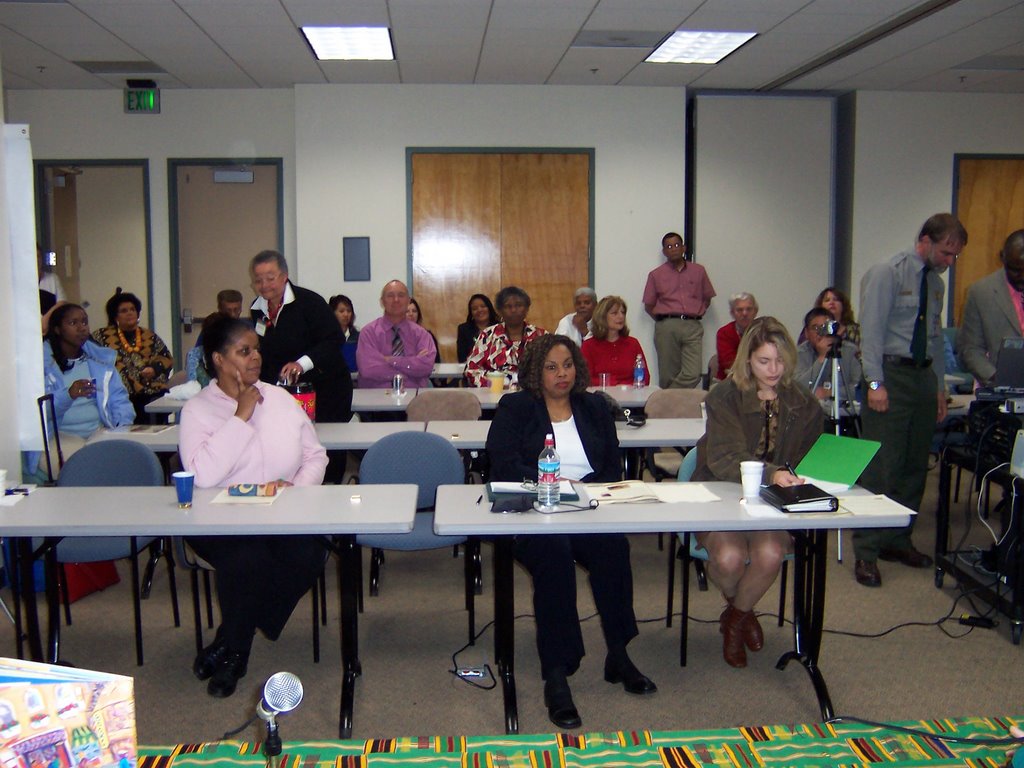
Photo: Taken not at the Chamber luncheon, but at a similar gathering at the U.S. Forest Service in Vallejo, California a few months ago. Forgot to take my camera along to the Chamber Leadership event. (Do remember that these are thumbnails and can be blown up to full size when you click on them.)

Tuesday, June 13, 2006

Maybe it's just a slow news day ...

...but I found myself one evening last week channel surfing and thinking about how much the television offerings have deteriorated since the great consolidation of the airways. Despite extensive cable offerings and at least five major network channels operating -- there's little more than the steady diet of crime shows, reality garbage, what I've begun to call "the last one standing" show; and pundits all yelling across the bow of anyone who dares to disagree with their always declarative proclamations!

PBS is in perpetual fundraising mode with the strangest assortment of barkers and snake oil salesmen and women one can imagine. If not that, there's the ever-present Andre Rieu (and where on earth did he come from, anyway?). I'm aware that the entire system of public broadcasting is under threat, but are we too late already? Is there now little left to save -- except for the occasional NOVA or Frontline? (And, yes, I'm sending my letters of protest to my representatives.) Were it it not for CSPAN, I'd probably cancel my account and bury myself in books again -- and blogs, or course.

I'd decided long ago (when considering a new more powerful teevee set or even HDTV) that I wouldn't invest another cent in the medium until the art catches up with the technology!

In this kind of petulant mode I happened across a KQED fundraiser featuring the exciting trumpet player, Chris Botti. I paused mid-remote-flick to hear him introducing a 16 year-old new jazz singer as the newest "...Sarah Vaughn or Ella Fitzgerald." This was an arresting statement and -- with remote hovering in mid-air -- I listened more closely. This kid must really be somethin', says I to no one in particular. The orchestra vamped for a few bars -- then she swung into gear, "every time it rains -- it rains -- (beat beat) pennies from heaven!" What a disappointment.

There was something familiar about all this, though -- and I suddenly recalled what it was:

Many posts back I found myself writing about the slow and methodical way black culture was being absorbed into American culture -- but that it was a one way street -- with our stuff going in and nothing coming out except the derivatives. These beautiful brass solos coming from Chris Botti were little more than Miles Davis in whiteface. It was again like hearing Lightnin' Hopkins swinging the blues from Eric Clapton's guitar! It was the recently-deceased Billy Preston swinging the entire Beatles combo from his electric piano or Hammond organ -- and never receiving so much as a mention except by the occasional critic who might refer to him as "the fifth Beatle."

On Sunday night I watched the Tony Awards along with the rest of the country -- and flinched at the irony of the Jersey Boys receiving their awards after a segment that clearly was based on Frankie Valli and his group singing Doo-Wop (picked up from black kids on the street corner of Philly or Detroit) and here were these broadway stars doing the Motown Temptations choreography with nary a credit to the originators nor an apology for the theft!

I thought of that really exciting young rhythm & blues singer from Britain who does such a credible job of covering Billie Holiday et al as she sexily slinks across the stage in her bare feet and hippy-like garb cradling the mike and breathing huskily the lyrics of old standards made famous in her grandparent's time. She's phenomenal -- and I'm moved by her ability to express those songs of my youth so movingly.

We've done a great job. Our culture is now so infused into the mainstream that artists rarely take the time to credit the source. It's all American, now. No longer black. Covers are no longer covers. Though depicted as a teenager hanging outside the windows of little black country churches to learn the licks that would bring him unanticipated fame, Elvis went to his grave "The King." Hogwash! He and Pat Boone and the others of the time brought to the public music and style that could not make it into the recording studios and film from the originators who couldn't get a contract and were still being let in the back door to perform in clubs that their friends couldn't follow them into. Even Sammy Davis Jr. and Dorothy Dandridge had to leave the clubs they worked in between shows, and could not be housed in the hotels where they performed. I later learned that this was also true in Hawaii where the Islanders who entertained were not permitted to stay in those posh hotels between shows but gathered at a small cafe nearby where they entertained each other. White supremacy reigned, and it was and is ugly, indeed!

On Sunday as I watched Chris Botti and the parade of young previously undiscovered white entertainers (except for Sting), I realized that the day has indeed come when people no longer are even aware that what they're watching are all the derivatives; those who have learned successfully and elegantly, to "paint by color." The music, the dance, the songs, of African Americans continue to find success most readily (surely in jazz) when adopted and performed by white performers.

I guess I'm resentful. And -- It concerns me when I find myself wondering where the new Dizzy Gillespies and Miles Davises and Louis Armstrongs and Ellas and Sarahs are going to come from? They once came up through the music programs in our public schools and lifted those kids out of the muck and into some measure of financial success (until late in the last century). But more important than the loss of a pathway to success through the arts -- I wonder about the loss of creativity -- of the kind that produced them for the world to emulate?

As I've said before, we've taken away access to the instruments and lessons that once were the keys to a kind of art that changed world culture. Having done that -- leaving them with no more than a pair of lips and a body that moves rhythmically -- differently than any others, our kids have turned that into an art form (Hip Hop and Rap) that has again taken over the world and become so infused into other cultures that I find myself seeking out Asian and Arabian and Island cultures on the teevee -- just to watch exotic-looking kids emulating Philly, Compton, and Oakland dance moves -- right down to the most intricate steps and rhythms.

Would sure like to see the more intricate and complicated demands of jazz continue to grow and prosper, but from our own. Learned in the late eighties that the best of contemporary jazz is now coming from the choir lofts of the country. Contemporary black gospel is jazz come home!

Ask Vicki Winans, and Kirk Franklin, et al. I suspect that those Texas mega-churches have been largely built by jazz-power. Ever watch them folks rock? Make a joyful noise ain't just a whistlin' Dixie. Those saints can blow!

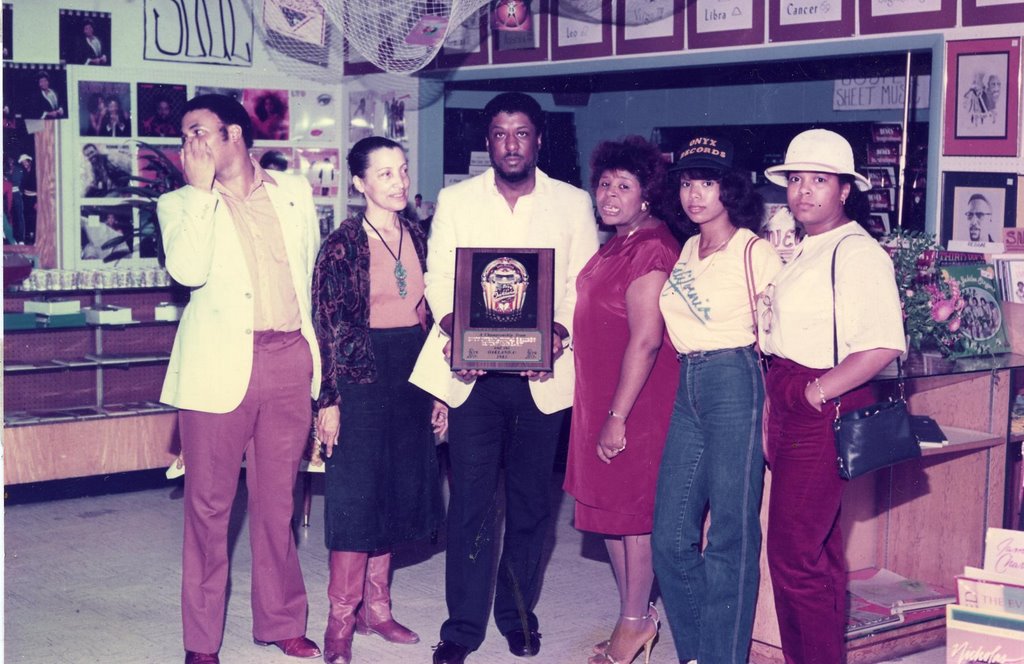
Photo: Taken at Reid's Records the day that the great Motown gospel singer, Vanessa Bell Armstrong, and her entourage visited. We'd just been honored with a plaque for outstanding pioneer work in introducing black gospel music on a grand scale to the music world.

Friday, June 09, 2006

Can you imagine that a mere 26% of the electorate bothered to vote on Tuesday?

... and to think of how I agonized over my responsibility to not only vote, but to vote in a primary of such little concern to so many. I simply cannot fathom how anyone can believe that a democracy can be maintained under such conditions. Small wonder that our power to effect change has diminished so drastically. It now takes so few to control the fate of the most powerful nation on earth. Does this mean that my vote is therefore potent beyond measure? Or does it simply mean that -- without a free press and enough of a constituency to make a difference -- a handful of us are plying the Ship of State through a storm-tossed sea with only one oar?

When Dorian and I arrived at our polling place on Tuesday at 3 o'clock in the afternoon, we were the 188th and 189th voters on the register. A bad sign. This is the first year that I've not done Get Out the Vote work out of the central headquarters, so have experienced poll-watching and nose-counting on election day. I could judge about how many voters my precinct should have produced by that hour. It would be relatively fast count, though, so I found solace in the fact that it wouldn't be a late night watching the website for the Secretary of State where the statewide returns are constantly updated.

Can't imagine that Richard Pombo was overwhelmingly victorious, and that the only Republican I could have ever actually voted for, Pete McClosky, would finish so poorly. Was also surprised that former governor, Jerry Brown would have won so handily after his miserable performance as the mayor of the city of Oakland. Name recognition had worked for him while serving Pete McClosky not at all. But then McClosky has been out of the public eye for long enough to be forgotten by younger voters, and Brown has remained center stage for several decades now.

Watched Ron Dellums mesmerize his election night audience with his gift of oratory and felt warm and hopeful. As I write this the count (still going on) gives him less than 50 votes short of enough of a majority to avoid a runoff for the mayor's seat.

There were other victories and enough strong showings among the losers to give hope that Progressives will show up well against their conservative opponents in November. California must continue to point the way toward a renewal of the promise of a better nation and world. We can do so much better.

Now I can work with renewed vigor for the election of Phil Angelides in the general election.

... sure wish for a crowded polling place next time.


Tuesday, June 06, 2006

Just couldn't do it after all ... the time for compromise is over ... .

Got to the polls and voted my conscience. Were it possible I would have voted throughout the state on every ballot for every candidate whose agendas match my own. The stakes are too high now, and the country I truly believe is in a state of such chaos that it will take millions of voters committing the act of independent thinking -- and demanding drastic change to turn it around.

I want nothing less than impeachment of those in power and will settle for no less; sorry.

I refuse to accept less than total withdrawal from the wars.

I insist upon an end to capital punishment.

I yearn for an America that never quite attained the greatness promised by her Constitution and Bill of Rights. I want another try at it in my time.

I want a nation worthy of world respect; a nation that honors commitments and treaties. A nation for whom preemptive war is unthinkable and peace is more than an idle hope of dreamers.

While fully understanding the implications of casting a vote that may have less power to make those hopes real than a butterfly in a hurricane, I have nonetheless voted my aspirations instead of my dispair.

I voted for Barbara Becnel for governor today and for everyone on my ballot who has expressed my hopes for a city, state, and country I can love and respect again. I find no comfort in deferring those concerns. I'll vote for Angelides in November. Today I voted against his lack of support for the abolition of the death penalty. I thought that his support of a woman's right to choose and of same sex marriage were enough. Not so. The elimination of capital punishment outstrips all else, and demands addressing before another life is taken in our names -- due to a dysfunctional system of justice that disproportionately devours the poor and uneducated and far too often overlooks the white and the wealthy.

Tomorrow I'll begin to look around for voices that echo my own and to work as hard as I can toward those goals for the November general election. I suspect that most of those voices are registered in Progressive Democrats of America led by Rep. John Conyers and supported by Cindy Sheehan et al. I'll continue to follow the lead of MoveOn.com and to listen for cues from Amy Goodman of Pacifica Radio's Democracy Now. I'll pay closer attention to Noam Chomsky and the writings of Greg Palast.

Now for a cup of hot tea and that scone I stashed in the freezer a while back ...

I'm feeling hungry -- and resolute. (I'm grinning with no one around to see; a good sign.)

Vote, everybody! Vote your concerns even if they're in opposition to mine. That's the way the process works. So many have died to protect this precious right that we so often squander. Never has it been more important to exercise the franchise. Our lives surely depend upon each of us each adding to the whole -- and by so doing -- together we will the move the Ship of State into safer waters. I am trustful of consensus and in our ability to achieve it through public debate.

With so much at stake and the death toll rising by the hour, those clowns in Washington are bitterly locked this day in a debate over whether marriage should be limited to a man and a woman, and that all other love relationships be forbidden by the Constitution! Does anyone truly believe that this is a matter of grave concern to the electorate? Tell that to Brad and Angelina -- Brittany and whoever will be her next captive stud. C'mon! Defense of marriage? Indeed!

There's a hint in the air that this transparent farce will be noted by voters everywhere -- and that we'll turn out this Administration of Idiocy come November! We the voters are so very much better than they know.

I'm certain of it.

Sunday, June 04, 2006

The Crucible ... .

The day has come to deliver to David my "talking window" ballot for Tuesday's Primary election. For years I've carefully studied the candidates and initiatives and -- as if I had the power to persuade -- would get out my roll of newsprint and marking pen, and prepare my ballot for the front window of our store. I've always done that with a sense of pride and a heady feeling of personal independence. No commercially designed mass produced signs for us. It was always a laboriously handprinted display with our signatures (David's and mine) at the end of our slate.

I've been trying to get to that project for weeks, realizing that I needed to do that early since many folks in South Berkeley would have voted absentee weeks ago. Couldn't face it this year. Have been plagued by indecision because of my deep concern about the issue of a moratorium on the death penalty and of the three vying for the governor's post refusing to support it.

I've planned all along to vote for Barbara Becnel as a protest, at least in the Primary. I volunteered months ago to work on her campaign. We met together to chat about just what role I might play, but due to her impossible schedule and (surely) lack of experience in the political process -- getting media attention and public support -- her workers simply didn't get around to organizing that and time slipped by without our ever coming together again.

The last thing I heard before turning off my bedside radio last night was the fact that Democratic candidates Steve Westley and Phil Angelides were in a deadlock for the nomination to face Arnold Schwarzenegger in November. And -- there are more undecided voters than ever before; believed to be a huge factor is the negative campaigning both engaged in over the past few weeks.

Looking at the campaign from the inside out -- from years of working for candidates for whom I was actually employed on an everyday basis -- I knew that this is not the work of the candidates, themselves, but are the words of their highly-paid campaign strategists who create the hit pieces, fund, and then spread them throughout the media. It's an ugly business that has served to discourage voters from participating in the process at all in many cases. This year it is more pronounced than ever, and I suspect that both candidates are embarrassed by this outcome.

This morning I must prepare my window ballot. Because this vote is so terribly important -- at a national level -- (again) -- I'm going to be forced to scrap my principles and vote for the candidate I've intended to support all along in the General Election in the fall; Phil Angelides. How I would have wished it were otherwise, but in an election this close, to vote for Barbara may risk the greater prize -- strengthening the Democratic power in this state to overcome possible losses elsewhere in the nation.

Do I believe that a single vote is that important? I do. One day after his election, I will make the trip to Sacramento with other advocates and make my case on the death penalty to Governor Angelides, personally. Once the pressures of the campaign are over, I cannot believe that this man of conscience (with a wife and daughters against the death penalty) won't provide the leadership necessary to creating a moratorium. With a California electorate that polls 70% in support of the death penalty, no candidate can afford to be in opposition. I'm far too practical to expect it to be otherwise, unfortunately.

And -- I'll vote out of hope and solidarity for the common good -- and with no cynicism. Ultimately, voting is a matter of great privilege and a ritual that I find both exciting and meaningful. But I do so with deep regret and a sincere apology to the memory of Stanley Tookie Williams. I'm fairly certain that Angela Davis would never make this compromise with principle; not on your life. That knowledge does little for my comfort level. Yet, I can't imagine that she doesn't act strategically when necessary. Is this what I'm doing now, or, by using that word am I asking to be qualified for forgiveness at least in my own eyes?

Are we again in that place in history that urgently demands an uncomplicated "black or white" response? Instead, do we find ourselves paralyzed by having to deal once again with one of the countless shades of grey? Does this account for such a wide margin of Liberal/Progressives not yet declared -- undecided on the eve of the Primary? Is this, too, another of the hidden disadvantages of aging; a time of life when experience has so broadened our breadth of understanding that there are few simple answers left?

This is only the most recent skirmish in the struggle to end capital punishment in my state and the nation. The work will continue as before.

Amen.

Saturday, June 03, 2006

Angela who... ?

In a moment of boredom this morning I turned on television and clicked the remote into CSPAN (untypical for this hour of the day, especially on a Saturday) to see Dr. Angela Davis of the University of California at Santa Cruz at the mike speaking before the Twelfth Annual Conference on Black Student Government at the University of Iowa. Having nothing better to do at the moment except for matching socks -- and I could do that while watching -- and besides they seem to match better when they're still warm from the clothes dryer, I'd just sit, match and watch.

This is someone I've always been quietly fascinated by, but also somewhat intimidated by as well. She is a brilliant revolutionary thinker far out of my league, I thought. I couldn't ever imagine being in conversation with this remarkable woman though we'd surely traveled on the same path for brief moments in time. But there it ends.

My activism was never deep enough to have taken me to jail for my principles. Nor was it strong enough to have demanded the kinds of risky stands that she'd taken for an entire lifetime. In all honesty, I've rarely felt capable of -- or brave enough to go the distance -- not in the face of the loss of the esteem of friend or fear of foe. I think that she's always made me feel a bit less than... .

Today there would be just Betty and Angela and there was nothing to defend or deny -- from my seat on the sofa I could just lie back and wiggle my bare Saturday morning toes on the hassock and take the time to figure it all out -- try to locate the root of my fascination and admiration -- and (yes) awe of this remarkably brave woman.

Early in her talk she made the vital connection and those "doors of perception" opened wide for me. In her very clear and understated way I heard her say, "... history is not a synonym for the past. History is alive and in this moment. It is dynamic. We are history. We carry the promise of history and it is we who must bear the pain of the past." All else was heard against those words. I sat at rapt sock-dropping attention for the next hour -- as much a part of her audience as were the young students in that auditorium.

It was soon apparent that the basis for my sense of inadequacy in the presence of her brilliance lay in the fact that I'd lived my entire life within about 30 miles in one of the most liberal areas in the world, and despite its shortcomings in real terms. She started life in the racist south born of activist parents; with a mother who'd been as dynamic as she. Her mother fought the fight to defend the Scottsboro boys, been active in the NAACP at a time in history when doing so was the equivalent to being a Communist during the Fifties. Angela was clearly an Internationalist. She surely didn't share my ambivalence about the illegal alien issue. For her there were no national boundaries. I've never grown beyond a kind of informed provincialism due to a lack of exposure to the wider world.

My sincere abhorence of capital punishment grew in isolation from that single exposure to Stanley Tookie Williams and Barbara Cottman Becnel, his activist friend of many years -- and the visit to Death Row a few years ago. Out of that instance, I was able to grasp the need for abolition of the death penalty for all our sakes, but it was from that very small window of experience. This was the microcosm that encapsulates my life, limits my vision, and keeps me properly humble.

Angela has enough education plus experience and the advantages of world travel to have come to the same place at a far more sophisticated level; from the macrocosm.

Says she, "Capital punishment is rooted in racism, and it cannot be abolished until we recognize that fact and move through. During the time of the Civil War there was only one crime for which a white man could be executed; murder. On the other hand, there were 77 crimes for which blacks could be put to death. We cannot get rid of it until we recognize that history and purge ourselves of this shameful legacy through contrition."

Of course. These are facts that I'd never known and, this day I found myself wondering anew at the huge gaps in my (our) education. That I am almost completely intuitive with a deep sense of the awesome cruelty and unfairness of the act -- and that I'd found myself some years ago arriving at the same position -- was the cause of wonder. I could not claim to have arrived at my position intellectually. It was/is therefore harder for me to defend. Angela's gift of clarification was one I'll not soon forget. I'll now dig deeper and not expect those I love to follow my lead blindly just because I have the courage to stand my ground at those San Quentin gates in the shadow of the gas chamber. I will learn more for the sake of furthering this cause.

It was also clear from her remarks that societal violence -- as expressed in so many ways both individually and collectively -- is all of a piece. The ultimate expression of that cancer is surely illustrated not only by capital punishment but by Abu Graib; Guantanamo; the irony of our marines taking "ethics of war lessons" on the battlefield and within earshot of an undeclared and cruel war as a result of murdering 22 innocents in Iraq; the McCarthy-izing of communications by sweeping wiretaps; hidden torture prisons in Europe and the Mideast; over two million of our citizens imprisoned; disenfranchisement via felony convictions; etc.

She ended her remarks with an interesting answer to a question from one of the students in the audience about just what can be done to bring constructive change : " ... it is the job now of youth to be figuring out the answer to that question. It's your responsibility. We've done our work and our role now is to to support yours."

Made me wish I had about 20 more active years. I'm just beginning to get the hang is of this incredible journey called life, I think, and time will surely run out before I get The World into any kind of order ... .

Attended the annual Point Richmond Summer Music Festival last night -- balmy, warm, great music -- and new questions to ponder ... .

My work with the National Park Service is casting me back in time in interesting ways. Many hours of my day are spent in mulling over World War II history in the attempt to discover ways to address those years in relation to the present. The ability to bring these eras together in some semblance of order may be what determines our success or failure in breathing life into this park. I didn't grow up here but nearby in Oakland, and must therefore borrow heavily from the memories of others in order to try to understand all that has happened.

In yesterday's early evening I sat for hours in one of those molded white plastic chairs among many other molded white plastic chairs holding big and little bottoms of the population of this fascinating city. This particular corner of it is the place where the history of Chevron Petroleum Corporation (nee Standard Oil) and the Santa Fe railroad are almost palpable. In this picturesque little town square in the shadow of the old Hotel Mac, lives a number of descendants of those whose roots were firmly embedded in those two pioneering companies. This city was established in the year 1905, and probably from the very spot that tonight hosted the annual music festival. It's now inhabited by numbers of descendants of those pioneer settlers; a fair-sized arts community; and a disproportionate number of those who currently run the city -- either formally or informally by "consent of the governed" (sometimes reluctantly granted).

After decades of languishing as a purely industrial community with minimal ties to the Greater Bay Area, Richmond had its rebirth in 1941 when the needs of the war machine and Henry J Kaiser's response to it boomed it into history in unprecedented ways. With that dramatic chapter came racial segregation -- sudden and almost complete.

What struck me last night was the fact that something unrecorded; unheralded, perhaps even unnoticed has occurred over the past sixty years that has changed forever the way Richmond sees itself. Almost more than any other place I've ever known, there was more unselfconscious race and gender mixing in the street dancing to the sound of reggae and zydeco last night -- from those from the age of four to perhaps 80. One might not find this innocent coming together in quite this way anywhere else on the planet. There was no feeling of "working at it." Equality is/was something taken for granted. Assumed. No longer labored. There surely must be vestiges of it remaining, but to hold such biases openly is no longer tolerated. Few would dare any outward expression of racism.

Found myself wondering as I watched the screen that pops up behind my eyes in those early moments before dropping off to sleep, whether the Bay Area in general and Richmond in particular has simply become a magnet for the enlightened over those years? Could this be what's happened? Maybe we've simply reached critical mass and the voices of the opposition can no longer be heard clearly. Though there are continuing signs of those who simply got trapped here and never were able to move on.

What I do suspect is that this small city with the unenviable reputation of being "the most dangerous city in the state of California" may be seen from the outside as less than desirable for the very reasons that are proof of our having become the most successfully racially integrated city in the Bay Area and the State. I used to be struck by the fact that the same racial demographic to be found at the Office of Human Resources; Kaiser Permanente's waiting room; the Social Security Agency, and the lines at the Department of Motor Vehicles, is the same demographic one will find at the Richmond Country Club during any of the numerous golf tournaments and fancy banquets that occur there from time to time.

We've done something right. Discovering just what that is may hold the secret to rebuilding hope and trust in a generation of youngsters who seem to have been left behind in a growing environment of violence. Maybe that's the mission of the park -- to help to retrace the steps that brought us to where we are and to try to reclaim with youngsters and for the young some of the spirit that got left behind during our struggles to survive and overcome. But then that's the mission of us all; those of us who lived long enough to have learned the lessons of our times, across all the lines of separation.

It was all there in the evening sounds last night -- in the Point Richmond Annual Music Festival. It was there in the easy laughter and in the swaying bodies of all sizes, shapes, and colors, to a beautiful Cajun waltz that I'm sure that I only imagined remembering ... and never knew.

Much like world peace ... .

Thursday, June 01, 2006

Interesting day, today. Was the luncheon speaker for the monthly meeting of the retirees of Local #790 of SEIU - AFL-CIO.

I am really beginning to enjoy these events -- and am more comfortable these days and less threatened by the limelight. In fact, I jokingly mentioned to Martha (park superintendent) when I got back that I might just take this show on the road and become one of them motivational speakers! Though there's little hope of that, given the enjoyment I'm getting every day just doing the work of the very creative process of park-building. These little special events come as quite incidental -- a phone call from someone with an invitation -- and a little mark on my calendar -- and ... .

Little preparation is required since I'm really only dealing with known history (known by me) and that's so subjective that there's really little reason to do much in advance except relax into it and enjoy.

Today I was struck by how interesting it is that history of 60 years ago has moved into the foreground all around the Bay Area. Among those who attended today was a union official (African American) who is working toward the restoration of the old 16th Street Southern Pacific railway station near Oakland's waterfront. His group is at the early beginnings of the project and their excitement is building. I could see the delight in his face and those of others when I began to cover the historical parts of my little talk -- and I could see that we were connecting.

There were people in that audience who were longtime East Bay residents -- some of whom had arrived during World War II as homefront workers. There were some who had been customers at our little store in South Berkeley and remembered me standing behind the counter learning the business while battling the streets. There was the feeling of homecoming today, and it felt right and good.

I'd brought a small supply of business cards, just in case anyone ... and regretted not having brought more. They were so quickly seized that I had to promise to send a supply for distribution as soon as I returned to my office. And I did just that. Mailed off a copy of "Lost Conversations and Untold Stories" DVD, a few brochures about the park site, with a handful of business cards to be distributed later.

I sensed the hunger for grounding, roots from the past, in that room today. I vowed to add to any future presentation the suggestion that we remove those real boundaries between these nine Bay Area counties that ring the bay and return to those days when the African American community was regional. With that greater pool from which to draw leadership in the old days, we were all enriched. Our community reached from Monterey in the south to Sacramento and Marysville in the north. Our social and cultural events drew from San Jose and San Mateo, San Francisco and Oakland and Richmond. We lost something when those articifial boundaries were imposed for reasons I've never quite understood.

Maybe we can begin to look at that as we rebuild our history and share our stories again. Maybe today was an important beginning of a broadened view of our park building. Maybe black history cannot be told without reuniting all of its elements.

Maybe I'd like to drive into Oakland soon and visit the old 16th Street Southern Pacific railroad station and re-imagine Uncle Herman Allen, Uncle Frederick Allen, Uncle Lloyd Allen (three sons of Papa George), and their other friends and co-workers as they worked that luggage as men of service; proud Red Caps! I remember from childhood how much taller those uncles stood when in uniform ... there's still something about a uniform, isn't there? Any uniform.

So many stories ... and so little time.

Wednesday, May 31, 2006


New thoughts on (as Steven Colbert might say) "Youthiness!"

Ever since our series of meetings last week referred to in the last post, I've been thinking about this next phase in the development of the historic downtown and its relationship to the Park. It's clearly etched in my mind, but the execution of the concept is still illusive, but I'm onto something critical, I think:

While listening quietly to the presentation of the "Memories of Macdonald" concept to the Arts Commission on Thursday evening -- it came to me. At one point I blurted it out in short bursts, and though the group surely were caught by my words -- they left me unsatisfied, incomplete, but I knew where I wanted to be going ... .

It has to do with the fact that I see the primary issue as change -- and as the common denominator between youth of our time and those of today. I recalled that on December 7th, at the beginning of World War II, I was barely out of my teens. That my generation of homefront workers and fighting forces were also barely out of their teens. That the important thing this park can do is to connect today's youth with those of yesterday. We need to relate from that perspective -- not as children and elders but as the youth of widely separated generations.

The important thing to focus on, in this case, is how our youth reacted to the traumatic changes we were forced to live through -- given the perilous state of the world and that of our own nation at that time. Perhaps today's kids -- while learning about that remarkable period in our country's life -- can try to identify the traumatic changes that their world is undergoing and then to try to identify the ways in which it is or is not coping with those changes.

After all, they're having to face unprecedented changes in the decreasing quality of education; 108 different languages in their schools; greater density in city life; uncontrolled possession of handguns with increasing street crime; the proliferation of illegal drugs in their neighborhoods; breakdowns in family structure with either non-working or both parents employed; gang warfare; fewer schools and more prisons; diminishing access to higher education; impending global disasters due to climate change; a national debt that will threaten their ability to ever rise to our former economic greatness; all making for a world that is frightening to those youngsters who are living in a world we elders never knew.

But the seeds of their world were sown to a large extent by how we responded to our times, the laws we passed that assured more equality to more of us; the fears we expressed as we contracted and distorted other freedoms after the assassinations of our national and spiritual leaders; the limitations we've allowed as we drew back from the international community after 9/11; our disgraceful declining involvement in the electoral process; -- and most of all -- the leaders we've chosen over time; all leading to the wars of their generation.

Heavy thoughts ... .

At the same time they enjoy greater mobility and far more independence that might also be seen as abandonment by the parental generation. We have no idea how much the creation of gangs is merely a way of coping with the disconnection from the parental generation for any number of reasons. Perhaps those gangs represent surrogate family groupings created to compensate for the losses they've experienced in this new kind of societal isolation.

A part of our planning involves the creation of Walking Tours using audiotapes and I-PODs that will take people through the historic districts. Having kids describe their world in the troubled Iron Triangle to those interested enough to do the walks could be an exciting way to share their more current history as juxtaposed with the history of our times. We will develop groups of youth guides out of existing programs for young people -- in much the way that our community "docents" are beginning to come into being as a feature of our bus tours they, too, will emerge over time.

When viewed through the lens of the element of change, we might find ourselves able to detoxify the generational differences in much the same way that our bus tours are allowing the sharing factually of a period of painful segregation across those sensitive lines of separation. Perhaps we can reduce the distance between Richmond's youth of yesterday and today, and erase those lines of separation to the extent possible.

Under the auspices of the Park, Joanna Haigood (Zaccho Dance Theatre) will be serving as an artist in residence at the East Bay Center for the Performing Arts later this year or in the early spring. Her project will evolve as a dance swap -- a series that will have the generations trading the dances of their period. They'll learn to Lindy and the Jitterbug, to do the Chicken, the Mashed Potatoes, and we'll get to learn the Electric Slide and Hip Hop and whatever else comes next! It will all be videotaped by EBCPA students and projected in huge images on the side of the old Storage Structure in Shipyard #3 or on the hull of the SS Red Oak Victory at the grand opening of the park sometime late next year.

As I said before, we've got ourselves a National Park to build, and it's going famously!

Should you have any ideas, please pass them along. Anybody can play in our park. After all, it's national.

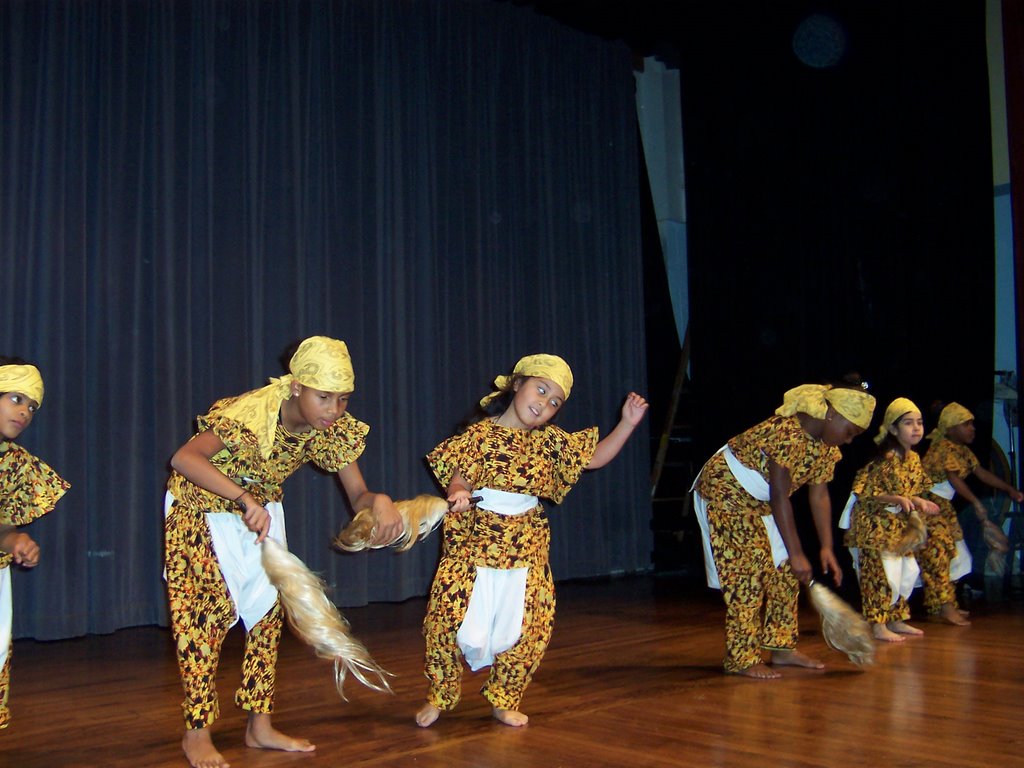
Photo: Not particularly relevant except that it gives me a chance to show 8 year-old granddaughter, Tamaya Reid, in a performance of her West African dance class in a recent East Bay Center for the Performing Arts afternoon event. That's Tamaya -- third dancer from the left -- right in the middle. She's a bit "youth-ier" than the teens I'm referring to in the above piece.
Shall I tell you about our exciting park tours? My weekend in Mendocino? "Too muchness" is becoming a problem ... .

Those tours are most successful. Choreographing the 4-hour sessions of community people from a list of volunteers has been a real joy. In the first place, these are people who are being asked quite subtly to participate in the beginnings of the building of a national park. We don't use those words, but in effect, that's precisely what we're doing.

We gather at city hall in one of the conference rooms, share coffee and fruit and watch our little "Lost conversations and untold stories ..." DVD and give them a chance to explore our collection of World War II artifacts collected from Rosies across the country through a grant from the Ford Motor Company. We board the little 28-passenger rented bus at around nine o'clock for a visit to the woman-designed Rosie Memorial on the site of what once was Kaiser Permanente Shipyard #2 and that is now the site of a development of upscale condos and a beautiful park. We spend the next 4 hours taking our "tourists" over areas they've been traversing for their entire lifetimes; past structures they stopped "seeing" long ago; past ground long-familiar and that has played background to the totality of their life experiences over the past 60-odd years. Watching the reawakening as our guests excitedly pop up from their seats to interrupt Naomi (our NPS guide and my co-worker) to add to the bare bones of her story. She's designed her presentation to provide context -- to purposely evoke this response. The history is so close to the surface and proves to be so irrepressible -- immediate -- alive!

The cast of characters of this -- our fourth tour over the past few months -- consisted in part of a Latino member of the county grand jury, a man raised in war housing of WWII; a member of the city's redevelopment agency staff and a newcomer to Richmond; the City Clerk; a contentious and courageous community activist (African American) for whom a new health clinic is about to be named; the owner of an historic deteriorating building -- the International Hotel -- that once housed the black Pullman porters while they waited out the servicing of the Pullman railroad cars at the nearby plant (still standing but converted to new uses) before returning to the upperclass travelers for whom they were designed.

That little building that consists of 20 sleeping rooms and a large reception hall has served as her home for all the years while she's fought for historic landmarking and the funding to restore it. It figures hugely in black history since African American workers could not stay in the (white) Pullman hotel at that time. This place was known across the country and would surely figure in the story of the fight for racial justice waged by C.L. Dellums in the 50's; a story that begs the attention of future black historians. Today was the day that we added Ethel Dotson's International Hotel to the tour and raised it to the level of "landmarking," officially, in the minds of our "tourists."

Antonio Medrano, upon our stop at the Mexican Baptist Church on the far western edge of the city, took over to tell us about the early days of Richmond's spanish-speaking community; that this area was once agricultural, where they tilled the soil and raised their food -- along the rail lines of the Santa Fe.

There is an openness in these recollections. Racial differences are briefly touched on, not so much as complaints, but rather as a clear recognition of the reality of those times -- the painful years that preceded the Civil Rights struggles of the Sixties. When seen against the progress that has followed in its wake, that history seems to have been at least partially detoxified -- ready now for sharing across the lines of separation.

We also had on board Steve Gilford, a Kaiser Permanente historian, whose work in researching of African American participation in the shipyards served as the basis for some of my own. When the tour reached Kaiser Shipyard #3, the site of the SS Red Oak Victory and the Whirley Crane that helped to build her, Steve took over and provided the more technical information that would have been otherwise missing. It was at this point in the tour that I started to see the need to involve more young people in these adventures. How wonderful it would have been had they been a part of the group. I thought of Glen Price, member of the West Contra Costa School District board who'd had to cancel at the last minute but who has signed on for the July tour.

Also on board was a reporter for the Berkeley Daily Planet, Jesse Douglas Allen-Taylor, who wrote a great story for last week's Friday edition -- a piece that has been widely circulated and appreciated by members of the National Park Service staff and management. It can be read at the paper's website.

Just before leaving for a restful weekend on the north coast I briefly visited another growing edge of our work, this time at the request of a team that's engaged in the planning of a streetscape project that will bring the park to the heart of the city, Macdonald Avenue, the main artery now undergoing revitalization. With that team we're participating in the planning of a series of programs called "Memories of Macdonald" that will engage the community in the gathering of more oral histories, digital video and digital-audio projects in which the kids of the East Bay Center for the Performing Arts will be involved this summer. Our meeting was with the artistic director and staff of the EBCPA with whom the park and the redevelopment agency are partnering. We later met with the city's Arts Commission to introduce them to the concept of civic engagement and of their part in it.

We're busily building a national park, guys, and it's an amazing process.

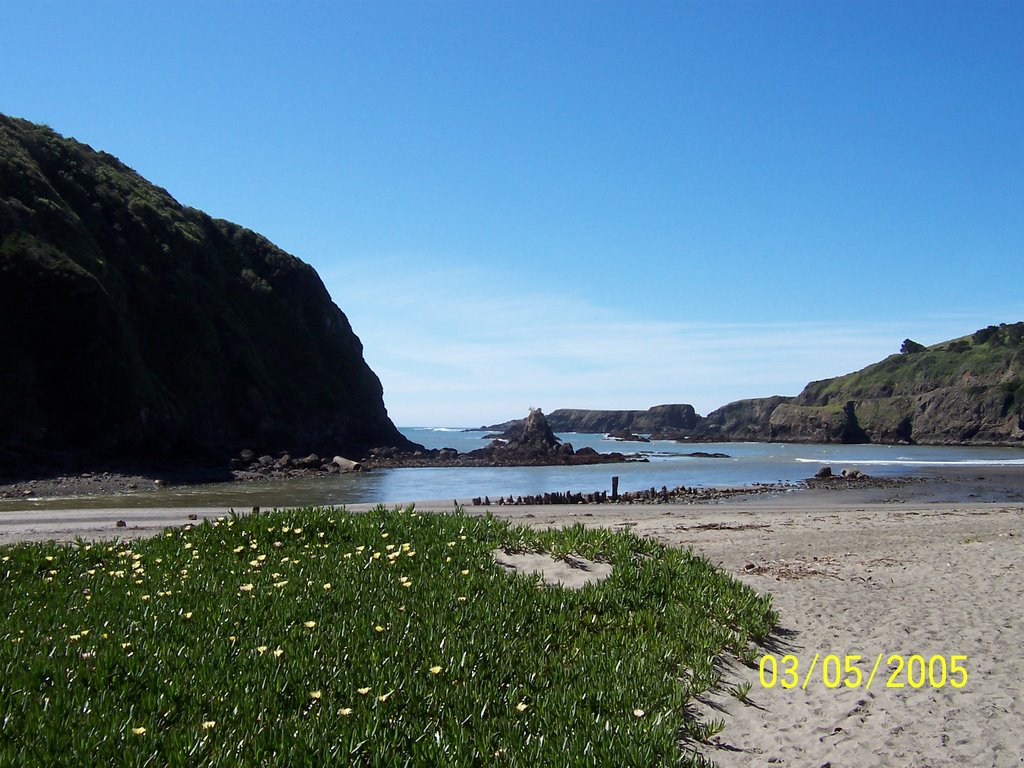
Photo: Taken under the old wooden bridge just south of the picturesque tiny town of Mendocino. Great place for picking up drift wood and lovely pastel-colored sea glass.

Wednesday, May 24, 2006


My upside down world ... also known as "Betty and the Bigots" ... .

I'm having such a difficult time these days; losing the ability to separate myself from the conversatives on the issue of illegal immigration. It's really terribly uncomfortable, sitting here watching CSPAN coverage of the senate debates on the immigration bill. I simply cannot imagine how on earth I manage to find myself nodding in silent agreement with the obviously racist tirades on the need to seal the southern borders against the invasion of illegals; poor people simply seeking better lives for themselves and for their families.

It's far easier to hear my own arguments reflected in the comments of CNN's Lou Dobbs because he, at least, applies some reason to the debate -- and his arguments sound a lot like my "wrong conversation" thesis. But there's a thin line there somewhere, one that I seem to have crossed -- where it all falls apart and I'm increasingly disturbed by how really close I'm coming to thoughts I once detested when applied to me and to those I love. Why is this different? Why does my American self bristle at the sight of Mexican flags being proudly paraded through our streets? Why am I so angry with President Fox when he seals his own southern border then comes to my state to ask more freedoms and acceptance for his citizens whose rights he should be championing at home? What's wrong with all this? Is what is not being said the culprit in all this? And ...why do I feel so guilty when people I trust and respect are over there on the other side asking for my understanding (Senator Barrack Obama, Attorney Van Jones, Rep. Maxine Waters, etc.)? What am I missing?

At the end of the day I still find myself resentful of having the debate framed by bigots who are usurping the language and tactics of the Civil Rights Movement. It's like Ward Connerly's anti-Affirmative Action arguments that are shaped in the same way -- using Dr. King's model as his own and therefore feeding the fires of discrimination unwittingly and creating supportive arguments for the opposition to all that I believe in. It's all so convoluted ... confused -- and why do I feel so defensive?

Why does only Lou Dobbs suggest that industrial, corporate, and agricultural interests be held to paying a livable wage so that those "jobs no American wants to do" would be filled by our own citizens who cannot live or support families on what illegals are paid? Why can't we talk about the millions of displaced service workers (black) abandoned to poverty and the streets because there is no way to support families and move into the mainstream when not even those "jobs no American wants to do" are available to them at a wage that will pay the bills and educate the young?

The unspoken beneficiaries of the current lack of a coherent policy are illegal laborers who are able to send back to Mexico billions of dollars to aid that economy, and corporate farms, hotels, hospitals, and large contractors whose profit margin is bloated by exploitative cost estimates that distort our own economy and overload our social systems.

Many newly-arrived illegals from below the border unwittingly benefit from white racism and have little reason to not take advantage of this fatal flaw in this nation's never-quite-attained self-portrait of the ideal democracy.

Are my feelings of today colored by those years when I worked in support of Cesar Chavez and the cause of the United Farmworkers? Those marches are still vivid in my mind. I remember how hard he worked against the guest worker "Bracero" program designed and executed by the owners of large farms in the Salinas Valley and was a thinly-veiled strategy to import scab labor designed to kill the farmworker's crusade to gain a living wage and humane working conditions. What's different now? Why am I still stuck there -- with the vision of feisty delegate, Dolores Huerta, at the '72 Democratic Convention where we combined the lettuce boycott with the business of the convention and won both? There was little indication of black/brown tensions at that time. I recall sitting two rows behind her waving my "boycott lettuce!" sign while the Alabama delegates in their straw hats and red/white/and blue outfits sat happily and defiantly chewing on lettuce leaves just one aisle over. Those were the bigots! We were all progressives seeking economic justice for all. What has changed?

And why does it feel as if the entire country has shifted far to the right, leaving me out here on the far left, alone, without having been aware of the changes that led to where I now find myself? I distinctly remember always thinking of myself as a political moderate. What happened to that? And, as a Liberal, why do I feel abandoned?

Is it true, then, that if the political extremes get too far out on their own paths -- that these eventually collapse into one indistinguishable whole, unrecognizable by either side?

Wish I could hear from you ... there are so rarely any comments from those who are reading here ... even when my words are truly controversial. Am I the only one with such questions? Am I the only one who hasn't gotten all this figured out yet? I'm both confused and deeply troubled ... .

Anybody.... ?

Photo: Traditional Mexican dance performed by students of the East Bay Center for the Performing Arts -- where children come to learn through their own cultures and through those of others. The West African dance and Mexican dance classes are among the most popular. Most of these children are from very low income families and attend through a generous largely grant-funded scholarship program. The EBCPA is in its 39th year of operation in the heart of Richmond's historic downtown. I'm working to build strong ties between that institution and the park for which I'm responsible for community outreach.

Sunday, May 21, 2006

Spring's officially arrived ... and nothing announces it more clearly than the East Bay Center for the Performing Arts ...

Yesterday we experienced another of those signs of a climate change. While other areas of the world are seeing typhoons and torrential rains -- here in the Bay Area we're experiencing a rare rainy season that has reached all the way into late May. Until recent years these were the deliciously hot days that promised summers that wouldn't truly arrive until around the last week of August. Sandwiched in between June and all of July are those cold and damp fogbound days that include a usually miserable Fourth of July.

I can remember my dad's younger brother, Louis Charbonnet, on a visit from New Orleans and an avid baseball fan, being taken to a game in San Francisco where people were sipping hot soup! He could hardly conceal his good-natured contempt for such a practice. Baseball season was the time of beer and soft drinks (preferably red). He could not stop laughing at the silliness of it all!

Having lived my entire life on the west side of the hills in the Oakland-Berkeley area of the East Bay, I had no idea as a youngster that one could simply drive through the Caldecott Tunnel, drive inland about 5 miles and there it would be -- summer! The temperature might never reach 45 degrees on one side of those hills that served to block the fog drawn in by the valley heat -- while only ten miles away in the valley people were sweltering around their swimming pools in 90-100 degrees under blue skies.

Yesterday Alyana and Tamaya were dancing and grandma was duty bound to be in the audience. I have an almost perfect record of attendance over the years. This week was a bonanza, Alyana (fourth grader) and her afterschool dance program made for a very special Wednesday afternoon. I watched her dance with a chair most imaginatively. Yesterday she performed with her West African dance group in a piece I've now seen so many times that I could probably do it myself, but it might take a martini or two. The two little ones are now 8 and 10 and are in their fifth year of dance lessons. Tamaya started when she was not quite three.

Lest you're fooled into thinking that this busy soul's entire life is made up of world-saving, be advised that I also do a fairly good job of grandmothering, too.

This was a very full week. The fourth in a series of Leadership Tours (on Friday) was resoundingly successful. It lived up to expectations and it appears that we will continue them into the foreseeable future. I was expecting to end the series in July, but they are building in importance and interest and the wait list is already approaching its limit of 28 "tourists" with the next outing still weeks away.

But that's for tomorrow's entry ...

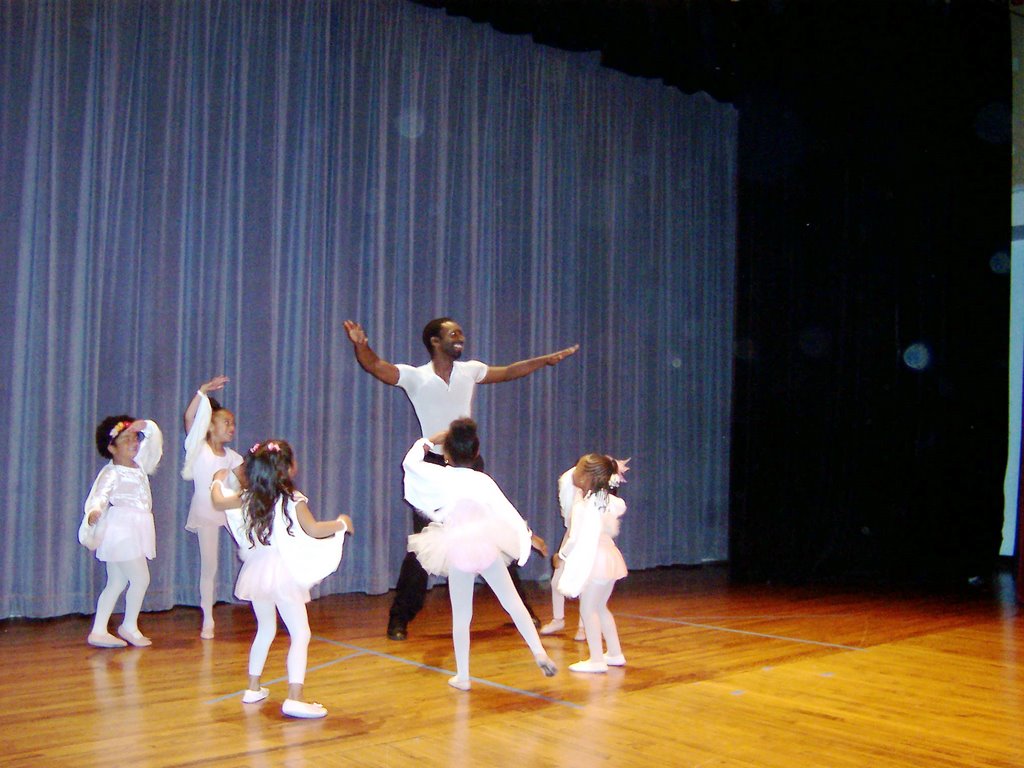
Left photo: The instructor with his class of 3-6 year-olds in Saturday's beginning ballet performance. There's nothing lovelier, except maybe the standing ovations received from proud young parents. Interesting to note that this audience -- largely African American, Latino, and young -- responded to this formal European dance form much as we do in the call-and-response tradition of the black church; "... you go baby!" and, "you got it," and shouted proudly mid-performance, "...that's mah baby!" This was probably not what Degas would have seen fit to paint, but was more in the spirit of, "...it ain't all Hip Hop, we can do this stuff, too." (Click to enlarge to full size.)

Right photo: Alyana dancing with her class at Berkeley Arts Magnet school's afterschool program.

Wednesday, May 17, 2006

Maybe a new cure has been found for vertigo ... the works of Alexander Calder.

Have been fully stabilized now for several days. Actually almost from the time that I stood before the great scuptures at the SFMOMA. There were a few traces of disorientation during the long walk from the museum to the financial district -- but for the most part the world settled down into some reasonable semblance of order on Friday and has remained so until now. The tendency to hold eyes to the front and pause before glancing left or right has disappeared and I'm again leaping over tall buildings in a single bound. I've tossed the Meclezine and its full steam ahead.

Another of our community-outreach "tours" is scheduled for the upcoming Friday and all seats are now taken. Word of the success of these bus tours has spread wildly, and the "civic" is now fully "engaged." Not sure what I've written about this phase of our work, but a word or two about now might be worthwhile:

As is true of other cities across the country, Richmond's downtown core was abandoned about 30 years ago as shopping centers were developed on the outer fringes of the most densely populated areas. As the merchant class moved out into the suburbs taking resources with them for the most part, the innercities began to disintegrate and implode as centers of poverty and crime took over. Banks and supermarkets followed those more affluent rooftops and city services declined miserably.

Only in recent times has the Smart Growth concept begun to take hold -- boosted by rising gas prices and (in California) inadequate public transportation systems. Construction of fewer affordable housing over recent year within the city proper -- is now being remedied by the introduction of transit village development; new more densely designed mini-communities within the whole. The redevelopment agency is beginning to have a positive impact on the blighted areas of the historic downtown. Our bus tours may serve to help distinguish blight from historic landmarks by raising the awareness of the city's celebrated wartime history. It appears that we're beginning to succeed in that effort.

As luck (and an act of Congress would dictate), early in the year 2000 Richmond was named as the one place in the nation where there were more World War II structures still standing than in any other state. Albeit they still stood as the result of benign neglect and not from any sense of reverence for its past, but nonetheless there is still much through which to tell that important story of an era. There are many still living who have active memories of those years, and -- if we can save them from the wrecking ball -- sites to be saved for posterity.

It's a complex story; one filled with both triumphant and painful memories. The story is largely of emancipated women (white) whose lives were forever changed by the opportunity presented by their times. These were the Rosies for whom every barrier was lifted to make possible their stepping into the labor force by the conscription of all able-bodied males to active duty in the war. Here were (still standing) the very first 24-hour-a-day childcare center in the nation; the Maritime Child Development Center we recently visited. The beautiful Albert Kahn Ford Assembly plant that switched from the autos to tanks in the early days of the global conflict -- and that has been beautifully restored to its original architectural splendor and will now be used for new peaceful purposes. It will house the new Rosie the Riveter/Home Front reception center along with other commercial enterprises.

Scattered throughout one of the most economically-deprived and neglected parts of the city -- the abandoned historic downtown -- are at least two wartime housing developments (once racially segregated), the Winters Building that once served as an air raid shelter and now houses the East Bay Center for the Performing Arts; the old Kaiser Field Hospital; the International Hotel, a decaying 20-room building that once was the stopping place for black porters who worked for the Pullman Company whose west coast servicing yards were in Richmond; the Oishi-Sakai greenhouses, Japanese flower growers whose owners were sent to internment camps far inland; Kaiser Permanente Shipyard #3, the current home of the last ship built by Kaiser, the SS Red Oak Victory, now under-going restoration by some of those who sailed on her in both WWII and the Korean wars; the Whirley Crane which built her; the old massive storage "bunker," machine shop, and paint shops, and the graving basins in which the 747 Kaiser-built ships were built and launched over a four-year wartime period. So much more than I can cover here (check out the Rosie the Riveter website for more).

The story is that those sites are scattered throughout the Iron Triangle, the long-neglected inner core of the city. Taking the community aboard small buses for a long morning starting with coffee, a short DVD, "Lost conversations ..." (seen in CBreaux Annex), has been our way of reacquainting the city with its own forgotten history. We load the bus with civic leaders combined with a few elders who lived those times and -- with a park narrator at the helm -- we help them to share their stories as we drive around to the various sites. To watch the reawakening of that history through their eyes is a revelation. The elders come alive and the "come-latelys" sharpen their ears. The civic leaders get to witness the community's response to that history. Suddenly the "we" extends from those of us whose business it is to breathe new life into those times, officially, to those who begin to make real connections with their own history. They begin to look at what up to now has been junk structures waiting to be replaced by new condos -- as critical to that history and historic preservation begins to take on new meaning. Just as suddenly, the awareness that their community is literally living in the middle of a brand new national park begins to dawn, and the fact that the National Park Service is here to help them to tell their story. Can you even imagine how exciting this process can be?

We have the opportunity to redefine the city's public image through its identification as a national resource and tourist mecca. This abandoned inner core can now be re-shaped with new opportunities for economic expansion. Most important to me is the possibility that we can include along with the truly important Rosie story, that of the very different African American homefront worker story; the Japanese internment story; the Latino story; that of the Italian and German immigrants who were each effected but who more quickly "overcame." We have an amazing role to play in bringing those stories with their amazing complexity into the national dialogue for a second look.

We have the rare chance to re-examine those factors that led to the rapid social changes that marked the next two decades in the history of the country. This park is that important, but only if we walk through the conflicts that created the times and avoid the temptation to paper over the lessons we should have but have not yet fully learned.

Those now in their later years have the rare opportunity to participate in that process. We're making every effort to include in each 28-passenger bus tour (we're now had 4 with a 5th coming up in July) a few of those who lived and worked in those tumultous war years. You have no idea how wonderful it is to see those workforce veteran voices held in such respect as their stories begin to be expressed as we ride along through the past ... their past ... with newfound reverence.

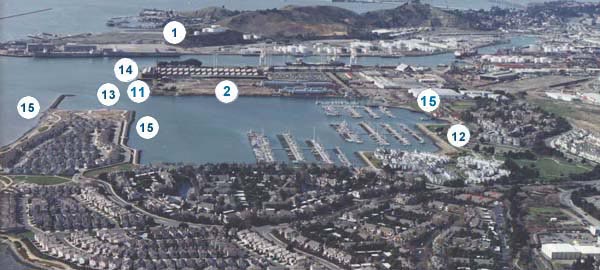
Photo: This thumbnail shows only those sites that lie along the shoreline. The structures that are less than one mile away are those that were the staging ground and the living spaces of the homefront workers. It is that part of the story that our tours highlight -- and quite successfully.

Monday, May 15, 2006

Mother's Day ... and, another of Dorian's delightful expressions of art. (Take note Marc Chagall.) ...

Saturday brought a trip to San Francisco's Crissy Center for the 5th annual Community Heroes award ceremony. The day was a rare one -- spring at her best -- and even at one o'clock in the afternoon, hometown folks, visiting suburbanites, and a healthy sprinkling of tourists were already gathering on the green for the Kaboom! activities that would end with one of the largest free barbecues and firework displays of the year.

I'd been asked to accept one of the 3 awards for Sharon Fuller of the Ma'at Environmental Youth Academy. Sharon could not be present and, as a member of her board, the role of recipient fell to me by default. It simply meant saying a few words about the honoree and having another opportunity to meet with the Golden Gate National Recreation Area national park staff and to revisit some of the young people who work with other younger people in some very exciting environmental programs.

The Crissy Center model is one we'd love to emulate in the emerging Rosie the Riveter/Homefront NHP on the Richmond shoreline. I've been fortunate in that my co-worker in developing the community outreach part of the program is one of the three Crissy Center staffmembers, Naomi Torres, who is with us on loan, parttime. It is from this experienced career park ranger, that I've learned much about the concept of civic engagement. Though I suspect that this is something I've known in theory a number of times over a long lifetime; something that keeps getting dusted off and renamed each decade. The important things are like that. They get rediscovered and refurbished and redefined into new realities -- if they're really worthy. Civic engagement may be one of those. There are times these days when I no longer know whether I'm learning or simply remembering old concepts.

On Sunday, David, Dorrie and I drove to a nearby Pacific Asian buffet restaurant where we joined many families (mostly Asian) celebrating parents lining up for booster seats for little wiggly ones -- it was one of those restaurants. Not a bit like the all-grownup sophisticated crowd at Tadich's in San Francisco's financial district on Thursday evening. Few smartly-dressed Porsche-driving brokers and admen and women here. A gaggle of strollers parked haphardly in the lobby. Shorts and tee-shirts on most; with a few "holiness" types decked out in church-going outfits topped by those elaborate signature hats African American sistahs wear on such occasions. The noises were different; the steady hum of conversations in strange languages nicely laced with the universal language-free sounds of children's laughter nicely blending with the clattering of pots and pans and cutlery.

Happy Mother's Day!

Photo: Dorrie's gift was this drawing of her two cats, Gracie and Marilyn, designated granddaughters for the day. The happiness in her choice of color may give some indication of the lack of fear at the fairly recent move into her own apartment across town. At least that is my hope. I see no indication of worry or instability in this drawing. I'm always searching for signs ... .

Sunday, May 14, 2006


... and Alexander Calder to the rescue!

It's been a week of happenings all leading to today. Despite queaziness brought on by not being sure where my feet were going to deliver the rest of me, I did manage to assign power to the top half of my body and -- eventually -- overcame what turned out to be disconcerting spasms of vertigo that strike with little warning -- depending upon too-quickly executed turns of the head, loud sounds, and fast movement picked up at the outer edges of my field of vision. However, in the process did a few stupid things that proved that it takes a little more than common sense to keep all the body parts neatly aligned and moving smoothly.

Feeling temporarily improved, on Wednesday I joined David and the kids for a trip across the bay to the Orpheum where we shared a rousing performance of Cathy Rigby in Peter Pan. What a show! Not sure what I expected, but surely not the great music and dance and delightful stage settings that we watched from the second row of the dress circle along with a soldout house where the median age must have been somewhere around 11, give or take a few toddlers and at least one octogenarian. What a time!

Together we groaned and booed at each entrance of the "Bli-my Sli-my Cap-tain Hook" with his cartoonlike pirate crew. The hardest part was not singing along with every song. The only explanation for the entire house not bursting into song at the drop of the maestro's baton and a few familiar notes was surely the median age of the audience and the lack of any memory of the original. I'm sure that every grownup in the theater knew every word of the score. "I gotta crow" made every muscle in my throat ache from the not-singing.

On Thursday I skipped a work-related scheduled tour of the bay aboard the Delphinus to visit the mothballed fleet at Suisun Bay near Vallejo. It was an annual volunteer's day event, sponsored by the park. Figured (wisely) that this would take more tha
n sea-legs and given the current state of my inner-ear problems, this was not the smartest thing to undertake. The combination of a trip over water sounded less attractive than an invitation to see the Calder Exhibition at the SFMOMA -- slated to close in a few days. Now that was a wise decision.

However, this was the first time I'd found myself fearful of looking up at the massive skyscrapers in the financial district (for fear of toppling over). For the first time I found myself acutely aware of the movement of traffic all around us. Even the movement of the escalator that fed us from underground of BART up to Market Street had been disorienting. Strange.

But that was of little concern compared to the stupidity of visiting the wing where the surrealists were being featured. Magritte does not play well when one's ears are ringing and the tones are about a half-note off -- one from the other -- making for a dissonance that is threatening to sanity,

But ... Alexander Calder's sculptures were magnificent! I'd only been aware of his mobiles and a few of his wire pieces, but here was an entire wing of his large sculptures in both wire and the most exquisitely-balanced and engineered pieces imaginable. I could have spent the entire afternoon in those rooms. Maybe -- in a way -- his works served to provide the one thing I most needed on this Thursday afternoon, on a day in May in 2006; balance. I felt "steadied" by it. In a strange way I felt whole, anchored. If I could just store up enough of this to carry me on the walk through the heavy five o'clock homebound traffic of the financial district to Tadich's where we would have an early dinner ... .

Alexander Calder had provided some temporary but much-needed relief but, unfortunately, this would not last more than a few hours.

Friday brought some stability and bright colors no longer shocked my peripheral perception, the ringing in my ears slipped into a single note, and the dissonance was lost in the busyness of another day at the office... .

Now if only the world would react similarly ... and the country would strike some kind of balance instead of careening off into more chaos each day. Could it be that my body is simply mirroring this new and frightening reality?

Could be ... .