Thursday, April 04, 2013

1942
Our offices are moving from our present location on Macdonald Avenue to the Civic Center complex which will be our permanent home ... 

... that means that -- as it is with most moves, one goes through the process of leafing through files and tossing all that stuff you didn't have the heart to trash at the time they were produced, but that you've never had occasion to ever need again.  I found myself re-reading letters, commentaries, invitations, copies of acceptances for speaking engagements -- remembering those occasions fondly, or not.

This one turned up and, though I have no idea why it was written 5 years ago, it seems heartfelt and important so I've filed it for additional life in my updated files, and am posting a copy of it here:


March 2, 2008


"Of Lost Conversations and Untold Stories"

Years ago -- it never dawned on me -- while dutifully filing change-of-address cards or taking dues payments in the small office of the racially segregated and powerless Boilersmakers A-36 union hall -- that I might live long enough to actually become black history, but so it seems.  Despite a dimming memory of working in that unassuming little office on Barrett Avenue in Richmond, and a strong reluctance to identify as the proverbial "Rosie the Riveter," life has placed a soapbox under my feet and here I am speaking publicly for a generation for whom my presence in the workforce was questionable at best.  As one of the female home front workers of WWII still standing, I often feel undeserving of the "Rosie" title.  I'm increasingly called upon to speak for a generation that helped to save the world from Fascist domination -- but I often feel that -- unlike my white counterparts, I'm fulfilling that role by default since so many of those voices have been silenced by time.  And since the equality we worked, fought, and in some cases, died for, has not yet been fully realized.

Due to working a considerable distance from the shipyards, and despite being a part of 98,000 home front workers who moved in and out of the Kaiser Permanente shipyards 24 hours-a-day and 7 days-a-week in one of the most intensive production efforts in human history, I never did see a ship under construction.  I never witnessed a launching.  Neither do I recall ever feeling the surge of patriotism that inspired the monumental achievement of completing 747 ships in 3 years and 8 months of the war.

Time tends to soften, alter, and revise history, and  the home front stories of WWII are no exception.  As a 20 year-old politically naive African America woman with little understanding of the war except for the disruption it brought to everyday life, confusion reigned as if some major fault line shifted under the weight of the unprecedented population explosion that changed the social fabric of the Bay Area, the West Coast, and the Nation for all time.

That confusion was driven by still raw memories of a nation that assigned 90% of black women to work in few categories --- agricultural, or as domestic servants, or restroom attendants.  To be allowed to do clerical work -- menial though such tasks might be in the scheme of things -- working in a Jim Crow union hall was a step up from making beds, caring for children, and mopping floors for white Americans.

Yet, in the wake of having become a full-time ranger for the National Park Service, I find myself invited to speak for that generation -- to share the stories of the times (and there are as many stories as there are workers who lived them) -- to many small groups and major organizations.  Over the past months I've been invited to participate in black history and women's history observances through the Greater Bay Area.  I've served as the representing "Rosie" as a member of a panel for the Oakland Museum docents program, the US Department of Agriculture; the Bay Area National Organization for Women, the Daughters of the American Revolution, and the Valley Baptist Church.  In the past I've appeared before the Social Security Administration, the Department of Forestry, before Berkeley's Arts Magnet schools' fifth grade classes, in a long distance interview with the Fruitvale Middle School school history classes in Bakersfield, California, and a long list of organizations now too numerous to mention.  Over the past month or two I'll be speaking at the Berkeley City Club for the University of California retirees and for the American Association of University Women, among others.

Does it feel real?  Have I learned to accept my new role as a spokesperson for a period in history which holds painful and often humiliating memories?  Oddly enough, the answer is yes.  I find that those I appear before are ready to explore that era with an openness that holds promise for continuing change that will insure that my granddaughters will benefit through my participation in this new national conversation.

The silence that worked against the change has given way to new possibilities for measuring progress toward a more equitable society, and Rosie the Riveter/World WarII Home Front National Historical Park is in a position to accelerate that movement through the "Lost Conversations and Untold Stores" we are able to provide in this new public role.

Perhaps the trajectory of my life from that young and confused disenfranchised union hall clerk to full-time national park ranger on a soapbox -- illustrates as much as today's campaigns for the presidency -- a women and an African American -- how far we've come in the on-going process of growing our democracy to the benefit of the world.


Sunday, March 24, 2013

Cinco de Mayo 2011
The Chinese are celebrating the Year of the Dragon while here in my city we may well be entering the Year of the Dinosaurs!

Received a call from former city Councilman John Marquez, a civic leader in the bordering town of San Pablo where the majority population is Latino.  He was announcing that -- as head of the planning committee for this year's Cinco de Mayo parade -- I'm being invited to serve as co-Grand Marshall, along with 97 year-old much-beloved Joe Gomes who served 40-odd years as a city councilman in San Pablo.  Now this is something I surely was not anticipating, but am greatly honored by.  Cinco de Mayo is the annual colorful parade and weekend festival attended by thousands and co-sponsored by the neighboring cities of San Pablo and Richmond. 


This is particularly important in this year of political turmoil at city hall where the council meetings have become toxic to the point where one can easily imagine that slur-by-slur, salvo-by-salvo, and verbal brick-by-brick (thrown!) the racial barriers of old are being brutally reconstructed after many decades of the painful struggle to dismantle them.   'Tis the pity!

Short-sightedness among some members is so marked that Council meetings are now a battleground where competing political forces are laying bare long-held fraying of the social fabric -- but this time the partisans are not black/white but conservative/progressive, or corporate/non-corporate with folks lined up in some surprising ways in which racial identity has become irrelevant; something I would have considered progress not so long ago.  Dormant problems were re-kindled by the recent city elections when cruelly divisive race-baiting measures fueled by seemingly limitless corporate moneys caused what may be irreparable harm.

Full recovery is still some distance in the future, but maybe this invitation is one of the embers that indicates an effort at beginning the healing process. 

That I, an African American, would be honored by this invitation from the Latino community to serve as a Grand Marshall for their biggest celebration of the year might well be answered, in kind, by someone from their community being so-honored by a similar invitation for our Juneteenth celebration this year.

Maybe that's just too much to ask in our current political climate, or is it?  

Friday, March 22, 2013

My commentaries at the Visitors Educational Center are becoming more focused at this point, and -- though unpredictable -- we're beginning to bring return audiences to our little theater ... 

... and, though I'm more comfortable with being able -- still -- to draw upon memory while standing before audiences, and though it's beginning to be repetitive in some instances, the newness of the expressions on the faces before me manages to keep it all fresh and meaningful.  I'm not sure how that happens, but having the docents turn up the lights when the film ends -- so that I can look into those faces seems to hold the answer.  My command of the room clearly depends upon my ability to look into the eyes before me.  I could never work under a spotlight which blinds and disconnects me from the source of life -- the human connection upon which everything depends.

When these afternoon presentations were initiated -- and for some time afterward -- I felt drained after what is essentially a 45-minute program which included a 16-minute film with a Q&A.  The 2 o'clock program (on Tuesday and Saturday afternoons) and end at 3:00 o'clock which is the normal end of my 5-hour workday.  At first I'd find it awkward to tarry long enough to get audience feedback, and would scurry off with head down for the parking lot.

One day that ended.  Not sure how that happened, but I'm now able to stand at the front of the room and allow folks to comment without wanting to look down at my shoes before bolting.

... and I'm awed by the make-up of those small audiences (theater only holds about 45 folks at a time), but on Tuesday there was only one person of color in the room, a man who crept in shortly after the film started.  At the end of my remarks he lingered long enough for others to take their leave before coming up to offer his hand.  His words, "I was interested that -- when you were listing those black heroes who made up the events that occurred during the lives of the 3 women in your family -- of whom you are one -- you left out my ancestor,  Frederick Douglass."  Our visitor turned out to be a state worker just driving through Richmond on Highway 580, and noticing the signs leading to the Visitors Education Center decided to check out this park he knew nothing of.  His surname was, indeed, Douglass (two esses) and his great-great-great-grandfather was the historic iconic figure we've so revered since childhood.  His own father (still living) worked at the White House -- but here's where I was so stunned by his identify, and his excitement about what he'd accidentally discovered here -- that the rest was lost.  His last words were, "wait 'til I tell my Dad about this!"  He promised to return with father in tow soon.

Ya nevah know ... .


Sunday, March 10, 2013

Such an emotionally rich experience ... and worth every minute of the worry invested in the writing ...

... and to look into those upturned faces almost cost all the composure I could muster.

The Boy Scouts making their entrance Presenting the Colors; the Pledge of Allegiance to the Flag; listening to the national anthem sung by a fine tenor from the East Bay Center for the Performing Arts ... watching the faces as new citizens raised their hands in the Oath of Allegiance to their new country ...


... yet learning just as I was about to climb the steps to the raised platform to deliver the welcoming address -- that the invitation for my doing so had come from the US Immigration Service and Homeland Security Agency.  I had been under the impression that this was simply an assignment that fell to me as a member of the Outreach team.  I didn't know that  my delivering of the keynote address was by a request from the partnering agency as the result of a talk I'd given there some time ago.  Perhaps this was best since I may have felt an added pressure and placed unnecessarily higher expectations on myself to perform well.  As it happened, attempting to write an appropriate welcoming speech against the background of the news coming out of the Supreme Court on the hearings for whether or not to renew the Voters Rights Act -- the awfulness of Justice Scalia's comments, and the continuing silence of Justice Clarence Thomas -- was stress enough.

The New York Times editorialized in yesterday's edition that the Roberts Court appears to be preparing to "eviscerate the Voters Rights Act."  Images of police dogs and fire hoses at the bridge in Selma years ago -- the brutal beatings that left Rep. John Lewis fighting for his life -- the high costs to the nation's honor; against the current practices now in place to discourage voting in some states.  Those images freshened and threatened my ability to stand apart long enough to allow the words to come that would allow me to remain truthful to my principles and yet to express the true patriotism that I do feel and can still express in my work.

What saved me in the end was that it eventually occurred to me that there was simply no way for me to welcome new citizens into Thomas's or Scalia's United States, but that the nation in which I believed was worthy of their allegiance.  So I welcomed them into my imperfect and ever-evolving land of hopeful and worthy Americans who, in complete faith that unseen others are out there leaning in the direction of positive change with us, and that we will ultimately prevail.

These Nationalization Day events are held several times each year at various park sites and are a joint collaboration of the National Park Service and the US Immigration Service and Homeland Security Agency based in San Francisco.

So memorable ... such an honor to have been a part of the fulfillment of the dreams for 75 new Americans, friends, and families.

Tuesday, March 05, 2013

Naturalization Day Address
March 5, 2013

“We the People of the United States of America, in Order to form a more perfect Union, establish Justice, insure domestic Tranquility, provide for the common defense, promote the general Welfare, and secure the Blessings of Liberty to ourselves and our Posterity, do ordain and establish this Constitution for the United States of America.”

These are the first stirring words of our Constitution, this founding document with its ever-evolving Bill of Rights that has sustained us as a nation for lo these many years -- defining and insuring our freedoms. 


I once heard those words as describing birthrights, as divinely inclusive, despite the fact that my African American enslaved ancestors were denied the freedoms described therein by the founding fathers.  Being born in relative freedom a half century after the Emancipation Proclamation freed my ancestors, this powerful document would -- in my mind, at least -- serve as the guarantor of my rights of citizenship and would become the basis for a lifetime of political activism against real and imagined injustices caused by ignorance and intolerance,  unworthy of and counter to -- the hopes and promises upon which this nation was originally founded.


In these later years, I’ve matured into a deeper understanding of its meaning.  The first sentence says it all:  “We the People,  in Order to form a more perfect union ....,”  a stark admission of the imperfections therein.  A more perfect Union.   The words appear to deliberately leave room for the social evolution that would occur over our lifetimes and into an unknown future. 


Those sacred documents were not delivered to us carved onto stone tablets; were never meant to be “deeds” to our birthright as American citizens, they are simply blueprints with which each succeeding generation must  re-create “democracy,”   each generation  bearing the responsibility of “...forming the more perfect union.”  


Ours is a participatory democracy requiring constant vigilance in order to defend, preserve, and protect our freedoms as described in the Bill of Rights.

We also have the freedom to err, to waver in our constancy; to be unwise and mistaken in judgment; to be unfair to and critical of ourselves and others as we travel through life experiences that define our individual selves, and our collective identity as a people ... and as a nation.


You, who have gathered with us  today, have chosen to assume the shared responsibility for re-creating democracy in our time.  You bring cultural differences, languages, and customs from distant lands to enrich what is already embedded in the national landscape; stories, music, poetry, literature, unique customs, religion and philosophy, and as yet undiscovered  secrets of science and technology. Our nation will continue to change and evolve for your having become a part of this never-ending striving toward the attainment of “... our more perfect Union.”


But be forewarned, this imperfect political system will always need the combined energy and voices of Americans new and old -- in every phase of the continuing struggle toward a perfection that is destined never to be fully attained despite our best efforts and often futile attempts. The illusive perfection of “democracy” will always be dependent upon our ability to maintain a balancing point between opposing political forces -- because it is in that vibrant and chaotic cauldron of constant and persistent change that the energy that empowers our dynamic system of governance is generated and renewed.  


And we must not forget that political dissent is a necessary element in the re-creation process; an important right that allows the nation to self-correct -- to regain stability when we stray too far from our stated ideals, and that there will sometimes be pain and sacrifice to be shared in the cause of securing and sustaining those freedoms.


We welcome your voice and your dreams and your presence among us -- as together, we continue the never-ending grand experiment of government of the people, by the people, and for the people, as citizens of these United States of America.


Again, welcome to each of you, from each of us, Americans ... all.

Monday, February 25, 2013

On Saturday our Legacy Series featured the first of 4 presentations depicting life as it was during WWII ... .

They will occur -- one each month until completed. Each will contribute vitally to a growing understanding of the era, and to our ability to interpret for ourselves and the public the Home Front stories as they were lived.


For me, at my present age, it's often merely "connecting the dots", making the linkages that earlier in life were simply not possible.   Maturity has brought with it an ability to stand apart from the mere facts; the ability to see the full spectrum of past experience; and to adjust my sights to better focus and isolate events and issues in new ways.  Having outlived my rage without losing my passion enables me to re-examine and analyze without feeling the need to correct -- and how freeing is that?  In the not too distant future life will go on without me to be assumed by those who come after.  And, in what on the surface appears to be a contradiction, I get to do all that while feeling fully engaged and still productive.

During the really wonderful talk on Saturday featuring the noted columnist and music critic, Lee Hildebrand, I got in touch with things that have been clouded for years: 

We sat listening to Lee's really informative talk in which he interwove brief snatches of recorded blues -- before a hushed and rapt audience of mostly white folks.   I found myself increasingly uncomfortable and didn't understand why, except that my toes were keeping time within the confines of my neatly shined regulation brown oxfords, and my fingers were busy "not" clapping in syncopation with the raspy voices of Jimmy McCracklin and Jesse James et al. 

What was wrong?  There was something strangely familiar about those feelings -- and before the hour was up the clouds parted and I knew.  It was the imposition of white culture upon black that formed the disconnect.  It felt familiar because I've become accustom to chamber music audiences where I'd learned this kind of audience discipline over time.  (One does not applaud after a movement, but only at the conclusion of a piece.)  There is never a spontaneous outburst of appreciation or emotion during a composition -- but silent attention to the intent of the composer's work.  If you could nail the year and age of the composer as well; that would surely add to your value as a patron of this form of the classical arts.  There is an intellectual prerequisite in order to be fully appreciative of the genre.  Though my enjoyment of classical music has grown over time, I've never completely gotten over the feeling of being one of the unwashed among those who "know."

I'm almost convinced that while white culture rewards what has gone before, black culture rewards creativity and innovation so we're ever-evolving and cutting new edges -- ever dependent upon what rises from within.  We've been changing and growing American dance, music, as well as language ever since arriving on these shores.

I once wrote copy for an ad for our store that stated that:   
"Contemporary Black Gospel is Jazz Come Home."  
... and I do believe that jazz and blues have never gone away.  They're still alive and well in the choir loft.  Though appearing about as tough as nails, there is a fragility to the art form that may have been lost through being separated from their roots.  When taken out of the natural environment  the music undergoes irreparable change and becomes as different from the original experience as life in the wild compares to fossils displayed under glass in our natural history museums.
A couple of weeks ago I attended a black gospel concert at our convention center.  The audience was nearly 100% African Americans who came ready to "have Church!"  They were spirited and expectant; dressed in proper  Sunday morning regalia and eager to raise the roof in reverence for "His holy name."  There were testimonies from the stage; proof of God's benevolent caring and personal guidance.   Here was Call and Response; witnessing, spontaneous dancing in the aisles and down front before the stage.   Predictably, the artist would come down from the stage and join in the demonstration at some point of irrepressible fervor! Even those seated respond to the artists individually as well as collectively -- standing in place rocking and clapping to the music as if all by themselves; shouting appreciation, and/or joining in the singing as the spirit moves them.  The artist rides on this wave of exuberance and pure ecstasy. It is absolutely wondrous and infectious, and almost impossible to resist!

I'm convinced that the racial make-up of the audience determines the nature of the cultural experience.   And though few take advantage of the open door to such concerts, anyone is welcome to attend.  Black folks are by nature a warmly welcoming society, and your presence will be most appreciated.  Y'all come, y' heah?

I cannot imagine black audiences sitting on their hands or waiting for agreed-upon signals to dictate  behavior.  Black music is a totally emotional and visceral experience.   If you can't leave your intellect at the door, then you'll just have to settle for something far less than this.

And so it is with the Blues.

On Saturday I noticed that the vast majority of those in the room were white blues lovers sitting in silent appreciation for Lee's talk and the snippets played to illustrate his stories.  It occurred to me that it was small wonder that the blues no longer attracts black audiences; the blues has been fossilized; ashes as opposed to embers Black music -- whether blues, soul, or gospel, loses its essence when taken out of context.  Such music was never meant to be performed in concert halls but in fields, on front porches, in gut-bucket night spots and darkened corners of living rooms and around kitchen tables.  This was not blues per se, but about blues; a very different experience.  It suddenly was clear that the only way to have a blues experience would be to arrange to have an "affirmative action" audience.  Audiences seeking to reproduce black cultural arts -- especially music -- need to be made up of at least 51 percent black people.  Anything less presents a restricted and distorted experience that merely resembles the original.

You haven't really heard the blues until you've heard them sitting among black folks who've lived them, and don't let Eric Clapton, Bonnie Raitt, or Mick Jagger tell you differently
.

Note:  For earlier posts on black music enter "blues and jazz and/or "black gospel" in the little white search bar at the top left side of the screen above my photo and the banner.

Sunday, February 24, 2013

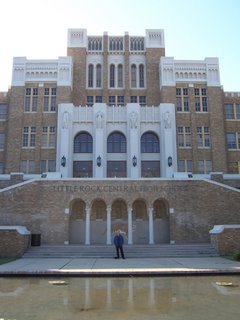
In the middle of my speech-writing attempt, Martha forwarded a video made on the 57th anniversary of the harrowing events at Little Rock's Central High ... .

... that was almost lost over time.  I'd almost forgotten ...

Haven't figured out how to  export that  to my blog yet, and it almost seems unfair to reference it here without sharing this disturbing though inspiring record of Minnijean Trickey Brown's witness to those awful days -- and, I promise to do so when possible .

Betty at Little Rock Central High
Meanwhile, you can access my own record of that history by the accounts of a visit on the 50th anniversary of those times that Ranger Lucy Lawliss and I made to Little Rock in 2006.  We participated in a National Women's History Project panel at the University of Arkansas where we were privileged to meet Ms. Brown and her NPS Ranger daughter, Spirit, and to hear that history firsthand by some who lived it.

The courage of those 9 teenagers leaves me awestruck to this day.  None was over the age of 16, yet they and their parents braved the evil hysteria of the mob with the support of the (untrusted) Arkansas State National Guard.  This magnificent school sat closed for two years afterwards in defiance of the desegregation order rather than allow students of color to attend school with white students.

The entire story is there to read, and I needn't repeat it here, but to the extent that it may add a deeper layer of understanding of the complexity that Americans of color live with in exercising our citizenship -- it may be important to share.

I'm reminded almost daily that -- for reasons unknown -- I've been privileged to have been allowed up front and center row seats from which to witness the past half-century of American history.

(Go to the little white search bar on the left side of the screen and above the banner and my photo and enter the words Little Rock High School.  Then scroll down.)

Wednesday, February 20, 2013

Note on Facebook (to myself) ... .


Today I've taken a work day at home to prepare a speech. That in itself is a contradiction in terms since I'm not accustomed to working from a written script-- ever. In my work I simply depend upon memory to rise up and take over -- and that rarely fails.  However, on March 5th I've been invited to give an address in the Craneway Pavilion as a part of the Naturalization Day ceremony welcoming 75 new citizens plus friends and family into our democracy; a tall order for a woman of color since my view of our political system has been inconsistent and greatly tainted by both real and imagined injustices throughout life. I've carried many a picket sign and marched in countless demonstrations over time -- and mounted many a challenge to the status quo.   From the outset it was clear that this one I couldn't just do "off the cuff," but needed to meticulously plan -- word for word.   It's far too important, and deserves the time it may take to fully think, and maybe meditate my way through the issues, and to honor the challenge this assignment demands.

My responsibility is that of an American, and my words must come from a place inside that cannot be limited by my skin color, outside. Yet, it is the "Betty of Color" whose life has been shaped by that external image imposed by an insensitive and unfair political system that I'm now wanting to rise above for this one occasion, and to do so without compromising my principles; a tall order. Maybe my position with the National Park Service has vaulted me high enough to allow me to stand above the fray at least long enough to share the earnest patriotic feelings I do truly experience of late after a lifetime of uncertainty and ill-ease -- and to be sincere in welcoming new citizens into the grand experiment we call Democracy in the hope that they will join the rest of us in " ... forming a more perfect Union." Amen.

Monday, February 11, 2013

The unresolved issues about the rights of undocumented immigrants just beginning to take shape in the White House and the Congress ... .

... are causing some sleeplessness these winter nights, and as is so often true, are becoming interwoven with another stubborn issue -- our disturbing numbers of American citizens of color living lives of desperation within the walls of our prisons.  (Read "The New Jim Crow" by Prof. Michelle Alexander for a more complete picture.)

I've now been blogging for so many years that there's a personal record of my having anguished through these issues before, and repeatedly.  No need to repeat that diatribe here.

I just took myself back a few years (by entering a few key words in that little white search bar on the left side of the screen just above the banner) where I was able to read back over earlier writings on these troubling subjects.

What makes today's news that the Post Office is threatened with further closures -- and that 1 in 5 postal workers has been African Americans since the 1880s -- means that literally thousands of unemployed people of color are soon to be added to the ranks of the unemployed in a national economy too weak to sustain them and their families.

I believe I've found them -- those displaced African American service workers.  They have been moved from the projects and welfare lines into our prison system where they are facing either life sentences, or, are faced with disenfranchisement upon release and re-entry without rehabilitation of any kind; stripped of the right to vote (in many states); having to register on job applications as having a criminal record, and with little hope for a future of any kind except the return to the prison as a means of survival.


Note: The passage of time and our failure to solve some basic issues as a nation, means that little has changed, except that I've grown older without finding comfort around these questions.  If you'll enter the words displaced service workers and/or Immigrant Rights into the search bar you'll bring up those discussions -- me with myself  -- on these subjects.   

Sunday, February 10, 2013

Lately I've been thinking about the dangers of absolutism and its expression thereof ... .

There's been a shift in the way I interpret philosophical issues these days ... a kind of re-thinking of long-held views.  I'm clinging less to my own analyses and finding fragments of opposing views creeping in --even when hopelessly contrary to my own strong beliefs.  Another developmental stage in the aging process?  It's likely.  I'm less subject to suffering fools of late, but more trusting of others to find their way without benefit of advice from me.  Finding more universality in myself and of the other's ability to figure it out without my interference; even my children and grandchildren.

Sitting in the audience of a gospel concert surrounded by "believers" might have shaken my agnosticism at some earlier time;, but at my age it's easy to not be intimidated, or, to feel envious of the fervent believing of others -- but I'm perfectly comfortable to sit as an outside observer to what I now see as the difference between faith and fact; to draw what I need from the experience (the magic of this amazing and soul-stirring roots music) and to leave what I cannot use behind.

That one believes something to be true does not make it so; not for oneself nor for others.  But when sitting among many who share beliefs-in-common, the seduction is palpable!  Small wonder that faith healers and shamans can perform their miracles.  There is an almost visible magnetism present, and the wanting to be healed is powerful enough to meet the healer half way.   Would that we could bend this power to our will in other areas of life.  For instance maybe gun conttol would not seem so unachievable.

Puts me in mind of the time that I was alone on the streets of Boston; a city I'd never before visited.  My destination lay several blocks away.  I'd been told that it was an easy walk from my hotel.  Except that it was five o'clock, and I was walking against a mass of people rushing past on the sidewalk -- with some even slipping off into the gutters in their haste.  It was all I could do to not turn around and fold into this stream of humanity.  Was there some incident up ahead -- out of sight -- some unforeseen danger that they were running from? Were they fleeing in fear from some unseen evil?  It took every ounce of human strength I could muster to not turn around and join the crowd rushing past!  I stopped for a minute -- leaned against a newsstand for support  to take another look at my hastily-written directions for reassurance.  At that moment I caught sight of a sign on a nearby lightpost that explained my dilemma.  That great moving mass of humanity was just getting off work at the end of the day and heading for the Metro.

The mind is quixotic:  The image that rose to mind a moment ago was -- that long ago during a menopausal hot flash I couldn't imagine that anyone in the room couldn't see the steam spewing from my ears!  Surely it was clearly visible.  Why did they not see?  If you could see my grin right now you'd know that the next thought was that -- if men experienced hot flashes -- a verse would have appeared somewhere in the bible that this was undeniable proof of the existence of the Soul.  And -- that for most of my life I just may have been moving on a path filled with people rushing swiftly for the Metro of life, and, that just might be okay -- if I just take the time to reassure myself every now and then.

... but I digress.


Monday, February 04, 2013

Giving a talk on board the USS Hornet some years ago
Lots to ponder ... .

Last week a call came from our Chief of Interpretation inviting me to think about giving the welcoming address at an upcoming celebration on March 5th.  This is a traditional National Park Service program that will take place in the beautiful cathedral-like expanse of the Craneway.  This is a first-time ceremony for our park, the birth of a new tradition?  It will celebrate the status of 75 brand new naturalized American citizens, their friends, and families.  What an honor!

The call came at a time when I'd just returned to the administrative offices after a ten minute "cool down" drive following a presentation in our Visitors Center theater.  As always, I feel spent, but affirmed by the experience which tends to leave me always with an emotional high -- though the why of it is puzzling but in a good way.  The urge to escape immediately into my car and onto the highway -- caged into its isolation chamber where I can climb back into my skin and re-set all the buttons into a neutral position.  Since the end of my work day coincides with the end of my commentary at these "performances," I usually hastily head back to the office where there is quiet and a way to disengage from public scrutiny in the confines of my cubicle before heading home. 

It was in just such a state that Morgan's call came -- I heard it as just another outreach assignment which of course was not to be questioned, but to be added to my to-do list and noted on the big shared calendar.

On the drive home it began to dawn -- how significant an event this could be.  It will surely require much more than my usual impromptu oral history talks which that have been so successful in our little theater's twice-weekly sessions.  Those only required an active memory and a willingness to share experiences of the home front of WWII.  This was radically different.  I just may have to actually write this one down, lest I lose control in mid-speech.

Could I, an African American, find it within me to create a welcoming speech as an "American," in a nation whose half-hearted treatment of its minorities over time has so effected my entire existence?  Would I need to acknowledge that duality in public, and at the same time, be ready to set aside criticism of my country and its incomplete journey toward "liberty and justice for all", at least long enough to uphold our pride of national purpose?  And -- could this be done without forfeiting at least a bit of my own integrity?

Such thoughts have kept me awake these past nights, but have also convinced me that it can be done.

Last night I went to my bedroom bookshelves to retrieve my copy of the fellow rebel, author Ken Kesey's, "Sometimes a Great Notion" from its place where it has lain for so many years (except for an occasional dusting).  I opened to a page where  a small shriveled dried-up nosegay of wild flowers the late Kesey had picked from the dunes -- and which he presented in an act of mock-courtliness --and in a game of self-imposed silence.  It was a fog-bound morning at Asilomar where I'd gone to reassert myself as an American, and to reclaim the symbols that had been given up over a lifetime of cynicism and political discontent.  It was the early 50s, and a time of a nation's chaotic but ever-lasting transformation.


Note:  If you'll type the name, Ken Kesey, into the little white search bar on the left side of the screen -- above my photo and the banner -- you'll better understand the references in this post.    


Saturday, January 26, 2013

I've now lived long enough to BE Back History ... and my week is fast coming up ... .

On my January 18th bus tour (where I serve as tour guide) a reporter for the Richmond Pulse -- complete with camera -- was along for the trip.  I've become pretty used to having this happen, and it doesn't take long before such folks fade into the background and are barely noticeable -- either by the other passengers or by me.

He remained behind when the trip ended two hours later, and wanted a  brief interview with which to complete his story; easy enough to comply.

A few days later he emailed a request for permission to use a photograph I'd posted online when someone entered my name into my high school online yearbook.  In the picture I'm a pretty and naive 17 year-old.  Since I have no way to know what shape his story is taking, I didn't want to try to influence his work, but at 91 I can hardly remember that young girl -- and it didn't seem appropriate somehow -- and how on earth would it be fitting? But maybe I need to just wait and see the article. 

That being said, I sent a current photo in the hope that it might influence his decision about the article.  I really am not caught up in the past, and am perfectly content with the current version of Betty.  Maybe the bar is simply lower by now, and my expectations for what life should look like for what we call "the Golden Years" is far different from anything that young girl might have ever envisioned in her wildest dreams!

Re-inventing myself as the times and conditions underwent changes -- living life in a constant state of surprise -- has led to every possible kind of challenge, and highs, lows, and in-betweens, that always held enough promise to propel me into the next year, month, day, and -- sometimes, hour. 

Besides, where were the reporters when that pretty young girl was building her resume and looking into a future -- dimly -- in an unenlightened nation?

Better late than never?

Maybe.


Monday, January 21, 2013

... but you can see from this National Park Service short video that there was magic enough to capture the moment ... .

This morning, while the grand folks were being shepherded in and out of the Chapel and moving in the impressive caravan of limos to the site of the ceremony at the Capitol --  I was remembering the first inauguration in 2009 when Martha Lee and I were making our way from our little rental (just for the occasion) near the Capitol -- on foot in the gathering crowds on the streets.  We stopped long enough to visit the bronze statue of Mary McLeod Methune, the great educator, and then on to the Mall where nearly two million new best friends were amassing at the gates where we would show credentials and find our seats.  Poor Martha was trapped in that tunnel -- folks who never got to see the ceremony at all.  I was more fortunate, and found my seat without problems.

But, unlike today when I'm comfortably dressed in my pajamas and warm socks -- and munching on toast and cinnamon tea (as opposed to being bundled up against 17 degree cold with steam coming out of my ears and icicles hanging from my nose), I'm seeing it all courtesy of CSPAN.

In the last inauguration -- even though seated in a VIP section as an invited guest of my representative -- I watched the entire pageant on the giant screens that were standing nearby.  The major players were tiny images high up on a platform, and only identifiable because of associated memories and the familiarity provided by years of seeing them on the small screen in my bedroom.  Otherwise I might just as well have watched at home -- as I do now -- without the travel.  But it wouldn't have been forever memorable.

Would I have preferred today's more comfortable viewing to the live experience of 4 years ago?  Of course not.  The energy of the shared experience was palpable.   Nowhere on earth was there more goodwill and fellowship concentrated in one place.  Being together magnified the experience for each  of us.  We'd come from great distances on every possible mode of transportation.  It was unforgettable.  Life-changing.

Funny ... now that I've seen the more complete pictures with the background filled in by knowledgeable historians ... it feels as if I went through the last inauguration encased in a 3' x 3' bubble that limited sight and sound.  But there was so much life in those moments that there was no awareness of what we were missing, factually.

The live experience was real, beyond imagination, with a spiritual element that more than made up for what was missing.  But this morning's viewing completed the very different experience of four years ago.   I'm so grateful for having this fuller picture to add to that personal history and to treasure always.

Now I'm going to have another cup of tea and just meditate on how far we've come in our time.

The speech was all I'd have wished it to be.

I'm no longer seeing the promise of democracy as unfulfilled.  My sense of self as an American has evolved over time.  Not only that, but I now see myself among those with the power to -- together with others -- make it real for generations yet unborn.

That, I now realize, is true -- and new, and will enrich my work from this day forward.
This video was created by the National Park Service for national distribution on "Inside NPS" for the first inauguration on January 20, 2009 ... the ritual as experienced by this ranger ... .

Sunday, January 20, 2013

This morning I've been watching the opening ceremonies of the (private) presidential inauguration for a second term ...

... and am reminded of four years ago and the feelings prior to that event  The following post is dated January 10th, ten days before Inauguration Day in the year 2009.  


I've been asked so often how this year's event compares with that experience, and it occurred to me that going back into the archives to retrieve those feelings just might suffice.  There are things that one never has the chance to re-live, and it may be futile to try to make such comparisons.  But I feel misty as I watch today, and all of the affect of this moment are with me still as I watch this peaceful change of governance and marvel at possibilities that still lie ahead  ... .


Saturday, January 10, 2009


Not only will I be going to the Inauguration next week, but I'll be audible!

The strange things that the mind holds in reserve ...

Somewhere between the years of 11 and 13(dated by the image of the Elmhurst Jr. High School auditorium that crops up in the remembering) there was a blinding insight that has been a major factor in the becoming of Betty for over a lifetime. This had to be associated with the absolutism of childhood combined with an awakening sense of social responsibility. The insight was life-altering and has been incorporated into a value system that persists to this day.

I recall that it was in that school assembly while reciting the Pledge of Allegiance that it hit me with the force of revealed "truth." I found myself instantly falling silent at the words, "...with liberty and justice for all." Not only that, but I continued to mouth the words while holding back the sounds. I recognized the phrase as absolutely untrue. I realized, perhaps for the first time, that the words didn't include me or anyone like me, surely not my dearest friend and grandfather, dark-skinned Papa George. I also realized, instinctively, that those young classmates standing around me with hand over heart and the piety of youth didn't know that. That the teacher whom I adored and who was leading the pledge -- was unaware, as well. I didn't know at that point where the blame should lie, but it wasn't with anyone here in this hall. That I was certain of, and I had no wish to dishonor their patriotism by allowing them to be witness to my dissent. I only knew that somewhere I'd read an anonymous quote (perhaps in a tiny box in the center of a page in the Readers' Digest) the words, "Every day in every way what I am to be I am now becoming. Words to live by" -- and with the passion of a small well-read and uncompromising little girl to support it. I would not participate in the lie. Not then -- and not ever.

Later I would extend the practice to falling silent at the words, "...under God" and not because I'd intellectually worked my way out of religious orthodoxy; that would have required a far higher level of sophistication than I could claim, but because I found the words non-inclusive of other belief systems (whose God?), and was inserted into the Pledge for all the wrong reasons. But that came much later and from a far more reasoned place.

So that left two "audible" blanks in my personal pledge to my country though I continued to rise in respect and participate to the extent that my values would allow. I'd never discussed this with anyone and presumed that I was alone in this practice of censoring and deleting appropriate to my personal beliefs.


On Inauguration Day in this year 2009, I will stand and (for the first time since childhood) I will bring sound to the Pledge. I'll take my place as one of "We the People," and I'll "promote the general welfare" and "form a more perfect Union", and boldly proclaim my part in the re-creation of all that may restore our once glorified and now badly tarnished image as the undisputed leader of the nations of the free world. And those words held suspect for so long will finally ring true.

...and I'll do all that while witnessing the swearing in of the nation's first black president -- completely awed by the arc of all of our American lives that has brought us to this place of reconciliation and patriotism of a kind that now begins to make sense to those of us who have been silent and/or conditional in expressing it.

As I watch that historic national rite on Inauguration Day from the stands, I will be the only member of that audience of flag-pledging Americans who will know that I've uttered those words

"With Liberty and Justice for All!"

aloud, for the first time in over 70 years, and that I will be doing so as the full-fledged member of

"We, the people!"

Wednesday, January 16, 2013


The more things change ...

I've been mulling this over since returning from New Orleans.  It's a scene that rises every now and then -- mostly when I'm needing a shot of humility to balance off some of the awesome things that happen unexpectedly and leave me feeling just a little intoxicated ... heady ... disbelieving.

It happened earlier this week when there were calls seeking commitments for engagements -- first as a presenter at Stanford for students in Feminist Studies.  A professor had traveled from the campus in Palo Alto to hear my commentary in the regular Saturday afternoon theater presentation.  She hung around afterward to extend the invitation.  I'd already accepted a role as panelist at St. Mary College's International Women's Day all-day conference there on March 9th.  (By now my head-band is showing signs of tightening ever so slightly!)  And -- I'm this year's speaker for the City of Richmond's Black History Month program in our Convention Center.

Then the invitation came from the Department of Citywide Administrative Services in New York City -- the writer of the email wanted to know if I would be willing to travel to New York anytime during the first two weeks of February -- for their Black History program.  What an honor! 

The first 3 months of the year are the busiest; January with its Dr. King observances; February as Black History Month; then March being Women's History Month.   I've been scheduled for months, and there was just no way to even think about trying to make such a trip for a single engagement.  Besides, my persona may be getting in the way of my work, and I could get lost in the hoopla and forget what's important.

Just about the time that I was threatened with a spasm of what could be terminal self-importance, I was reminded of the man in the elevator back in December:

I'd just finished my speech for the International Conference of the WWII Museum in New Orleans.  Again, it had happened; that magical thing where I'm just coming to the end of my speech and I become aware of the dead silence in a room of 500 people -- painfully aware of the responsibility one has for delivering something of meaning into that void when you've become the object of pure focus -- and I felt my voice trail off -- uttered something inane and returned to my seat on the dais.  At which point the audience rose as one in a standing ovation and my knees threatened to cave ... but didn't.  It was a magical and unforgettable moment in time!

Because one never knows what to do after such moments, I sat and waited for it to end, then headed head down for the elevator hoping for a few minutes of stillness before returning to join the other presenters for a walk through the French Quarter to Armand's Restaurant for the celebratory banquet.  For now I needed time to reset my buttons, allow the adrenalin to flow back into balance, and then I'd be good to go again.

As I pushed the elevator button for the 9th floor of the Astor Crowne Plaza hotel, a huge hulk of a Southern gentleman rose up beside me.  Here was Big Daddy straight out of "Cat on a Hot Tin Roof".  Only the straw hat, white suit and stogie were missing.    When the elevator arrived he followed me in and stood quietly in the back.  After a few minutes he spoke in an unmistakable Mississippi drawl, ".... Lil lady, Ah wants you to know that you are a credit to yo race!"

There it was.  Pure Senator Claghorn (who?) and should have been followed by "that's a joke, son!"  What scriptwriter would dare use such words these days?  Does anybody really talk like that any more?  I looked back at him and smiled a smile that threatened to explode into an undignified giggle!  I could think of nothing to say in response, but the quick glance back assured me that this southern gentleman was sincere. He was doing his level best to reach out beyond the barrier.  He was praising me for what had happened in that ballroom a few moments ago.  This was the deepest part of the South, and only I was out of context.  He continued as we approached my floor, "... and Ah sho would like to know what kind of pills you takin' to stay so young!"  The little light for the 9th floor flashed and the elevator slowed as I answered,  "No pill, sir, but it just might be that race mixin' enhances the gene pool!"

The elevator door closed behind me and my hero was on to the next level; probably muttering  to himself!

Today, in thinking back on my rising profile, I was again reminded of just how far there is yet to go, and of how small a cog I am in the Wheel of Life. 


... the more they are the same ... .

Friday, January 04, 2013

Still nursing a miserable cold and finding it impossible to hold a thought longer than it takes to sneeze ... .

... since the day after Christmas life has been moving with less speed and minimal clarity due to this year's version of "the Crud."  Decided that I failed to allow enough rest between the landing of my return flight on Wednesday evening, and appearance at the Visitors Center at ten o'clock the very next day!  Foolish, I suppose, but with adenaline still flowing, and the eagerness to share the trip with ranger colleagues, docents, made it impossible to turn off -- at least not yet.  Tomorrow I may not remember ... the details ... the new information ... the new memories that needed sorting out, a process that required other ears and voices with whom to debrief.  There was the added complication of not being able to access the photos in my camera, or, having enough energy to sit before my computer at night to "write it out" here.  Now it becomes clear that much of the inability to organize my thoughts was due to the fact that I was incubating an illness that would bring everything to a halt within a few days, demanding detachment from everything until "the bod" could catch up with the brain!

After a week of idling, yesterday came my official return to work, and I'm back in the swing of things -- feeling properly recovered -- and vitally interested again in whatever needs doing.  That includes writing year-end reports for our division chief, and returning to a schedule of activities in preparation for the first 3 busy months of the new year; Dr. King's January birthday celebrations, Black History Month observances; and in March, Women's History Month -- all with commitments to fulfill.

Looking back over last year's datebook for material for my part of the year-end report, I was dumbfounded by all that was accomplished.  It was a busy and productive year, filled with fascinating people, assignments, panels, awards, recognitions; far more than I'd remembered.

Let's hope that 2013 will prove as interesting and fulfilling as the past year has been.  When one reaches these final years, the preciousness of time; the continuing sense of urgency imposed by a growing acceptance of just how finite life must be. Time becomes something almost palpable, certainly priceless and not to be captured by containment in relentlessly insistent clocks, forward marching calendars, and the perennial hourglass, but -- by definition -- being another dimension; a plane of existence, it becomes an enticing -- more than theoretical element -- and subject to a growing need to understand and accept the inevitability of its passing in irreversible pulsations into the forever after.  Fears of endings are gradually being replaced by a new appreciation and respect for "order," and "succession."

Fascinating how life begins to narrow the lens of the living as age closes in on itself.

Ninety-one holds the promise of new worlds of experience; and the newness continues with each waking day. Surely there's room for a year ninety-two, right?  What is there left undiscovered out there beyond tomorrow?

...  I'm ready for whatever that might be ... .


Saturday, December 29, 2012

Does my visit to the ancestral home of the Charbonnet attest to the differences in racial relations in New Orleans, as opposed to other places ... ?

When I think of how warmly, how easily Paul, and Shirley, and I interact -- and of how the stories of the accommodations to traditions of the times fit that profile, it's cause to wonder.  I sensed no holding back; no self-censoring -- in the leisurely evening talks in the kitchen at the end of each day of my brief visit.  We honored the opportunity to share meaningful time together, and used it to exchange the most intimate details about where life had taken us over the eons of separation, especially with Paul.   I've grown so fond of them both .  We have truly closed the circle, and are inside, together. 

I'm not certain that this new relationship across the racial lines are much different from those of our fathers and grandfathers of old.  Surely there are enough stories among those passed along by my father that would suggest this.  He spoke often of how Judge Charbonnet would intervene when one of his 7 brothers ran afoul of the law; would speak with them privately and send them home to their father with a caution that they mend their ways and pay attention to his word.

The story that brought Paul and I together was my writing of how his father, Paul, and my uncle, Louis,  both contractors -- would bid on the jobs that fell on either side of Canal Street in order that there be an equal distribution of opportunity.   I'm not certain that this wasn't just some silent gentlemen's agreement.  Surely there was no formal contract; just "family". They apparently did not defy southern tradition by mixing socially, as Paul and I do, but it was a different era, and there was custom and southern tradition to be honored.  There was something to be said for everybody having a place in the society, and honoring whatever status they enjoyed in life.

Though today's residents of the Tremé are very aware of Congo Square as a place of slave-trading, I'm not certain that Creoles ever considered themselves as a part of that story.  Surely my parents never passed any hint of a consciousness of the slave experience as personal.  That story needs more fleshing out.  My mother's slave ancestry is recognized, however, on our paternal side, there are few if any slave references -- yet ... .

Ours is surely a historical pattern indicative of the uniqueness of New Orleans culture, which recognized Creoles as a third class with relationships to both sides of the racial equation.

I often wondered at my Dad's reference to "when the Americans came."  I'm more and more certain that this referred to non-New Orleanian whites who brought with them from other parts of the country a different form of racial prejudice; one that was less tolerant of the subtle variations in attitude that was specific to the times and place.

The Charbonnet Family was probably typical of an easy-going cultural landscape with complex liaisons that may have had to do with a liberal sexual attitude brought from France where such affairs were tolerated by society, and only gently frowned on by the Church.

Surely this was true of Amable Charbonnet, who experienced in Haiti a culture that was led by a mulatto elite --  made up of sons of the Napoleonic French fighters who defended against the rebel forces of Toussaint L'overture -- bi-racial sons who'd been sent back to France to be educated then returned as the ruling class.  It was among the members of that brown culture that he seemed to have found meaning, at least comfort enough to have returned after the Revolution for a significant period of time before returning to New Orleans to take up life in one of the cultural centers of the new nation.  It was surely that experience which prepared him for taking up life with a mulatto woman with whom he fathered the descendants that formed my branch of the family tree.

Ken Norton's "Lydia Bailey," resonates as a wonderful telling of my story.  Also, Isabel Allende's more recent, "Islands Beneath the Sea" reads like Amable's personal account of that history.

 
Revising history after visiting with relatives ... .

I remember clearly the day cousin Ruth (Isabel Allen LeBeouf Warnie's daughter) and I were driving back from the Golden Gate Federal Cemetery in San Bruno after discovering the earliest microfiche records of our great grandmother.  In the Catholic Church records in Baton Rouge that of Leontine's mother, Celestine ("of no last name"), had turned up as being married to slave owner and planter, Edouard Breaux, of St. James Parish, Louisiana.  That was in 1865 as enabled by the Emancipation Proclamation.  At the time of that marriage, Leontine was 19 years old.

I'd assumed that this was an intact family that consisted of Celestine, Eduoard, Leontine, and Theophile (whom we've lost track of).  According to Diocesan records, 3-year-old Theophile's birth was legitimized by the marriage.  I remember wondering just how it had been possible to limit that little family to two children, and by what method was their spacing accomplished?

But the important fact to me was that -- atypical of many black family histories -- ours had not resulted from rape or sexual exploitation, but that there was a traceable familial relationship sanctioned by the church.  How naive was I?  Having learned over time that it was because of the fact that the Cajuns were an agrarian people with a long history of working the fields alongside their slaves at that time, that marriages were not a rare event, but were fairly common.  It was clear that Leontine was the result of a bi-racial union of some sort. 

I suppose that I was so wedded to that positive story, that when we received the documents from the War Department that included testimonies by the neighbors and friends in St. James, I failed to notice that Leontine provided the name of her father as Sylvestre Breaux, who is listed in the census of the time as Edouard's older brother.  These were the testimonies submitted to justify her as deserving of a widow's pension ($45/mo) for her husband, George Allen's, Civil War service to his country.

It is cousin Sandra's suggestion that Celestine had been raped 19 years earlier than the 1865 date of her mother's marriage to Eduoard, and that Leontine had been aware of her parentage all of her life.

I suspect that rape would have been so common at that time, that it would have been of no particular importance in the scheme of things.  In 1846 -- more than a dozen years after the British had outlawed slavery (1833) -- American slave-owners were producing their own "stock" by impregnating their female slaves in order to compete in the marketplace; in order to have chattel to pass along to their heirs; in order to preserve the Southern economy and the time-honored southern way of life which had been built upon the slave trade.  I've never gotten over the fact that those planters were quite literally producing and selling their own children.  Under those circumstances, it was necessary that Blacks be regarded as less than human.  Were that not so, the entire system would be undermined.  You can imagine that such a practice would been one of the inhumane results of human bondage that ended with the Emancipation Proclamation -- but would have been left out of history books in defense of our national integrity, or at least the integrity that we claim in theory.

But then I would not have been viewed as a part of the "we," at that time, since white male supremacy ruled the day, much as it has since that time.  White supremacy along with white privilege have been prohibitive of social change and has resisted any attempt at altering the lens through which we see "American" life in the century that followed.  

Small wonder that we've never been able to process that history. It says horrific things about us as a nation and of our trail of cruelty and abusiveness since we landed on these shores over 300 years ago. 

That's a part of my maternal family history, and there is no escape from its influences upon my life to this day.  Maybe the best we can hope for is that the country gradually begins to own its history and find ways to excise the trauma in order to move on.  There are visible signs that this is happening, at least in my world.

There is still significant work to be done before we're home free.


Tuesday, December 25, 2012

Mecca!

... Paul, Shirley, and I searched in vain on Sunday morning.  We arrived at the wrong St. Louis Cemetery (there are four), for the tomb of our Charbonnet ancestor-in-common; the elusive Amable -- whose history involves some years in Santo Domingo (now known as Haiti) both during and after the Revolution in the early 1800s.  According to Paul's narrative, he was apparently quite comfortable living among the native population, so returned  to spend at least a part of his life on the island before his eventual return to New Orleans.

Amable was married for a time to a French wife, but took up life with my ancestor, Marie Beaulieu, (a mulatto enslaved woman) with whom he fathered a separate family -- here's where the Charbonnets went to "living color" somewhere around the mid-1800s.  It is of interest to me that, according to the records, Marie lived to the age of 104.

On Sunday we arrived to find that the cemetery was closed for the day, and that we'd need to come back on Wednesday, prior to boarding time at United Airlines.

Louis, Shirley and Paul, Betty, Armand, Simone, and Kim Charbonnet
After some hours spent searching, Paul felt "summoned," just as we were about to give up what was obviously a failed odyssey.  He called out to us that, indeed, the protective iron fence -- which had been our clue to identifying the tomb had disappeared -- obviously a victim of Time -- yet it was evident from the inscription that here lay Amable Charbonnet, b. 1790.   His daughter, Emma, a girl only 7 year's old, shared his burial place.  

The grave had suffered years of neglect and  surely had suffered the effects of Katrina, but its beauty was still awesome.  It was carved of white marble and was created in Paris.  The artist's signature was prominent on the front of the tomb, and one can only wonder who was responsible for commissioning this work of art?  Did Amable order it prior to his death?  It would have been brought by ship, of course, but that would have been some years after his demise.

Our cousin, Armand Charbonnet (of the Charbonnet-Labat Funeral Home -- about a two blocks away from the cemetery) -- explained that -- from the appearance of the grave,  Amable's body had been lowered into the ground, and the tomb added at a later time.

It was a moment that will be remembered always.  After centuries, the Charbonnets are now one ... and it appears that I've become the matriarch of a legendary American Family.  

Sunday, December 23, 2012

A simple act of kindness in the information age ... .

Received an email message from new friends, Nigel and Raynel Hamilton, shortly after reaching home.
Their brief words confirmed that the New Orleans experience was, indeed, not wrought by my imagination, but had really happened.  They've promised to stay in touch, and to visit our park when next they travel to the West Coast where Raynel's mother still lives.

Corpus Christi School
Haven't yet decided just how I will begin to incorporate the new chapter into my twice-weekly presentations in the Visitors Center theater.  They were surely important to capturing my life as it progresses now with the speed of light!

There are still things learned that are too disturbing to share -- at least not yet.  I'd not realized how wedded I've become to what was once purely speculative and now needs to be given up for the sake of truth-telling.  But then I'm still not certain that -- since there is no way to know when one's speculations outweigh those of others in geneaology -- just why I shouldn't just keep to a "truth" that may be less disturbing remains a mystery.

There are two new elements in the tracing of our family histories that may provide a more accurate record than before.  My late  sister, Lottie, was doing some great work -- separate from mine -- using Ancestor.com's program.  My work was largely based upon stories passed down from my mother's sister, Vivian, and my grandfather, Papa George.  I'd gathered what I could from census records and the Family History Center of the Mormon Church.  Two family researchers had helped along the way, son, Bob, and cousin Doug Allen.  Together we'd built a fairly accurate history that is online and accessible on the left side of the screen above the archives.

Recently, Cousin Paul Charbonnet (paternal line) opened up the Ancestry.com work and invited me to join him in that endeavor, and a new channel of learning popped up in my life, and Lottie's earlier work was revealed to me for the first time.  How I wish we'd worked together before she took leave of this dimension!

This is also true of Cousin Sandra Colomb (maternal side), with whom I was able to share a wonderful day during my visit, and it was her work that revealed new speculations on our great grandmother Leontine Breaux Allen's origins that begins to make sense when one considers the times in which she lived.

If my visit to our ancestral home accomplished what I'd hoped for, it was that the Circle of Life was completed for me.  In the Tremé I was able to remember the sounds of the street vendors (now gone), and remember things from early childhood as if there had been no interruption that brought me so far from what was surely home.

I now have the answer to the question of what to do with the dozen or so engineering volumes, the blueprint of the banana conveyer; the fading photographs of my grandfather, Louis Charbonnet; of buildings, a baseball field in the Treme, and other structures should be sent to the Amistad Collections at Tulane University.  There are already articles based on his work there, and -- with what I've learned of the value of ephemera through our park's cultural resources division -- I need to send those artifacts home.   I will send copies of the original blueprints to be exhibited at the Charbonnet-Labat funeral home to be hung beside the rest of the family photos. The processing firm that reproduced a copy of the banana conveyor included a disk from which more copies can be made -- will donate that to Armand and Louis for their collection.

But first I will confer with my children over Christmas dinner on Tuesday. 

Monday, December 17, 2012

My friend, Lewis Watts, Professor at the University of California at Santa Cruz sent these great black and white photos of a jazz funeral at the Charbonnet Funeral Home and they begged to be shared ... .

... found myself wishing that he'd been along on this pilgrimage.  My photos are still in my camera, waiting for me to find the installation disc to free them from lock-up. I've acquired a new computer recently, and the software isn't able to make them accessible, so I've been scavenging whatever others have sent until Olympus or those Mac geniuses answer my calls for help!


Lew was reading my blog and it reminded him of the unforgettable experience of his first jazz funeral, so he sent his images along.  Hope he doesn't mind my sharing them.  They'll be included in his soon-to-be-published photo book on New Orleans life.

R.I.P. Uncle Lionel Batiste Funeral Fri, July 20, 2012

I want to share this amazing video. It almost defies logic, but is the work of my cousins at the Charbonnet-Labat Funeral Home in New Orleans ... .

"Uncle" Elliott Batiste was an old jazz musician who's family decided that they wanted him to be standing up at his service (he was laid to rest in a casket the day after the viewing).  He was "second-lined" for 3 days after, according to my cousin Armand, co-director of the mortuary.

This is a fine example of cultural differences between white and black religious traditions.  There is little distance between the sacred and the profane in African American culture.  It's all a part of life and to be celebrated in the cultural language of the deceased.  The funeral procession with its somber dirge-like cadence of Amazing Grace contrasted with the spirited jazz once the procession reaches the Mahalia Jackson Auditorium in Congo Square is a fine example of this.   The traditional, "Oh didn't he ramble" is a favorite of the second-liners, and in the case of Uncle Elliott's funeral -- it's clear that every jazz musician in town was in that procession.   According to cousin Armand, "they second-lined him for 3 days!"

The Charbonnet brothers have never revealed how they managed to pull this one off, and it remains a mystery to this day.

We Charbonnets do rise to the challenges though, right?

Uncle Lionel Batiste's Last Stand

It occurred to me that new readers may need some context through which to catch up with my stories, thus the re-posting of "This is Us" ... .

This was produced about 3 years ago by PBS, and gives a fairly good portrait of my work with the National Park Service. 

This Is Us! Betty Soskin