Wednesday, June 08, 2005

No longer waiting to exhale ...

It has been less than 24 hours since those crucial decisions were arrived at to begin a 90 degree turn in the pattern of our lives. I'm feeling less pain than relief -- though this may be a temporary state and not one to count on quite yet.

The immediate crisis has passed. Life at home is again on an even keel with little sign of the trauma of the past several days.

The biggest change is the one taking place in my mind -- coming to terms with where we are in space and time. I've been living with a daughter who is chronologically at middle age with a mental age of a rebellious young adolescent. She is composed of a mind that is riddled with empty spaces where logic and judgement and rationality should be residing; a mind with huge deficits controlling a normal healthy body, with a raging libido and all of the hungers of an adult woman. A necessary hysterectomy performed about two years ago has thrust this healthy female body prematurely into menopause -- adding the ultimate combination of traumatic physical/emotional elements to an already compromised female system. I am no match for what nature has wrought. No one is. It will take a team of professionals blending abilities and training to even begin to address something so complex. Everything short of that will fall short of what is needed to maximize her again.

I know what that looks like because -- when she arrived home from several years of schooling at St. Vincents Academy in Santa Barbara at 19 -- that word would have described her. She had been maximized. My hopes for her were realistic in light of what she'd been exposed to. She had received her high school diploma with the ability to enter any community college at the vocational level. She was self-confident, capable of holding her own socially, and with enough training to benefit in sheltered-workshop situations. It was all I could have asked for. My sense of what she might be capable of was strongly influenced by what she'd been given up to that point in her life, and of how much she'd profited from it. I had high hopes that didn't take into account the slippage in the safety net that would follow in the wake of huge and consistent cutbacks in what the state allotted to the services to the developmentally disabled.

When assessed in that way, I feel fortunate to have been able to cope so well for so long. There is no disgrace nor failure to rue. Superfriends are immune to all that. We just do the best we can given the tools we have to work with. The trick is to know when the system reaches overload, and to begin to increase the universe of minds required to deal with it as needed. I've done that.

Now I will concentrate on doing those things that keep me whole and capable of letting go gradually. We will probably have until August before the necessary processes have been worked through by those in whose hands our fate now rests. I will concentrate of my role as protector-mother until circumstances change that into whatever comes next.

She will swim this weekend at the University of the Pacific and will come home bedecked with ribbons (as always), filled with pride of achievement. She's preparing for the next NIAD art reception and exhibit in about ten days and that will hold us in a comfortable relationship where she is fully occupied by good things.

Me? I'll begin my own process of separation -- already begun as you can see -- which will be so much easier now that next steps are beginning to emerge. I'm no longer alone with the decisions and -- even better than that -- I trust those in whose hands our fate now rests. It's been a long time since I've had the will or the strength to allow that to happen.

Her future is not as I'd envisioned it when she was a toddler -- when I was coming to terms with the life ahead for her -- but it can still work. I will still be needed but in a new way; one that is ill-defined right now, but one that may require more distance between us than ever before. That will be hard. But I'm beginning to understand that her ability to adjust to those next steps may be embedded in my ability to allow for the distance between her life and my own to be broadened considerably.

A life of my own ...

Now that's a concept that I don't think I've ever really considered ...

...maybe I'll see the birth of at least one more Betty; one who's outlived or outgrown the need to mother. Or, maybe I'll learn whether one of my lesser "Bettys" will emerge to take over. It would be lovely if I found that my "woman" has stepped up in front of my "mother" to take charge of the 'bod' and that there are still discoveries to be made from yet one more edge of my being.

I'm sure that he'll appreciate such an outcome.

We'll get to test that out this weekend while Dorian is in Stockton and while I'm aware that this is the beginning of something unexpected but probably long overdue. We'll start with dinner and a concert on Saturday evening ... and maybe I'll begin to let it feel 'normal.' My cell phone will be fully-charged and waiting for word of disaster (as always) but maybe just a little less so than before.

Life will go on, and for both Dorian and me.

Photo: Dorian Leon Reid upon her graduation from St. Vincent's Academy in Santa Barbara.

Tuesday, June 07, 2005


So many decisions -- so little time ...

It's been days since I've written and the reasons have little to do with not having anything to write about, but with so many events happening so fast -- all having such huge impacts on my immediate future. It's dizzying!

There are so many conversations going on in my head (me with self) that I'm beginning to lose track of just which of "me" is directing my life at any given moment. And, as I've cautioned before -- this has nothing to do with pathology -- but with which of the many women that I am will have control over my movements? I so want to simply relax into the Betty evoked by my new romantic interest but feel compelled by the very maternal me who is the facilitator of the life of my handicapped daughter, Dorian. The pull is strong in both directions, and the urgency of waning days on the planet is working hard to keep me tied to a position of enlightened self-interest.

Dorian's life is being threatened by the fact that we're needing to separate her from me in order to re-establish her path toward full independence -- interrupted by the deteriorating support system we'd so carefully built over many years. State budget cuts ended those plans when the safety net crumbled and her apartment had to be closed and a return to share my home was the only answer. Many have faced homelessness and life under bridges at that point. We were lucky that I'm still living and able to absorb her into my life.

But that's been less than successful. I've learned over the past year through living with her that this probably was never a viable option anyway, and -- having had a close look at her mental deficits -- I'm quite certain that she should never have been a candidate for independent living. Having the social system collapse may have been a hidden blessing.

She is now in a state of total "adolescent rebellion" and both our lives are impacted by my inability to protect her from herself. We needed outside counsel and I received that this morning. After a conference with her case manager and social worker I've agreed that she is needing a residential treatment program for at least a year. Just such a program exists within 40 miles (reachable for visits) and at the end of that time she will be evermore in a supportive-living placement -- probably in a group home somewhere.

This means giving up her five-day-a-week program at NIAD, but it also means that art will become a part of her treatment program since it means so much to her. That's hard to deal with. It also means an end to her Special Olympics programs as well. She is such a successful athlete that she has been selected to compete in the swimming competitions at the California State Games at the University of Pacific in Stockton this very weekend.

I cannot imagine that anything as important to her as these elements being sacrificed, but I also am ready to yield to the advice of professionals with more objectivity than I have at the moment.

I'll miss her. She is a huge part of my life and has become really central over the past year despite the difficulties of being her mother, therapist, best friend, and mentor.

There is also the sense of guilt at being given back my own life again at the expense of diminishing hers. Though I'm surely wise enough to know that this is an unavoidable aspect of being a parent, and that the feeling will eventually leave as I see the effects of giving her a new environment in which to grow and adjust to being separate from me. I've regressed a great deal over the past year; becoming Momma instead of Superfriend as before. I'd also begun to "diagnose" and "treat" inappropriately, drawing on a great deal of experience in the field of the disabled as the result of my professional life where I was the representative responsible for the interactions between my state assembly position and that of the disabled community; its parents, clients, and vendors. It was impossible for me to live up to my own expectations.

All said, I've a lot to get used to over the next few weeks as the changes begin to take place. It will not be easy for either of us. We'll both be ambivalent since she is angry with me these days and acting out -- and I'm feeling trapped by the constant need to provide oversight and protection in a situation that is clearly beyond my control. We need to move fast while she is distracted by her anger with me -- and willing to trying something else. Waiting until we're in a good and loving place will work against our ability to separate. A paradox.

I may not have been writing because of my mixed feelings, and may continue to be unable to put those into words. On the other hand, I may find that the candor that tends to work for me when I'm writing will make it possible for me to work though the trauma by setting it into words on this screen. In that case, anyone reading this may find themselves reflected here if they're dealing with similar problems of involuntary separations.

Hold us in your thoughts ...

Even more, write to me if there are concerns, questions, or words of advice that might help this transition.

In typing that last word, it felt good. Long lives have undergone a myriad of transitions. That word almost better than any other, fits the life process so well. Learning to move in and out of patterns can serve one well, if we've learned to embrace rather than resist those that cannot be altered or avoided. I believe that I've learned that lesson well, and that by now things simply fall into place pretty neatly if I don't put up too much resistance. I know that the positive can be enhanced by embracing change and that the negative can be overcome by caring.

That will leave me free to begin to explore next steps ... and to help Dorian do the same.


Wednesday, June 01, 2005


First Holy Communion in today's world ...

Since Sunday I've been wondering how to talk about the re-visiting the "faith of my fathers" on the occasion of the sacramental ceremony for my exquisitely lovely young granddaughters, Alyana and Tamaya Reid. So much bubbled up that I'm still running it all over and over in my head and coming up with little more than great pride and joy in their innocent acceptance of the faith that has supported our family for generations.

I was certainly not prepared for the changes in Catholicism. Much of which is shaped by changing demographics in Oakland plus the calling of a priest to St. Patricks whose history includes parish work in South Africa as well as time spent with Mother Teresa in India. He is white in a parish that is not. This added a note of irony to hear his homily reminding us of how "God so loved the poor and of the beauty in the pride of parents with little to give but love...". The church is situated in one of the poorest areas of the city with a congregation made up of largely African-American and Latino parishioners. Both the priest and the church have yielded to new demands for relevance by the congregations and holds its masses in two languages. In this formerly all-black church there is an adapted fundamentalist black gospel liturgy that closely resembles protestantism. This characterized the communion mass that honored David's children.

When I received First Holy Communion many years ago it was with a large class of kids with whom I'd studied catechism over several months. Little girls were dressed like tiny brides (as were my granddaughters) and marched in a long procession before a gathering of proud parents. We stood awed by the Latin mass -- the scent of incense -- the terrifying sight of Jesus hanging on the cross ... and were inducted fearfully yet reverently into the faith of our elders.

Alyana and Tamaya were the only young celebrants on Sunday. The other children had received the sacrament the day before in the Spanish-speaking mass. This day was to be ours, alone, with family and friends and the rest of the English-speaking parishioners.

When I was a child the area that held the altar was sacrosanct and no one save the priest and the altar boys crossed past the altar rail under any circumstances. Genuflecting and the making the sign of the cross was practiced each time one walked past the altar by way of the middle aisle. At St. Patricks the altar sits on a raised platform closer to the congregation -- with no separating altar rail -- and with the (African-American) choir seated behind the altar in that eerie "no-trespassing" area of old. The sense of mystery and piety had evaporated and that familiar sense of the "presence of The Almighty" had disappeared along with it. For me Catholicism has gone generic; has blanded out.

I saw no kneelers until someone pointed them out to me when I asked -- tucked up idly under the pews -- and not in use throughout the entire 2 hour mass. Nothing was familiar; surely not any of the things that I'd relinquished to my need for truth and logic many years before. I missed the "awe" of it all.

What had not changed, however, was the strength of the deep love and pride and trust in a forgiving savior that was everywhere in that sanctuary. David, is a strong believer as are his children. I honor that. My other son, Bob, seated beside me on the front row probably is still unchurched after years of UUism, but for the moment we were both at least temporarily, believers, too. We believed in David, in Alyana, and in Tamaya and supportive in their trust in the path they'd chosen - in the footsteps of my parents and their parents and all of the generations gone before.

What was dramatically new was the large role that our little girls played throughout the ceremony. They marched in with the priest who carried the tall brass crucifix glinting in the soft light from stained glass windows, the altar boys, and the church dignitaries in a processional. I saw no nuns -- but then since they're not often dressed in habits any more -- how would one know? The two little ones sat in the front row in full view of the parishioners -- aware of being celebrated. At one point during the rites, they disappeared only to emerge later at the head of another procession from the back of the sanctuary -- this time leading while they together carried a large folded immaculate sacred snow white cloth that they set into place on the altar in preparation for the sharing of the host.

The ceremony ended with these two little girls standing before microphones singing a lovely gospel song (black gospel) to a surprised congregation who shouted their approval in typical black "call and response" at various high points in the music. It was astounding!

I sat weeping with joy but nonetheless still comfortable in my religious independence yet with not one shred of regret at having moved on long ago into a personal search for truth. But oh, how I wish them continued joy in their own believing; and that this belief system will hold them close and nurture them until such time as they, too, enter the age of inquiry. I truly believe that -- if allowed to be -- spirituality is as developmental as the rest of us, and that -- given education and experience through which to gain the strength to step off into the chasm of unknowing along with other seekers after truth, they, too will be strong and principled and compassionate.

I've found it to be true that those without a sense of certainty and mission are far less strident and evangelical than those claiming truth. The cruelties seen today coming from fundamentalists living distorted versions of Christianity bears little resemblence to the ways of the gentle Jesus who, I firmly believe, was also a seeker after truth -- a leader who became one by virtue of being followed and not by self-proclamation.

In that respect, I can probably claim to be in good company. I can only wish His kind of love and humility for my newly-blessed little Catholics, Alyana and Tamaya Reid.

Amen.

Tuesday, May 31, 2005


On believing ... (dated November 29, 1997)

Realized while away that one of the things that I found hardest to deal with was the assumption on the part of friends that I had become a "non-believer" because I'd not yet "found God," or that I'd simply not yet discovered their system of belief. I find that equally as frustrating whether it comes from the religious right (the fundamentalists) or from the religious left (New Age).

Many of the pseudo-religious-spiritual cliches I see here in these discussions have been familiar concepts for many years. Having survived catechism classes under the strong hand of Sr. Richard Marie as a child; Tibetan Buddhism (ten years -- by osmosis through marriage) and a warm and close friendship with Lama Wangdor; Zen Buddhism with occasional weekends at Tassajara in the Santa Cruz Mountains; Esalan with Gregory Bateson, lectures by Joseph Campbell of his work in masks and myths, etc. Add to that study in the world of the Graduate Theological Union where I have the privilege (as a Trustee) of participating in seminars with graduate students who are working hard to hammer out understandings worthy of passing on to others; plus the chance to sit at the feet of ever-searching Jesuits in conversations about life in the post-Christian world (yes!). Listening to Fr. Matthew Fox lecture on almost anything stirs the imagination "beyond belief" (and I mean that to be en quotes). After all of that, what I've ended up with is a more and more complex jungle of possibilities to find my way through, far fewer answers, and the firm sense that the only human response possible in this time of exploding theorem in astrophysics is to wait and withhold judgement until the confusion clears.

That I've arrived at this age in a state of wonder seems just fine to me. That I have by now a very critical mind that demands logic even while standing in awe of the miraculous is equally so. In the process of maturing, I've lost the need to "make sense" of the countless possibilities and live now quite comfortably with conflicting truths, contradictions, and paradoxes, and the need to rule out anything becomes less important as I continue to grow and learn. I've remained open to new thought, and have a hardest time when I find myself trodding old ground long ago explored and exhausted. But sometimes I find new truths in a fresh understanding of old themes -- and I never know when that will happen so I find myself staying "tuned in," just in case.

I suspect that I will leave this life still reaching ... .

Maybe the word humanist best describes where I find myself at the moment, but even that's subject to change in the light of new revelations.

In the words of my (at that time) 13 year-old son, Bob, when questioned about his beliefs by the parent of a young friend, "I don't think that I'm an atheist -- because there's nobody up there not to believe in."

I suppose that says it for me, too.


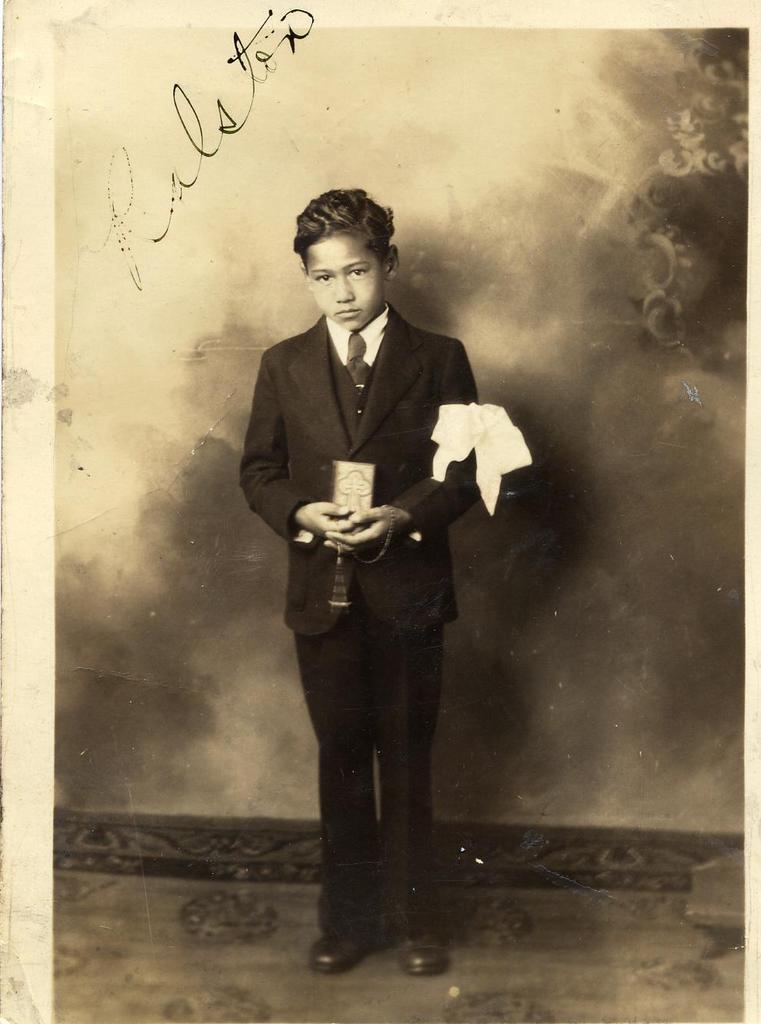
Photo: Young cousin, Ralston Brown, only son of Doritha Charbonnet Brown and her husband Louis. He was 7 when this picture was taken at his First Holy Communion ceremony. Dorita was Dad's youngest sister. Ralston is a jazz drummer who plays in and around the Santa Cruz area and has for many years.

Saturday, May 28, 2005

It's all in the language of change ...

Over recent weeks I've been struggling -- not only with substantive issues like thoughts of giving up my condo in favor of a small studio apartment when Dorian leaves; and just what in the world will I do with all these books that I have no time to read and can't bear to part with? That will work its way out in time, I suppose. What I can't seem to come to terms with, however, is just how long it's taking for me to begin to think of myself as retired rather than simply unemployed? That's a sea change (and what in the world does 'sea' mean, anyway") and one that is purely attitudinal but oh so important. The day I manage to overcome that one I think that life will be far simpler.

Retirement seems more optional. One choice among many. Unemployment is a horse of another color altogether, and carries such negative baggage -- like being idle because you're not wanted anywhere, or, that your skills and talents are no longer seen as necessary to anyone for anything. Now, that's death! Being without meaningful work leaves so much of me unused -- left over. I can't seem to lose my need to be gainfully employed.

Will plan to work on that in the days to come. Retiring in order to write a book seems so much more fulfilling. Less involuntary. Especially if the book is one that no one else can write anyway. That's a calling, isn't it? That says that you're a central character in your own scenario, doesn't it? Maybe if I work on that -- I can make it through the next few years intact.

There's too much of me still vital and whole. I cannot imagine how others deal with moving off stage center while still in good health and spirits. I suspect that the secret may be in retiring early (if and when one can afford to) and looking at these as years for fulfilling deferred dreams. I suppose that's the intention. I just got started too late on my career path and stayed past all the exit signs. Besides, I don't seem to have had any deferred dreams -- all of mine have been aspirations ever unfolding into a continuing sense of future. It appears that I've lived them all and more. The pace has been breathless. I cannot imagine having been given more or that any more living (both good and bad) could have been squeezed into the years.

I just don't know ... but there are moments these days -- when I feel panic. It's subtle, but surely adding to that sense of urgency that comes with aging.

Time has never been more important; maybe to us all in these frightening days of unspeakable violence and death.

Photo: More mountains yet to climb? I was on a climb among the ancient cave dwellings of the long lost Annastazi in New Mexico -- where I found myself suddenly overcome by tears. Killing grounds? Don't know... . (1998)


Been giving some thought to this writing business ...

as a potentially serious author, that is. The keeping of a journal has its appeal I suppose, but one has to assume that an otherwise disinterested public wants to hear what one has to say. That's a big question. It takes a lot of ego to ascribe to that; maybe more than I have.

I understand and appreciate the appeal of Toni Morrison, Alice Walker, Terri McMillan, and Zora Neale Hurston. Their writings describe black life and in many cases in the vernacular of the black experience. I suppose that my admiration for their abilities has prevented me from even considering myself capable of consideration; as being worthy of the title "author." My voice may be so atypical with such an atypical story to tell that there will be no audience wanting to know. A hybrid of the times. After all, I'm still working my way out of feeling as though, racially, I'm nothing. But I've finally decided that, in fact, I'm really everything -- and a wonderful thing to be, after all. At least that's the way I see my beautifully blended grandchildren.

My life experiences are in many ways a mirror of countless other African Americans who are members of the middle class brought up to middleclass mores and values. We're often the beneficiaries of a wide variety of cultures by virtue of mescegination, greater access to socio-political life, and are often placed in positions that allow us to affect social change disproportionately -- if we opt to use it in that way. We find ourselves being sought after to validate racial diversity on boards and commissions everywhere -- often for the simple reason that we're seen as "not like those others." Many of us fall prey to ego by believing that we represent more than that. One of the most painful lessons learned in life as a black woman in white suburbia was that the concept of a middle class black exists only in the mind of a middle class black. To most of the rest of the country, a nigger is a nigger is a nigger! An architect designed home, a backyard swimming pool, a wood paneled station wagon, Armani suits and vacations in Hawaii or Palm Beach do not a member of the elite make, despite arguments to the contrary. Acceptance is invariably conditional.

Perhaps my value and marketability as a writer will lie in the fact that mine may be a relatively unheard voice. Maybe it's one of the voices of the future; a forerunner of a nation forced to write new rules of conduct to cover a country going "beige" with new guidelines created to maintain white superiority in a nation where skin color or lack thereof is fast losing power to control governance; a revolutionary thought, and one that is already bending the rules of the game. There is hope in the knowledge that many ordinary Americans are now beginning to see the fallacy in white supremacy and that its protection cannot be maintained without sacrificing democrary itself.

There are millions of us out there growing up in a world forever effected by the revolutionary social changes of the past 50 years. They've already changed the world for the better, though if you don't know where to look, you won't know that.

One of the exciting signs for me is that when I'm sitting with other elders in organizations like BCA (Berkeley Citizens Actions) or the NIOT (Not In Our Town), I see good folks still working hard to bring about racial equality for all the right reasons. But it's still a goal to be attained at great risk and personal sacrifice. If I cross town to sit in a Poetry Jam at Black Dot or the Alice Art Center, or the Yerba Buena Center for the Arts, young people of every color, racial or ethnic group, gender orientation, economic class, and educational background can be seen with their eyebrow rings, skull caps and baggy pants -- sharing their poetry in a world where those differences have been relegated to a back seat and equality is simply assumed. They're not really working at it anymore. It's called the Hip Hop world, and that world has already arrived. It's standing on spindly wobbly legs like a newborn colt, but it's here. The Internet is giving it strength. The arts are giving it form. And in many ways, I can recognize it because at the Nu Upper Room in Oakland, California, I along with others acted as midwives to its birth. We weren't alone. In many corners of the country it's been coming alive simultaneously -- struggling to be heard above the din of a war that wants to crush them out to still their voices.

It's a matter of stepping ahead with them into a future that they're busily creating. The young know. And, just as that remarkable group of socially venturesome intellectuals and spiritual gurus in the late Seventies and early Eighties arrived in the Greater Bay Area in large enough numbers to establish the Human Potential Movement in the wake of the Free Speech Movement and Freedom Summer of the explosive Sixties, there is now a critical mass of youth doing the same for racial equality, environmental, and criminal justice. It's the magic of the self-fulfilling prophecy. Through its magic the Bay Area has been transformed for the better and been radiating out into the country and the world ever since.

Maybe I'll be worth reading because mine is a voice of hope. I've seen the future in the faces of the young and my only wish is that I could hang around and live it with you.
Maybe -- as a translator of the language of social change over a great expanse of time -- my voice is one of the carriers of history and a reliable predicter of the future.
Maybe because, for whatever reason, I've remained politically and experientially Black despite the seduction of expediency and the quest for personal fortune.
Maybe because I've retained the ability to say and be what I am and what it is with candor and without restraint -- mine is another Black voice to be read and heard alongside the rest.
Maybe because a deviant voice adds breadth and depth to and expands the Black experience .
Maybe this is the time to speak beyond the listeners at my shoulder and in the board rooms before it's too late and time runs out ... and just maybe

this is a gentle way of avenging the cruel enslavement of my ancestors, Celestine "Of no last name," and Leontine Breaux Allen, into whose shoes I've stepped in my time -- by giving them legitimate voices beyond the grave and into the continuum of family and national history.

...and there it is!

My reason to write -- that which only I will have lived and documented because only I have lived their lineage down through all of the drama of all of the generations and into my humble shoes!


But where do I go from here ... ?

Friday, May 27, 2005

Time out in the Marin Headlands ...

The intensity of the past few days of writing demanded a break. I should re-word that -- it's not the writing but the thinking that is so troublesome. The writing comes easily, but with each new fragment upturned there are glimpses into things long forgotten, and when night comes I can feel my jaw muscles begin to relax. Hadn't realized how much energy gets locked up there until they're released ... .

I'd been looking forward to spending all day on Thursday with the board of directors of Ma'at Academy at the Marin Headlands Institute. This is an amazing program designed by its founding director, Sharon Fuller, to bring awareness and educational opportunities to the local minority community around issues of environmental injustice. This issue is of critical importance to Contra Costa County since recent studies show that there are 300 toxic-emitting facilities in the city of Richmond. There are 5 petroleum refineries in Contra Costa County, the most in any area in the nation. Despite the constant redefining of what constitutes a brownfield, this and surrounding cities are awash with them. The statistics on breast cancer, asthma, and autism are stunning. From a speech I wrote two years ago for my former boss, Assemblywoman Loni Hancock of the 14th Assembly District -- the alarming statistic for autism showed a 97% leap in four years and a chilling rise of 634% since 1987 (West County Times, Wednesday 5/14/2003).

Consider that ours is a city with a large population dependent upon public assistance due to joblessness. In order to supplement what foods are available through food stamp programs, a good number of folks still try to grow their own vegetables in small kitchen gardens only to find the ground in which they're grown is highly contaminated by pesticides -- and that serious illnesses came along with nourishment. Much of the bay water is now so contaminated by mercury and other toxins that the fish caught are no longer edible without treatment. The most popular fishing spots sit over what has been long designated as Superfund sites. It's been a major job to get the state to post warnings to that effect; an effort that Ma'at Academy has worked to encourage for years.

The problems of environmental justice are major issues in communities of color. This is true across the country. It will be a growing issue as awareness of the dangers loom larger in years ahead. Ma'at is at the forefront of the struggle to educate the local minority community to the hazards ahead through a variety of approaches, including conducting afterschool programs in the local high schools. It is important work. I'm honored to be a part of it.

It was a good meeting, scheduled to end at four o'clock in the afternoon -- but we were actually on the road back to Richmond by two. It's that "road back to Richmond" that I found so exciting. As we drove up the backside of the headlands -- up the hillside to the cliffs that overhang the ocean side of the Golden Gate bridge there comes into view the most astounding vista that I have ever seen. And that in an area of the world where stunning vistas appear framed by your windshield with such frequency that those of us who've lived here all our lives simply yawn and drive on.

It is only matched by my first view of Mt. Shasta experienced only a short time ago. Maybe it's even better than that, because it brings together the magnificence of nature with the magnificence of human-produced architectural splendor and incomparable beauty! It gives one the best of both in ways that affirm our ability to be a part of creation.

And I knew that somewhere not too far away -- but out of view -- I was about as close to the Farallons as ever I'd been from land -- and that I'd played a part in both the creation of the GGNRA (Golden Gate National Recreational Area) by having served with others on its founding board and that I'd had a role in that remarkable film on the automation of the light on the Farallon Islands that saved it as avian habitat.

I'd just spent the day (for the first time) here where hundreds of school children can be seen with teachers and guides hiking the trails and sitting around in small study groups learning about the environment and biota of this beautiful area. How privileged have I been over time! How wondrous that I've lived long enough to witness the full bloom of those activities entered into so long ago by those of us with little sense of the impact of sitting in those beanbag chairs in Berkeley livingrooms with other dreamers and planners -- drunk with our ability to make real for some future generation the vision of "swords into ploughshares!" We'd just come through Vietnam, after all. It was the drama of our Ann vs. the Department of Interior -- and Ann won the Presidio, the Marin Headlands, and actualized the first urban national park in the nation!

It's possible that there are young people now sitting in trees, around campfires, and working in labs, creating the answers to global warming -- without any idea that their efforts will someday be rewarded in just this way. Each adding their small piece to the whole that will bring an end to the greed of over-consumption, pieces that may slow the melting of the glaciers and the rising of the oceans. Maybe those redwoods will not be lost after all, and some 80 year-olds in the far distant future will know (only in retrospect) that placing their bodies against those chainsaws and hanging banners across freeways really worked.

That's the way it felt when I climbed into bed last night. Those feelings were not stated on the drive home -- it was just that I was filled to overflowing with words that got pressed behind the words that made it out of my mouth! I felt as though I dominated the conversation all the way home by answering every question raised by anyone and holding back on the feelings that were causing my breathing to be shallow and thin and my voice to sound reedy with echoes in my head as I heard the sounds of my far-too-many words fill the van.

I think that Ma'at Academy will be one of those Bay Area wonders that will someday sweep the nation as a replicable model and that those involved will be the elders of tomorrow looking back in wonder.

I won't live long enough to reap the benefits of their work, but at my age I have the ability to see how it all fits together and to try to voice that for those caught up in and discouraged by the hopelessness of the struggles of the moment.

Maybe this describes the progress of civilizations ...

But what explains wars?

Wednesday, May 25, 2005

Endless games of Solitaire ...

After yesterday's post I found myself unable to disengage from the past. For more then 3 hours I sat playing Solitaire; absently, tearfully. For just a while there the lapse back into time caused by the sudden reminder of our anniversary totally blocked out the present ... . Strange. May 24th has slipped by unnoticed for many years now, pushed aside by anniversaries being amassed by time and events more worthy of celebration. After all, that marriage ended painfully long ago, and another had replaced it fairly quickly. Yet, here it was; delivered by a fragment of notepaper from some place deep in my subconsciousness -- and freshened into the present as if summoned.

It was that oddness that I'd struggled with during the years diagnosed as a period of "mental illness" -- that feeling of being out of sync with time and place. Was there some knowing place in me that guided my movements over the past weeks into these old papers? I'm tearful and when not, I'm feeling dry sobs that cause quick intakes of breath from time to time, as if I'm forgetting to breathe... .

One thing is becoming clearer with each new revelation. Those strident lyrics must have come near the point where I was still searching hungrily for strength from outside myself. I was still without a sense of having control of my own destiny. Still looking for my man to deliver completion. For all the brave words in this anthem of defiance, I was still a very lost young woman screaming for self-definition. I was forced to do that in the midst of also learning the hard lessons of racism and irrational societal rejection, and all while trying to meet the challenges of motherhood. The convergence of traumatic events was devastating and had to be vented somehow. Had I not found a way to express the pain my personality might have splintered hopelessly. I had to find a way to travel great distances in such a way that my brain-damaged 3 year-old could cling to my skirt and not become lost. The only possible escape was to move ever deeper into myself.

By virtue of hindsight, I'm beginning to see that the mental break may have marked the point where I came to terms with the fact that the source of all power was internal. Where I stopped looking for completion from outside myself. This may have been the place where I grew up, so-to-speak. The imaginative idealist and deeply-knowing little girl of six reappeared (disguised as psychosis) and took over control, eventually. She'd survived into the Sixties -- a childhood lived in a poor but proud black family during the uncertainty of the Great Depression; an adolescence supported by 2 or 3 imaginative and caring school teachers (that's all it takes, really), and those few remnants of her were still there to save me when the persona that I'd so carefully created to cope gave way. She was the one with the magic and the ability to survive, I truly believe, and still is.

It was at the age of 7 that First Communion training took over and all power was relegated to "God!" That is undoubtedly where the quiet acceptance of male dominance emerged and where I dared not ever even think that a lowly little girl could create anything of note. After all, creating was the province of The Almighty! The concept of Divine Intervention worked against my need to claim my own 'edges;' to know what I could or could not control, create, or define. I'd grown painfully into the ability to assume personal responsibility for my own life. I'd grown out of orthodoxy and into I knew not what, but whatever it was, it was mine.

I wonder if it's really this simple? Could be. For all those reasons and more, I shut that little girl down early in life, though she surely remained in the subconscious and learned to sing Edna St. Vincent Millay's poetry in secret behind the garage at around age 11, and to read Maxwell Anderson and cry with Maria in Winterset; and to pretend the world of Camelot into being when the real world became too painful. I probably shared all that as sins to Father Kelly in the confessional on some misguided Saturday afternoon before receiving Sunday morning communion. What foolishness! How on earth is a child to know?

And now, here she was -- meditating while ironing his shirts ... .

I know that at some point early in life I put a lid on my own spirituality -- my individuality -- and settled for being an appendage to others. That, fortunately, ended when it was no longer sustainable.

I don't think that I can blame anyone for that.

Except maybe those guys at the Masters in Augusta, Georgia, who still believe they hold the keys to the kingdom and the rights to define power (god) in their own image.

Guess you can count me among the uncompromising feminists.

...and how on earth could I have not ended up an atheist?


Tuesday, May 24, 2005

What a find!

Still foraging through these boxes and in the process happened upon two additional verses of the lyric included in the entry of Thursday, May 19th. They include a reference to my young husband, Mel Reid, and some indication of the loneliness that balances off the defiance. It's all there.

the gods (if there be) surely knew in their infinite wisdom
that life's gifts are safer in storms held in branches that bend
trees rooted in earth cradling seedlets of life gone before it
a Woman am I - and the day of my dawning is now!

If I could but know in my soul of these truths I am singing
if he could but show in his living of time that he sees ...
and if we could but grow toward this light that these years might be bringing
this woman could cry - that the day of my dawning is now!

© Betty Reid 6/1961

And today is May 24, 2005. I was married to Mel on this very day in 1942 -- only months after Pearl Harbor and the beginning of more milestones that are undoubtedly stashed here in these papers -- waiting to be rediscovered ... .

It should, but it doesn't strike me as odd that I would have discovered this never-sung, long forgotten psalm on this day. I sit with tears of obscure meaning coursing down my cheeks quietly as I remember him and the innocence of those years, and the hunger for I knew not what ... but that I knew in my heart that he could never fulfill. My suspicion was that no one could because I could neither name it nor recognize its source ... .

Find myself wondering if you've noticed that I was witness to so many of the major social, political, and ceremonial events of my century. I've not really been aware of that until now. It's like knowing the taste, feel, and exact time of the tragic assassinations of the Sixties. All of the affect comes up for me in the act of fingering letters, fragile news clippings, song lyrics, poetry, sketches in margins.

Wish I'd thought to do this long ago ... but I would not be in my years of summation, I think. Maybe introspection takes considerable aging and mellowing before candor kicks in and one can step outside oneself and look back without a sense of involvement except as an observer. Don't think I could have done this before now.

Now back to foraging ... .

Sunday, May 22, 2005

Lost in a reverie of times past ...
Finally took the time to read back into time through these pages. I've been fearful of doing that for fear that I would become self-conscious and the writing would become stilted -- losing spontaneity. This, after all is intended to be stream of consciousness journaling, with no pattern except for whatever the momentum of memory creates. I do see that the words ring with authenticity. Because they're moving freely without needing to honor any prescription, they're providing triggers into the past in ways that bring my own laughter and tears in the writing of them. That's good, I think. Fortunately, I'm a touch typist and the thoughts flow from my fingertips as quickly as they form in my brain.

Decided to try to give some form -- style -- to my "book," in the hope that it might read more smoothly to eyes of strangers who may have expectations that I haven't met. Not sure what to do about that, though.

You'll notice that I've introduced color and type size for emphasis. Nice? Or have I now simply added an element of "cuteness?"

In reading back there is a pattern that didn't show up before in the living of it. I've been defiant all my life, haven't I? Throughout all of the pain and sorrow, the good days and the bad, I've refused ever to yield to mediocrity and/or false promises. I've possessed a remarkable nonsense detector that has sifted everything that entered my brain for what modicum of truth might be there, and tossed everything that didn't "scan" properly. There's been a healthy amount of skepticism that's shielded me from deception, even when I didn't recognize it. And, it truly does appear that I live by my intuition, even when there's little evidence that this was advisable. And, as I grew older, willingness to trust myself above all others has prevailed. Crazy? You're right.

I've been lost in these blue plastic storage boxes now for several days. There is so much there -- notes from experiences that would have disappeared into oblivion had not those scraps been squirreled away in these fading manila folders. Not sure how I can ever organize them into sentences and paragraphs that aren't reductive. Some evoke stories that would make entire chapters in a book, and that defy abridgement.

Since that last post (Thursday?), I've spent many hours wandering around in the past -- remembering events that have become real again, and that are so important in the continuum of this life. I've been hardly sleeping, at least not soundly, waking with new revelations triggered by a scrap of paper with a few sentences jotted carelessly long ago. They flesh out during dreamtime, and become whole again -- with the urgency and potency of the original experience. I pop out of bed, creep to the kitchen to not wake Dorian, and pour myself a tall glass of cold milk ... .

I may need to stop writing for a few days, and just spend time with the photos and writings of old -- not trying to make anything of them until my mind can do the initial editing, leaving me with essences of experiences rather than full-real authors excel and separate themselves from the novices. They've learned to suggest, to imply, to use words as surgical instruments -- coaxing with a few words pictures of entire experiences.
blown replays. I suspect that this is where

Maybe I'm already doing that to some extent ... but I don't really know.

...but I'm beginning to seriously consider the possibility that writing professionally may be my next calling ...

Do I hear an amen?

Thursday, May 19, 2005


New (old) and precious discoveries ...

Organizing my files of yellowed fragile papers is a bit like being reborn. I'm finding correspondence from many now deceased but well remembered; bits of incomplete poems jotted hastily on the backs of envelopes long ago; song lyrics that failed to give birth to music; faded newspaper clippings of feats I'd forgotten long ago but now see as the stepping stones leading to the Betty of now. All demanding that I stop and pay attention. Every scrap leading to openings into a past of all of the women that I am. What a strange, emotionally exhausting, and wonderful process ... .

For instance:

I discovered these notes of something called

Meditation

(while ironing)

The sun glows within me - the wind sings my song
the ebb and the flow of the tides mark my cycle of being
A Woman am I -- and the day of my dawning is now!

I hold deep within me the buds of the flowr's of creation
their blooms ... color all I behold!
with man I have moved throughout time 'roun this Garden of Being
A Woman am I - and the day of my dawning is now!

I've carried within me the kings, queens, and slaves of the ages
I've havened the dreams of the poets and painters and pages
I've borne, nurtured, buried the young ones destroyed by man's rages
A Woman am I -- and the day of my dawning is now!

© Betty Reid, 6/1961

The date on these notes places their origin long before the Womens' Liberation Movement became an irresistible force for change. Prophetic?

I can only imagine very young Betty standing over that ironing board on a blazingly hot day -- dreaming huge dreams of power and rebellion and starved for freedom from life with no access to the depths of herself; trying terribly hard to fulfill the expectations of marriage and motherhood. Can't remember the time of day or what caused such a sense of determination; defiance! It must have been an epiphany that heralded a major life change. If I recall correctly, this preceded the beginnings of what would later be diagnosed as a period of psychosis. In looking back through the lens imbued with the wisdom of accumulated years, I know now that this was surely an unfortunate mis-diagnosis. It did not take into account the impossibility of being sane in a world gone mad.

As a lonely young mother in a failing marriage with a troubled adolescent son struggling with gender identification; two little boys battling valiantly with racism in an all-white world of the suburbs; having to deal daily with rejection from an irrational hostile community because of skin color; and just beginning to come to terms with the growing certainty that my beautiful 3 year-old daughter was born brain damaged and would need a lifetime of constant care. I'm certain now that what was then seen as a mental breakdown was an appropriate response to an impossible set of life circumstances. The mind finds ways to protect itself from what it cannot process. Mine did it through art and music. What could have been more fitting?

That there was undeniable evidence of suicidal tendencies was troublesome, but I was able to move past that crisis and survive. I apparently used it well under the care of a sensitive and caring therapist who -- after months of reassembling my psyche, was able to broaden my understanding of what "normal" meant and to broaden the definition enough to include myself with little alteration. No small feat, that. He gave me the strength to be centered, to stand pat, and to let the world adjust to me. I suppose that I'm still doing that, even as we speak.

I know that the song was never completed since the cadence is rough though I can surely hear strains of the music in my head still, as I read the words and know where the "held" notes are that create the rhythm of the piece and make the words fit into a melodic pattern.

There are many more such works here in these boxes; some that went on to be performed, but many -- as in this one -- never rose above their existence as words scrawled passionately in pencil on fading notebook paper, or in some cases, brown paper bags - then long forgotten.

It's quite possible that in this neglected collection of papers -- moved laboriously in cardboard boxes from place to place over a long lifetime without really knowing why, or even taking the time to open the files to read through them -- are the makings of a book. It could be that mine is a life with universal themes as there are in all our lives; themes that speak meaningfully to other women from other times across many lines of separation ...

Surely there are ironing meditations in the lives of most of us -- even while the chore of ironing has virtually disappeared with the development of synthetic fabrics. Along with them may have come synthetic lives in which the variables must be erased in order to be compliant with some agreed-upon normalcy. Maybe such thoughts now come to us on the stairmaster or while waiting in the SUV in the parking lot of the soccer field -- while we wait for an insane world to adjust to us... .

Maybe ... .

Could it be?

Wednesday, May 18, 2005

So many battlefronts, so little time ...

Met last evening with two dedicated women working hard to find answers to the problem of youngsters returning from incarceration -- most coming back into environments that created their problems in the first place. Both were African American. One is a legal assistant while the other is a long time professional who works with the California Youth Authority. Both are compassionate, bright, effective people determined to take a new look at an old problem, and were inviting me to join with them in that effort. What they want to do is to create a support system for families that will enable them to help their youngsters re-adjust more effectively into home, schools, and the society; a tall order.

It's such a familiar story, and one that re-awakens cynicism each time I hear it. It's such an overwhelming social problem with such longterm systemic causes that I find it hard to stay focussed and pay attention when others raise these issues. My mind wants to opt out in self defense. After all, my own sons are now adults. My grandchildren are the responsibility of their own caring parents, and the issues are now purely academic for me, happily, except when I overdo the grandmotherly worrying thing.

There have been so many enlightening studies done over so many decades now, that one has to wonder why we haven't reacted to those findings and corrected what has to be obvious to law enforcement, the justice system, PTAs, criminal courts, judges, drug abuse clinics, social services, colleges and universities, clinical psychologists, anthropologists, etc. The files and archives of every university library and research laboratory are filled to overflowing with those study results -- all pointing directly to the inadequacies of our justice systems, racism, and lack of the ability to move into the mainstream due to unequal educational opportunities and/or job training. Just how many ways can that story be told? How many more billions of taxpayer dollars will be spent before we move to implementation of those findings? I don't believe it too much of an exaggeration to state that -- if the billions of dollars spent on studies nationwide had been used instead to implement once the causes were revealed, we might have lifted the lion's share of the neediest out of poverty and into the mainstream long ago.

There are days when I'm convinced that those studies are really meant to provide career opportunities for middleclass professionals and were never intended to bring any really significant social change to benefit the poor, the societally abused, and/or the disenfranchised. They get funded, evaluated, then shelved until displaced by a new one that essentially proves the same or similar results, ad infinitum.

For instance:

A couple of years ago in my role as field representative for Assemblywoman Loni Hancock, I attended the annual convention of African American city planners. It was fascinating. The most interesting section by far was the presentation of the results of a study done in Hennepin County, Minnesota. As is true in most heavily populated innercity communities, those imprisoned were disportionately young men of color. The assumption being, of course, that these were largely youth jailed for illegal drug offenses. Not so.

The study found that the place where young black males first encounter the justice system was through traffic court. Yes, and as often as not for relatively minor traffic violations.

Youngsters find themselves facing a fine that they can't possibly pay (maybe $60) so -- because they can't ask their already stressed parent for the money, they ignore the ticket. Next comes a doubling of the fine to $120, then to $240, then after months of fear and worry, they identify with the subculture of those outside the law, a warrant is issued and they're picked up and jailed. Incarceration then introduces them to gang life and a higher level of sophistication in street crime. The alternative is that this is the place where they opt to sell a few grams of crack to get the money and that leads to deeper involvement and, finally, to entering the underground economy feuled by illegal drug sales -- in many cases to supplement family incomes (remember the cuts in welfare benefits?), then for status in gang life, tattoos, or gold chains and proper bling. the spiraling down is tragically traceable; predictable.

As the direct result of the study findings, Hennepin County social services, police department, educators, probation officers, etc., came together to recommend addressing the problems by declaring an amnesty to declare a clean slate and new beginnings while positive alternatives were sought by all for all. They expected a few hundred to turn up and instead found themselves with a couple of thousand! It worked. The pattern was recognized and addressed with workable solutions and measurable successes. Not sure what the status of the problem is at this moment, but it's worth checking to see. Will do.

Interesting?

Wonder how many more effective programs are at work out there?


Given the changes I'm dealing with in my personal life at the moment, I can't possibly take on any major responsibility for organizing around the problems of youngsters returning from the CYA. Besides, I need to return to the work force before I go into total financial meltdown! But I will surely try to work with them at least during the first few organizing sessions -- long enough to try to feed new strategies into the mix and try to change the old conversations enough to breathe new energy into the subject. Maybe, even to spend some time on the web researching other study results that beg implementation. Surely there has been a wealth of work done in many places and under reputable institutions and/or nonprofits.

Besides, now that I'm learning to speak only in declarative sentences, I'm getting listened to more closely (grin).

We'll see.

Tuesday, May 17, 2005


Finally, movement!

With full recognition that I am simply not capable of being case manager, social worker, nurse's aide, policewoman, and returner-of-all-things-to-unsuspecting-mall-merchants -- I made that call. I've finally accepted the fact that the most important role I'll play in my daughter's life is that of superfriend. Only I can be her mother. Having to place myself in the role of disciplinarian and keeper of the checkbook is threatening to our friendship. I need to be the one she can turn to when the world runs out of patience with her. That must be protected against any assault from outside. I need to step back and allow that to be reinstated as of old. If I continue to battle with her over finances and/or anything else, I'll jeopardize our ability to maintain the kind of trust we had before she returned home last year.

Yesterday, as promised, I found the name of that nearby Senior Housing development and emailed it to Dorian's case manager. She will call and try to make arrangements for us to find a way to bypass HUD's age requirements and secure a one bedroom apartment for her. If it works, we may be ready to make the move on the first of the month. She will be less than two blocks away in a safe complex -- where she can reach out to me when and if she needs to -- and where I can give her freedom from the mounting battles over her inability to resist instant gratification.

Under the Lanterman Act funded Regional Center of the East Bay, that agency will receive her SSA check each month and dole it out to her as needed. She will have her finances managed so that her rent will be paid and her monthly obligations met automatically. She will also receive living skills training (as before) to take care of menu planning, cooking, budgeting, etc., and I can go back to more hugging and less nagging!

The state budget cutbacks had so seriously cut into her safety net, that moving her back to live with me was a necessity. She was in an unsafe situation and something had to be done. That is still true, except that where she was living some distance away without support -- she will now be within an arm's length but still protected by oversight when and if needed. She will still be picked up by First Transit (bus service) every day for the trip to and from NIAD (National Institute for Artists with Disabilities), and I can take her to her sports activities on Saturdays. Her program is 5 hours a day 5 days a week, and her life is full and relatively happy. She is doing fine work in sculpturing now, and getting kudos for her accomplishments. Her work is selling well, which benefits both her and the organization (50% split). She feels successful. Now we need to make her independent again.

We do need to get me out of her everyday existence so that she can pick up where she left off in the growing process. As I've said, she continues to grow and learn -- unlike some of those disabled from birth. At this point she's in her late teens. She will need to live to be at least 159 in order to bring her mental age to her chronological -- but we'll settle for a cool 21 any time. It would be nice if she could at least reach the mental age of abstract ability -- an impossibility -- but hoped for nonetheless.

Like so many "normal" folks, she simply cannot project into the what ifs and the supposing thats so will never be able to deal with the relationship between cause and effect. She is totally without the ability to make judgements. But hey, I run into that wall myself on occasion. That's what I'm trying to deal with at this very moment; the confusion and fear of abandonment caused by robbing her of the ability to grow into her own future -- whatever that might be, is the effect that so frightens me.

Having her enjoy a bit of distance may protect her from my unrealistic expectations of her. She must be allowed to find her own level of existence for herself. That may be something that I may never be capable of judging with any accuracy at all. That may take someone from "the world;" the world that I have such a hard time trusting with her life. The living of my own life has left little reason to trust such a world with her future.

I guess that says it all.

Sincerely,

Dorrie's mother (hoping to be superfriend again one day soon).


Photo: Dorian at 19 on her first job tending animals at the Oakland Lake Merritt Children's Zoo. She was living at one of the Clausen House program's nearby, and learning to move about in the community with some assistance and a fine network of guides from that institution. The program worked for her for many years but eventually state budget cuts eviscerated much of that support and we had to adapt to the changes.

Monday, May 16, 2005


At loose ends, and hating it ...

Life with Dorian is filled with problems that beg denial. If I think too much about them, paralysis sets in and I become immobilized. It is so at the moment.

I've still not come to terms with moving her out on her own. The past year has allowed me to see just how vulnerable she is in the world, and made it almost impossible to do those things that must be done to re-establish her interrupted independence.

Yesterday we spent the greater part of the day at the Special Olympics swim competition at Laney College. That world is such an interesting one. It is a culture all its own. Parents, volunteers (young and old), members of the Fire Department, specially-trained sports teachers and trainers who work with the disabled year round come together at these sports events in ways that are so heartening. Each athlete is trying so terribly hard to make damaged minds and bodies come together in the valiant effort to compete without envy or false pride. To watch those faces reciting the Special Olympics oath at the start of the games is to experience innocence at its most poignant. "Let me win, but if I cannot win, let me be brave in the attempt." Each believes this with every breath. It's expressed throughout the day in every way.

Dorian won 2 golds and 1 silver for the 100 in the backstroke, a second in the 50 yd freestyle, and another 1st for 50 ft. backstroke. She was jubilant! But she was equally content in the two other events where she did not place at all. She is now qualified for the state games to be held at the University of the Pacific in Stockton in early June.

Meanwhile, I really do need to deal with our housing needs.

Yesterday after returning from the games I went into the livingroom closet to find something I needed and discovered another brand new sewing machine. Not sure when it was purchased, but I do know that there is an expensive one in storage -- one with parts missing (mostly cords). She cannot sew. She cannot read. She cannot possibly use a sewing machine in any way. Her bank account is again overdrawn. She's now clever enough to toss the packaging and manuals so that it's impossible for me to return the items that she picks up impulsively. The rebellious teenager reigns at such times and I'm helpless to manage events with any wisdom.

In a way I fully understand her purchases, foolish though they may be. In her distorted mind, she has some notion that sewing machines "make things." She has no idea just how that happens, but when she popped into the hobby store to pick up more yarn, there it was -- promising so much. I'm sure that she's been watching one of the sewing shows on television and that the idea was planted there. It's like the cell phone commercials that are so hard to resist always with their promises of "more".

I also found a receipt for $89 for the purchase of more minutes for her cellular phone. The one she bought most recently (and that I didn't return) is one that has no contract attached and for which she buys minutes each month. She has only one (also retarded) friend with whom she spends endless hours in conversation every night. It's an important friendship for them both. I'm guessing that she also speaks with him during the day from her cell. I insist upon her using our Lan phone when she's at home. This means that she may be spending $200-300 a month for those minutes. She is totally out of control and the Regional Center will not give her home assistance unless she's living on her own. That means no budget counseling or restraints.

So now I will log off and make those phone calls to the Regional Center and set things in motion (again) for locating a new living arrangement that will bring with it the essential independent living services that she must have and that are beyond my power to give her with the kind of objectivity that is needed.

It is at such times as these that I seriously consider a tour of duty in the Peace Corps!

More later.

Friday, May 13, 2005

Not In Our Town ... or yours ...

Drove out into the Diablo Valley last night to attend a screening of the PBS documentary, "Not In Our Town, Part II" hosted by the local NIOT organization. It was held in suburban Concord at the community center, and drew about 70 social activists to an evening of soul-searching and introspection. Though the valley is perhaps 99% white, there is a very slowly-growing minority middleclass now in the mix. They're a long way from claiming racial diversity, but at least this tiny group of perhaps 20 socially aware suburbanites are doing their best -- still -- to sensitize their surroundings toward greater acceptance of "others."

It was in the neighboring community of Walnut Creek that my young family lived and where I was radicalized by racism years ago. Some of the dear friends in the audience last night have been actively working for positive change over the past 35 years. They still are my dearest friends. I returned last night because of the strong bonds we've shared for at least that long.

It was a strange evening.

While the original film's focus was based on anti-Semitism and racism aimed at African-Americans and a community's response to it, the central themes have seen a subtle change to focus on gender, primarily. I realized last night that -- just as the womens' movement (feminism) stepped in front of the march of Blacks toward full freedom and equality some years ago -- the same can now be said of gender politics. There were perhaps 6-7 African Americans and about the same number of Asians in last night's audience. When the discussion started after the screening -- it was clear that many of those attending (especially the youth present) were here to deal with crimes against homosexuals. The case of Newark's horrendous killing of Gwen Arejo by 3 young males appears to have attracted the greatest community response. Racial aspects were de-emphasized during the talkback, though the problems were certainly given equal attention in the film. Poignantly, an elderly Japanese man rose toward the end the discussion to speak of his internment in a relocation camp during WWII, but the subject was no longer relevant. Response to him was merely patient and polite. The country's concerns have again become "Euro-centered," and racism has now been relegated to the past as if solutions had been found long ago and mattered little now except to the extent that those issues served to jumpstart other movements.

I found myself in a strange place. I thought that my (expected) contribution would be helping to bring an urban Black perspective to the evening. Why else would I have driven from so far to be here? What happened, though, was that for the first 15 minutes of the 1 hour film I was Black. When that feeling dropped away, while watching the film, I was left with being the mother of a deeply troubled gay son now deceased. The pain of that resurfaced as if it had all happened yesterday -- to reduce me to tears at his loss and outrage at finding myself in a kind of double jeopardy. I was surprised at how powerful the grief continues to be.

We were asked by the facilitator, Hugh Vasquez, to pair up (with a stranger) to talk for two minutes -- uninterrupted -- about our personal reaction to what we'd just seen. I was chosen by a gay man (a physician?), one both proud and articulate. He spoke of his defense of a gay man who'd been returned to the community after serving time for sexual offenses. He was passionate. I was unmoved; still struggling with my own confusion and wondering if I could do this -- or even if I wanted to?

But I did. Though most of my mind was taken up by framing my response while he was making his two-minute declaration of his empathy (and it was that), I did manage to spill out some description of my confusion at trying to deal with racial bigotry and gender crimes simultaneously and how the loss of my son to both was crowding out everything else leaving me with only tears of embarrassment at the inability to crowd all that into 2 minutes even if uninterrupted. The frustration was paralyzing. This stranger reached over to drape his arms over my shoulders in an effort to comfort me as my words trailed away into nothingness... .

Then the floor was opened up so that everyone could speak their minds. The microphone was passed around as each spoke kind and thoughtful words of love and compassion for those less fortunate. Remember, these were liberals gathered in celebration of other communities that had illustrated super-sensitivity and the ability to create proper responses to the outrage of social injustice.

I wondered if I would be able to say anything sensible? After perhaps 20-25 brief comments by these good folks, I finally found my voice, signalled for the microphone and said:


"I'm Betty Reid Soskin. I'm here
out of context. I've driven from 37 miles away -- from Richmond, at the invitation of friends to join with you to view this great documentary. However, if this screening were held in my town tonight instead of here in Concord, at least 40% of this audience would be African/American, perhaps 36% would be Latino, a number of Laotian refugees, and the minority might well be White. Forty-nine percent of their children would have dropped out of highschool before the 10th grade. Most would be lower-income and many unemployed. I find myself wondering how differently the viewing of NIOT would be in such a setting? This film is directed toward the privileged, to those assumed to have the power and the will to discriminate unfairly to the detriment of others.

I've ha
d a difficult time all evening moving between my black self, my mother self, and that part of me that shares in privilege. My eldest son, gay, dark-skinned, and deeply troubled over his entire lifetime -- died a few years ago of societally- and self-inflicted wounds from physical and mental abuse and alcoholism. He suffered countless muggings. He suffered the added burden of being one in a black/white monogamous partnership that lasted for 18 tortured years. They lived with the scorn and rejection of both racists and homophobes who frowned on everything that they were. Both were filled with self-hatred that manifested in an addiction to alcohol.

Were we there, we would have been viewing this film with those who are the
victims of racial and gender bigotry with little need to self-examine their "privilege." They would be the subjects of the crimes with none of the ability to share in the largesse of attitude possible here.

Yes,
I'm totally out of context, and I'm not sure in this moment how to handle that."

In a few moments when the discussion ended, the film's producer-director told me that there was nothing she would like more than to show this film in Richmond. She asked that I speak with her partner to find just how we might arrange that. I will do that. But I'm stuck with wondering just how much interest there would be in this documentary, one so specifically designed to reduce the crime of bigotry in the communities of haves. The problems of the inner city are defensive problems; problems of the have-nots. There is a major problem of internalized hatred (the killer of my son and those like him) that is destroying young Black males in numbers that shake the community to its soul as gun violence continues to escalate on the streets of Richmond without pause or reason.

I can remember hearing someone in a very high position in the state remark that "...there is some logic in allowing these street hustlers to kill each other off without interference by the police. It saves society the costs of trials and imprisonment." It's my suspicion that there are members of the police departments who echo those feelings and act on them. That these young lives are marked by self-hatred learned at an early age from the damning attitudes of the greater society; attitudes reinforced daily in the schools, on the playgrounds, and on the streets of the inner cities of the country are of no concern. I'm ashamed to admit that I stood in stunned silence, unable to find a reasonable response to my friend's telling comment; embarrassed for him, but allowing his awful words to stand unchallenged. How many times has this happened to us all?

Maybe that's a genre of filmmaking that needs to be explored -- but that presents a different order of problem -- one every bit as destructive as the examples we saw last night on the screen of the fire-bombing of a Jewish synagogue in Sacramento, the murders of two honored and much-loved gay men in Redding, the burning of a cross on the lawn of an African-American mother in Anderson in Shasta County, and the unbelievably brutal beating death of lovely young transgendered Eddie "Gwen" Arejo in Newark.

The destruction of human lives through internalized hatred may be one of the most important unexplored issues of our times.

How on earth does one go about examining doing that through film?

Wednesday, May 11, 2005


Cleaning out the cobwebs of the mind and the bright blue plastic storage boxes ...

After writing about the Colorado Springs encampment, I recalled that a few years ago I'd read a description of the event in the Starr King Journal on the occasion of the death of Jim Stoll, a minister deeply connected with that summer's activities. After making that entry here, so much began to come up for me in relation to it that there was nothing to do but stop everything and try to locate that edition so that it could be shared here. That meant sifting through papers long packed away for "someday." Anyone who's ever gotten themselves into "trunk in the attic" mode can attest, there's no way to do that except slowly savoring every old/new discovery. Unfortunately, I've not yet run into that journal but will keep looking.

Ran across a yellowed script from "Farallon Light," the master's thesis of Charles Peterson of San Francisco State University. Here were the stills from the 30 minutes documentary and the narration with places marked for music -- written and performed by Betty Reid (before Soskin). I remembered how exciting that had been, and of how serendipitously Peterson's wife happened to be in the audience and heard me perform in a concert at Sacramento State that year. "You're singing my husband's footage," she'd said, and after some conversations with Peterson later that week, I'd made my way to the sound studions for the taping and inclusion in this prize-winning film.

That year (1971) it won prizes at the Atlanta Film Festival, another at Montreal, at the San Francisco Film Festival -- after coming in first at the university's spring festival of that year.

Spent much of the past few days trying to locate a copy of it somewhere in the world. Called SF State, the Unversity of California, Berkeley Extension Division (I'd learned that there was a copy in their catalogue at one time.

Then remembered that one day when I visited the Lawrence Science Museum with my very young granddaughter, Kokee; as we walked down the hall toward the theater -- I could (unbelievably) hear the sound of my own voice singing! We entered the dark and empty theater to see Farallon Light being shown on the large screen. It was eerie. It had been years since I'd performed the work. I knew that 6 year-old Kokee could hardly appreciate the fact that her grandmother was related to any of this in any way, so I simply sat there in the dark and marveled at this miracle. David, my youngest son and her father, was still in his teens when this was written and performed. She would not be born for many years. Yet, here we were, together at the museum high in the Berkeley hills -- sharing my music in this remarkable film. That was the only the second time that I'd seen it. The first time was the night of it's premiere at S.F. State many years before.

That brings us to today. I've still found no way to trace this lovely piece of personal history. Would love to own a copy for my children (who know nothing about it, incidentally) and theirs. As an artifact of my life and legacy it's now important to me. It came into being from the secret life of the artist, Betty, who lives only in those years of transition -- that later produced political activist Betty. She was fragile, vulnerable, and probably created art as a defense against a world far too complex and cruelly paradoxical to cope with. Art was the escape valve. I feared that any product coming from that inner place was little more than symptomatic of mental illness. Such a pity!

The important facts are: Title: "Farallon Light," from Altair Productions, San Francisco; Filmmaker Charles Peterson; music composed and performed by Betty Reid; Year of release, 1971.

Any ideas?

I'm fearful that Peterson may no longer be alive. I find no trace of any further work when I search the Internet. I do have friends in media who may be able to help me to find it, but after so much time has elapsed, I'm not sure that's any longer a possiblity.

So saying, I'm knee-deep in papers and souvenirs of my past -- with a paper shredder at my elbow and a strong intention of tossing anything that doesn't cause the hair on nape of my neck to rise!

Good thing is that lots of life has freshened while I tossed and some of the anger that was surfacing last week will be transformed by some of the truly wonderful and rich periods that were interwoven through those years. Today I feel soft and yielding -- and reasonable. But that promises to last only until the next outrage from Washington surfaces.

Now I need to call my representatives and try to do something about Bolton!