S.F. Bay Cruise with LaborFest -- big union event and a return to the "Being of the Reluctant Rosie" ...
A few weeks ago I accepted an invitation for a cruise on the Bay. I didn't realize at the time that this will involve union folks, historians, union people interested in the new national park, two other Rosies and moi. Learned of my "star" status when I ran across a flyer advertising the event.
Am having the usual mixed feelings about playing this role, but it's becoming less awkward for me -- and provides an opportunity to get folks to re-visit that period of history with the benefit of having now lived with the enlightenment provided by the social revolution of the Sixties. I've become a rather important part of the truth-telling brigade that may keep us from forgetting some important and painfully learned truths.
When will I ever have a chance, again, to spend 3 hours with members of previously segregated unions? Most of those I'll see tomorrow and interact with might have no idea of the nature of human relations in the workplace during WWII and, for some, the years following. Perhaps their unions are still not welcoming to non-whites (only more cleverly manipulated) -- and if only one or two can gain some understanding of and appreciation for a time before laws were changed and access won -- the afternoon will be worth the time taken.
Besides, I'm beginning to get a kick out of carrying this particular torch. And mostly because I find so few able or willing to express those painful truths. We do have a tendency to paper over the troubling parts of our past -- thereby risking the probability of having to relive that which we should have grown beyond long ago in some systematic way.
Am still very ambivalent about unions and the Labor Movement ... even when I have no idea what we could possibly have done without them. But the rank and file, after all, reflects all of the best and worst of the general population. It's easy to forget that in our zeal to add our voices to the Progressive power bloc, we may not be taking the necessary time required to consolidate our gains as African Americans. I sense that -- in this struggle for economic power and social equality in the time of yet another war -- something precious may be in the process of being lost.
This opportunity to raise important questions -- even when the answers remain beyond reach -- is one I shouldn't under-estimate; and I don't. Having a chance to do that on a Bay cruise on a lovely summer day is beyond expectations.
Saturday, July 16, 2005

Friday, July 15, 2005
Death and the aftermath ...
I'm not sure that I have ever experienced such a long spell between entries. Not sure why that is, but this is not the best of times. So many changes to morph into some kind of undetermined future.
The events surrounding the death of Marionella churned up so much that I thought was buried forever in the past -- but, no. Despite the fact that most of those with whom I shared the early years have now passed on or are surely in no shape to wield hurts of any kind. Still, there is this corrosive quality that lingers on through the epochal events like funerals that brings one's past back in living color. It was like that. It's this intimately-connected but still distant collection of relatives who come together now only in these occasional "snapshots" provided by the need to memorialize one or the other of us whose life has now ended.
Despite triumphs over adversity and monumental problems overcome, in the chapel at St. Elizabeth-Seton Catholic church in Pleasanton on Wednesday morning all the good stuff was stripped away by the service (being conducted by our family priest of long standing -- someone I grew up with), and the vastly changed faces from my childhood of children now grown old. There I sat -- feeling all of the inadequacies I'd lived as a kid -- never quite being enough or doing enough or just not being enough like those around me. Long before I learned that it was really just fine to not fit the mold and that being different wasn't a punishable offense.
I suppose one of the reasons the loss of uncomplicated loving Marionella was so disturbing was that she was the non-judgemental open and warm kin who one never had to explain or apologize to or be anything more or less than one was. She asked only that. Her love and loyalty were unconditional. She gave so much. She's gone. Life will fold in around that fact and we will go on; of course. That's the process. Until the change comes that will take me with it... .
But now it's back to packing and storing and preparing for another huge change. Dorian is moving away, back into her own precarious life again; the life of the mentally disabled. I will busy myself with the physical parts of that and postpone the disturbing thinking parts until later on when I can give myself over to it fully. I'll then cry some and celebrate some, I'm sure. But between those extremes there will be a recurring of fears about her safety in an explosive world where innocence can be fatal to her survival. That's the big stuff. The small stuff is just where in the world can I cram all of her belongings now scattered around my condo into one small bedroom across town? If I can stay with that, I'll make it through the next few days.
Then it's back to work at the National Park Service in a week or so and back to weekend trips to Mendocino to his beautiful home at oceanside and sunsets and art shows and concerts and allowing my woman to rise above my mother -- before it's too late to bring her out again into the world.
Lots to juggle, isn't there?
But then when was there ever not ... ?
I'm not sure that I have ever experienced such a long spell between entries. Not sure why that is, but this is not the best of times. So many changes to morph into some kind of undetermined future.
The events surrounding the death of Marionella churned up so much that I thought was buried forever in the past -- but, no. Despite the fact that most of those with whom I shared the early years have now passed on or are surely in no shape to wield hurts of any kind. Still, there is this corrosive quality that lingers on through the epochal events like funerals that brings one's past back in living color. It was like that. It's this intimately-connected but still distant collection of relatives who come together now only in these occasional "snapshots" provided by the need to memorialize one or the other of us whose life has now ended.
Despite triumphs over adversity and monumental problems overcome, in the chapel at St. Elizabeth-Seton Catholic church in Pleasanton on Wednesday morning all the good stuff was stripped away by the service (being conducted by our family priest of long standing -- someone I grew up with), and the vastly changed faces from my childhood of children now grown old. There I sat -- feeling all of the inadequacies I'd lived as a kid -- never quite being enough or doing enough or just not being enough like those around me. Long before I learned that it was really just fine to not fit the mold and that being different wasn't a punishable offense.
I suppose one of the reasons the loss of uncomplicated loving Marionella was so disturbing was that she was the non-judgemental open and warm kin who one never had to explain or apologize to or be anything more or less than one was. She asked only that. Her love and loyalty were unconditional. She gave so much. She's gone. Life will fold in around that fact and we will go on; of course. That's the process. Until the change comes that will take me with it... .
But now it's back to packing and storing and preparing for another huge change. Dorian is moving away, back into her own precarious life again; the life of the mentally disabled. I will busy myself with the physical parts of that and postpone the disturbing thinking parts until later on when I can give myself over to it fully. I'll then cry some and celebrate some, I'm sure. But between those extremes there will be a recurring of fears about her safety in an explosive world where innocence can be fatal to her survival. That's the big stuff. The small stuff is just where in the world can I cram all of her belongings now scattered around my condo into one small bedroom across town? If I can stay with that, I'll make it through the next few days.
Then it's back to work at the National Park Service in a week or so and back to weekend trips to Mendocino to his beautiful home at oceanside and sunsets and art shows and concerts and allowing my woman to rise above my mother -- before it's too late to bring her out again into the world.
Lots to juggle, isn't there?
But then when was there ever not ... ?
Wednesday, July 06, 2005

Revelations ... and a re-examination of a nation's twisted psyche ...
A very dear member of my family left the earth at the end of the day on the 4th of July. This was one of the dearest women I knew. The world is a poorer place without Marionella LeBeouf Cobette (an Allen-Breaux descendant).
As is more and more true in these final years, her death was a grim reminder of how much work there is still to be done before my time arrives. As one of the unofficial holders of the family history, it becomes ever so important to try hard to use the time well and to leave a legacy of truth for others to build on in years to come.
Over time I've done fairly well with researching both my maternal and paternal lines and it's all fairly neatly stored in two large binders -- with maps and photographs and artifacts that help to tell the stories.
The lineage has been traced from two who entered the country several centuries ago: My maternal ancestor, Vincent Breaux who left Loudon, France, in 1631 with an early wave of the Acadians who traveled over time to Nova Scotia, then to Maryland, and finally being permitted by the Spanish (who held Louisiana at the time) to settle in St. James Parish, Louisiana. Then there was my father's earliest traceable ancestor, Raimond Charbonnet, who started in Thiers, France, born between 1646-1649 and married to Gabrielle (Dutuel) Charbonnet. For both I've been able to document all the way up to my own parents, Dorson Louis Charbonnet and Lottie Allen Charbonnet. But all roads lead at one point to the slave curtain, 'til now impossible to penetrate.
The French Catholics have kept great records that came alive for me through church documents. There was lots of help from other researchers such as "cousins" Clarence Breaux of Louisiana who provided 26 generations along with Prof. Robert Brault (note German spelling) of Canada with whom he wrote his book on the Breaux family. There was also researcher Ken Jenkins, an architect at Louisiana State University. His wife's family, Charbonnet, intersects with mine far back in New Orleans history. Her line is white. Mine veers off in the early 1800's when there was a liaison between a white Charbonnet and a "Free Person of Color" with whom he had a lifelong relationship that produced eleven children -- one being my great great grandfather, Dorson Louis Charbonnet, Sr.
Ken Jenkins says in a letter:
"The Charbonnet story is such a great one - wish we knew enough to publish. It has the French-Indian War, French Revolution, slave revolt in Santo Domingo, War of 1812, Gone-with-the-wind Plantation, in-marriages with French - Spanish - African American - Canary Island - and American families. It has prisoners of war in Canada and the Civil War - people serving in the Creole Militia - Free People of Color - Old French Family arrogance - lost love, lost chances, lost fortunes ... Judges, Admirals, Street Car Conductors ... and hint of lost French Royalty."
But the above serves only as a prelude to the emotional time I spent yesterday afternoon. In the wake of my cousin's death I decided (finally) to try to break the barrier on slave ancestors. Where were they from? From which African tribes? To whom were they sold? Until her death in her mid-nineties, my mother's sister, Vivian, told stories about her great grandmother, Celestine, whom she remembered well. She was called "Mom" and (according to Vivian) walked along the levee with a long pole (like the herders among the Masai?). I knew that she and her daughter, Leontine, (my great grandmother) spoke only French and rarely wore shoes except on Sundays -- and that Mamma (Leontine) would bring out a tiny pipe from behind the stove every evening after everyone else was in bed in that tiny cabin on the banks of the Mississippi. Little girl Vivian would be allowed to fill it with tobacco and "tamp it down" as an honored privilege. I remember Mamma (Leontine) who lived to be 102 and died when I was 27 years old. (Her story is told on our family web site -- link provided on the left -- under California Black Pioneers.)
Revisited a site I'd not seen for a long time -- AfriGeneas -- a web site created by Vivian King Nelson et al established at the University of Mississippi to provide the tools for African American researchers to trace their ancestry. I'd tried years ago to break through the slave curtain but gave up after a time. They've now added the slave records, narratives, Freedman's Bureau, countless new archives to work through -- to what was already a very rich resource. It was those records that I spent the afternoon going through looking at slave ship manifests for clues to Celestine's early journey. I had little to go on, only the name. Church records at the Catholic Diocese at Baton Rouge had her listed as "Celestine of no last name." I'd always found that fact strangely comforting in that she must have refused to take the name of her owner. But that was only true until her marriage to (Cajun farmer) Eduoard Breaux in 1865, just after the Emancipation Proclamation was signed.
Until yesterday I'd assumed that those ship's cargoes were carrying slaves from Africa but it didn't take long to realize that this was no longer necessarily true. By the years 1800 through 1840 (the period covered in the slave records) slavery had been in effect for over 200 years. The names listed in those manifests were several generations later than the original "cargoes." What was shocking to me when I was able to internalize it -- was that a large percentage of these people were described as mulatto with brief descriptions beside their names (mostly first names, only). They are listed as tawny, yellow, black, brown, light tan, very dark brown and almost white. I was surprised at the ages given, few were over 35 with most in their late teens and early twenties. They were so young. There were many described as suckling mothers. There were also many of children of all ages.
These were not ships unloading their human cargo from across the ocean. This was slave stock being shipped as a part of interstate commerce. They were being transferred as an inheritance from some slaveowner's will to heirs living elsewhere in the South. They were simply property - chattel -- being moved around the colonies and perhaps to and from the Gulf Coast islands.
It was chilling to read on the AfriGeneas website encouraging words about the need to stick with the search despite the difficulties, "...remember that slaves were currency. Follow the money. They'll show up in wills and as capital in estate sales; in bank records. They will be traceable in the family bibles of owners." All true.
But the most shocking of all was the moment when I realized that 200 years out, the reason that there were so many mulattos listed was due to the fact that slave owners used their own sperm to boost their holdings. Is what I was seeing in those records proof that men were literally selling their own children and grandchildren? Is this the ugly secret that's so hard for this nation to face? Could this be the reason that we've not yet recovered completely from the scars of the Civil War? Two hundred years out, there was little reason to continue to import slaves since the nation's slave owners were creating their own slave stock. The utter callousness of such a practice is hard to accept, but if we're to think of slaves as currency, what other conclusion can be drawn? I would urge anyone reading this to visit those web pages and read through those descriptions for yourself. If you draw different conclusions, I would be most interested in hearing from you.
I'd read only recently in a biography on George Washington that he'd often paid his gambling debt with slaves. We're all by now familiar with the schizophrenic writings of Thomas Jefferson on the subject of black inferiority despite the liaison's both his father and he had with Sally Hemmings and her mother.
I didn't find Celestine among those listed in the ship's manifests. Not anyone by that name. Not sure where to go from here. Nor did I find the name of her owner, the Breaux. This may mean that it was not she who was brought through the Middle Passage -- but her parents, or theirs, sometime in the 1600's. As Aunt Vivian described her, she was a mulatto (one white parent). Since she was owned by a family into which she later married, it's unlikely that I will find her on the manifest of any ship.
What a way to spend Independence Day. I came away from the AfriGeneas pages feeling a singular part of it all; a descendant of slaves, slave owners, several veterans of the New Orleans Militia, of a French naval officer who fought in the Haitian Revolution, a white general and an admiral in the Civil War, and related to both the brutal shame of and the ultimate victory over slavery that my family and those like it present to the world. Indeed, "...one nation under God."
And here we are on this Independence Day, seemingly more "under God" than ever and I have absolutely no idea what to do with the obvious paradox, or just how to reconcile our cruel history and our current expressions of brutality with our professed religious beliefs; beliefs for which we are apparently willing to fight, kill, and die, but by which we will not live.
Take the time to visit those slave records and draw your own conclusions. It may be that we're ready to have this conversation, and that some resolution will come in our time.
Hoping that your's was a thoughtful holiday filled with family and friends. Ours was sad with the loss of a dear one, but well spent remembering.
Marionella LeBeouf Cobette
(1925-2005)
(1925-2005)
would have surely wished all "cousins" a blessed and loving day of celebration in her gentle way of loving unconditionally. The country and the world could use more of that.
We will miss her ... .
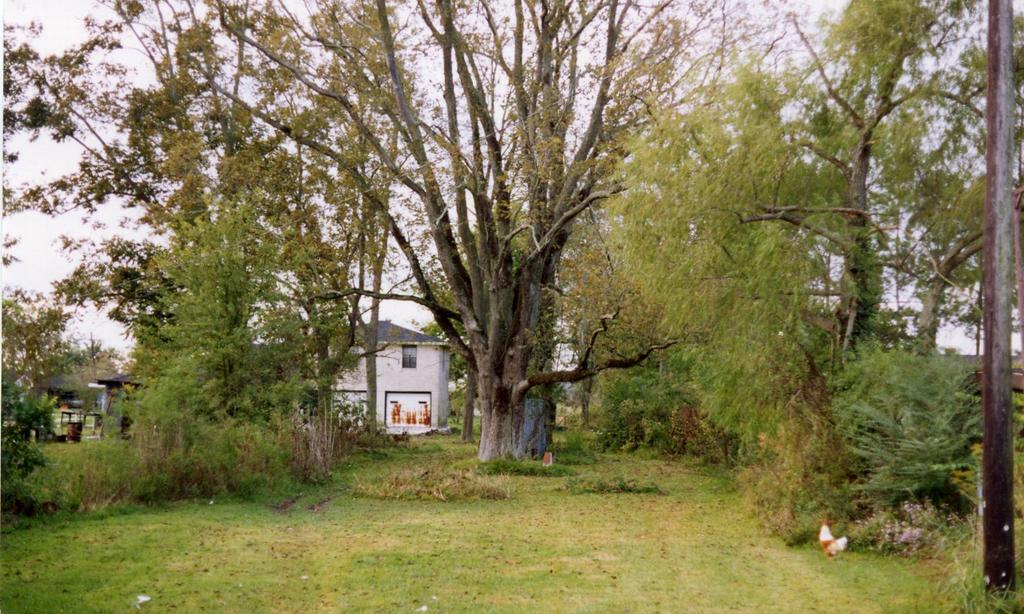
Photos: Left is a picture taken in 1944 by cousin Janet Duncan -- it's the site of the Allen (Breaux) Cabin in Welcome Post Office, St. James Parish, Louisiana. The cabin had burned down, accidentally some time in the Seventies. Only the land remains.
The second is a plantation map showing the Breaux Plantation among others. All front on the river and meet at the levee. Mammá's small site was left to her mother, Celestine, by Eduoard Breaux, her (Cajun) legal husband and the plantation owner. Mammá lived in that little house until her death in 1948, surrounded by her brood of children, grandchildren.
Friday, July 01, 2005
Back to the "nine to five," and timed just about right ...
The formal call came this morning announcing that paperwork is being completed and that I'm to start work (officially) on July 26th at the offices of the new National Park. Couldn't come at a more auspicious time since -- in that way my life has of converging in strange and interesting ways -- my interest in working with kids; with the environmental justice issues; the upcoming Richmond centennial events; are all providing the opportunity to help to shape this NPS monument to the history of my era. What a fine opportunity to influence change. Is anyone more blessed?
Only problem is that my very brief consideration of becoming the next Toni Morrison may have been harpooned before it ever got launched. Writing for me tends to take a back seat to acting out my principles more directly in the political arena. Maybe blogging is about as far as I can take this flair. But perhaps not. Having given the possibility considerable thought now, maybe I can do it all.
To add to this strange timeliness, all decisions about Dorian's future have been decided (one of those meetings that bunched up on Tuesday) and she will be moving into a group home on August 1st. The painful transition will probably not be that at all, but a time of excitement for us both. It was her appeal (in a fit of pique) to her case manager that brought us to the point of decision, so she has the feeling of having guided her own future -- the system responded to her wishes. She's moving away from me. She displays no signs of feeling pushed out onto her own for having failed in our ability to live together. That's important. She's just moving on because it's her wish to be out in the world again as before.
This time she won't be truly on her own, but will be in a program called Harmony Homes, a vendor of the Regional Center of the East Bay -- supported by Lanterman Funds, and an entitlement for the mentally disabled. She will share an apartment in a pleasant and safe area of El Cerrito with another young woman like herself -- in a four-plex that houses several such pairings. She will live no more than about 8 minutes away from my apartment. Harmony House staff provides oversight and training opportunities. She will continue with her 5 day-a-week arts program at NIAD and Special Olympics (year round) and is as happy as a clam to be moving into semi-independence. Her money will be managed by the Regional Center, giving her an allowance each week and saving her SSA balance in an account she cannot access without agreement by her workers. We're both in heaven!
I'll now have my own life back to do with as I will. May still need to consider marketing my condo and moving to a smaller rental somewhere, but I'll remain in Richmond for the foreseeable future.
This is all proof that there's little reason to always be pushing the river. If allowed to, life does have its way of smoothing out the rough spots if given half a chance to just lie back and drift downstream from time to time.
And the bonus is that the NPS sounds as delighted to have me return as I am at the prospect of doing so. The contract will run through to October 1st and then we'll be back to decision-making time again, but the choices will have changed and I may be far more ready to hang up my Palm Pilot than before. We'll see. Maybe that's when I become, belatedly, an author of note. Maybe that's when being restfully idle will feel more like retirement and less like simply being unemployed.
(Submitted one blog entry to an e-newspaper at the suggestion of a friend, and am waiting to see if there's interest in publishing it. That will give some idea of whether writing is in my future. Oh, and while I was at it - I also forwarded it to Weekend's All Things Considered on NPR. Maybe Scott Simon will find it of interest. Did that on a whim, and since there's an element of time sensitivity to it -- it just may die for just cause. Given the ease of communicating by Internet -- "whims" have gained new importance. I just file them under "and why not?")
The formal call came this morning announcing that paperwork is being completed and that I'm to start work (officially) on July 26th at the offices of the new National Park. Couldn't come at a more auspicious time since -- in that way my life has of converging in strange and interesting ways -- my interest in working with kids; with the environmental justice issues; the upcoming Richmond centennial events; are all providing the opportunity to help to shape this NPS monument to the history of my era. What a fine opportunity to influence change. Is anyone more blessed?
Only problem is that my very brief consideration of becoming the next Toni Morrison may have been harpooned before it ever got launched. Writing for me tends to take a back seat to acting out my principles more directly in the political arena. Maybe blogging is about as far as I can take this flair. But perhaps not. Having given the possibility considerable thought now, maybe I can do it all.
To add to this strange timeliness, all decisions about Dorian's future have been decided (one of those meetings that bunched up on Tuesday) and she will be moving into a group home on August 1st. The painful transition will probably not be that at all, but a time of excitement for us both. It was her appeal (in a fit of pique) to her case manager that brought us to the point of decision, so she has the feeling of having guided her own future -- the system responded to her wishes. She's moving away from me. She displays no signs of feeling pushed out onto her own for having failed in our ability to live together. That's important. She's just moving on because it's her wish to be out in the world again as before.
This time she won't be truly on her own, but will be in a program called Harmony Homes, a vendor of the Regional Center of the East Bay -- supported by Lanterman Funds, and an entitlement for the mentally disabled. She will share an apartment in a pleasant and safe area of El Cerrito with another young woman like herself -- in a four-plex that houses several such pairings. She will live no more than about 8 minutes away from my apartment. Harmony House staff provides oversight and training opportunities. She will continue with her 5 day-a-week arts program at NIAD and Special Olympics (year round) and is as happy as a clam to be moving into semi-independence. Her money will be managed by the Regional Center, giving her an allowance each week and saving her SSA balance in an account she cannot access without agreement by her workers. We're both in heaven!
I'll now have my own life back to do with as I will. May still need to consider marketing my condo and moving to a smaller rental somewhere, but I'll remain in Richmond for the foreseeable future.
This is all proof that there's little reason to always be pushing the river. If allowed to, life does have its way of smoothing out the rough spots if given half a chance to just lie back and drift downstream from time to time.
And the bonus is that the NPS sounds as delighted to have me return as I am at the prospect of doing so. The contract will run through to October 1st and then we'll be back to decision-making time again, but the choices will have changed and I may be far more ready to hang up my Palm Pilot than before. We'll see. Maybe that's when I become, belatedly, an author of note. Maybe that's when being restfully idle will feel more like retirement and less like simply being unemployed.
(Submitted one blog entry to an e-newspaper at the suggestion of a friend, and am waiting to see if there's interest in publishing it. That will give some idea of whether writing is in my future. Oh, and while I was at it - I also forwarded it to Weekend's All Things Considered on NPR. Maybe Scott Simon will find it of interest. Did that on a whim, and since there's an element of time sensitivity to it -- it just may die for just cause. Given the ease of communicating by Internet -- "whims" have gained new importance. I just file them under "and why not?")
Thursday, June 30, 2005

Poor Bill Cosby ... he may have stayed too long at the Fair...
Watched the Night Line interview last night of the meltdown of a man we've all admired for so long. He did his awkward rambling boorish lecture before an audience in St. Louis -- an audience of poor black folks he's been verbally chastising publicly to the embarrassment of so many. I wanted to turn off the power -- actually did mute the remote several times as I watched him in an unbelievable show of insensivity -- stupidity! He's a man out of contact with himself as well as the rest of us, I believe. I can imagine that his wife and daughters are cringing in horror at the sad spectable he's become. Unfortunately, his celebrity lends weight to his words as it lends power to the political conservatives who preach the old "pull yourselves up by your bootstraps" mantra to those poor souls without boots. I can see in my mind's eye the likes of Thomas Sowell, Clarence Thomas, Armstrong Williams, et al, rubbing their hands together in absolute glee! How tragic!
But I felt compassion for him before it ended (unexpectedly) and so wanted him to abandon the rest of his tour, one that will bring him to Detroit, Cleveland, Gary, and other innercity hot spots where he will preach to those living in the projects and on the margins of society about the virtues of coming together to confront their "sins" and "turn in their children to the authorities instead of turning a blind eye to the evils" of what he sees as "self-inflicted poverty and shame." How he could not be aware of the complexity of the issues he so blithely prescribes for is baffling. His life of relative ease and exposure to the thinking of the mental health professionals he surrounded himself with in the old Cosby show days should have produced more than the simplistic old bastard showing off his ignorance before a puzzled audience of just plain poor folks -- and a national audience that deserved more from an old and admired friend.
How I wish dear Camille Cosby could reel in her foolish husband, the old reprobate with a checkered past of his own, apply a tight gag over his foul mouth, and tie him to his rocking chair before someone does it for her!
He was the prime example of the old adage that money can't buy everything.
Photo: Newspaper pic of football great Jim Brown, Pat Meyers, comic Bill Cosby (very young Coz), Cleo Jackson, Muhammad Ali, my niece, Victoria Jones (Charbonnet-Allen-Breaux-Balugo), and above her, pro basketball player, Bill Russell.
 All dressed up with nowhere to go ...
Received an eleventh hour call late on Monday evening advising that the event with the Lighthouse Charter School had to be rescheduled due to the inability of some of the out-of-staters to get flights that would bring them here in time. It was fine. New date is August 26th with a larger body of participants than before.
As it happened, I was already trying to accommodate two other commitments into the same day and the squeeze was taking its toll on my sanity. The old "feast or famine" analogy is most fitting at moments like this.
Met on Monday evening with the board of Ma'at Environmental Youth Academy -- out of which grew some rather exciting new possibilities that brings together several elements of my life.
The new national park (Rosie the Riveter), where I will be working again come July 26th is still "under construction." As you may know, the mission of the National Park Service is to tell the story of the nation through its structures. The Park does not own properties but partners with foundations, civic governments, etc., to develop its urban parks.
It was decided by those so charged with that responsibility -- that the story of World War II was best told by the Kaiser Richmond "ruins" that line the shoreline. Much of what is still standing is in one or another state of decomposition -- not by choice but through abandonment and neglect. After the war ended, those who created this powerful machine of war walked away leaving the ghosts of structures to rust away into infinity without interference.
There were originally 5 Kaiser yards in Richmond. The city's Redevelopment Agency has since totally replaced Kaiser Shipyard II with an impressive housing development (a gated community), public parks, the Bay Trail segment, plus the Rosie the Riveter Memorial. One sees a lovely marina filled with sailboats and catamarans, and rows of luxury boats moored in the marina waiting to be launched for trips to Angel Island, Sausalito, San Francisco, Emeryville, Vallejo, and the southbay. Makes for a slick brochure for the Chamber of Commerce's marketing to potential developers.
But just at the edge of that lies Kaiser Shipyard III which is still a working port surrounded by the ghosts of WWII -- the SS Red Oak Victory in the process of restoration lies against the dock; the old Ford Assembly Plant that put together tanks for shipment to the South Pacific war theater sits at the end of Harbor Way in the process of a multi-million dollar restoration; the huge cement "bunker" where all of the supplies were stored that filled the holds of ships just before sailing off into the wars; the machine shops (newly restored and serving a new purpose), the old Whirley Cranes; and the bays where the ships were built in drydock then launched with great celebrations upon completion. There are the remains of the Kaiser Field Hospital and the buildings that housed the cafeteria that fed workers round the clock and the childcare centers. It is still possible to see war housing stock left over from the period in Nystrom and Atchison Villages -- and two 24 hour-a-day childcare centers that Kaiser initiated as the first of its kind in the nation.
All of these sites have become elements in the Rosie the Riveter Homefront Historical Park -- a driving tour that covers several miles. The interim reception center at city hall holds the archives, the library of collected relevant materials for researchers, artifacts collected from Rosie's across the country as the result of a national campaign a few years ago. It has a growing collection that has brought out of old trunks and attics the personal stories of thousands of Rosies both in oral histories (videotapes) and through letters from those who lived them. It is already an active and alive park with a growing number of visitors each day. The permanent NPS Reception Center has now been funded and will eventually be housed in a large area set aside in the historic old Ford Assembly Plant building, the reception center in planning stages.
Over the past several years I participated in the sessions that designed the park and its planned building uses along with historians, architects, city planners, park superintendents, marine engineers, etc., from across the country. But at the time I was working as a field rep for a member of the state Assembly. Now I will be working directly with the NPS in an entirely new phase of the park's development. Exciting work.
But back to the present: Learned on Monday at the Ma'at board meeting that the assemblymember (my former boss) is interested in sponsoring the creation of an environmental center for young people somewhere in Richmond. She has located the funding for it, and is ready to explore possibilities. The Ma'at executive director was contacted and there is need to move on to find a location and to begin the planning.
Any one of the old Kaiser sites are the natural choices, I believe. This brings together my Ma'at Academy interests with the new position involving community liaison work between the city and the NPS -- with any leftover influence that may still be recoverable with the state. Makes for some exciting possibilities, right? These are embers worth breathing on -- maybe a small flame here or there will flare up into a brilliant new adventure. It may mean simply bringing together those who can facilitate the next steps. And -- as has been proven over and over again throughout my life -- if you don't care about who gets the credit, all things are possible. This may be another of those times when I get to make a hero or heroine of someone else.
That's one under-rated thrill that I've never known quite how to exploit. It just doesn't show up on one's resume. It's funny. In a way I'm like a bit like those who are famous for being famous. When I try to make a list of my individual accomplishments, I wind up scratching my head in wonder. Almost everything I've accomplished over a lifetime has been in achieved in coalition with others -- rarely alone. It isn't easy to get credit for teaching people to fish, is it? Besides, I've always considered it a failure in leadership if that leadership is visible. I've always loved being the wind beneath the wings... .
But maybe that doesn't really matter any more now than it did before.
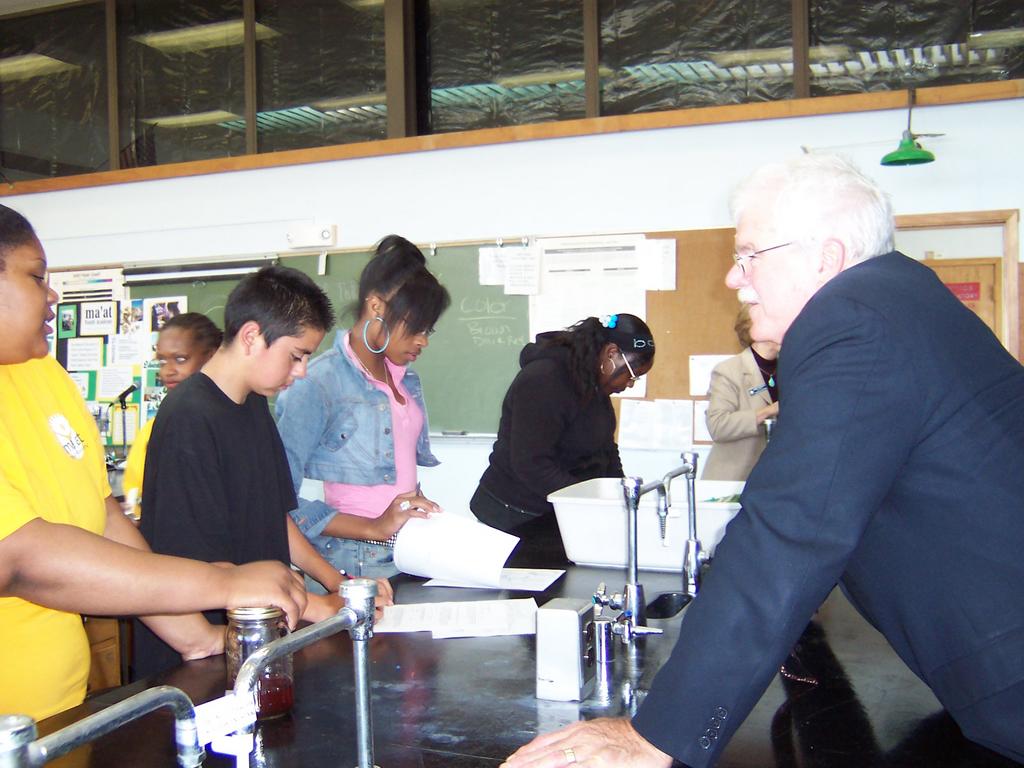
Photo: Students of Ma'at Environmental Academy conducting an experiment in urban pollution before Congressman George Miller recently. These are high school kids who are attending Contra Costa Community college full time. They were self-selected into the program then chosen from a lottery for the program that is vastly over-subscribed.
Saturday, June 25, 2005
"Betty and the Big War" -- one more time ...
Two days ago I found myself wallowing around in the past -- here at my computer -- actually reluctant to leave it (it was all so over-the-top emotionally) when the phone rang; not once, but several times. Much of the time these days -- it's relatively silent except for the frequent exchanges with Dorian. Each of the calls beckoned strongly to pull me away from the awful nostalgia but I was resistant. It seemed important that I stay with the writing until all of the pain had been used up -- with little held over for another time. That reservoir is over-flowing now that I'm allowing everything to rise to the surface that wants release. I finally answered the phone and as briefly as I could -- each time I dispatched the caller without much thought.
One was a reminder from Lighthouse Charter School about my promise to attend their workshop on Tuesday. I'll trot out the artifacts and photos of WWII vintage and read over notes from previous informal lectures from before. But, as is usually the case, I'll probably just wing it and count on the Q&A to put the meat on the bones of the talk. That's always the most interesting for me; learning about just how much information of the period has been held in the minds of those several generations removed. It's so easy to forget that these young teachers have no way of knowing the world before Jimmy Carter held the presidency, and for many Kennedy is only a mythical tragic figure of history. The first president I remember is Herbert Hoover (dimly) and Franklin Delano Roosevelt. I might as well be speaking of John Adams or Thomas Jefferson to this group!
The other call was the more important. It was from a man who identified himself as Miles Saunders of PBS-Channel KTEH of San Jose, California. He is head of a production company that is in the planning stages of a 4-part documentary series on San Francisco Bay. A major part of the Bay's story is the tremendous role it played in the staging and supplying of the arms and ships for World War II. And in that, the five Henry J. Kaiser shipyards were the big story.
"I just talked with the people at the Rosie the Riveter National Park and they referred me to you as someone who needs to be interviewed on camera for that segment," says he. My immediate response (as always) was to refer him to a real Rosie, telling him that I'd not actually worked in the shipyards at all, but was employed by the Jim Crow Boilermaker's auxiliary way over on Barrett Avenue in the center of town, and never actually saw a ship. "You'll want to talk with one of the actual Rosies. "I was actually more of a Rosie May." With that I laughed realizing that the sting of the indignation is actually beginning to quiet and it's now pretty funny. If ever there was a stereotype buster, I'm it; and I'm surely aware of it.
Instead of backing away, the caller suddenly perked up with the words, "...oh yeah. I heard about that. They didn't have racial integration then, did they?" Here was that time gap again -- where the caller's life experience was a total mismatch to my own. "I so want to talk with you, Ms. Soskin!"
I tried again, "...the Bancroft Library has done a 2-day, 4-hour videotaped oral history that may hold everything you'll need. You may want to check that out before we commit to repeating much that's already accessible in the park's archives."
Wouldn't do. "Could we arrange for me to bring my cameras and team to meet with you in late July to do a segment?"
The series will be aired nationally sometime this fall, I believe, and whatever the hell it is that they're seeking will be a part of it.
Maybe I've found a new career as the dissonant voice of WWII. The park is well aware of my stories and the untold stories of so many others -- and are obviously not loathe to sharing them. If they were, I'm certain that they'd not want any part of opening up what is another of the shameful chapters in the life of the nation's ongoing struggles with the evils of racism. I can only assume that they are complicit in the telling of the story and that -- as I'm hoping -- we all may have matured enough to have those much needed conversations, at last.
A half hour later the phone rang again, "...Hello, I'm writing a story for the Globe and was told that you might be willing to be interviewed for the Richmond Centennial series we're running in July." She sounded African American and very young -- an intern from one of the high schools? I really didn't want to refuse but also didn't feel particularly interested. "You might want to talk with Mary Head, an African American woman who actually did work on the ships here in the yards." Then a new thought, "...would you like to come on Tuesday to an informal Q&A that I'm doing for the Lighthouse School workshop? Bring your notebook and you may get your story in a much better way."
How's that for being inventive?
Two days ago I found myself wallowing around in the past -- here at my computer -- actually reluctant to leave it (it was all so over-the-top emotionally) when the phone rang; not once, but several times. Much of the time these days -- it's relatively silent except for the frequent exchanges with Dorian. Each of the calls beckoned strongly to pull me away from the awful nostalgia but I was resistant. It seemed important that I stay with the writing until all of the pain had been used up -- with little held over for another time. That reservoir is over-flowing now that I'm allowing everything to rise to the surface that wants release. I finally answered the phone and as briefly as I could -- each time I dispatched the caller without much thought.
One was a reminder from Lighthouse Charter School about my promise to attend their workshop on Tuesday. I'll trot out the artifacts and photos of WWII vintage and read over notes from previous informal lectures from before. But, as is usually the case, I'll probably just wing it and count on the Q&A to put the meat on the bones of the talk. That's always the most interesting for me; learning about just how much information of the period has been held in the minds of those several generations removed. It's so easy to forget that these young teachers have no way of knowing the world before Jimmy Carter held the presidency, and for many Kennedy is only a mythical tragic figure of history. The first president I remember is Herbert Hoover (dimly) and Franklin Delano Roosevelt. I might as well be speaking of John Adams or Thomas Jefferson to this group!
The other call was the more important. It was from a man who identified himself as Miles Saunders of PBS-Channel KTEH of San Jose, California. He is head of a production company that is in the planning stages of a 4-part documentary series on San Francisco Bay. A major part of the Bay's story is the tremendous role it played in the staging and supplying of the arms and ships for World War II. And in that, the five Henry J. Kaiser shipyards were the big story.
"I just talked with the people at the Rosie the Riveter National Park and they referred me to you as someone who needs to be interviewed on camera for that segment," says he. My immediate response (as always) was to refer him to a real Rosie, telling him that I'd not actually worked in the shipyards at all, but was employed by the Jim Crow Boilermaker's auxiliary way over on Barrett Avenue in the center of town, and never actually saw a ship. "You'll want to talk with one of the actual Rosies. "I was actually more of a Rosie May." With that I laughed realizing that the sting of the indignation is actually beginning to quiet and it's now pretty funny. If ever there was a stereotype buster, I'm it; and I'm surely aware of it.
Instead of backing away, the caller suddenly perked up with the words, "...oh yeah. I heard about that. They didn't have racial integration then, did they?" Here was that time gap again -- where the caller's life experience was a total mismatch to my own. "I so want to talk with you, Ms. Soskin!"
I tried again, "...the Bancroft Library has done a 2-day, 4-hour videotaped oral history that may hold everything you'll need. You may want to check that out before we commit to repeating much that's already accessible in the park's archives."
Wouldn't do. "Could we arrange for me to bring my cameras and team to meet with you in late July to do a segment?"
The series will be aired nationally sometime this fall, I believe, and whatever the hell it is that they're seeking will be a part of it.
Maybe I've found a new career as the dissonant voice of WWII. The park is well aware of my stories and the untold stories of so many others -- and are obviously not loathe to sharing them. If they were, I'm certain that they'd not want any part of opening up what is another of the shameful chapters in the life of the nation's ongoing struggles with the evils of racism. I can only assume that they are complicit in the telling of the story and that -- as I'm hoping -- we all may have matured enough to have those much needed conversations, at last.
A half hour later the phone rang again, "...Hello, I'm writing a story for the Globe and was told that you might be willing to be interviewed for the Richmond Centennial series we're running in July." She sounded African American and very young -- an intern from one of the high schools? I really didn't want to refuse but also didn't feel particularly interested. "You might want to talk with Mary Head, an African American woman who actually did work on the ships here in the yards." Then a new thought, "...would you like to come on Tuesday to an informal Q&A that I'm doing for the Lighthouse School workshop? Bring your notebook and you may get your story in a much better way."
How's that for being inventive?
Friday, June 24, 2005

Screaming across the chasm ...!
I rarely awaken so tired -- as if I've been wrestling with demons throughout the night ... and in a way, I suppose, I have.
For the first time in a very long time Papa George visited me in dreams -- probably summoned by the Killen verdict in Philadelphia, Mississippi, plus the angst around the typing of that list of senators who refused to sign on to the anti-lynching resolution. Enough to stir up lots of anguish. Found myself staring at each of those I could identify as they appeared before the microphones from the floor today on CSPAN. My awareness changed the nature of the experience of viewing the debate -- and how differently their arguments began to sound to me. Here were Alexander and Lott and Grassley et al from the list, arguing the merits of amendments to a bill -- but all I could hear was their silence on lynching.
I remember Papa's stories about how -- when he was a boy in rural Louisiana -- he'd heard whispers about those luckless African Americans who'd been caught by the infamous Ku Klux Klan. That the usual result of the chase would be that the victim would be hog-tied (ankles to wrists from behind) tossed into the back of a wagon or pickup truck then set on his knees facing down -- at the edge of the levee. Then the murderers would jump on his back until the spine shattered. Only then would they toss him into the river to drown. It was chilling to the 7 year-old, Betty, standing beside him as we weeded the vegetable garden together. His younger brother, (and my great-uncle) Albert, had fled to Kansas never to return to St. James Parish. It was rumored that he'd shot and killed a Klansman in self defense and was being hunted by the Night Riders. I don't believe that Papa ever saw him again. I'm not sure that he spoke much about Albert to anyone but me. I can still see that vacant place in his eyes -- as though he were really alone-- the way grownups do when they don't expect answers. Then he'd laugh and sing another of his crazy little song snatches to dismiss the agony of memory and bring us both back to the moment and the endless pulling of the weeds... .
Those images came up again for me last night -- all mixed in with the kids killing kids on Richmond's streets -- and the three civil rights workers murdered in Mississippi 41 years ago. I remembered that, during the long search for those bodies, a number of black bodies were discovered -- bodies no one ever bothered to identify. It had never been against the law to kill blacks. The only reason that the one black member of the trio was being sought was because he'd met his death with two whites. It was only they who were killed illegally; lynched. I thought of that infamous list of 20 posted yesterday who refused to even apologize for that heinous act and by now forgotten by most of us... .
It was those deaths and Papa George's stories of the "black logs" found in the Mississippi from time to time, that created this song:
Black Log
black log driftin' down da bayou in de mawnin'
limbs a-draggin' 'gainst da willow
black log floatin' down da bayou in da mawnin'
now it's sun-up, Owl must leave you
time to fine his mossy pillow
bullfrog croakin' out his grievin' from dis strange lily pad
three-finga, twisted lily pad
noontime -- comes da rivah 'roun' de levee
Boy heah fish' fo his suppa-time
caught one! ... no, tain't nuthin' ... but a black log
black log rushin' down da rivah in de evenin'
log cain't see da evenin'
caught! -- now free... , log 'n me .. in da rivah -- no retrievin'
comes da sea now -- here's da open sea now!
Freedom!
Too late... .
limbs a-draggin' 'gainst da willow
black log floatin' down da bayou in da mawnin'
now it's sun-up, Owl must leave you
time to fine his mossy pillow
bullfrog croakin' out his grievin' from dis strange lily pad
three-finga, twisted lily pad
noontime -- comes da rivah 'roun' de levee
Boy heah fish' fo his suppa-time
caught one! ... no, tain't nuthin' ... but a black log
black log rushin' down da rivah in de evenin'
log cain't see da evenin'
caught! -- now free... , log 'n me .. in da rivah -- no retrievin'
comes da sea now -- here's da open sea now!
Freedom!
Too late... .
(Betty Reid © 1965)
Malvina Reynolds Shroder Music Publishing Co.
Listened this morning to commentary on the Killen verdict and recalled my own reaction a day or so ago. Thought of that mean old white man hooked up to his IV and lashing out at reporters who lined up alongside the pathway he was being taken up in his wheelchair. It was a hollow victory, but my feeling was that at least there was some accountability at last for that community. Then I remembered that the system that had created and permitted such atrocities is still in place and rubber-stamped by at least 20 members of the Senate. How frightening is that?
It was but a short step to connecting the everyday American families who packed picnics baskets to sit in the town square to witness the castrating and burning alive of a black man hung from a tree -- to secretly photographed picture postcards sent home by our soldiers of prisoners being tortured and humiliated at Abu Graib. In some cases the intentions may have been honorable, intended to expose the awful interrogations being conducted there. In most, I truly fear that this is a repeat of the sadistic voyeurism so reminiscent of those earlier shameful picnics in the town square on Mainstreets, USA.
Occasionally I have such strong feelings that we live in totally different realities. and that what I'm saying here only resonates with other African Americans. Perhaps. But it needs saying, if only to point up the dissonance.
That the list of the Senate Twenty strikes fear into my heart -- enough to bring Papa George back into consciousness is a strong statement of the power of those images, still.
When I wrote "Black Log" in 1965 I truly believed that those lives had not been sacrificed in vain, and that the nation would rise to its founding principles and promises. It hasn't; at least not yet. And to think that we're spending billions of dollars and countless lives in the attempt to export this unfinished and imperfect democracy out into an unknowing world through corrupted policies and imperial ambition.
... and ... it was almost close enough to touch ... .
Freedom.
Photo: Maternal grandfather George Allen, Jr.,eldest son of Leontine Breaux Allen and George Allen, Sr, who served in Civil War. Leontine was enslaved until the age of 19 (1865). She was born in 1846 and died in 1948, when I was 27.
Malvina Reynolds Shroder Music Publishing Co.
Listened this morning to commentary on the Killen verdict and recalled my own reaction a day or so ago. Thought of that mean old white man hooked up to his IV and lashing out at reporters who lined up alongside the pathway he was being taken up in his wheelchair. It was a hollow victory, but my feeling was that at least there was some accountability at last for that community. Then I remembered that the system that had created and permitted such atrocities is still in place and rubber-stamped by at least 20 members of the Senate. How frightening is that?
It was but a short step to connecting the everyday American families who packed picnics baskets to sit in the town square to witness the castrating and burning alive of a black man hung from a tree -- to secretly photographed picture postcards sent home by our soldiers of prisoners being tortured and humiliated at Abu Graib. In some cases the intentions may have been honorable, intended to expose the awful interrogations being conducted there. In most, I truly fear that this is a repeat of the sadistic voyeurism so reminiscent of those earlier shameful picnics in the town square on Mainstreets, USA.
Occasionally I have such strong feelings that we live in totally different realities. and that what I'm saying here only resonates with other African Americans. Perhaps. But it needs saying, if only to point up the dissonance.
That the list of the Senate Twenty strikes fear into my heart -- enough to bring Papa George back into consciousness is a strong statement of the power of those images, still.
When I wrote "Black Log" in 1965 I truly believed that those lives had not been sacrificed in vain, and that the nation would rise to its founding principles and promises. It hasn't; at least not yet. And to think that we're spending billions of dollars and countless lives in the attempt to export this unfinished and imperfect democracy out into an unknowing world through corrupted policies and imperial ambition.
... and ... it was almost close enough to touch ... .
Freedom.
Photo: Maternal grandfather George Allen, Jr.,eldest son of Leontine Breaux Allen and George Allen, Sr, who served in Civil War. Leontine was enslaved until the age of 19 (1865). She was born in 1846 and died in 1948, when I was 27.
Wednesday, June 22, 2005
Senators who refused to sign anti-lynching resolution ...
by KOS
Tuesday Jun 14th, 2005
Here are the 20 Senators who 1) refused to co-sponsor the anti-lynching resolution passed yesterday, and 2) refused a roll-call vote so they'd have to put their names on the resolution:
Lamar Alexander (R-TN)
Robert Bennett (R-UT)
Christopher Bond (R-MO)
Jim Bunning (R-KY)
Conrad Burns (R-MT)
Saxby Chambliss (R-GA)
Thad Cochran (R-MS)
Kent Conrad (D-ND)
John Cornyn (R-TX)
Michael Crapo (R-ID)
Michael Enzi (R-WY)
Chuck Grassley (R-IA)
Judd Gregg (R-NH)
Orrin Hatch (R-UT)
Trent Lott (R-MS)
Linda Murkowski (R-AK)
Richard Shelby (R-AL)
John Sununu (R-NH)
Craig Thomas (R-WY)
George Voinovich (R-OH)
19 Republicans and 1 Democrat, a real wall of shame.
by KOS
Tuesday Jun 14th, 2005
Here are the 20 Senators who 1) refused to co-sponsor the anti-lynching resolution passed yesterday, and 2) refused a roll-call vote so they'd have to put their names on the resolution:
Lamar Alexander (R-TN)
Robert Bennett (R-UT)
Christopher Bond (R-MO)
Jim Bunning (R-KY)
Conrad Burns (R-MT)
Saxby Chambliss (R-GA)
Thad Cochran (R-MS)
Kent Conrad (D-ND)
John Cornyn (R-TX)
Michael Crapo (R-ID)
Michael Enzi (R-WY)
Chuck Grassley (R-IA)
Judd Gregg (R-NH)
Orrin Hatch (R-UT)
Trent Lott (R-MS)
Linda Murkowski (R-AK)
Richard Shelby (R-AL)
John Sununu (R-NH)
Craig Thomas (R-WY)
George Voinovich (R-OH)
19 Republicans and 1 Democrat, a real wall of shame.
The universality of fear ...
Came to terms with this just before becoming fully awake this morning. I'll no longer concern myself with re-locating. It was in that split second of clarity that I knew that the fear that I'm feeling has by now become my constant state of being. It attaches itself momentarily to the sound of sirens as the refineries set off their monthly test blasts promptly at eleven o'clock on the first Wednesday; it surfaces again when the traffic helicopters fly low overhead. It's now become my "normal." It has little to do with this beleaguered city. It may have more to do with Washington, D.C., and with the machinations of K Street, or, New York and the board rooms of Wall Street. I don't know. What I do know is that it has less to do with where I am than with what I'm feeling.
Those feelings were strong earlier this week as I watched CSPAN's coverage of the Rep. John Conyers forum on the Downing Memo -- with 32 Democrats squeezing in and out of that tiny room in a Washington basement -- looking impotent and defiant in the face of the most frightening display of power by the administration yet seen. For the first time I found myself able to understand the frailty of the Progressive side of the political equation. I felt it again the next day when Durbin apologized for his remarks instead of holding to his truths under the barrage of Republican criticism. My fears have more to do with lack of empowerment than of finding myself in the crossfire of a gang-related gun fight. Such a fear is far less likely to be realized.
Last night the Richmond city council chamber was crowded with 600 community people in a room meant to hold 200, maybe, in response to the news that they might be proclaiming a State of Emergency in light of the string of violent deaths experienced over the past two weeks. To my surprise and pleasure -- the vote was to not do so, but to look for other ways to respond to what has become a truly frightening climate of terror for many families.
What we have forgotten is the fact that this was surely predictable in light of the budget cuts that removed all services to young people in this town, leaving them with few supervised activities and little hope except for escape into military service and the killing fields of the Middle East. Controlling gun possession has proven to be impossible given the persistent idiocy of the NRA. With the proliferation of illegal drugs rampant and most funds for programs now buried in police budgets instead of recreation departments, what did we expect? We left young black youth with no alternatives other than the armed services or prison. We'd forgotten how dangerous it is to leave the young with high energy and intiative but no hope for a viable future. Left to their own devices, they've created a world of their own; one that mimicked ours, but with fewer safeguards or sense of morality; since ours have become invisible of late -- with the signposts buried behind caveats and false diplomacy; lies, murder, and mayhem without cause. What on earth did we expect?
The fears that have taken up permanent space in my psyche attached to the local body count, but even when I woke this morning with a sense that we'd reached the other side in the Richmond crisis -- the disembodied fear was and is still present.
Find myself wondering if we're all not feeling it -- as if we've hit some tipping point with triggers now touching off panic at the slightest provocation? It has to do with the sense that the nation (the world?) is out of control and that we're all players in the coming self-inflicted nuclear destruction -- be it worldwide catastrophes from global warming, weapons of mass destruction, avian flu, or, being slain on the streets of Richmond. Maybe we'll simply die of over- consumption of breaking news headlines! Dead is dead.
Maybe all I need by way of coping mechanisms is to not give the media access to my panic buttons. No easy task, but my sanity may be dependent upon doing just that.
There is no safe place on the planet to run to. Moving back to Berkeley will accomplish nothing. I'm precisely where I need to be -- and where I want to be at this point in my life. There's work to be done -- more things are possible here -- ways to make a difference in my own life and in the lives of those around me.
I'll drive in to look over the bulletin boards around town to see if there's some place where I can volunteer to work with kids in some way that's meaningful. I know that it's not children that I'm fearful of. Maybe they're fearful, too. It might be important to learn if that's true... .
Nowhere to hide ... .
Came to terms with this just before becoming fully awake this morning. I'll no longer concern myself with re-locating. It was in that split second of clarity that I knew that the fear that I'm feeling has by now become my constant state of being. It attaches itself momentarily to the sound of sirens as the refineries set off their monthly test blasts promptly at eleven o'clock on the first Wednesday; it surfaces again when the traffic helicopters fly low overhead. It's now become my "normal." It has little to do with this beleaguered city. It may have more to do with Washington, D.C., and with the machinations of K Street, or, New York and the board rooms of Wall Street. I don't know. What I do know is that it has less to do with where I am than with what I'm feeling.
Those feelings were strong earlier this week as I watched CSPAN's coverage of the Rep. John Conyers forum on the Downing Memo -- with 32 Democrats squeezing in and out of that tiny room in a Washington basement -- looking impotent and defiant in the face of the most frightening display of power by the administration yet seen. For the first time I found myself able to understand the frailty of the Progressive side of the political equation. I felt it again the next day when Durbin apologized for his remarks instead of holding to his truths under the barrage of Republican criticism. My fears have more to do with lack of empowerment than of finding myself in the crossfire of a gang-related gun fight. Such a fear is far less likely to be realized.
Last night the Richmond city council chamber was crowded with 600 community people in a room meant to hold 200, maybe, in response to the news that they might be proclaiming a State of Emergency in light of the string of violent deaths experienced over the past two weeks. To my surprise and pleasure -- the vote was to not do so, but to look for other ways to respond to what has become a truly frightening climate of terror for many families.
What we have forgotten is the fact that this was surely predictable in light of the budget cuts that removed all services to young people in this town, leaving them with few supervised activities and little hope except for escape into military service and the killing fields of the Middle East. Controlling gun possession has proven to be impossible given the persistent idiocy of the NRA. With the proliferation of illegal drugs rampant and most funds for programs now buried in police budgets instead of recreation departments, what did we expect? We left young black youth with no alternatives other than the armed services or prison. We'd forgotten how dangerous it is to leave the young with high energy and intiative but no hope for a viable future. Left to their own devices, they've created a world of their own; one that mimicked ours, but with fewer safeguards or sense of morality; since ours have become invisible of late -- with the signposts buried behind caveats and false diplomacy; lies, murder, and mayhem without cause. What on earth did we expect?
The fears that have taken up permanent space in my psyche attached to the local body count, but even when I woke this morning with a sense that we'd reached the other side in the Richmond crisis -- the disembodied fear was and is still present.
Find myself wondering if we're all not feeling it -- as if we've hit some tipping point with triggers now touching off panic at the slightest provocation? It has to do with the sense that the nation (the world?) is out of control and that we're all players in the coming self-inflicted nuclear destruction -- be it worldwide catastrophes from global warming, weapons of mass destruction, avian flu, or, being slain on the streets of Richmond. Maybe we'll simply die of over- consumption of breaking news headlines! Dead is dead.
Maybe all I need by way of coping mechanisms is to not give the media access to my panic buttons. No easy task, but my sanity may be dependent upon doing just that.
There is no safe place on the planet to run to. Moving back to Berkeley will accomplish nothing. I'm precisely where I need to be -- and where I want to be at this point in my life. There's work to be done -- more things are possible here -- ways to make a difference in my own life and in the lives of those around me.
I'll drive in to look over the bulletin boards around town to see if there's some place where I can volunteer to work with kids in some way that's meaningful. I know that it's not children that I'm fearful of. Maybe they're fearful, too. It might be important to learn if that's true... .
Nowhere to hide ... .
Tuesday, June 21, 2005
It surely isn't all sack cloth and ashes ... there are new challenges ahead.
While I was sneezin' and snufflin' over the past few days -- trying to throw off a cold -- there were two interesting new developments on the career front.
Now to try to envision ways to combine my NPS work with my dissonant black history into something that just might ignite some interest in this important new national park here in this community where so much of it was lived. There is some really proud African American history here -- there just may be some way to bring that to life for some of the troubled kids now wandering these streets ... maybe. Lots of food for thought ... and much to try to recapture for young minds so bereft of meaningful connections with the greater community. It must be dreadful to feel homesick -- when you're at home. There may be something here to draw from across the generations and the wars of their times.
What may be important about this -- or where the connection are -- remain unclear as I write, but time will take care of that. And, ironically, time is what I have the least of right now. But of what there remains must be shared with a new generation struggling with their destiny in a time when our institutions are in a shambles and new outrages must be lived through... .
But then most of the young have known little else.
Maybe we lived out all of the good years.
While I was sneezin' and snufflin' over the past few days -- trying to throw off a cold -- there were two interesting new developments on the career front.
- It's now official. I'll enter a new contract with the National Park Service on July 26th in the Rosie the Riveter National Homefront Historical Park in Richmond. They've apparently found the funding to bring me on to staff. It's only a short contract, but then so am I! It will be good to be back at work again. Never did get the hang of this retirement business ... .
- Also received a telephone call from a very interesting charter school in Oakland called The Lighthouse. Last year when I was working for the NPS, I was a lecturer for a workshop staged for a national group of young teachers who visited the park to study the untold stories of World War II. It was an really fascinating day.
- They are coming back with another group on Tuesday of next week for an encore performance. We will meet in The Hold of the SS Red Oak Victory where I will do a hour's presentation on the role of African Americans in the Good War ( or at least this one). I'm much better prepared this time, and am looking forward to meeting with these young teachers and their new crop of educators.
Now to try to envision ways to combine my NPS work with my dissonant black history into something that just might ignite some interest in this important new national park here in this community where so much of it was lived. There is some really proud African American history here -- there just may be some way to bring that to life for some of the troubled kids now wandering these streets ... maybe. Lots of food for thought ... and much to try to recapture for young minds so bereft of meaningful connections with the greater community. It must be dreadful to feel homesick -- when you're at home. There may be something here to draw from across the generations and the wars of their times.
What may be important about this -- or where the connection are -- remain unclear as I write, but time will take care of that. And, ironically, time is what I have the least of right now. But of what there remains must be shared with a new generation struggling with their destiny in a time when our institutions are in a shambles and new outrages must be lived through... .
But then most of the young have known little else.
Maybe we lived out all of the good years.

Breakthrough!
I've spent the entire morning in tears. This is the worst kind of depression. I hadn't the foggiest notion of why I've been so down over the past week. Couldn't write. Could hardly make it through the days without the most awesome panic attacks. Not that there wasn't good reason, of course. The headlines are enough to bury the best of us in hopelessness. My inability to get myself out of bed each morning -- except for the most urgent of reasons -- should have been the tip off. It wasn't.
I've been blaming my dark moods on the fact that Dorian will be leaving around August 1st and that this will bring many changes into my life -- not all of which are good. There will be economic implications since I bought this condo only two years ago and have little equity to claim should I sell it. And, sell it I must because it I could only afford it based upon our plan for shared living expenses. The thought of moving again opens up the possibility of relocating out of the area and into a place where I feel more secure; safer. We both receive SSA and I have some very modest investment dividends and retirement checks to bolster that. Now that must change. Reason enough, maybe. But not enough.
The death count in Richmond has climbed so rapidly that there have been 6 bodies to add to the count over the past weekend. One killing happened within a few blocks of our apartment. We heard the gunshots. Reason enough, again, only maybe. We've been here before. These are the drug wars that have now taken over our lives.
It couldn't have been the headlines that have caused this dive into panic since I cut off newspaper delivery over a year ago in favor of getting all of my news through the Internet. My video viewing is pretty well covered by West Wing reruns and CSPAN with occasional PBS programs from time to time. And -- wouldn't miss Jon Stewart and the Daily Show crazies or the outrageous Reno 911 that is funny enough to blast me out of any blue funk that I may fall into from the sounds of our crumbling institutions. I've given up on trying to make sense of our foreign or even domestic policy decisions. I've also given up on the notion that there is anything I can do about any of it; except to just ride out my remaining years and hope for the best for my children and theirs.
But ...
Something is beginning to surface that both gives me hope and brings further despair. It has to do with the killing spree that has turned this city upon itself in pockets of hopelessness and fear. It has given rise to defiance in some and terror in others. No one is untouched. And there is a familiarity to it. It is the 3000 block of Sacramento Street in Berkeley in the year 1978; the year that I returned to take over our failing small business in the heart of the drug trade. The fear that I'm feeling is no longer just below the surface but is now washing over me in waves. The enormous victory over the environmental changes that I experienced some 7 years later now seems unreal. It's as if only the images of a young man with his face shot off -- lying within 100 ft. of my building is the only one left in my head. I didn't know him. I was told at the time that he was 22 and was the fourth I'd witnessed as the result of drive-bys over less than ten days.
In the early days I was still far too fearful to even look up into the faces of those youngsters each day as I walked from my car into my store. They were invading my space and destroying my ability to survive economically. I saw them as the enemy and wanted them gone!
- That was long before I'd learned to speak to the streets through my use of "talking windows" that carried bulletins and information about things that mattered to me and should have to them.
- That was before I'd used those windows to talk about who I would vote for in the upcoming elections, and where I posted a huge facsimile of my ballot with explanations for what I would do and who I would endorse for office.
- That was before Fred Stripp (veteran of Pearl Harbor and a wino) began to arrive each morning with his worn down broom to voluntarily sweep the sidewalks in front of my doorway on each day of sobriety.
- And, before Touche began to stop by to add plants from his little garden to the little sidewalk flower boxes that bracketed the entry to the store.
- That was before I'd learned to stash a gallon paint mixed to match my exterior walls to immediately cover the tiniest sign of grafitti, and before the drug dealers took over the responsibility of seeing to it that the building was not touched by anyone.
- That was before I'd claimed "turf."
- That was before I learned that -- on the street -- I had a name and that with it came the protection of those who haunted the corners. And that those kids stationed themselves at the bus stop immediately across the street to watch over me at night.
- That was before "Red Pants" started popping in at closing time each night to walk me to my car in the dark -- so that I'd be safe.
- That was before I realized that the little store had become -- over many years -- a neighborhood institution and that I ran it with the consent and blessing of the community.
- That it was safe to bring in papers that looked important to be read and interpreted.
- and where kids stopped by on their way home from the elementary school two blocks away on the day when report cards were passed out -- to share their marks and pick up a token prize for those with the greatest signs of improvement.
- This was the place to announce a job has been secured or acceptance into a program of some sort.
- It had become a place where grief was shared over the loss of someone dear.
- And, I learned it on the day that I stood in front of my store alone and laughed aloud at the sight of drug dealers making sales right in front of a huge billboard that advertised (of all things) cigarette papers!
This morning it dawned on me that what had really happened was that those young men (and a few desparate young women) who had no dreams of their own had bought into mine. It was with their gradual buy-in that I was able to succeed. Those kids moved in and out of jails and prisons over that seven year period of struggle but they gradually became my cohorts over time. A few of them helped to register voters toward the end -- though there were few in the community who had not lost the franchise due to felonies on their records. I recall two young men who walked into the store one day day to pick up their clipboards dressed in suits and ties (I'd put out a call from my talking windows) -- neither could add their names to the forms that were attached. I recall how ironic it was to me at the time, and of how proud I was of them both for spending an entire day walking the streets trying to get others to come up to my store to read my window sample ballots and mark to their own.
I woke this morning feeling fearful -- and frustrated to be so certain that there are answers and that I'd innocently happened upon some of them during those years. I knew better than to ever ask their names but gave them names of my own (as they had for me) and would look around as I climbed out of my car each morning -- asking, "...where is Red Pants this morning?" And would feel real concern when told that he had been picked up the night before by the police. I learned to walk out of my store and join other bystanders when the police were performing a raid -- I'd be silent but the kids would know that I was watching so that nothing cruel would happen to them. They knew that I was respected by the police and that my presence might prevent unnecessary roughness.
I believed in my own dream of bringing positive change to that little community. I believed that it could be done. Over time those kids bought into those dreams and -- together -- we made it happen. A couple of them still drop in from time to time. My son and the current Reid proprietor, David, passes along their greetings. I've since learned some real names -- and when I recognize a face or two in the newspapers under the title "Drug King Pin" I say, "...oh, that's Mrs. So-and-So's nephew!" One would think that after many years of community policing, the police would evolve an attitude in the same way and that justice would then become more humane and compassionate. But then most members of the police department do not live in the communities that they police but are seen by the kids as an occupying force from outside. This must change.
Somehow we have to provide dreams big and strong enough for kids to buy into. We have to believe so strongly in the possibility of change that our visions overpower their despair and hopelessness. No small thing, of course, but surely possible. I've lived it and survived.
If only I could convince this city that is in such fear at the moment to put all of their resources -- not into new high tech surveillance cameras or to place new police officers on the streets -- but instead to open the now-closed sports facilities, afterschool programs, and locked community centers. It might not change the kids we've lost to violence, but such moves will go a long way toward changing the reality for those youngsters coming up behind them.
We need to set resources aside with which to build new dreams for ourselves that our kids can buy into until they can gain enough education, knowledge, experience, and compassion, to create their own. That's a tall order and depends upon the ability and willingness of the greater society to contribute, but it's still possible. This, is the place for the dropping in of reparations for past history.
This is the living prophecy of Lorraine Hansberry. This is the Raisin in the Sun in the process of festering.
This, I know is true.
I've lived it.
Change is inevitable. The shape of that change is the only thing in question.
Photo #1: Gospel singer, Vanessa Bell Armstrong with her manager on a visit to Reid's, our store on Sacramento Street. I'm the booted one on her left.
Photo #2: Berkeley Mayor Loni Hancock and City Councilmember Ann Chandler - the press, and me -- as we performed the groundbreaking for 43 units of new housing in a development that replaced the city's small slum area, across the street from Reid's -- the little family store that we established in June of 1945. It was then that I learned that beauty was as contagious as blight and the community has continued to bloom.
Friday, June 17, 2005
About that wild and crazy border-crossing ...
Have been wanting to say something profound about that weird man who crossed the border from Canada a couple of weeks ago. The words were hard to find. It was all so obvious. Surely everyone had reacted to the news similarly, but I wasn't sure. After all, the jokes were numerous and the night show hosts must be having a field day. "Stranger passes immigration carrying brass knuckles, a sword, a knife and a chainsaw stained with what appeared to be blood." How crazy is that?
Allowing it to pass without comment seemed the wisest course. After all, wouldn't anyone reading those words feel the same shock over the lack of "homeland security"? That would be only one aspect of the incident, however. There was so much more to the story, not to mention the decapitated male body plus that of some unidentified woman found later. This, plus the fact that the Canadian justice system was awaiting his appearance in court that very day.
What did it say to me? The obvious was that this was the ultimate example of white privilege. The explanations given quite seriously by some good friends and some public figures were that -- the immigration agents could not be held to blame since there were no grounds upon which to hold him. (They'd confiscated his weapons, after all.) He'd received an unknown number of points simply for being white -- a kind of affirmative action not often considered publicly but silently accorded to the anointed.
Were that wild man of a different skin color; black or brown or had he appeared middle eastern, would there have been any hesitation to hold him at the border until a thorough investigation had been undertaken? The double standard has allowed for the imprisonment of hundreds (thousands?) of darkskinned people with no known crimes on record -- to be held for years in Guantanamo and elsewhere. Many have been released as innocents after losing years out of their lives to our paranoia. Many are suffering torture at the hands of American "contractors" in our names after being flown into countries known to embrace the most brutal of interrogation practices. I cannot imagine that we "good Germans" haven't taken our outrage to the streets before now in an effort to stop such practices in our names.
It is painfully clear that this obvious sociopath was given a pass because our government would never hold a "white guy" until there was clear evidence of a good reason to do so. "We had no valid reason to keep him from entering the USA. That being so, we had to allow him through."
The irony is inescapable.
Have been wanting to say something profound about that weird man who crossed the border from Canada a couple of weeks ago. The words were hard to find. It was all so obvious. Surely everyone had reacted to the news similarly, but I wasn't sure. After all, the jokes were numerous and the night show hosts must be having a field day. "Stranger passes immigration carrying brass knuckles, a sword, a knife and a chainsaw stained with what appeared to be blood." How crazy is that?
Allowing it to pass without comment seemed the wisest course. After all, wouldn't anyone reading those words feel the same shock over the lack of "homeland security"? That would be only one aspect of the incident, however. There was so much more to the story, not to mention the decapitated male body plus that of some unidentified woman found later. This, plus the fact that the Canadian justice system was awaiting his appearance in court that very day.
What did it say to me? The obvious was that this was the ultimate example of white privilege. The explanations given quite seriously by some good friends and some public figures were that -- the immigration agents could not be held to blame since there were no grounds upon which to hold him. (They'd confiscated his weapons, after all.) He'd received an unknown number of points simply for being white -- a kind of affirmative action not often considered publicly but silently accorded to the anointed.
Were that wild man of a different skin color; black or brown or had he appeared middle eastern, would there have been any hesitation to hold him at the border until a thorough investigation had been undertaken? The double standard has allowed for the imprisonment of hundreds (thousands?) of darkskinned people with no known crimes on record -- to be held for years in Guantanamo and elsewhere. Many have been released as innocents after losing years out of their lives to our paranoia. Many are suffering torture at the hands of American "contractors" in our names after being flown into countries known to embrace the most brutal of interrogation practices. I cannot imagine that we "good Germans" haven't taken our outrage to the streets before now in an effort to stop such practices in our names.
It is painfully clear that this obvious sociopath was given a pass because our government would never hold a "white guy" until there was clear evidence of a good reason to do so. "We had no valid reason to keep him from entering the USA. That being so, we had to allow him through."
The irony is inescapable.
Thursday, June 16, 2005
New body count ...
The feeling that the earth is shifting beneath our feet is more pronounced today than it was only a few days ago. In the interim between the last entry and this has seen a 7.2 earthquake at Crescent City -- at the northwestern corner of the state. The tsunami warning involved the entire coast from Alaska to Mexico. My apartment looks out on San Francisco Bay. The sight of water was as menacing as if it were the ocean. Above us is a huge earthen dam that stores all of the water for the city of Richmond. It's several miles long. My apartment complex sits in the direct path of the San Pablo Dam. The Hayward fault runs very near to our home and -- if viewed on the map is shown dropping off into the Bay at Point Pinole -- about a mile-and-a-half from where I sit at this moment.
Add to that the sound of bullets piercing the night at around ten last night. The screams of sirens and the window-rattling roar of police helicopters announced that the street wars have moved from the rotting heart of the city to within sight of Hilltop Village -- where my home is located. Last night at least one more death and three more critical injuries were added to the list of casualties. The death toll is now 14. Four of those occurred over the past week. Today the mayor will announce a state of emergency -- as if that will quiet either the earth under our feet or our streets under assault by gun violence.
I'm certain that we're seeing a leaderless revolution and that the answers won't be easily found. During my long lifetime I've seen us reach this boiling point before. Each time only a fragment of the problem is addressed -- postponing the day of reckoning but rarely if ever taking the full corrective action required.
I'm not sure that anyone is making the connections between the fact that -- only yesterday -- the Senate was again unable to pull together a unanimous vote of apology for the horror of lynching. Since the days of Reconstruction there have been over 5000 (mostly black men) hung from trees, eviscerated, burned alive, dragged behind trucks, etc., and to the jeering and amusement of crowds of white families who participated as bystanders to a shameful continuing era in our history:
We've created a legacy of unbelievable cruelty over many decades, and are now exporting it worldwide. Our leadership models on the world stage precisely depict what we're now living with in Richmond. This is insurgency warfare just as brutal as what we're seeing in the Middle East. The only thing lacking at this point would be the heroism of those who sacrifice their lives by becoming human bombs in the pursuit of their goal to oust the occupiers. There's little heroism on our streets; only terror and a one-way trip to the yawning gates of the prisons. But the plight of the Iraqi resembles that of Richmond's street warriors in at least one way; hopelessness deep enough to merit suicide. The differences lie in the fact that the Iraqis are struggling to rid their country of invaders who are imposing their will and threatening their sovereignty. The Richmond youngsters don't even know who the enemy is and therefore their suicide has no rational meaning. They appear to be eliminating the "self" that is reflected from others around them. They're living under a code of violence that few can penetrate. It appears that we've lost them to that code.
Today I'm frightened. In the background I can hear the voices of those testifying at the Conyers hearings in Washington. It all feels so hopeless. It's all so familiar. I'm not sure how the impeachment of the president et al will effect the threat that lies so close to me, but it may serve to give hope to those with the power to change things. It may not save the street warriors in the immediate future, but over time, it may make life safer for my grandchildren. How I wish I had the power to love these kids back into the mainstream. But my place in it is only conditionally secure, and subject to the vagaries of a changing ethos of a nation in complete moral disarray.
After all, yesterday 20 Republican senators refused to vote to apologize for the lynching of black Americans. They were not being asked to support a bill but a simple resolution. Since it was a voice vote, Majority Leader Bill Frist was able to refuse to allow the votes to be polled - thereby protecting their identity from voters. Their refusal grants permission to their constituents to continue to deny rights and perpetuate the cruelties that leave shameful stains on the body politic. It is attitudes such as theirs that continues to cheapen life and feed the rage that is exploding so brutally on the streets of Richmond.
I'm not sure how we can discover which senators voted against the resolution, it will be difficult to respond effectively. Maybe you will join with me and others in trying to identify them and to help to select suitable leaders to succeed them in 2006. We're going to have to begin to support candidates in a nationwide way -- living in the San Francisco Bay Area as I do, it would be easy to relax in the knowledge that our leadership caucus is enlightened and can be counted on to express that in their votes. I'll look at the next elections in a very different way, I think, and hope that others will do the same. Acting locally in a world economy may mean acting nationally. The context has changed drastically and our responses probably need to adjust accordingly. The time has come when we must think of Georgians and Iowans as our neighbors for the purpose of bringing change. The greatest nightmare of those who have usurped control of our country would be the coming together of ordinary people like me and thee for the purpose of bringing us back to the pursuit of a truly compassionate America. In such a nation Guantanamo, Abu Graib, and the terrifying street wars of cities like mine might eventually disappear into history as we begin to build a new future together.
There may be lots of blue state folks who are as appalled by the state of the union as we. Do you suppose?
It's a thought... .
The feeling that the earth is shifting beneath our feet is more pronounced today than it was only a few days ago. In the interim between the last entry and this has seen a 7.2 earthquake at Crescent City -- at the northwestern corner of the state. The tsunami warning involved the entire coast from Alaska to Mexico. My apartment looks out on San Francisco Bay. The sight of water was as menacing as if it were the ocean. Above us is a huge earthen dam that stores all of the water for the city of Richmond. It's several miles long. My apartment complex sits in the direct path of the San Pablo Dam. The Hayward fault runs very near to our home and -- if viewed on the map is shown dropping off into the Bay at Point Pinole -- about a mile-and-a-half from where I sit at this moment.
Add to that the sound of bullets piercing the night at around ten last night. The screams of sirens and the window-rattling roar of police helicopters announced that the street wars have moved from the rotting heart of the city to within sight of Hilltop Village -- where my home is located. Last night at least one more death and three more critical injuries were added to the list of casualties. The death toll is now 14. Four of those occurred over the past week. Today the mayor will announce a state of emergency -- as if that will quiet either the earth under our feet or our streets under assault by gun violence.
I'm certain that we're seeing a leaderless revolution and that the answers won't be easily found. During my long lifetime I've seen us reach this boiling point before. Each time only a fragment of the problem is addressed -- postponing the day of reckoning but rarely if ever taking the full corrective action required.
I'm not sure that anyone is making the connections between the fact that -- only yesterday -- the Senate was again unable to pull together a unanimous vote of apology for the horror of lynching. Since the days of Reconstruction there have been over 5000 (mostly black men) hung from trees, eviscerated, burned alive, dragged behind trucks, etc., and to the jeering and amusement of crowds of white families who participated as bystanders to a shameful continuing era in our history:
There is a relationship between what is happening at Guantanamo and Abu Graib and the kinds of brutality that a significant number of our citizens are capable of. We are -- and maybe always have been -- a cruel people. That our children know this at some visceral level and are reflecting that cruelty should come as no surprise. The models are before them on the small screen, in the multi-plexes in living color and surround-sound, and from the media, the internet, and at times -- from personal experiences in our juvenile detention centers and prisons. There are no surprises here. We're creating monsters and we make no apology for it.
WASHINGTON -- The Senate officially apologized Monday for something it didn't do -- take a stand against the lynching of thousands of black people.
By a voice vote, the Senate approved an apology for failing to enact anti-lynching legislation. At least 80 senators signed on as co-sponsors.
Between 1890 and 1952 seven presidents urged Congress to end lynching. Nearly 200 anti-lynching bills were introduced over that period.
But the Senate, with Southern conservatives wielding their filibuster powers, refused to act.
With the enactment of civil rights laws in the 1960s and changes in national attitudes, the issue faded away.
(Washington Post - June 15)
We've created a legacy of unbelievable cruelty over many decades, and are now exporting it worldwide. Our leadership models on the world stage precisely depict what we're now living with in Richmond. This is insurgency warfare just as brutal as what we're seeing in the Middle East. The only thing lacking at this point would be the heroism of those who sacrifice their lives by becoming human bombs in the pursuit of their goal to oust the occupiers. There's little heroism on our streets; only terror and a one-way trip to the yawning gates of the prisons. But the plight of the Iraqi resembles that of Richmond's street warriors in at least one way; hopelessness deep enough to merit suicide. The differences lie in the fact that the Iraqis are struggling to rid their country of invaders who are imposing their will and threatening their sovereignty. The Richmond youngsters don't even know who the enemy is and therefore their suicide has no rational meaning. They appear to be eliminating the "self" that is reflected from others around them. They're living under a code of violence that few can penetrate. It appears that we've lost them to that code.
Today I'm frightened. In the background I can hear the voices of those testifying at the Conyers hearings in Washington. It all feels so hopeless. It's all so familiar. I'm not sure how the impeachment of the president et al will effect the threat that lies so close to me, but it may serve to give hope to those with the power to change things. It may not save the street warriors in the immediate future, but over time, it may make life safer for my grandchildren. How I wish I had the power to love these kids back into the mainstream. But my place in it is only conditionally secure, and subject to the vagaries of a changing ethos of a nation in complete moral disarray.
After all, yesterday 20 Republican senators refused to vote to apologize for the lynching of black Americans. They were not being asked to support a bill but a simple resolution. Since it was a voice vote, Majority Leader Bill Frist was able to refuse to allow the votes to be polled - thereby protecting their identity from voters. Their refusal grants permission to their constituents to continue to deny rights and perpetuate the cruelties that leave shameful stains on the body politic. It is attitudes such as theirs that continues to cheapen life and feed the rage that is exploding so brutally on the streets of Richmond.
I'm not sure how we can discover which senators voted against the resolution, it will be difficult to respond effectively. Maybe you will join with me and others in trying to identify them and to help to select suitable leaders to succeed them in 2006. We're going to have to begin to support candidates in a nationwide way -- living in the San Francisco Bay Area as I do, it would be easy to relax in the knowledge that our leadership caucus is enlightened and can be counted on to express that in their votes. I'll look at the next elections in a very different way, I think, and hope that others will do the same. Acting locally in a world economy may mean acting nationally. The context has changed drastically and our responses probably need to adjust accordingly. The time has come when we must think of Georgians and Iowans as our neighbors for the purpose of bringing change. The greatest nightmare of those who have usurped control of our country would be the coming together of ordinary people like me and thee for the purpose of bringing us back to the pursuit of a truly compassionate America. In such a nation Guantanamo, Abu Graib, and the terrifying street wars of cities like mine might eventually disappear into history as we begin to build a new future together.
There may be lots of blue state folks who are as appalled by the state of the union as we. Do you suppose?
It's a thought... .
Sunday, June 12, 2005
 All of the notes but none of the music ...
Spent last evening in the suburbs in the company of my friend and his grandson, a really fine 14 year-old youngster, an avid musician aspiring to find a place in the jazz scene once he matures into it. Both his parents are professional classical musicians so his world is rich with potential. I looked over at his innocent ruddy cheeks with the dark bangs stopping just above his brows in the way of the English schoolboy. He plays in a middle school jazz band that involves 80 youngsters. I thought about him and about his world in contrast to my own and that of the children I see around me from my windows. It is stark.
This morning I met with a black entrepreneur who is considering taking on some of my writings for some national exposure (don't ask). We were acquainted many years ago when we both were residents of Berkeley and when he headed the school board there and I was an aide to a member of the Berkeley City Council. He is now heading up a task force that is trying to address the out of control spate of black on black crime in Richmond. It was he who masterminded a summit about a week ago that brought together all of the forces (civic, faith, nonprofits, social agencies, and political figures and the media) to spend a full day examining the causes and effects of this frightening situation.
I learned from him that there have been 90 shootings since January 1st (all black), resulting in countless injuries and 10 deaths, the most recent being two days ago within a block of NIAD, the place where Dorrie spends her days. She'd mentioned when she came home on Thursday the yellow tape that surrounded the block. I felt a chill but it was quickly dissipated as my mind absorbed this no longer unfamiliar announcement and the buzzer sounded on the micro wave oven announcing supper.
Richmond is now listed as the most dangerous city in the entire state. It is the 12th most dangerous in the nation. It is a city without its soul ... .
Last night I sat in one of the clubhouses in Rossmoor, a relatively affluent mostly white gated community of 10,000. The room held perhaps 75 elders (except for Matthew) to listen to a concert featuring Dmitri Matheny on flugelhorn accompanied by a jazz pianist whose name I didn't catch. They were playing standards so "standard" that I could have named the arrangers and hummed the lead on anything played (and did to the annoyance of the woman sitting to my left!). It was a typical 'white folks' audience -- sitting quietly between songs and clapping politely as the ends were tagged; so sterile. I've seen a far greater level of enthusiasm in a chamber music audience -- but only in a highly controlled manner that dictates precisely where applause is allowed (only at the end of the piece and surely not ever after a movement).
It was clear that no one in the room realized that jazz here was totally out of context, and that the only way to fully experience this music is to be in an "affirmative action" crowd made up of at least 65% black folks. Only half of the experience is derived from what happens onstage, the other half comes to life from those listening. It's the old "call and response" that feeds the musicians and floats under them in a way that provides the impetus for creativity -- the "music". It's the same element that a rousing black gospel choir provides for the preacher to soar over and drives the frenzy that good preaching evokes and sets up the spontaneous altar shuffle, the occasional swoon -- and the "speaking in tongues" phenomena. Black audiences relate to performers one-on-one. The response is immediate, passionate, noisy, with shouts of appreciation of any especially inventive phrase -- and right in the middle of a riff! They're participants in the performance. They're sophisticated and pick up every nuance and the players know it. Musicians work as hard to bring that to life in an audience as black preachers do to get folks to "testify!"
It was clear that those two very accomplished white musicians last night were striving to bring the audience into their realm, but they were left with only the notes. They had no idea of how to produce the jazz experience in that "civilized" room. I'm not even sure that they knew that they have only partial control over the end product -- the music. I wonder if they know that the notes that they play may be on the charts on the music stands before them -- but that the music is in the people they are trying so hard to emulate. These audiences don't have a clue.
The black kids who are wielding the guns on our streets probably have no idea that the product being so faithfully imitated in Matt's 80-piece middle school jazz band, and that which was being presented last night at Rossmoor originated on the streets, in the clubs, in the choir lofts of street-front churches is their legacy -- bought and paid for by much pain and humiliation by black musicians who preceded them. They've lost sight of that blacks created America's only original internationally-celebrated art form by a lifetime. Perhaps they never knew. Where would they have learned about themselves and their culture -- about jazz?
Because the links have never been made to a culture that continues to enrich the world, these kids are bereft of a crucial connection to their own souls. Self-hatred has been internalized to the point where what we're seeing may actually be a leaderless revolution" misnamed - "Crime in the Streets." Life has been cheapened by successive wars communicated by successive major developments in the delivery of information to masses now armed to emulate the destruction on their own scarred and crime-ridden city streets of neighborhoods that exist in a state of hopelessness.
The black musicians who created the playbook that has lived into our times climbed out of the ghettos and into international prominence through their instruments and access to instruction through either working as teens with older pros or with borrowed instruments through public school programs. The access to this art has now been stripped from school curricula. That is, except for the Matts out in the safety of the suburbs where affluent parents have created foundations through which to augment the arts and keep them as avenues to fame and fortune -- for the enrichment of their own children. What Richmond kids have access to are illegal drugs and guns. The 49% dropout rate can probably be partially attributed to the loss of the arts in public schools. Those 49% of students of color drop out of school by the tenth grade.
Bereft of alternatives but with music and "the beat" crying for expression from somewhere deep within, our kids have been left with only their voices -- their lips -- to use -- and out of that they've fashioned rap, Hip Hop,, an art form that has swept the world and become the vehicle for poets and DeeJays of every language. They've re-shaped street culture at least one more time. That so much of it expresses rage should be a surprise to no one. Rage has become the irresistible driving force for much of the contemporary music of the young, and rightly so. But it transforms when expressed by those who've been lucky enough to attain the resources to combine their artistry with that of others -- often across cultures -- and in the way of Josh Redman, Jill Scott, Paul "DJ Spookie" Miller, and Will Power.
There was a sadness for me last night. I found myself wondering where the new black players are going to come from? Will the art form simply die when the sources have all become derivative and innovation has succumbed to market forces and aging memories? What will happen when there is no one left who remembers that -- once the emotional content has been stripped away -- once the performer is no longer fed by the listener; once the "call and response" has disappeared ... are we simply listening to empty echoes of what once was? And are the sounds I heard last night merely ashes to the embers of the originals? Is this new hybrid composed of black innovation plus white emulation going to be enough to resurrect the souls of our children? Will education ever become relevant enough to nourish and promote their entry into the culture with full credit for ancestral contributions already invested? Or will black culture continue to be expropriated without recognition; with critical elements left on the cutting-room floor because we've simply forgotten all of the elements and accept it in a form that is soul-less?
... and ... in the final analysis, is the essence of what jazz is being defined by the emulators?
What will that mean?
I wonder if "all of the notes but none of the music" isn't a metaphor for a lot of what I'm living in these confusing final years?
Something to think about before falling to sleep tonight ... .
Photo: Ceramic on wood. This was an award received by our store, Reid's Records, for having pioneered black gospel music and for having contributed significantly to the popularizing of the art form. Geoffrey's Circle in downtown Oakland hosted the event in the early mid-90's.
Wednesday, June 08, 2005
Lost in the confusion of past days ... found while foraging through old memories ...
a large cache of papers (correspondence and notes) from the experience of the Unitarian-Universalist Black Caucus at a critical time in UU history. They're written to friends with whom I shared the experience and give an accurate picture of a truly historic era that has not been heavily documented. On an impulse, I emailed an African American minister friend now living in the Boston area telling him that -- while going through old files I'd come upon papers that he might find of interest. He's far younger than I; the age of my eldest son, I think, and one with an abiding interest in recent black history.
I read through only a few of the papers -- fully intending to run them through the paper shredder but finding it difficult to do so. They held little of importance to me at this point in my life -- especially when there were so many other ways to go in recalling the events of my history -- but should they be trashed? Probably not.
I didn't see them as anything more than my personal account of events, but, suppose other personal accounts could be turned up from basements or attics in other parts of the country? It was after all, a national movement involving 3 meetings in 3 states over 3 years and filled with content that should be remembered. Supposing he could combine my documents with those of others yet to be discovered? Could that not be interesting?
He responded almost immediately and within two weeks sent a message that he would be here in the Bay Area for several days soon and would love to have a chance to talk about my offer. It was a given that he was enthusiastic about having possession of my papers.
He came last Wednesday; we spent the day together, and I learned from him that there is, indeed, work being done at the moment in gathering together just such works into an archive being established at the University of Chicago. We agreed that I will pull my papers together into protective sheets in a binder and send them to him for inclusion. My request was that he first scan them for anything that might be hurtful to anyone -- or that might be politically inappropriate in light of subsequent developments in the years following -- but otherwise they're his to use as he sees fit. It's a considerable batch of sometimes hyperbolic accounts of events, but the few that I took the time to scan were exciting to read. I believe that others will find them equally so.
So you see, I may be becoming a writer by default.
Over the next few days I'll go back to foraging through these yellowing crumbling documents for more pieces to share here. But that may mean more discoveries that need to be directed into other avenues for sharing to more targeted readers in the black community.
It could be that I've lived many books, any one of which could find its way into print. Maybe the hardest job will be choosing which book to write. It may be that I will become stuck -- unable to decide and lose the momentum to write at all. It could be that the remembering will serve its own purpose and not need to be acted on. But deep down I think that would be regrettable.
Will I stop long enough in the living of it to tell about it?
a large cache of papers (correspondence and notes) from the experience of the Unitarian-Universalist Black Caucus at a critical time in UU history. They're written to friends with whom I shared the experience and give an accurate picture of a truly historic era that has not been heavily documented. On an impulse, I emailed an African American minister friend now living in the Boston area telling him that -- while going through old files I'd come upon papers that he might find of interest. He's far younger than I; the age of my eldest son, I think, and one with an abiding interest in recent black history.
I read through only a few of the papers -- fully intending to run them through the paper shredder but finding it difficult to do so. They held little of importance to me at this point in my life -- especially when there were so many other ways to go in recalling the events of my history -- but should they be trashed? Probably not.
I didn't see them as anything more than my personal account of events, but, suppose other personal accounts could be turned up from basements or attics in other parts of the country? It was after all, a national movement involving 3 meetings in 3 states over 3 years and filled with content that should be remembered. Supposing he could combine my documents with those of others yet to be discovered? Could that not be interesting?
He responded almost immediately and within two weeks sent a message that he would be here in the Bay Area for several days soon and would love to have a chance to talk about my offer. It was a given that he was enthusiastic about having possession of my papers.
He came last Wednesday; we spent the day together, and I learned from him that there is, indeed, work being done at the moment in gathering together just such works into an archive being established at the University of Chicago. We agreed that I will pull my papers together into protective sheets in a binder and send them to him for inclusion. My request was that he first scan them for anything that might be hurtful to anyone -- or that might be politically inappropriate in light of subsequent developments in the years following -- but otherwise they're his to use as he sees fit. It's a considerable batch of sometimes hyperbolic accounts of events, but the few that I took the time to scan were exciting to read. I believe that others will find them equally so.
So you see, I may be becoming a writer by default.
Over the next few days I'll go back to foraging through these yellowing crumbling documents for more pieces to share here. But that may mean more discoveries that need to be directed into other avenues for sharing to more targeted readers in the black community.
It could be that I've lived many books, any one of which could find its way into print. Maybe the hardest job will be choosing which book to write. It may be that I will become stuck -- unable to decide and lose the momentum to write at all. It could be that the remembering will serve its own purpose and not need to be acted on. But deep down I think that would be regrettable.
Will I stop long enough in the living of it to tell about it?
 No longer waiting to exhale ...
It has been less than 24 hours since those crucial decisions were arrived at to begin a 90 degree turn in the pattern of our lives. I'm feeling less pain than relief -- though this may be a temporary state and not one to count on quite yet.
The immediate crisis has passed. Life at home is again on an even keel with little sign of the trauma of the past several days.
The biggest change is the one taking place in my mind -- coming to terms with where we are in space and time. I've been living with a daughter who is chronologically at middle age with a mental age of a rebellious young adolescent. She is composed of a mind that is riddled with empty spaces where logic and judgement and rationality should be residing; a mind with huge deficits controlling a normal healthy body, with a raging libido and all of the hungers of an adult woman. A necessary hysterectomy performed about two years ago has thrust this healthy female body prematurely into menopause -- adding the ultimate combination of traumatic physical/emotional elements to an already compromised female system. I am no match for what nature has wrought. No one is. It will take a team of professionals blending abilities and training to even begin to address something so complex. Everything short of that will fall short of what is needed to maximize her again.
I know what that looks like because -- when she arrived home from several years of schooling at St. Vincents Academy in Santa Barbara at 19 -- that word would have described her. She had been maximized. My hopes for her were realistic in light of what she'd been exposed to. She had received her high school diploma with the ability to enter any community college at the vocational level. She was self-confident, capable of holding her own socially, and with enough training to benefit in sheltered-workshop situations. It was all I could have asked for. My sense of what she might be capable of was strongly influenced by what she'd been given up to that point in her life, and of how much she'd profited from it. I had high hopes that didn't take into account the slippage in the safety net that would follow in the wake of huge and consistent cutbacks in what the state allotted to the services to the developmentally disabled.
When assessed in that way, I feel fortunate to have been able to cope so well for so long. There is no disgrace nor failure to rue. Superfriends are immune to all that. We just do the best we can given the tools we have to work with. The trick is to know when the system reaches overload, and to begin to increase the universe of minds required to deal with it as needed. I've done that.
Now I will concentrate on doing those things that keep me whole and capable of letting go gradually. We will probably have until August before the necessary processes have been worked through by those in whose hands our fate now rests. I will concentrate of my role as protector-mother until circumstances change that into whatever comes next.
She will swim this weekend at the University of the Pacific and will come home bedecked with ribbons (as always), filled with pride of achievement. She's preparing for the next NIAD art reception and exhibit in about ten days and that will hold us in a comfortable relationship where she is fully occupied by good things.
Me? I'll begin my own process of separation -- already begun as you can see -- which will be so much easier now that next steps are beginning to emerge. I'm no longer alone with the decisions and -- even better than that -- I trust those in whose hands our fate now rests. It's been a long time since I've had the will or the strength to allow that to happen.
Her future is not as I'd envisioned it when she was a toddler -- when I was coming to terms with the life ahead for her -- but it can still work. I will still be needed but in a new way; one that is ill-defined right now, but one that may require more distance between us than ever before. That will be hard. But I'm beginning to understand that her ability to adjust to those next steps may be embedded in my ability to allow for the distance between her life and my own to be broadened considerably.
A life of my own ...
Now that's a concept that I don't think I've ever really considered ...
...maybe I'll see the birth of at least one more Betty; one who's outlived or outgrown the need to mother. Or, maybe I'll learn whether one of my lesser "Bettys" will emerge to take over. It would be lovely if I found that my "woman" has stepped up in front of my "mother" to take charge of the 'bod' and that there are still discoveries to be made from yet one more edge of my being.
I'm sure that he'll appreciate such an outcome.
We'll get to test that out this weekend while Dorian is in Stockton and while I'm aware that this is the beginning of something unexpected but probably long overdue. We'll start with dinner and a concert on Saturday evening ... and maybe I'll begin to let it feel 'normal.' My cell phone will be fully-charged and waiting for word of disaster (as always) but maybe just a little less so than before.
Life will go on, and for both Dorian and me.
Photo: Dorian Leon Reid upon her graduation from St. Vincent's Academy in Santa Barbara.
Subscribe to:
Posts (Atom)