Thursday, August 10, 2006

What on earth has happened to dispel the fear?

For several days now I've been in a strange state where even the awfulness of the images from Heathrow Airport in England fail to register on my psyche. It's as though I've crossed some kind of divide, leaving behind the normal sensations that nature provided to protect me. Have I simply stopped believing those voices screaming from the media? Have I entered a kind of Oz-created "behind the curtain" place where the Wizard prevails but where truth has neutered him into submission?

All of the signs are present that should trigger the fight or flight response -- but they're not working ... and I have no idea why. Surely the possibilities are strong that something awful can and will happen -- that those terrorists will strike in some dramatic way that will take many lives ... and that this nation has surely been guilty of enough terrorist-producing atrocities to invite retaliation ... then why? Why am I not as fearful as when I wrote the last entry some days ago?

The fears have all dropped away by some kind of magic -- and I can again watch Keith Olbermann with dispassion, suspecting that he, too, may be topping out into this state of disbelief. But -- do you suppose this kind of cynicism can be lethal? Maybe that's why I choose to watch the news filtered through satire -- through Jon Stewart.

Have the terrorists on our side (Rove, Cheney, Bush, Rumsfeld, Gonzales, et al) finally lost their ability to convince me of the truth of their warnings? Is it all simply too conveniently Blair/Bush? Was it all too close to the upcoming November elections and the Connecticutt primary and the Leiberman loss and the Israeli failures in Lebanon to not be suspect? Has it all become so predictable that there is no longer any credibility and that I'll die along with the rest in some horrific holocaust -- but with an attitude of both helplessness and fatalistic acceptance?

But shouldn't that shoot me past the top measure on the screaming panic meter?

Why don't I any longer believe them?

Have they finally lost their power over me -- and others as well? Have they overplayed their hand at last? I can't believe that I'm alone in this ... I may have finally been desensitized along with millions around the world -- perhaps on the eve of our re-awakening ... ?

What on earth ...?

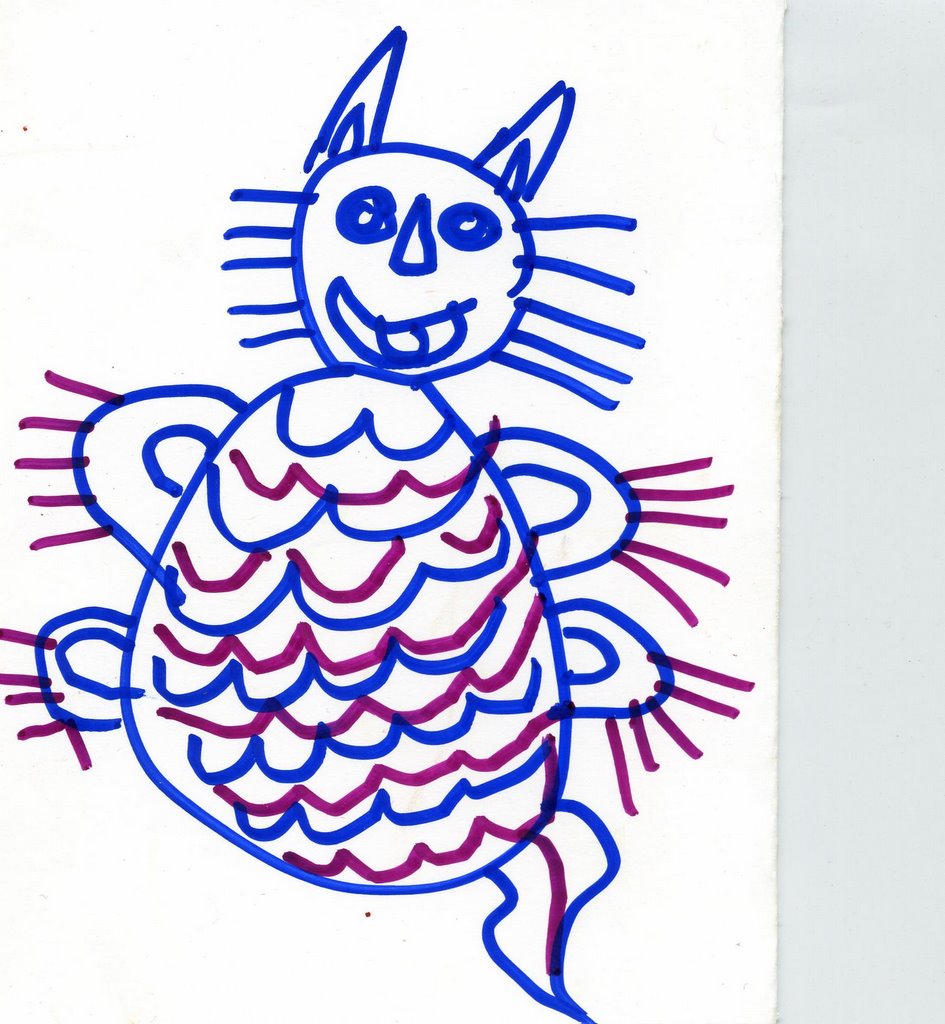
Photo: Another of Dorian's quirky cat sketches. It may be a little over the top, but in a way it depicts the weirdness I'm feeling right now -- just a tad nutty!

Monday, July 31, 2006

I'm noticing signs of an old pattern of behavior ...

In 1978 when I received that alarming phone call from Rick -- pleading for help. He'd arrived at work at our store that morning to find his dad lying on the floor in a coma in the back office where he had been living for months. Rick was terrified! No one knew that Mel had been diagnosed as diabetic. He was a former athlete who'd taken particularly good care of his health for all the years that I'd known him. I hardly recognized this helpless disheveled bearded man who lay so still and helpless -- body so awkwardly twisted that morning. None of us knew how long he'd been in that state.

We'd been divorced for some years and I was now remarried and working at Project Community, a research project at the university and somewhat out of touch with Mel and our now young adult sons, except in the way that once-married parents touch lives in peripheral ways around birthdays and holidays. During those years Dorian was away at St. Vincents boarding school in Santa Barbara. But extreme emergencies leap across time and barriers of separation and the still-existing threads of familial love return unexpectedly in a rush in times of stress and -- at the sound of panic in Rick's voice on the phone -- I 'd immediately dropped everything to rush to the side of my former husband and our eldest son.

It was then that I first learned of just how much Mel's life had deteriorated; how awful was the state of business; and of just how totally the store had descended to street level. The street had made its way into the store and changed everything. Drug dealers lined the sidewalks against the display windows and conducted their deals within a few feet of the entry. But all of that was diffused by the awfulness of the situation at hand -- the fears were swept away in those moments as I rushed past our terrified son to try to revive Mel and then to call an ambulance that would carry him off to the nearest emergency room. Within hours Mel's right leg would be amputated at the knee and Bill (my new husband) and I would be standing over his bed in ICU waiting for him to wake from the anesthesia to discover this tragic truth. Mel and Bill had never met. Fortunately for us, the psychologist Bill was standing beside me in all of his professionalism -- and was able to deftly guide the three of us through those critical first hours of this family tragedy. Dr. William F. Soskin could not have been more loving or helpful. His generosity with his expertise, his compassion, and his ability and willingness to support us in all ways was beyond expectations. I could not have felt more loved, or less ready to incorporate the demands of caretaking of a former husband into my new life with Bill. But fortunately, the old friendship Mel and I had shared as youngsters returned to see us through and a new relationship formed in place of the old marriage.

Over the next several weeks we found ourselves in a new and quite different relationship -- one that I'd not been prepared for. One that required that I give up my position at the university and become more active again in a life I'd abandoned years before. It meant taking on a failed business in the attempt to save the last vestiges of our children's legacy. It meant adding the physical care of my former husband and blending it with the demands of the man with whom I now shared my life. I became the inheritor of a commercial building that was in foreclosure -- a building that was the only remaining asset that was meant to be the legacy for our kids. It was during those days that I first felt myself developing the defensive strategy that I'm now beginning to witness returning. And all this had been added almost overnight to a list of obligations that included the care and management of my aging parents -- now both over ninety and needful.

I remember standing in that store -- knowing little about how to save the business -- and saying to myself, "...okay, Betty. You can only manage about 500 feet at this point. You've got to compress the world into that space, and everything within it has to shape up!" I decided to let others take care of everything beyond that range. I'd mentally dropped a string around this limited space -- and with the gift of enough money from Bill with which to reinstate the mortgage and try to restore the business -- I left my university position to begin the work on reclaiming my "500 feet." Meanwhile, I'd work hard to gain some control over only what I could comfortably reach.

I've begun to notice over the past days and weeks that I no longer watch much television, except for CSPAN and the Daily Show. I read a few columns (Frank Rich and Paul Krugman and Maureen Dowd and -- always -- the columns of J. Douglas Allen-Taylor of the Berkeley Daily Planet) and listen to Democracy Now at times. But for the most part my world is again compressing and I'm tending to allow not much more than those 500 feet into my awareness.

The world is so frightening and my sense of being able to control any of it is diminishing to a greater and greater degree. I'm quietly terrified so much of the time -- and it's not from the gunshots I sometimes hear in the night. The crime stats pale against the images on the small screen of the slaughter of innocent people overseas -- people who are considered "collateral damage" and little more.

I'm increasingly afraid that something will happen that is far beyond my control and that I'll be separated from Dorian who lives across town in her own apartment (will there be cell phone service when it happens?). She's so proud to be on her own, and so unaware of anything beyond her brain-limited "500 feet." And what about the Dorries in Gaza or Lebanon or Afghanistan? Who is caring for them in a world gone mad?

The sense of being out of total control of events is causing me to contract, draw in, walk past my television set sitting silently against the wall -- beside that beautiful tall African woodcarving Bill bought for me the year before he died ... .

Tonight I'm so afraid. I'm grateful, I suppose, that mentally-retarded Dorian lacks the ability to understand the peril of the world we're living in. Maybe that's a blessing, maybe.

If everyone isn't paralyzed by fear at this point then maybe they're not paying attention. Our world has careened out of control -- just as it felt that awful day when the two of us stood together holding hands beside Mel's unconscious body -- waiting for him to wake into consciousness and the pain -- and wondering how it would be ...

One of the most awful days of my life -- but it all pales in comparison to the days in the lives of those living in the Mideast now. On a newcast tonight I caught a fleeting glance of an obviously mentally retarded teenage boy being pushed along the streets in a crowd of refugees from the bombings. His look of utter bewilderment haunts me still ...

Life in our times... .

But why am I not in the streets demanding an end to the killing? And where are all the others?

Is this, then, what it felt like to be a good German?

Photo: Left - Mel Reid, playing left halfback for the University of San Francisco Dons -- early in our marriage. Right - Bill Soskin, the man I married for the second half, after my children were grown up and my first marriage had ended in divorce.

Wednesday, July 26, 2006


Reduce juvenile crime stats by one-third immediately? You're right. That's crazy. Or is it?

If we can agree that there is much profiling of youth of color in innercities -- largely from inequality rising from abject fear coming not only from the adult population -- but from the police as well, then we have a place to stand while we debate the issue.

The city I live in is reputed to be "the most dangerous city in the state of California" with a murder rate of 47 for this year and climbing. Enough legitimate reason to be fearful? Maybe. Maybe not.

I lay on my sofa and watched the city council meeting on cable television last night -- between my feet -- one of the best shows in town. The fact that we're in an election cycle with only a few months to go made for some rousing theater. There was a familiar ring to proceedings -- the same arguments and the same complaints expressed that drove those pre-election campaign community meetings in South Berkeley years ago when I was doing my community leader thing (and getting nowhere) until I started to see through the charade.

At that time it was drugs and crime and drive-by shootings and abusive police power and weeping mothers and grandmothers -- and (oh God!) empty promises of social programs and job-training -- and that was in the Seventies. There were also ambitious political wannabees devising "Campaigns of Hope" (this time it's called "Safe Streets") designed to exploit the very real fears of families struggling against poverty and drug and alcohol addiction spawned by hopelessness and institutional racism that was by now so cleverly masked that it would take the smarts and sensitivity of an Einstein or a Thomas Jefferson to see through it all; and all for political gain. The more things change ... .

Is the awful stuff real? You bet it is. Is that all there is? Absolutely not. In the years that I've lived in Richmond I've never seen a drive-by nor a mugging nor have I ever been attacked or had my house broken into or my car hi-jacked. Is that real? You bet it is. So -- as it was in South Berkeley -- I get to choose my own reality. And I do, and what I choose is what guides my life in this town. I move about without fear for the most part. Occasionally I drive north to Mendocino and become aware of the tension only as it drops away, and I'm grateful for a few days of drifting and not having to push the river ... but that doesn't last. After each drive back through that beautiful country and into my troubled city I'm anxious to get back to a place where I have a sense of the aliveness that comes with doing meaningful work that allows me to bend into the winds of positive change with others who live with similar intentionality and purpose.

Now about that first sentence about a dramatic reduction in the crime rate and number of troubled kids:

In a study done in Hennepin County, Wisconsin, a few years ago it was discovered that the first encounter most young black and brown men had with the criminal justice system was not for drug use and/or possession at all, but through traffic violations. Yes, traffic violations. Teens would be cited for a speeding ticket or for driving without a license -- a busted out tail light -- or simply for driving while black or brown. They had no jobs so had no way of paying the fines -- nor could they approach their struggling family for help (now dropped from the welfare rolls due to welfare reform) -- so would simply not show up at traffic court. In a few months that fine would double -- then triple -- and eventually a warrant for their arrest would be issued. (You're getting ahead of me.)

Meanwhile, the seduction of getting a few rocks of cocaine or an easily concealable packet of crack to sell was too great to resist for long. This served as an easy way of getting out from under their traffic problem and jump started their street careers. As often as not, if they're successful, they now have the ability to alleviate some of the stress on their debt-burdened parents and siblings by contributing to the household income, or, now they can start one of their own. "Manhood" has arrived prematurely, and with a kind of status that cannot be attained by any other means. They've now entered the world of the underground economy fueled by illegal drugs.

Hennepin Country addressed the problem by bringing together the probation officers, the community policing experts, social workers, psychologists, etc., and together they devised a plan to create a program of amnesty that would give young people a clean start, would expunge minor violations from their records, to see what might happen. The results were dramatic. Where they'd expected a few hundred to turn up, they were faced with a couple of thousand, and a breath of fresh air blew through the county as the percentage of young people outside the law suddenly decreased dramatically.

What would happen if a similar program came into being here in Richmond? Instead of the constant fear of discovery and threat of punishment -- recreation and job-training resources would (again) be available to young people as entitlements and not because they had to be defined as being "at risk." What if the professionals in social services, public health, and law enforcement got together and granted amnesty for all misdemeanors and crimes of possession and traffic violations and gave everyone a fresh start? They would not have to check "yes" to ever having been arrested on job application forms, qualifying them immediately for employment opportunities otherwise beyond their reach. What if (like the homeless man who shoplifted in order to have himself jailed because that was the only way to get a shower and clean clothes) those kids reduced the "criminal element" by one-third simply by being accepted back into the mainstream where love was an entitlement and where fear was reserved for the Saturday matinee at the Bijou multiplex?

By so doing, we would have instantly reduced the universe of truly criminal and seriously dangerous to a significant degree, a number that might then be manageable. We would have calmed the panic and dread that I watched last night from those parents who have suffered the loss of kids who didn't deserve to die at the hands of other kids who've been robbed by a fearful public of a sense of belonging -- and didn't deserve to be doomed to life behind penitentiary walls.

Long before those young people pulled those triggers -- they'd lost all sense of connectedness with the rest of their communities by being placed in prison-like schools where they were fed messages of hate and rejection until they completely internalized the soul-destroying toxins. We may be seeing the first wave of children who were crack-damaged en utero -- now grown to young adulthood. That's a public health problem and must be faced as such or we'll continue to build penitentiaries to house them where the annual costs per prisoner would pay their way through Harvard!

One only has to watch CNN on any given evening to see how cheap life has become. Richmond is not yet Kabul or Beirut, but I'm not sure that our kids can tell the difference. And in a world where the bully is now king, and amorality has become the accepted underpinning of international diplomacy -- what hope is there for any rational means of addressing conflict for us, much less for our children?

I'm hoping that we might soon stop looking at the problem and start looking at the kids. There's at least one member of the city council who might listen. I'll send him an invitation to lunch one day next week ... .

Photo: My brilliant Little Leaguer grandson at about the age of 10 -- with a great passion and a bright future ahead in sports. He's now a much-loved but deeply troubled 18 year-old, trying to find his way in a world that does little to allay his confusion and inner pain. And ... I don't know how to be helpful, except to let him know that I believe in him deeply and in his ability to eventually overcome our collective heartless insensitivity to the plight of today's young people.

Saturday, July 22, 2006

These guided bus tours are teaching me as much as the "tourists" whom we're engaging in the process ... .

Most of my work for the parks is involved in choreographing and "casting" a series of bus tours designed to inform the community of the fact that they are -- quite literally -- living in the middle of a congressionally-designated national park. "The Rosie the Riveter/Home Front Historical National Park" does not lie on the shoreline as one might be led to believe by the close connection to the Kaiser shipyards and environs, but is made up of over 20 war-related structures that are still standing throughout the city. My mission, as a community outreach specialist, is to raise public awareness of that fact -- toward both the need to preserve those structures -- and to help to move the city toward a greater sense of its role in the telling of the story of the Second World War for the nation. That's a tall order, but achievable.

Yesterday the group made up of the mayor; members of several boards and commissions, the designer of the beautiful Rosie Memorial monument; a major developer who is razing and re-creating a two square block four-story mix-use project on Macdonald Avenue; the district director for state Senator Don Perata; a program evaluator from the National Parks Foundation and his aide (here from Texas); the Gen. Manager of the Richmond Chamber of Commerce; members of several Neighborhood Councils (there are 39 in this city) and several members of park staff gathered at city hall for our fifth such tour. It was amazing!

We use a small 28-passenger bus in order to preserve the feeling of intimacy -- and it works like magic. Everyone is close enough to converse in two's but the group is small enough so that -- when we need to -- we can instantly become part of a single conversation; a deliberate strategy.

When one realizes that these are people who are the civic leaders, and that they've been passing these structures in the course of their lives for many years, it seems a minor miracle to me that they could find this activity of even passing interest.

We gather at 8:30 in the morning for coffee and introductions, view the "Lost Conversations and Untold Stories" DVD (available to view under CBreaux Annex), visit the collections of artifacts and view the growing archives of studies and oral histories, then board the bus for the first stop at the Memorial. Many have surely already seen this stuff, right, so what's the big deal? But from the moment that Naomi picks up the bullhorn to begin the guided tour up 23rd Street, past the Newell Market, the Galileo Club, the Greyhound bus station, the Park Florist and the Winter's Building, etc., the conversations begin to grow louder and more insistent and memories are triggered and chaos reigns! It's the most delightful chaos imaginable.

Everybody has stories to tell. The World War II memories are triggered and lessons either never learned or now forgotten begin to surface.

Many who have been silenced by either the racial or cultural divide are freed to have those conversations that were stilled long ago. The questions that have gone unanswered çan be expressed. Candor is the rule of the day.

On the tour, an African American leader -- upon the discovery of the tiny Mexican-American Baptist church on the border of the Santa Fe-Baltimore railyards was heard to say, "...and I was wondering why they were all comin' here. They've been here all the time!" It was only in the moment before that she'd learned that the historically-designated Atchison Village (whites-only) WWII housing development had been erected upon what had been an historic Mexican-American settlement; upon the agricultural lands that had sustained them before the war came in 1941. What a revelation!

After visits to many more sites (including the Ford Assembly Plant, the SS Red Oak Victory and the Whirley Crane that built her, the Kaiser Permanente field hospital and fire station) we return to city hall for a quick lunch and de-briefing.

Out of many contructive comments (all dutifully noted by a recorder), one stands out for me:

A strikingly attractive older woman (white) who heads the Planning Commission rose from her seat to ask (yea, demand!) that "... you must add an hour to the tour (8:30 'til 12:30 now) in order to enable folks to visit the African-American historic area of North Richmond -- where blacks had built a community from scraps discarded in the dismantling of the HUD-built temporary war housing. "That history must not be lost. We need to visit North Richmond and/or Parchester Village (also black) if we're going to tell this story." I felt my heart beat in my ears. This was the precise direction I'd hoped we'd find ourselves embarking on, but we're here so much sooner than I would have ever hoped or dreamed. The history is crossing the racial lines it couldn't have dared cross while those times were being lived -- and by many of those on today's tour.

And later, "... the NPS must be present at the table as we continue to create the city's General Plan." This was an important oversight that (I suspect) will soon be corrected.

Our sixth and seventh tours slated for September (dates to be decided) have already developed a wait-list of eleven who couldn't be accommodated on this one.

An interesting idea is beginning to germinate in the back of my mind -- that may be of interest in days to come. How great would it be to combine -- on future tours -- 4 or 5 outsider tourists visiting the area -- with insiders from the city -- so that visitors from elsewhere might be able to witness this growing phenomenon of this community re-living its history, together, on a small bus -- and reclaiming those years informed by all the years of social change that ensued?

Over the next month or so I plan to make a greater effort to engage the growing communities of Sikhs and Laotians et al so that they, too, can begin to better understand the cultural living environment they've chosen to share with those who came before. How wonderful it could be were they able to eavesdrop on the rest of the community reliving its past in this way -- providing in the process a model they might find helpful to their own journey toward assimilation? The Laotians have only 30 years to build on in this strange and contradictory land of mixed messages.

I think that I'm only just beginning to get a hint of the powers inherent in this new process of civic engagement. Maybe just as important as the park's engagement with the "civic" is the "civic's" engagement with itself. And -- in the end -- is this not the same thing? And, if not, what is it that I'm missing?

Thursday, July 20, 2006

What can I tell you about the Marcus Shelby concert ... ?

I had such mixed feelings -- sitting in the audience. I felt petty -- nitpicking petty. Why was that?

The auditorium was huge -- probably held at least 3500 people (I'm not very good at judging such things). There could hardly have been more than 50 people in the audience. The band on stage would have added about 15. What had happened?

But when I thought back over the day it was clear that the relatively small town of Pittsburg had a number of groups vying for center stage in advance of this day. After all, Port Chicago (no longer a viable town -- closed by the government after the explosion) lay in the shadow of Pittsburg, the site of Camp Stoneman, a major army base during World War II. The Concord Weapons Station is still an operating army site and it borders the town of Pittsburg, a working-class city with a racially diverse population. Bay Point is an adjunct area that is where the low low-income folks live, and resembles North Richmond in many ways. Both towns are leftovers from the great war and neither has ever recovered or been able to carve out any other identity. The great explosion on July 17, 1944 stands as their great historic event and a number of organizations had planned observances that ran throughout the day and evening.

No one was expected to attend all of the programs offered (starting at 9 in the morning and running through until the concert ended at around nine o'clock in the evening. Except for Superintendent Martha Lee, Dr. Stanton, other NPS park staff, and me. It was a long day. I take the time to describe that marathon of a day as one way of explaining to myself my less than enthusiastic reaction to the jazz concert. The music was -- by anyone's standards -- just fine.

The Jazz Suite for Port Chicago opened with a melodic line that borrowed heavily from Duke Ellington. A good thing, surely. But before the first notes were sounded, I was struck by the fact that only two of the musicians in this jazz orchestra were African American. Is this, then, the result of the virtual elimination of music and the arts from innercity schools across the country? Only the composer/bassist, Shelby, himself, and a saxophonist were "brothas," and the sax player didn't take a single solo. He scarcely smiled nor did he have any reaction to the music throughout the long composition.

Here it was. The thing I've feared and have written about quite a bit over time. All of the composed parts were exciting and well-constructed, but it didn't take long to see that the weak places were those places where individual musicians improvised against the organized background. Here it tended to fall into that kind of "...lots of notes but very little music."

There's that thing that Miles Davis used to talk about, "the Zone." Most of the jazz greats learned early on to respect the silences -- the places between the notes -- the place where the listener can anticipate the next notes or phrases along with the player -- and get that sense of participation when the notes anticipated actually creep out through the horn, or the piano keys, or the ...

I remembered now -- in the first movement -- that was so strongly Ellingtonesque -- that I felt visceral disappointment when Juan Tizol or Harry Carney should have come in and didn't ... . It was strange.

I felt a real sadness when the young brotha failed to ever stand and take a solo. I was obviously placing an awful lot of weight on just what that ought to sound like -- but he never did. Only in one of the blues movements did I see the music turn the corners of his mouth up in the shadow of a smile and -- if I looked closely enough -- just the hint of a swaying of his body. Other than that -- this was clearly just a job.

I missed the call and response of the audience, especially when that blues movement got to really swinging -- and I wished for an audience that was at least 75% black, because they wouldn't be sitting on their hands but would be shouting out and clapping along and swingin'!

It's what I miss most in white audiences -- that call and response that feeds the players and urges them out of mediocrity and into greatness if only for a few notes at the end of a transcending improvised solo. Without it you may just as well be listening to Haydn or Mozart. I'm reminded of my 8 year-old granddaughter, Tamaya, at her first chamber music concert last spring. Tom and I had taken the two kids to hear an evening dedicated to Mozart. The girls and I were the only African Americans in the elite suburban audience. It was an important concert -- Mozart's birthday celebration. The two kids had squirmed for about as long as they could stand it and at one point Tamaya leaned over to whisper in my ear, "...Grandma, why aren't they dancing?" Tamaya like her grandmother, is hard-wired for jazz and Mozart just didn't speak to her -- at least not without the chance to express the music in some way.

It was another of those times when it felt to me as though the heart has been removed from our own classical music, and that those who "source" it are fast disappearing -- leaving behind only the derivatives who are setting the new standard for jazz and without realizing that much of it is simply melodically painting by numbers now.

Oh how I wished for young Mr. Marcus Shelby an entire band of brothas as in the old days. Even the Duke -- though taking on a number of sideman who were not black -- was careful to keep the majority strong enough to command the direction and execution of the music. That's the way it should be. We need to define what jazz is. Otherwise it simply isn't!

I'm not even sure that anyone who is now young enough to not recognize the loss can be trusted with this cultural treasure. I'm not sure that -- in this day of cultural integration of the arts -- there will ever be a time like that again.

What will happen to our music when there's no one left who remembers?

Sunday, July 16, 2006

And then there were few ...

If you've ever read Dr. Robert L. Allen's disturbing account of the July 17, 1944 Mutiny at Port Chicago, then you'll have some appreciation for the events of yesterday. It is a must read for anyone wanting to pinpoint the place where the great Civil Rights struggles of the Sixties began.

At the invitation of our park superintendent, Martha Lee, I joined her for the drive to Walnut Creek to pick up our honored guest for the day, Dr. Robert Stanton, former Director of the National Park Service (appointed by President Bill Clinton). He and others had flown out from Washington, D.C., to honor this day with us. We would spend a long day observing and memorializing the most horrific loss of life suffered on home soil during World War II. The celebration was scheduled to end with a performance of the African American composer and musician, Marcus Shelby, of a jazz suite written in honor of this tragic event at Port Chicago. It was the annual day of remembrance of the 320 men lost in the great explosion; 220 of whom were young black navy men.

I'd spent much of the day before re-reading Mutiny in preparation for the event -- and was struck by a kind of dissonance -- a place where my recollections of the Port Chicago tragedy and the account as written by Allen were just slightly out of sync. The tiny difference was to surface fullblown as I sat in the memorial service yesterday quietly listening to the service.

It was this:

When we entered the room where the service was to be held, the entire first two rows -- across the width of the hall -- had neatly-printed signs on each chair stating, "reserved for survivors and families." I walked to the far side of the room and found a seat some rows back and settled in for the somber ceremonies.

It wouldn't become evident until late in the service; after speeches by a local historian, then Dr. Stanton, the base chaplin et al -- then Martha reappeared at the lectern to invite anyone present who had to story to share ...

I kept looking at those two front rows and finally turned to Cynthia Morris, another of the visitors from Washington, -- seated to my right and whispered, "...why are there so few African Americans seated with the survivors and their families?" She acknowledged my question with a glance toward the front of the room and with a quizzical look answered, "I don't know. Wondered about that myself."

I listened for a while longer and ... suddenly ... I felt my throat tighten as the truth began to shorten my breathing and crowd out all else. It was that thing that had not quite fit in the account in the book. Dr. Allen had interviewed survivors -- the men who had lived through the tragedy and then been tried for mutiny by the military, some of whom were jailed, convicted, and later served time for refusing to return to the docks to load explosives as before. That was the operative word here, "men."


On that fateful Saturday afternoon on July 17, 1944, my young husband, Mel, and I held one of the many house parties that took place on weekends throughout the Bay Area for colored servicemen. At that time there were literally no recreational activities provided for them. The USO was reserved for white servicemen and women. The armed forces were not yet racially integrated. From time to time, we opened our little Sacramento Street (Berkeley) apartment to these youngsters (like ourselves) who were far away from home. It was just such a day. There were a number of Port Chicago kids (Mel and I were in our early twenties) like ourselves in the mix. I only recall the name of one, Richert, and I'm not sure just why that is, except that he seemed far too young to be serving and admitted to being only 16.

Because of the dim-out that we lived under and the defense-imposed curfews, those young men were all on their way back to Port Chicago and Camp Stoneman by 8 o'clock. At a bit after ten that night, the blast that registered on the Richter scale was heard and felt throughout the Bay Area. It was awful! The first reaction was that it was an earthquake. The next was that the Japanese had finally made a successful hit somewhere in the vicinity. That it was the munitions ships being loaded around the clock at Port Chicago never entered our minds; or that those youngsters who only a few hours before had been dancing and laughing and teasing and flirting -- would have been blown to bits!

But they were.

After a number of speakers raised their hands to take the microphone to share memories, I felt my arm drifting upward as if being pulled by an invisible string. I knew what was wrong with those two front rows. Dr. Allen had interviewed mature men who were survivors, and many years after the fact. I had experienced not men, but boys in my little apartment at the time of the explosion. Allen described the eldest of the group of "mutineers" as "... Joe Smalls who had evolved as the leader of the group because he was the oldest of the bunch, at 22." DrAllen gave the ages of those young sailors as "...16 to 20."

The disconnect I was experiencing yesterday in those moments before I stood to speak was that those 202 youngsters who were being mourned had not lived long enough to have left survivors. Most were too young to have married or produced children. I had met them not as men but as boys -- and that's how they've remained in my mind for all these years.

Those first two rows were taken up by survivors of the Port Chicago Explosion from the no-longer-existing town of Port Chicago. These were white former residents who were speaking of the impact on their lives of the awfulness that still resonates after 62 years. And, of course, it is quite real. With the exception of two black survivors and the daughter and son of another, those who were here today were recalling how the blast had effected their lives.

"...windows blown in and walls imploding and splinters of glass flying through the air -- everywhere..."!

In that moment -- an insight: This, then is how history gets written. There need be no dark conspiracy to censor the black stories. Suddenly I realized that within a few more years only those who'd lived nearby in the tiny town of Port Chicago and/or their descendants will be sitting in those two front rows as the carriers of the lore. It will be the majority story that will overwhelm the minority story and only that will survive. Those two front rows will hold no more black survivors and the tragic story of their loss will have faded into the past as if it never happened.

If we don't advocate for the final exoneration of those men who were convicted of mutiny; if we don't advocate for those 202 who were lost before they lived long enough to create survivors of their own -- they will be forgotten. Time will fold in around these memories, and the truth of their effects upon all that followed will have been lost.

What we will remember of Port Chicago on July 17, 1944 will be the implosion and collapsing of the wall in the movie house on main street, and little else. It is this that will become the stuff of legend for future generations.

That will extend the tragedy and lose an important part of the story of this nation, the story of the beginning of the social revolution that changed a nation and altered the course of history -- and -- that started on the piers just off the tiny town of Port Chicago -- not in the south, but in California -- on the edge of the Pacific, at the edge of the continent. A place that -- in that horrific moment in time became the cutting edge of social change.

The mission of the National Park Service may be our only defense against such a loss. This is the repository for the nation's collective memory. That agency is charged with the preservation of the places and stories that tell of who we are and of what matters most to us all. I'm awed by being able to be a part of the process.

Photo: Self-evident, I guess, except for the second photo that shows Dr. Stanton and another dignitary in the process of laying the wreath upon the waters of the no-longer existing Port Chicago munitions pier.


Thursday, July 13, 2006


The work goes well -- so well, in fact -- that it's head-scratching time, I think... .

Last night we (Donna Graves, historian; Lew Watts, photographer-historian; and I) met at Nevin Center with the community that lives within what is now designated as the "Rosie the Riveter/Home Front National Historical Park" for a presentation by the firm that is doing the design for a complete new streetscape for the abandoned historic downtown district of the city of Richmond. For the past several years -- as a field rep for Assemblywomen Aroner and later, Hancock -- I participated as a member of a number of advisory groups that contributed to where we are today. We're engaged in the process of restoring the abandoned central core of the city. When completed, the full length of this main street will have been reconfigured, reconstructed, and restored to its former glory as the primary artery through the city. It runs from the Santa Fe-Baltimore & Ohio railroad yards in the west to San Pablo Avenue (main street through the entire east bay area that transects several cities) on the east. This is a major undertaking.

Having served on the advisory committee to the design team that redesigned the entire district (Old Town, Civic Center, and beyond), my relationship to the project has been almost constant from the beginning; but there's a difference now. My role has changed -- maybe deepened -- in that the relationship to the project now involves the City of Richmond's new role as a host city to a brand new national park, and I'm now employed by the National Park Service as the community outreach staffer to bring the city and the federal agency together in the creation of the park.

Since joining the staff a year or so ago, I've concentrated on raising the public awareness of the fact that the previously abandoned inner core of this beleaguered city is now the central piece in the Park that is slated to become a world destination. "The Park" consists not only of the shoreline shipyard, the SS Red Oak Victory, the beautiful Albert Kahn-designed Ford Assembly Plant, but in addition, about 20 war-related structures scattered throughout the historic old downtown area. In this respect, it is a unique park that requires new sensibilities. In most places, properties are owned by the Parks Service through the Dept. of Interior. Here in Richnond, the structures are privately-owned. For instance, the old 23rd Street Greyhound Bus station is now a Mexican-Peruvian restaurant which we hope can be marked by a plaque that describes the role it played during the war years in bringing so many strangers here. Sidewalks might have landmarking plaques embedded where many relevant places (now gone) once stood.

Deliberating with the community just how and what to designate, and encouraging individual artists to conceive ways of doing that should feed the creative juices of the young and the gifted for years to come. Under the guidance of historian, Donna Graves, we've involved Iron Triangle teens from two programs -- one from the East Bay Center for the Performing Arts and another called City Studios -- of the San Francisco Arts Institute -- in a project of photography and videography under the direction of University of California at Santa Cruz faculty member, Lew Watts and his team. They will document the process of restoration, community involvement, and education as we go along.

As an aside, over the year I became aware of a relatively new concept that's been adopted by the National Park Service; that of "civic engagement." This means that there is a mandate from the top that new ways be found through which to build a stronger relationship between communities and places that we hold as worthy of reverence and/or through which we share history in common as a nation. Richmond, by an act of Congress five years ago, was designated as such a place. We have only to grow the awareness of that fact with a community that has suffered slow degradation over the past 60 or more years. Many of the structures now marked for reverence exist only through benign neglect, and have been awaiting the wrecking ball for decades. The only factor that saved them was undoubtedly the lack of funds with which to do the work. In more affluent cities, war-related sites have been slowly disappearing; being replaced by sports stadia, industrial parks, etc. Richmond was on a slower time schedule, I suppose, and not particularly reverent about its past.

Kaiser Permanente walked away at war's end, leaving behind a city that had grown from 28,000 to 108,000 almost overnight. It had been a bustling wartime city with 8 movie theaters and major department stores -- but became an economic ghost town within weeks of war's end -- leaving behind jobless, homeless, deserted people who'd been brought west a short time before to fill the ranks of homefront workers who built the ships and helped to defeat the enemy in a time of national need.

Richmond held together for some years, but about 30 years ago the central core fell victim to the national move toward suburbanization. The central core was abandoned to the forces which created shopping malls. Richmond's was established about five miles away at the northern edge of the city, leaving the old downtown with its historic structures to deteriorate into poverty, high street crimes, despair, and a general climate of hopelessness and neglect.

During World War II, African American homefront workers were shunned in the central parts of the city (this was a time of rampant racial segregation), and those who stayed on after the war foraged and salvaged what they could from the deconstruction of the temporary war housing that HUD had provided and built living spaces for themselves in North Richmond on the only land open to them. Over the years, as the downtown was abandoned by whites who fled to the suburbs and elsewhere in the Bay Area, homes in the historic downtown became available to non-whites. According to the last census, 40% of the Iron Triangle population (downtown) is African-American. It is in this section of the city that most of the low low-income HUD housing has been built. Currently, there's a fast-growing Latino population competing for low-income housing and related agencies and businesses to support them in the same areas.

The changing demographics have altered social patterns, but racial integration is a reality here. There is a quiet acceptance of differences though one still finds the more subtle patterns of discrimination as can be found almost anywhere in the nation if we look closely enough. But for the most part, Richmond is a fine example of positive co-existence.

There is much to be learned from the people of this city -- and the park may help to reveal that to the nation and the world. Only problem is that I don't think the city is aware of its uniqueness yet. My work involves finding ways to reveal this reality to those who are living it today, as well as to those who come to revere these heroic workers and sites and structures that served as background for the women and minorities who came here to serve in the homefront mobilization that helped to save the world.

A daunting challenge -- but one that excites me into sleeplessness many nights. Find myself looking around for some Faustian bargain that will grant me at least another five years -- at least.

But then I think of Sage, and Maybelle, and Dorothy, and Flossie, and Linda, and all the other women whom we've known and lost over the past year, and ... .

How dare I plead for more!

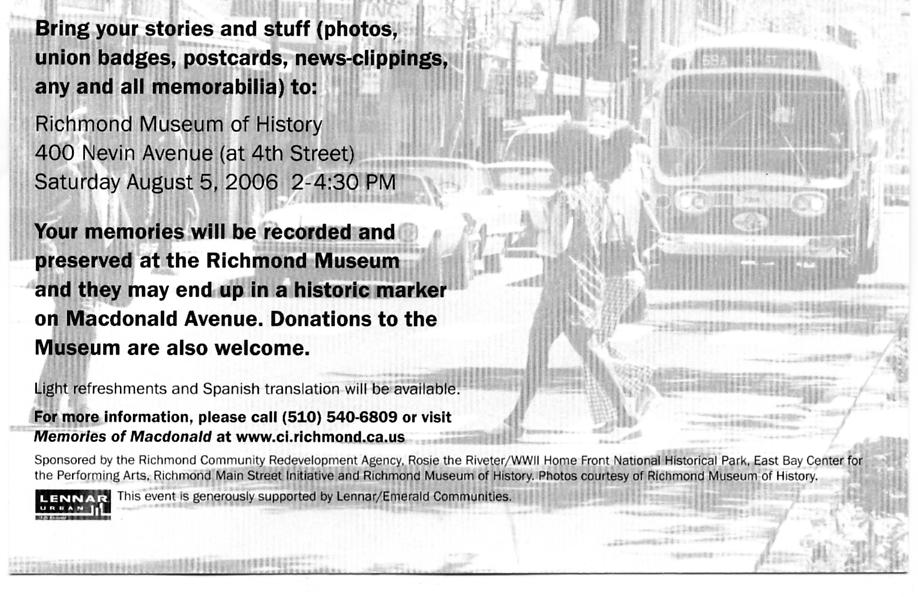
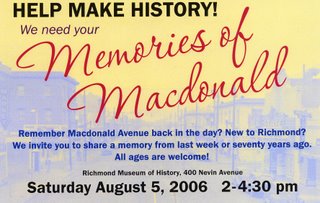
Photo: Postcard advertising upcoming event to be held August 5th at the Richmond Museum of History. We will collect stories and artifacts, oral histories, and begin the process of gathering the material that will be used to produce interpretive markers to stand along the sidewalks in the historic downtown. Click on to expand to read content.
Sunday, July 09, 2006

Aha! There's an inconsistency in our Bill of Rights.

It's been taking up most of my thoughts since writing that last post...the thing that bothers me still and won't be dismissed casually:

It's this.

I fully understand the concept of Civil Disobedience. I've engaged in it around matters of importance, like the time that I joined with others to block the passage of trucks carrying war cargo into the Concord Weapons Station in Concord during the Vietnam War. Or, more recently when we stood at the gates of the Bayer Pharmaceutical Corp. in Berkeley when they joined with other big pharmas to block the sale of generic drugs to HIV victims in Africa. I (We) were on both occasions purposely disobeying the law to call attention to an unjust policy -- with full awareness of the legal consequences and willing to be arrested for the actions. That, according to Kohlberg ethical standards, is the highest form of patriotism. One has only to re-read Thoreau or Dr. King for confirmation. The hard fact is that -- according to the Bill of Rights -- I can engage in Civil Disobedience, but must be willing to face the penalty for my actions.

However, under the Freedom of Speech dictum, we have to face the old "you can't yell fire in a crowded theater" gambit -- without facing criminal charges;" the sole exception punishable by law.

In the case of the displaying of the Confederate flag or any other paraphernalia (KKK regalia, for instance), those rights can be exercised and are fully protected, but the policy does not provide for a penalty for exercising that right in the event of the dire consequences it may invoke or the pain it might inflict on the unsuspecting or the intended victims. That's a problem that needs addressing, I believe.

But, the fact that the Civil War was never cleanly won, nor have the issues of full emancipation or the question of reparations been addressed, much has been left unfinished; in political limbo. These critical omissions are clearly indicated by the fact that the 1863 date of the signing of the Emancipation Proclamation -- clearly the epochal event in the life of this nation -- has never been declared a national holiday -- makes one wonder, doesn't it?

Now that's a conversation we've postponed for far too long. I'm almost certain that I'd have been spared the pain of uncertainty about my position in space on this 4th of July, had it been so. My right to stand in my own shoes upon any spot in the city, the state, or the nation on that day should have been unquestioned, at least in my own mind. After all, my family has been a part of this nation since the 1600s on one side and before the 1805 Louisiana Purchase on the other!

It is inconceivable that I should have been made to feel defensive about fears and resentment at the sight of those who would question my right to exist -- as I did in seeing blatant evidence of strident segregationists on the streets of a small town in my state -- and on the day celebrating the birth of my nation!

Fear gone -- anger present and accounted for. Now to find ways to continue to transform it into something usable and not destructive to myself and those around me ... .


I've been silenced by fear, I think ... at least for a few days ... .

The 4th of July holiday started out uneventful enough but quickly escalated into a climate of unease that was completely unexpected.

On Saturday morning I drove up Highway 101 to Route 128 -- through the Anderson Valley, through the winding country roads that opened into that beautiful redwood forest leading to scenic Coast Highway #1 -- without a care in the world. Had thought to take along an audio book of "The Devil Wears Prada" (don't bother -- it's a waste of print) that shortened the trip considerably -- until I discovered that the book wasn't going anywhere that I cared to be. It just made me feel old and irrelevant.

Arrived in Mendocino anticipating a bucolic 4th of July weekend in the quiet artist colony now beginning to fill with tourists and weekenders from nearby towns -- in for the festivities.

Dorian had chosen to spend the weekend in town with friends; David and his kids were occupied; and I hadn't heard from Bob for weeks, but assumed that meant that he was deep into his own life and needed me not. A mother could hardly ask for more -- even an older one whose "children" had outlived their childhood by many years.

This would be a time to enjoy. I'd thought to bring along my camera this time in the hope that the Headlands might still be wildflower-covered against the blue sea. I'd so regretted losing that shot on my last visit. Just maybe the coastal areas were more forgiving and the fog just might have slowed summer enough to not have lost spring, totally.

It was not to be. I slipped into town shortly after arriving at Tom's -- camera in hand -- but the headlands yielded nothing but dandelions and a few stray California poppies that were not those of my childhood (a deep orange) but indistinguishable from the sulphuric yellow of the dandelions that they now mimic; a disappointment.

After a quiet weekend, July 4th arrived to the rare sound of traffic slowly-building to a crescendo along Highway 1. Tom and I had decided to skip the fireworks the night before at Fort Bragg, but would drive in for the parade scheduled to start around noon. I was excited. It's been a long time since I've witnessed this kind of classic American smalltown holiday parade and it made me nostalgic for a time I've never lived -- kind of borrowed from a Norman Rockwell cover of the Saturday Evening Post of long ago. It was all to be Boston-Pops-on-the-Green and "American Pie."

We drove the short 5 minutes from his home and parked just a block or so inland from the Headlands to join the other walkers to the place where the parade was haphazardly organizing itself. There were decorated antique cars, the volunteer fire truck; children with crepe-paper-decorated tricycles; homemade "floats" covered with plastic flowers; balloons and dogs with fancy collars; flags everyhere, and for a few hours there I had found myself so steeped in small town celebrating that I forgot ... .

It came to me in a momentarily flash -- that I was the only person of color among thousands! This is a uniquely white American holiday -- in celebration of a time when I would have been enslaved. I'd forgotten.

In the city of Richmond where I live there is a 40% African American population, perhaps 35% Latino, a significant East Indian as well as Laotion and Asian demographic as well. We forget that we're not the generic people, but the exotics, because our numbers tell us differently.

I thought ruefully for just a minute as the tune ran across my mind, "Where have all the powers gone?" Obviously, there really are two Americas; the one where I live, and the one where I found myself this day. How quickly I forgot... lulled to sleep by my friendships that span time and space and distance and race -- and that have in these years when there's more wheat and less chaff -- I no longer make those distinctions so readily.

Then it happened: We came alongside a flag-draped flatbed truck carrying muscular young white males. They were displaying two large flags -- one traditional stars and stripes -- and the other, that of the Confederacy! I felt a chill. I wondered if Tom had noticed. He had. I wanted to run. Fear and panic took over my body and my sense of balance and logic -- and all I could think of was leaving. Now! And we did.

Later we spoke of it. He said all the logical things about there not being any way to prevent such expression -- given the Freedom of Speech mandate of the Bill of Rights. But I didn't want logic. I didn't know precisely what I wanted to hear, but that wasn't it.

Then I recalled an online encounter I'd had years ago with a woman somewhere in the South. She'd spoken with great pride of her southern heritage and love for the flag of the Confederacy -- and I'd challenged her, but I wasn't at all sure of my ground. We'd been virtual friends up to that point, discussing many things upon which we fully agreed. What was different now?

She'd also brought up the "Freedom of Speech" issue, and I was just as troubled then about why that didn't suffice for me as I was on Tuesday. Until -- until I realized what was wrong with that argument. "Of course you have the right to display your flag," I told her. "But there is a cost to your doing so. It means that you must sacrifice my friendship by such an act. And, if you are willing to pay that price, then it is surely your right to so choose." I felt our mutual sadness at the time, but felt the truth in my words and held to them.

Perhaps that goes for the young Americans on that flatbed truck. It seems to me that they're displaying a total disregard for those who carry in their DNA the suffering associated with the nation's history of slavery and injustice. The cost of their action might well be the inciting of violence from those so marked. The cost of their act might well be the sacrifice of peaceful coexistence. Their willingness to do so by holding to this particular expression of the freedom of speech is an affront to freedom and justice for all. And, of course, that is their right, guaranteed by our founding documents. But do you suppose that anyone ever takes the time to weigh the cost?

I drove home -- back through the redwoods seeing for the first time more shadow than the flickering filtered sunlight that usually is so visually interesting -- and back through Philo and Booneville where I saw only that there were no people of color anywhere in sight -- and I drove just a little faster ... .

Happy 4th of July may not be all that I'd hoped, but I'm workin' on it.

Photo: "Sage in Bloom," from The POD. In memorium.
Thanks, Alf and Fern.

Saturday, July 08, 2006

The strangeness of loss in Cyberspace ...

We'd never met, Sage McKenzie and I. We were members of an online community known as Seniornet, a San Francisco-based program designed for seniors a couple of decades ago. I logged on for the first time about twelve years ago when our cyber-village was made up largely of retired business executives, teachers and lawyers and physicians and artists; all venturesome elders who had the wherewithall to both afford the hardware and the courage and the skills necessary to learn to use the software that allowed us into this brave new world. We brought with us no small amount of experience and daring with which to enter the information age as wide-eyed as the youngsters who accepted technological advancement as their natural legacy. Sage came into it as an artist, interior designer, and website constructor -- I through the doors of political activism and public service. We both embraced the times and advanced years that life afforded us as uniquely as we had embraced that period in the Eighties when the human potential movement was in its prime and Esalan was the Valhalla that beckoned us into new dimensions of reality and exciting new concepts about our inner workings. We shared interests in Tibetan Buddhism and humanism in small ways and terse sentences -- usually through online conversations with others that drew us in from time to time. We'd always planned to meet one day ... to continue those conversations... .

It was during those early years in the Nineties that I learned some valuable lessons. I knew, for instance, that it would be possible (if one so wished) to toss "self" and take on a persona of one's own choosing. In those first days on AOL I could see that it would be possible to drop all signs of race and enter into my generic-person self without the handicaps of racial identification and all the stuff that so troubled others. That lasted about 3 days. How on earth would anyone know what my words meant if I didn't express them with total honesty? What meaning could mere words have without context -- and that providing background would be required for the sake of integrity. Everything would have to be succinctly expressed in the few short sentences and paragraphs demanded by this new defining communication system. Would I waste them by using it as a toy? What did it mean that AOL offered me up to five different screen names; separate identities to be used at will? Could this be encouraging deception? Could one trust this new virtual world?

Maybe it was the fact that we were all elders with the growing sense of urgency that comes with these declining years. Perhaps it was that the medium held something inherent that promoted a level of intimacy otherwise impossible in the everyday world of reality. Maybe we needed to relearn what constitutes intimacy at all -- and what it is that allows us to skip through the walls of separation that no other medium had ever allowed us? Whatever it was, we seemed to recognize the privilege we'd been allowed by those kids in suburban garages tinkering with wires and electrons that could bring the entire world together for the good or ill of humankind.

After years of those online conversations that gave us the ability to advise and consent; express both love or rage as needed; deal with old hurts through surrogate online relationships; find empathy and support when life demanded it; Sage McKenzie emailed me one day to say that my words held deep meaning for her, and that it felt sad that more people were not in a position to read them. "I hear beyond your words, Betty, to a place where you touch on the universal. You are a writer who needs to be experienced. Your honesty comes through in ways that instruct and teach. I'd like to create a website for you -- of your own -- to say what you will." I've tried hard to live up to those lofty expectations. Only you will know whether I've succeeded. I'm still humbled by her faith in my abilities.

And so saying, this lovely woman whom I'd never met except in that place in the mind where we leap space, time, and distance; this artist who designed websites, wove beautiful fabrics, designed virtual systems; created "Cbreaux Speaks," and from some small town in Texas that I'd never even heard of.

She included links to my blog on her own website and -- though we rarely were in contact except when something happened that begged sharing (an occasional news item or special mention), we remained relative strangers.

Therefore, it's hard to understand just why today when I learned of her death -- I feel wounded and in despair -- as if a part of my being has left this dimension. And -- it's more than simply the feeling of losing a friend -- but as if a part of my soul has been torn away leaving tender places where once there was wholeness.

There is a remaining small group of women who know themselves as "The POD," whom Sage created on a website that gave physicality to each in a place and time when we were simply words on a small screen. Over the years several have passed on -- Glorious, PurpleGram, BeaSmooth, Nadi, Lleena, and others -- leaving fewer of us now who are all on this day feeling the pain and loss of her through the oft quoted "... death from natural causes."

Maybe the over-riding "natural cause" is that final escape into the dimension of inexplicable and unending love we must all slip into one day -- out of this life and into the memories of those who've loved us into an immortality that both Sage and I believed in fervently. We've shared so much of life in this unlikely medium that has provided so much caring across time and space and distances that only the Star Ship Enterprise has previously had the capacity to travel through.

Thank you, Sage McKenzie.

Rest in peace ... .

Betty

Tuesday, June 27, 2006

Thinking about Elliot and Jason Blaine and "The Music People, Inc." ...

Maybe I witnessed the crossroads where Hip Hop Culture and Gangsta Rap came together in the City of Oakland. Maybe.

During those years as the proprietor of Reid's Records, my major music supplier was an Emeryville firm run by a father and son team of former New York entrepreneurs. "The Music People, Inc." was a one-stop operation that specialized in small label releases for Mom & Pop music stores that couldn't afford to buy in the huge quantities common to discount house merchandise orders.

Wholesale costs are based on volume -- and we small stores were buying dozens of an item while the big dealers were ordering caseloads. One of the secrets of the industry was that -- with the feature of return privilege -- those big guys were buying in huge quantities and then returning the unsold items for credit, making the economics of the distributor highly volatile. Failures of record stores were frequent -- leaving Music People with merchandise returns of releases that had lost their shelf life long before and were by then completely worthless.

We paid more at wholesale than the discounters sell their products for over the counter. The only way to survive was to specialize; and that we did -- in black gospel music.

We were a motley group that could only exist day-to-day by the goodwill and patience (that's saying it as kindly as possible) of a family that carried most of us on the books with a perpetual indebtedness that held us in a never-ending grasp of debt and servitude. It was probably a marriage of convenience; as the Blaines needed our little band of intrepid store (mostly young and/or black) owners on their books in order to survive in the wholesale marketplace as a bottomless pool of "receivables" that serves as the coin of the realm in the chaotic music business.

We were brought together from time to time for celebrations - hosted by Elliott and Jason -- that heralded the release of some fledgling recording artist. Over time we enjoyed their largesse but also developed a sense of duty to them. After all, it was Elliott Blaine who allowed me to keep possession of our store when Mel crashed, financially, and lost it all. The wholesale bills I inherited were staggering. Over time it was the willingness of Music People to allow the time for me to recover enough to change the direction of the store -- and to shift seriously into black gospel music at a time before the general market had recognized this as a lucrative field. That made the difference between survival and utter failure. But that was back in the Seventies and -- eventually the disaster was overcome and Reid's survived even Mel's tragic collapse and eventually death in the Eighties, and still does after 62 years of struggle. Another generation of Reid's continues the reign, our youngest son, David, is now at the helm.

Meanwhile, however, I watched Stanley (MC Hammer) emerge along with a string of young rappers who came under the wing (and exploitation) of Jason Blaine. Stan was a nice kid who was known to hang around the A's dugout at the Oakland Coliseum -- to dance like a demon -- and exude enough personality to light up a large room. We knew he would one day blaze a new trail in the record industry, and he did, though his trajectory failed in less time than it takes to tell the story. I'm sure that the Blaines were instrumental in his ascendance.

They eventually shifted their inventory to take advantage of the new wave of Gangsta Rap that was emerging in Oakland, and their One-Stop operation slowly lost its value to me and my "old fashioned" inventory needs. The son, Jason, became an ardent promoter and, eventually, a producer of rap artists and I watched as the wave of the genre began to sweep like wildfire through inner cities across the country, giving status and bling to a new generation of unlikely baggy pants black-hooded finger-jabbing stage-stalking stars with little to share save unbelievable energy and a formidable beat! But I'm quick to add that a number of true poets rose among them, and continues to do so.

Early on, I found myself caught in a strong resistance to the kinds of material coming out of the industry. It was strange to have young elementary school children come into the store with their little walkman tape players in hand -- to buy cassettes that played the questionable material of LLCoolJ directly into their ears. I'd listened to those tapes and knew that -- if it had been a record they'd purchased and placed it on their family's player for all to hear, their parents (most of whom I knew) would have been shocked and horrified! Instead, I'd watch them walk out of my store (having split the plastic, hurriedly inserted the tape, and checked the earpiece) with an evil grin on their little faces -- knowing that I'd supplied them with sounds and language and mayhem and no one else (but their young friends) would know. I could hear them at times, gathering on the street corner rapping a word-for-word replication of things far beyond their experience and it saddened me. And -- I'd become an unwitting co-conspirator by simply making an honest sale. I couldn't do it.

I posted a sign in my window to the effect that those releases would not be available at Reid's and that I'd suggest that they pick them up across town at Leopold's. Music People, Inc., was extremely unhappy with me, and my quiet protest caused a small riot in the daily newspapers when a reporter happened to drive past and made note of my sign. The radio stations picked it up as well. I was suddenly a minor celebrity after a radio talk show host stopped by for an interview that was aired throughout the area.

"Have you not, in effect, denied the right of free speech by such an action?"

"Nope. Everybody's rights were honored. The record producer had the right to make the record. The artist's right to perform the material was respected. The child has a right to buy it if he or she so wishes. But I have a right not to stock it if that is my wish. Every time time I purchase records for resale, I'm making a pre-selection for my customers. There is nothing special in this action. I chose not to sell a product for my own reasons. That is my right."

Over the ensuing years -- watching the tragic deaths of artists like Tupac Shakur (a true Hip Hop poet), Biggie Smalls, et al, I've seen nothing that would have caused me to regret that action. I saw Music People, Inc. and the record industry in general elevate and commercially exploit the genre to a place where materialism in the form of gilded teeth and diamond encrusted Rolexes and multiple stretch Hummers overpowered the arts movement as represented by the Nu Upper Room artists and the exciting non-abusive arts they expressed so magnificently.

I see the remnants still in Jill Scott, yes, and Will Power et al. Maybe their time has come -- and the wisdom of Bill Moyers will finally bring them the recognition in American Letters they so richly deserve.

With the experience of the Nu Upper Room so fresh, I could not be satisfied with what was beginning to evolve as a distortion of Hip Hop, or, at least a distant piece of the whole that was to form the basis of new black music -- as the direct results of commercial exploitation by a heartless industry. This would become the commercial face of this new art form, and would eventually crowd out the Hip Hop culture that I'd come to so admire.

Anybody wanna fight? (Grin)

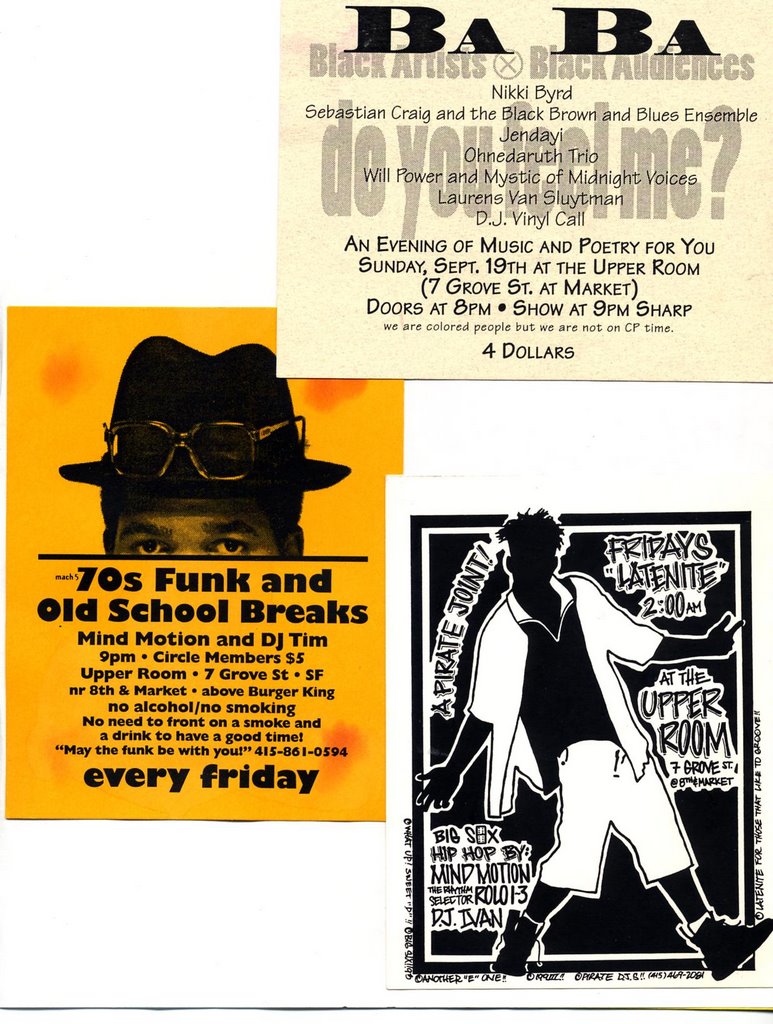
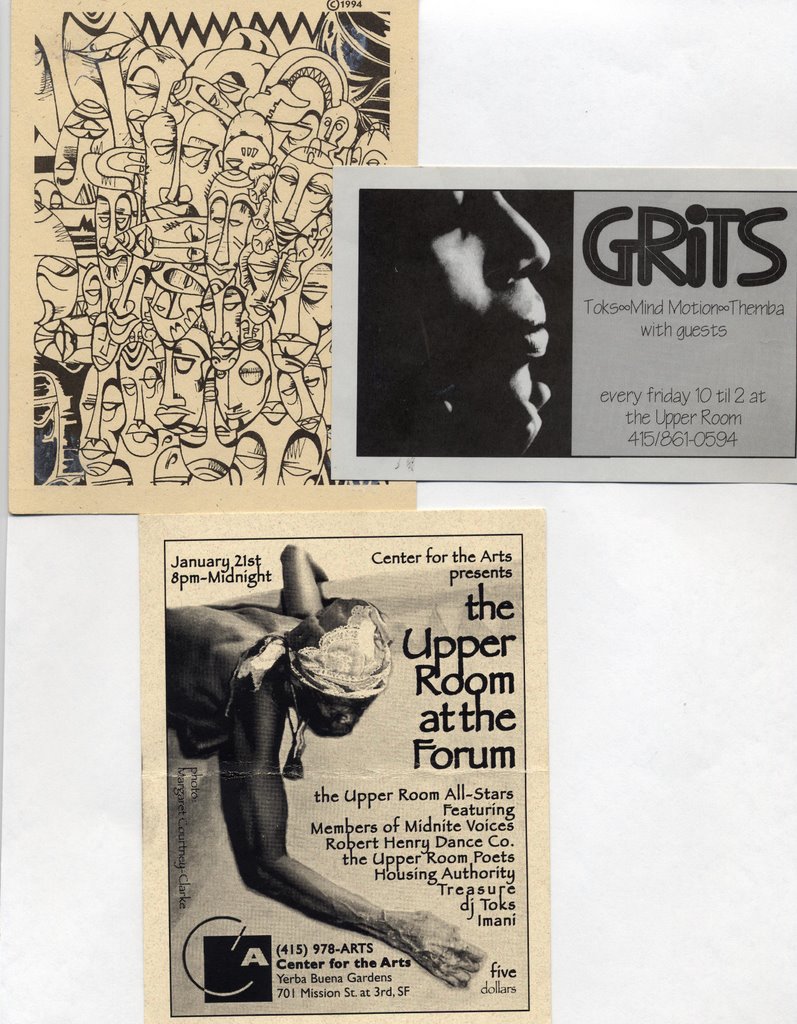
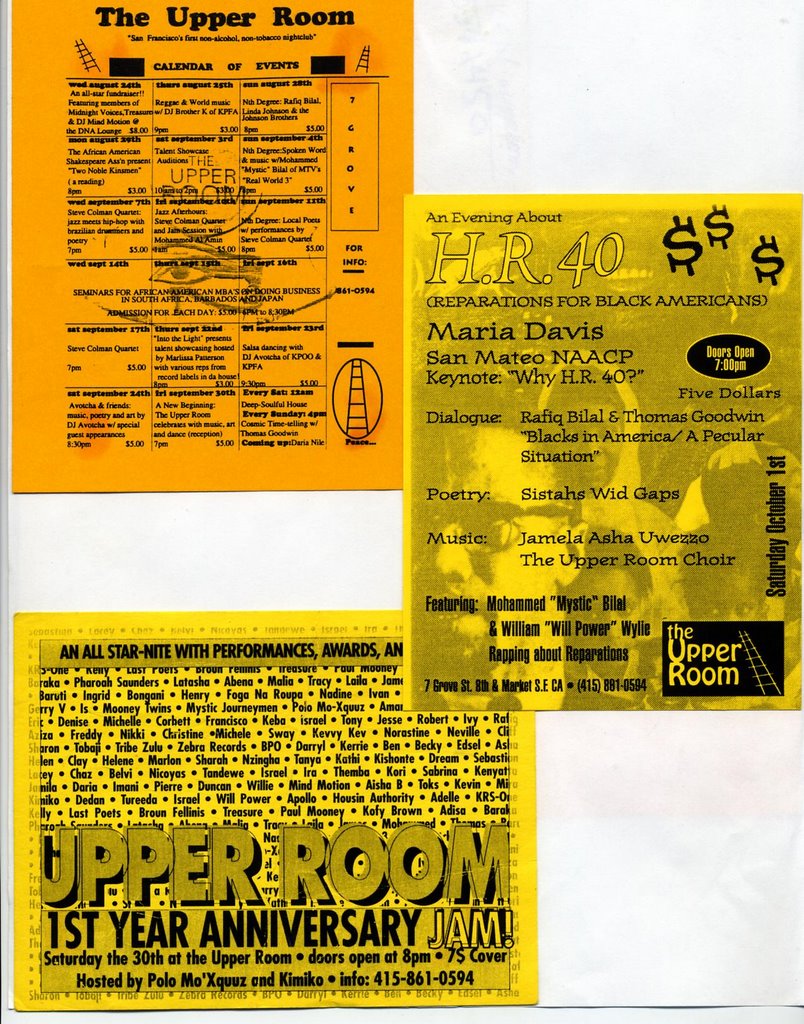
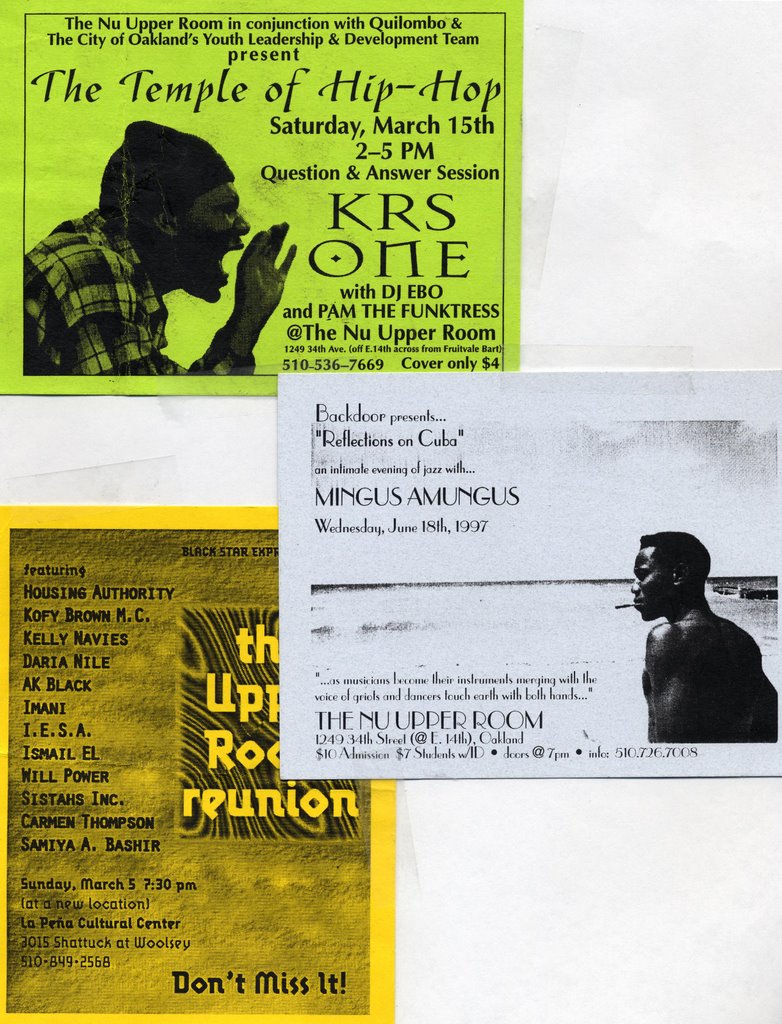
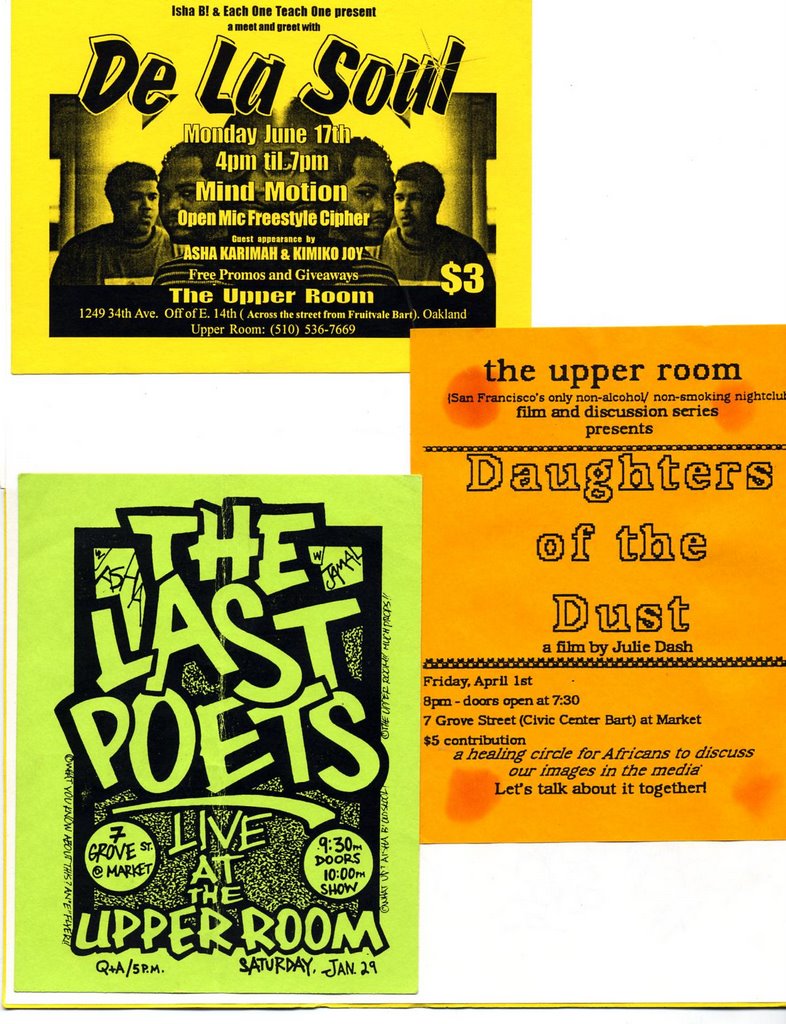
Photo: Wish I could find some way to donate these historic flyers of a brief era in Camelot to a place that would treasure them as I do. Any ideas? There are more ... .

Sunday, June 25, 2006


From then to now ... and the PBS interview ... .

Okay, so I've gotten myself caught up in the past again, and in those unbelievably exciting days of discovery and the evolution of the Hip Hop generation. Could be that this may be regarded as highly inappropriate for an octogenarian, even one as active and aware as I. Not so.

Last Wednesday, on the hottest day of the year, I drove out along the Richmond Parkway to an industrial area where I was to meet with the team of three videographers who are working on the 4-hour documentary on San Francisco Bay. It will be shown nationwide in four one-hour segments at some point in the future. The interview was set for three o'clock, and the place was the unlikely hard-to-find small corrugated metal building set back from the road through a winding course past dumpsters and shacks and trucks of all sizes. I'd been met by a series of handprinted signs leading through the maze to enter from the rear of the complex of old dusty structures.

For this I'd dressed meticulously in conservative black and my most modest silver jewelry -- a gift from Tom and created by a well-known Mendocino jeweler. My hair was swept back in the classic Betty hairdo that was no hairdo at all, really. Just parted in the middle and caught in a small jeweled clip at the nape. Looking like someone ready for afternoon tea, I arrived to walk into this strange unbearably hot (102 degrees outside) building that had been sprayed with something called theatrical "smoke," used to diffuse the background. The cameraman told me that this building had been purposely rented for these interviews for the Kaiser Homefront segment in order to give an "industrial" appearance to the piece. Should have worn my blue jeans, maybe, and a bandana. Wondered for a minute if I hadn't chosen precisely the wrong appearance for this interview.

I was following County Jury Foreman, Antonio Medrano, who was just completing his camera time. He was dressed casually in slacks and open-collared shirt. My feeling of being over-dressed lingered for no more than a minute or two -- and quickly disappeared as I was caught up in the process.

Seated on a straight-backed chair banked by baffles and lighting screens -- across from the off-scene interviewer (being a "talking head"), we then entered into a dialogue that lasted for just short of an hour --- from which no more than 5 minutes will be used, I'm guessing. On the drive home -- as I ran back over the experience in my head -- I figured that I'd be lucky to not come off as proud and highly arrogant. I really had never really accepted the role of "Rosie the Riveter," given my personal warfront history as a simple file clerk in a Jim Crow union auxiliary that had no power and not even a view of either ships or a shipyard. I'm certain that my 60-year-old anger bled through the interview. It was payback time and I was ready to speak my peace, and did.

Fortunately, as I left the building, the director was driving out behind me to pick up the next interviewee, a woman who had not been "in place" when the war came, but had been a 14 year-old 4th grade grammar school dropout from the Bayou country of Louisiana who had been allowed by her mother to accompany a man who was on his way to California, hopefully, to find work in the war effort. I've often heard Mary "Peace" Head tell her story, and wondered each time at the huge differences in the experiences of many women in that population of blacks and whites who made up the 108,000 newcomers who descended on the Bay Area and changed our world completely -- and those of us who were in place when war came to us.

Mary and I are both African American, but there could hardly be two more different lives than those we represent. One of the production team had remarked when he announced that he was off to pick her up from her home in nearby Parchester Village, that "Mary is so colorful!" She is that, in every way. I felt drab and terribly conservative for a few seconds as I let those words sink in. Mary is prayerful and goes by the name of "Peace," stating that this name was given her during her time of working in the shipyards because she prayed with the workers, and over her own work to bring peace to those overseas who might be touched by it. She wears a sequin-decorated hard hat to these occasions, and proudly. "We all got along," says she. "The hell with that," says I! "We'd have killed one another if we didn't have those damned ships to build!"

I have no idea what will be used or what will be edited out, but I surely didn't withhold my feelings -- not for a minute -- but always with characteristic restraint and modulated in ways that wouldn't sound belligerent and cause me to be tuned out. I've learned to be careful about that at all times. But I could not allow this opportunity to be truthful about a period when race relations were so highly romanticized -- to stand without challenge. After all, the black and white workers from the southern states, had not yet shared drinking foundations or public accommodations and wouldn't for another 20 years. They'd brought the South and its segregation practices here to the Bay Area, and I don't think I've ever forgotten.

I was also to learn over time that, in addition, they also brought a resistance movement that would serve to bring major social change over the next few decades, and for that I am eternally grateful. It might have taken those of us in place another generation to accomplish what those black southerners gave birth to by having had their expectations raised by the experience of leaving the hostile South and finding, instead, more of the same in this new land of opportunity.

I think the nation is ready for those conversations.

I know that I am.

Photo: More flyers that depict the richness of activities and the life at the Nu Upper Room. The print of the multiple faces is one of Naven Norling's drawings. This young genius also left for New York when the Room closed, but I've no idea what kind of success he may have found there. Would love to know if anyone has followed his career in the art world.
More Nu Upper Room handbills:

It has occurred to me in looking through this file that I may have saved enough of these wonderful artifacts to have a website created. What other way could this history be shared?

I'm certain that there are others who had the good fortune to have lived a part of all this -- and who might be thrilled to be able to recover whatever might remain of the living history of the Camelot that was ...

Somewhere I have numbers for Will Power in New York, or Naven Norling who designed some of these flyers, or Keba Konte or Aisha Bilal ... .

In the event that you, the reader, have any idea of how to pass these along, email me by using the link on the left side of these entries.

Oh, another thought in passing: "...if every bit of black influence was stripped away from what is loosely called, "American popular music," we'd have nothing left but Lawrence Welk!

The erotic images below are a reminder of Naj, a young woman patron of the Upper Room. She was from Iran and a very successful career national rep for a major cosmetic firm. It was Naj who first introduced us to the lyrical poetry of Rumi. We were planning a late night reading about the time that news of the impending closure of the Room came to us.

Saturday, June 24, 2006

More flyers from the Nu Upper Room era...

as created by the artists, themselves, in these small handbills. No one charged a fee for performing at the Upper Room though there were times when the hat was passed for someone in need. The young people occasionally prepared food at home to sell or share during events. "Do not smoke" signs were prominent as both a warning and as a political statement of meaning -- a part of the decor in the form of huge paintings on oil cloth by the taggers among them. Those young artists made the rules and those of us who were honored enough to be allowed entrance into their world were among the most fortunate of people.

Over the years some of these kids have gone on to fame and fortune in the Hip Hop world; some dropped off into the bland world of the workplaces where their talents had to be restrained for the sake of supporting themselves and offspring in -- mundane traditional ways of a market place inhabited day-to-day by the "ordinary." Some surely found themselves caught up in the prison system -- since they would have fallen within the statistics common to young black and brown males. Others found their way into the Alice Art Center to lead and learn from others. Some have undoubtedly lost their lives through gun violence on the mean streets that eventually over-rode their attempts at creating a peaceful world of the arts. But all can look back on a time when they proudly refused to be dragged into the fogbound world of addictions to nicotine, chemicals, and opiates, and lived instead in a world where the only drugs were the arts and life among peers as creative as themselves, and they did it as agnostics with no affiliation to any religion or agreed-upon philosophy except that of human love and acceptance of one another across all known barriers of gender, race, or ethnicity.

How sad that they weren't embraced by an unsuspecting and mistrusting society which still has no idea that this Camelot flourished over several years in the City of Oakland for a period like no other before or since; except for maybe those years when Isadora Duncan, Edward McDowell, Jack London, José Limon and others of their day, reveled in literary salons a few miles away in the meeting rooms of the historic Oakland Unitarian Universalist Church on 14th and Castro streets. How can I make such sweeping claims? It's easy. On Thursday night I saw Will Power sitting in the chair across from Bill Moyers, and felt the rush of confidence in my ability to recognize genius. Wonder what would have happened if those wonder kids had been accorded the same respect and reverence? They were surely equally as important to the cultural and artistic development of the Bay Area as were those earlier bohemian trail blazers of the arts world.

Now we'll never know because black talent continues to be regarded as little more than raw material to be infused into mainstream popular culture -- and often less - except for the occasional single shining star that rises above the crowd and soars ...!

So sad!

How destructive to the lives of aspiring young black artists ... .


Photos: Click on them to open to full size.

Recognized it at first sight ... here was one of the great ones ... .

During the Nineties, I believe, a time of one of the many great adventures in my life -- I served as a self-appointed-co-interim director of the Nu Upper Room in the Fruitvale district of East Oakland. It happened by sheer accident. One of my music store customers was a fascinating youngish dreadlocked green-eyed lightskinned handsome and proud African American man from San Francisco. He called himself Rafiq Bilal, and appeared to be a gentle revolutionary. He stopped in one day when I was behind the counter -- wanting to sell a two album videotaped set of "The Story of Africa." He needed money, and at that time I maintained the only location in the Bay Area that specialized in the rental of African American videos. It was a fateful meeting. I instantly and intuitively recognized him as some one I would love to know -- and indeed did in a friendship that grew and flourished over the next several years.

The Nu Upper Room at that time was an interesting gathering place in the South of Market Area of San Francisco. It had evolved out of a drug treatment program that Rafiq had directed at Rev. Cecil Williams's Glide Memorial Church in the Tenderloin. It served as an evening meeting place for members of the recovery community -- where there would be fewer temptations to relapse back into the underworld of abuse. Rafiq had created a place where poets, writers, singers and dancers, came together in an informal collective where they could share their work in an atmosphere free of drugs or alcohol, and be safe.

Over time, young people from around the Bay stumbled upon the place and slowly took it over and began to form a loosely-connected artist's showcase where visiting musicians and artists joined with young people and mentorships started to form and the arts flourished. The young soon outnumbered those first participants and this became their "in" place. The young had also yearned for a safe place for themselves in a world increasingly enveloped in the darkness of addictions of one kind or another.

As it is with places where young people of color begin to collect in significant numbers, the S.F. police eventually grew suspicious over time and harassment forced this incubator for exciting new arts to relocate outside of the city; cross the Bay and into an old crumbling Masonic Temple in the Fruitvale District in Oakland. It was here that I first visited this remarkable collection of young people in full bloom.

With no more than colorfully designed flyers scattered in high school campus parking lots and tacked on telephone poles and slipped behind windshield wipers around the Bay Area -- literally hundreds of young people would come together in that leaky old building with code violations galore and few fire exits -- for concerts and Hip Hop poetry jams; young grafitti artists painting with large brushes from buckets -- onto 4'x8' panels of sheetrock -- to the sounds of experimental live jazz as young dancers improvised to the music ... it was a period of the most exciting arts movement one could ever witness or dare to be a part of.

Not too long after I was first introduced to this magical place (where I now spent many weekend hours) Rafiq Bilal suffered a massive stroke and was hospitalized in the local county hospital. The Nu Upper Room family was demoralized for weeks before Jennifer Ross, Shakiri, and I began to alternate as a group of "den mothers," kind of interim emergency artistic directors -- as a way to keep the place open and operating long enough to find answers to where it might be moved and nurtured into the fullblown movement we each recognized it to be. We knew intuitively that here was something precious and important, if only we could protect it long enough for others to know ... .

In time the blossoming of something I saw as just as significant as the Flower Child period of the Haight was forced to disband. This alcohol- and drug-free oasis of an environment that was producing such exciting art must soon be abandoned -- due to the impending redevelopment of the Fruitvale district and our inability to meet the really tiny amount of moneys needed to continue to occupy the disintegrating 100 year-old building. I'd like to add that the local police -- fully aware of our activities that ran late into the night on many occasions -- were totally supportive of our presence despite those clear code violations and significant weekend noise. They often stopped by in plain clothes during their off-duty hours to participate in these underground activities. Unlike San Francisco, the Oakland officers were wonderful about looking the other way in order to protect our late-night partying. Those same police in a different time but in the same place, are in a constant struggle to quell the Side Shows that are seen by an unknowing community as a scourge upon the city. Little do they realize what was lost or how different it all may have been had they known and nurtured the Nu Upper Room and its collective of creative artists.

It was on such nights that I often sat in that darkened hall to listen to Amiri Baraka read from his latest works; Steve Coleman lead jam sessions that grew from informal jazz workshops; young rappers express the new cadence and body movements -- competing in the telling of the stories of their lives and peoples; dancers and choreographers testing new materials; there was (now) internationally known visual artist and photographer, Keba Konte; older blues singers and monologists working together. We saw a reunion of the Last Poets of the Sixties and the early days of the great jazz group, Mingus Amungus. Gradually, the age groups shifted to be more inclusive and Robert Henry Johnson (at one time one of the Alvin Ailey dancers) and his mother, a former San Francisco nightclub singer appeared together one evening before an audience of hundreds. Sister Shakiri of Zaccho Dance Theatre, a playright of note presented new works, -- and -- the reason for this entry at all -- Will Power, one of the young guiding lights of the Nu Upper Room, 6 foot 3 inches of lanky richly-talented San Francisco performance artist, would present solo pieces that were astounding in their perception and sheer brilliance. If there had been a Board, Will would have surely been considered its chairman -- and Rafiq's protogé.

After it's closure, that talented collection of extraordinary young artists were scattered to the winds. I tried vainly to find a building to drop over them, but failed miserably. Despite years of building goodwill with the Berkeley city government, I could get no one to listen. Black Repertory was the location I worked hard to acquire for at least a few nights each month. But there was no way to share with the family under whose control it remained through an unbreakable 25 year contract with the city (for a dollar a year!). It was my intention to try to get this city-owned community theater to allow us to book its dark nights to begin to house this emerging new art form and the broad spectrum of young artists who were creating it. I could convince no one of what I'd seen growing in the East Bay -- and gradually those young people of the Nu Upper Room began to disappear to Southern California; a few started to appear from time to time at La Pena on Shattuck Avenue; later a few created Black Dot, a similar though smaller undertaking in Oakland. But the most dedicated moved on to New York where they continued to mature into their arts as performers of note.

Imagine my amazement when last night while watching Charlie Rose interviewing leading intellectuals and theologians Bill and Judith Moyers on the eve of the airing of the first segment of their new ten-week PBS series, "Faith and Reason," suddenly on screen was no other then handsome, brilliant, "...35 year-old Will Power," as described by Judith Moyers. He is now a full-fledged N.Y. playright with a show off-Broadway based on the Oedipus myth -- but done in Hip Hop. A snippet from his upcoming segment has him seated across from Moyers in a one-on-one being interviewed and being treated with the same riveted attention as that bestowed upon the late Joseph Campbell or Salman Rushdie. I was stunned! And oh how affirmed I felt! The world was now ready to see what I'd seen those years ago, but for so many it was too late.

I recalled the last time I'd see Will -- it was some years later -- at La Pena in Berkeley in a one-man show -- and how warmly we met as though the Upper Room experience had been only yesterday. He was superb! Then I lost him again - as he followed the muse to New York and Broadway. I later saw a half-page rave review of his one-man show in the New York Times Sunday Arts & Entertainment section. I clipped and pinned it above my desk until its edges began to curl ... .

Fell asleep thinking about Will and Paul "DJ Spooky" Miller and Joanna Haigood and Shakiri -- and the so misunderstood Hip Hop World that beckoned them into prominence over time. One day we'll look back and see that they and those like them have ushered in the major art influences of the era, and even the exalted intellectuals of the day have been effected by their talents.

Will Power may be the most recent prophet of the Hip Hop movement -- and these may be the early signs that the world has come to terms with its significance.

Can't wait to see the Bill Moyers/Will Power segment on "Faith and Reason" one evening very soon. Will check the PBS website for time and dates.

Photo: Sample of the little card-style advertising flyers young people tucked behind windshield wipers through the community. Most were designed by Naven Norling, a very young visual artist who also eventually migrated to New York. A example of the way the City of Oakland has bled away its most vulnerable and talented young black kids. It was the Nu Upper Room that preceded the Side Shows as the only available youth activity in a changing community.