Saturday, April 29, 2006


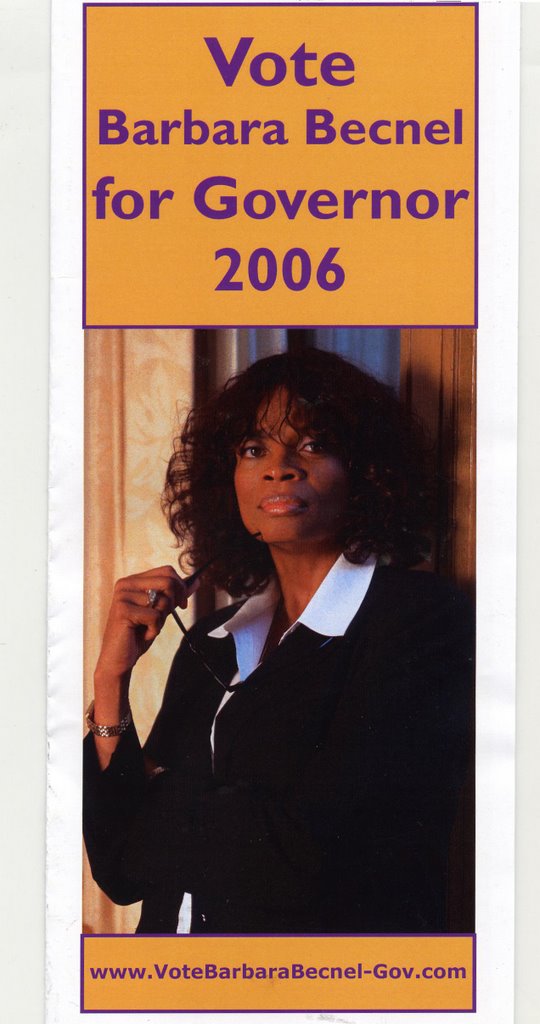
Barbara Becnel; first woman governor of the nation's largest state -- California?

maybe, and -- in the best of all worlds -- hope reigns! There appears to be a growing leadership vacuum, and surely this is a woman worthy of serious consideration -- one who will force the much-needed debate on our system of justice and capital punishment over the next few weeks leading to the June primary. Can't recall ever being stopped by the quoted odds of chances of victory -- and this isn't the time to start.

Last night I ventured in to Berkeley to hear my friend give a presentation at the Berkeley Fellowship of Unitarian-Universalists. In the audience were a number of familiar faces -- those with whom I'd stood on vigil at the gates of San Quentin in the eerie days and hours before an execution -- over many years.

I recalled that UUs were almost always strongly represented in most of the causes I've supported over time, and that is true across the nation. Have always suspected that I could go to any part of the country, visit the local UU church or fellowship and start a conversation with anyone -- starting in the middle of the fourth paragraph and leaving out all the indefinite articles! Have wondered from time to time whether there is something we've learned through UUism or whether the power lies in the kinds of individuals who are attracted to the denomination? The percentage of UUs working hard in support of equal rights, human rights, fair wages, single-sex marriage, reforms in campaign financing, world peace, etc., far outstrips almost any other denomination. When combined with the Ethical Culturists, the American Friends Service Committee, the Humanists, ACLU, and the United Methodists -- there are probably enough of us to shape almost any progressive political endeavor, and often do, by sheer strength of our convictions and the determination to act on them.

Sitting in that modest sanctuary with the others last night -- listening to Barbara make her presentation that included a description of the last day and hours spent in the death chamber as a witness to Stanley Tookie Williams' execution -- gave some sense of what I've missed by going it alone over recent years. Seeing Ann Fagin Ginger, a noted authority on the United Nations, international law, and longtime head of the Berkeley Peace Commission -- stirred those embers of days of Berkeley activism -- and reminded me to make those re-connections soon. Amplifying my voice by working more closely with others is surely something to reactivate. Living in Richmond has served to dull some political nerve endings that may have some life left in them.

Barbara has asked that I do some writing for her campaign. We'll meet again later this week to talk about that. If we're going to get the debate on the moratorium up and running through her campaign -- the time is now. There is less than a month-and-a-half left in which to move the issue into front and center of the debates. She has never even paused in her efforts to stop state sanctioned killing. It is I who slackened of late. It is I who needs now to get out of my paper hat and back to work.

All three candidates (the governor, Steve Westley, and Phil Angelides) are committed to continuing the death penalty in this state. None will even allow for reconsideration of a moratorium though there are several bills waiting to be heard in the legislature. In the event that Barbara picks up a significant number of votes in the June primary -- she will have placed the issue squarely into the debates. In the event of a close election, if a significant number of voters who are calling for a moritorium or for abolition were to vote for her -- this would represent a solid block of potential votes any contender will need in order to insure victory in November. Her candidacy may not seek the governorship as much as it is a plea for the hearts of those who aspire to lead us.

I've been hoping that Angelides would relent and tap into the growing restlessness in this state and nation around the question of the death penalty. Maybe, together, we can help him to shift to a new position. We need to convince him that there is a large and growing constituency for abolition. I know that his position is bolstered by the other two candidates, and a reluctance to break ranks in the middle of a campaign. He told me at the meeting in Mendocino that he stands alone in his family. His wife and daughters are staunchly opposed to capital punishment. Interesting?

Judge Foley has postponed from May to August the decision to rule on the unusual cruelty aspect of death by lethal injection; so that judgement will fall within the timespan of a lively and contentious political campaign for the office of governor. That should justify an open discussion before the statewide electorate. Barbara will be the instrument for that discussion and I will support her in that effort.

The media is ignoring her presence in the race. She's a courageous woman whose persistence, passion, and sheer power of intellect will serve the cause well. She will travel to Soweto after the primary to scatter Stan's ashes there as promised. Meanwhile, his cause and that of others, as well as our collective consciences will be well served by her run in the primary.

This morning (quite early) we talked briefly by phone. She was on the freeway on her way to appear on a panel on street violence at Oakland's city hall. She will attend the Democratic Convention where she will bring her cause to the table. I no longer hold delegate status in the 14th Assembly district so can't be of much help there -- but next week we'll confer and maybe, together with enlightened friends (you?), -- we can make a statement that will be heard 'roun' the world.

Wish us well. Do take the time to respond to this entry ... would appreciate hearing from you in these troubled times.

Photo: For additional information go to www.VoteBarbaraBecnel-Gov.com or send an email to Barbara@VoteBarbaraBecnel-Gov.com. We'll need volunteers throughout the state. Join us in this important struggle to bring to a halt this barbaric practice of killing in our names. It's quite possible that these are the first steps in bringing a reconsideration of preemptive war and the possibility of peace in our day, or that of our children.

Friday, April 28, 2006


Log jam ... !

Am experiencing an unfamiliar problem and it's affecting my ability to write. Too much input, too little time. No way to assimilate those thoughts that are obviously screaming more loudly as the result of the past week's experiences. Sleep doesn't come easily -- though my need for sleep is actually less these days. Have no idea whether I'm less tired or simply afraid to waste time being unconscious and unaware when the value of time has increased so noticeably in these later years. The sense of urgency that comes as a natural consequence of aging, waxes and wanes, but is more acute as the days shorten.

I'm also struggling with the feeling of being out of step on some important issues, and with the sense that I, alone, know. That is so dangerous to my sense of propriety that -- rather than that awareness coming with a proud sense of possessing some superior knowledge and therefore privilege -- I'm left feeling conflicted; feeling a disconnect with others whom I respect -- and ... old. That, because I know this cannot be true. Despite all, the feeling persists and a sense of increasing isolation comes with it.

Case in point: The immigrant question may be the most troubling. I know that I'm not a racist but that's what nearly all racists convince themselves of. None but the most evil would own such biases, surely not willingly. But I truly believe that we're in the wrong conversation. We've allowed questionable political forces to frame the debate and they've done it to their advantage.

I felt it so strongly the other evening while watching the president repeating ad nauseum, "...they do the work no American wants to do!" I thought of the countless times I've heard that phrase over the past months and years. The real truth is that no one should be asked to " ...do the work no American wants to do" surely not at slave wages. The question is less about immigration than it's about the need to pay a living wage to all workers. That's the conversation we need to be having. How long since we've seen a rise in the minimum wage?

The fact that illegal immigrants are being shamelessly exploited by corporate interests by forcing wages down for everyone is rarely discussed. Those workers are only trying to better their own lives but in the process are benefitting by white racism, innocently. The debate should not be brown against black but both against corporate exploitation!

The displacement of service workers is no longer a part of the conversation, and should be. No more pump jockeys at gas stations; no newspaper delivery boys; no elevator attendants and fewer non-skilled jobs across the board. Called Earthlink Help Desk a week ago and the techie I spoke with was in India! We've out-sourced many jobs to other countries and in-sourced more and more to those who can get past the barriers at the borders in a quest for economic salvation. And all to the advantage of corporate interests and at the cost to non-skilled and low-skilled poor whites and people of color who are being robbed by a broken system of public education and little or no health care.

Homelessness is growing exponentially. People where I live are doubling and tripling up in modest structures designed for a single family. Many are invisible because they're living in outbuildings and garages. They have no legal addresses (therefore are disenfranchised) because their makeshift "homes" are most often illegal and in violation of city codes. They are in no position to complain about roof leaks or faulty plumbing, or lack of heat, and ... .

Learned this morning that 70% of young black males are now high school dropouts. That 70% are either incarcerated or on parole by the time they're thirty. That means that we've substituted prisons for institutions for learning in the lives of the young, black, brown, and under-educated. In California 50% of students of color (both boys and girls) are "... pushed out of the public school system by the ninth grade." It's disgraceful! Small wonder that I can't sleep.

How many of these (do you suppose) would have been the gas station attendants, the janitors, nurses aides, phone operators, artists and musicians, bank tellers, elevator operators, bus boys,gardeners, red caps and barbers and cosmeticians, of another day? What ever happened to vocational training and the jobs that went with them in the crafts and service industries? And -- if we were providing preparations for such jobs would our schools be educating kids for a world that no longer exists? Isn't that another of the conversations we ought to be having?

Is the only answer warehousing our young in prisons where they're asked to provide slave labor to corporations who pay them little or nothing for their labor making furniture or assembling widgets -- (the new form of "rehabilitiative" prison practices). It's ironic that some of that work provides training of a sort, but upon release former inmates are confronted with prohibitions in those same industries that -- bans that prevent employment due to having been convicted of a felony and having served prison time; the classic "catch 22."

We're in the wrong conversation ... but how on earth do we change our course when the media and the forces that control it holds us to this mantra that eats away at our sanity and leaves us with the choice of either joining their conversation or run the risk of being branded racist -- UnAmerican -- and even more tragic than that; old!

No one can possibly survive in this country on what "guest workers" must settle for in order for the machine of American industry to continue to serve our collective needs. The costs to the rest of us are a persistently rising poverty level for the least able among us, a large section of the population subsisting on the ill-gotten gains from the underground economy fueled by the drug trade, and a bloated upper class now obscenely wealthy and powerful.

We must bear the costs of healthcare for those who cannot possibly take care of themselves as they continue to crowd the emergency rooms across the country or have no healthcare at all or suffer in silence until easily-preventable diseases bring death. And, at a time when so many of the middleclass can no longer afford health care services even for their own families. There is constant threat of deportation and the disintegration of families as children born in this country (Americans by birth) face the possibility of losing parents through discovery of their status as illegals. Who would wish that on anyone? Who but the wealthiest and least caring would see such lives as livable, or, that anyone should deserve such a fate? What kind of arrogance requires that anyone be relegated to lives of such desperation? And -- all for the purpose of allowing us to continue to live beyond our means in a collapsing world economy?

Yes. We're being seduced into the wrong conversations, as we are about the need to drill in Anwar while failing to mention the need to conserve (junk the SUVs!) or R&D of alternative energies; and about that issue that's allowing for the surveilance of US citizens in the name of National Security ... all wrong conversations.

I'm thinking that -- come November -- if we play our cards right, maybe we'll get to frame the debate again. Do you suppose?

(Think I'll click into MoveOn.com and pledge my $15/month as requested in today's plea for support.)

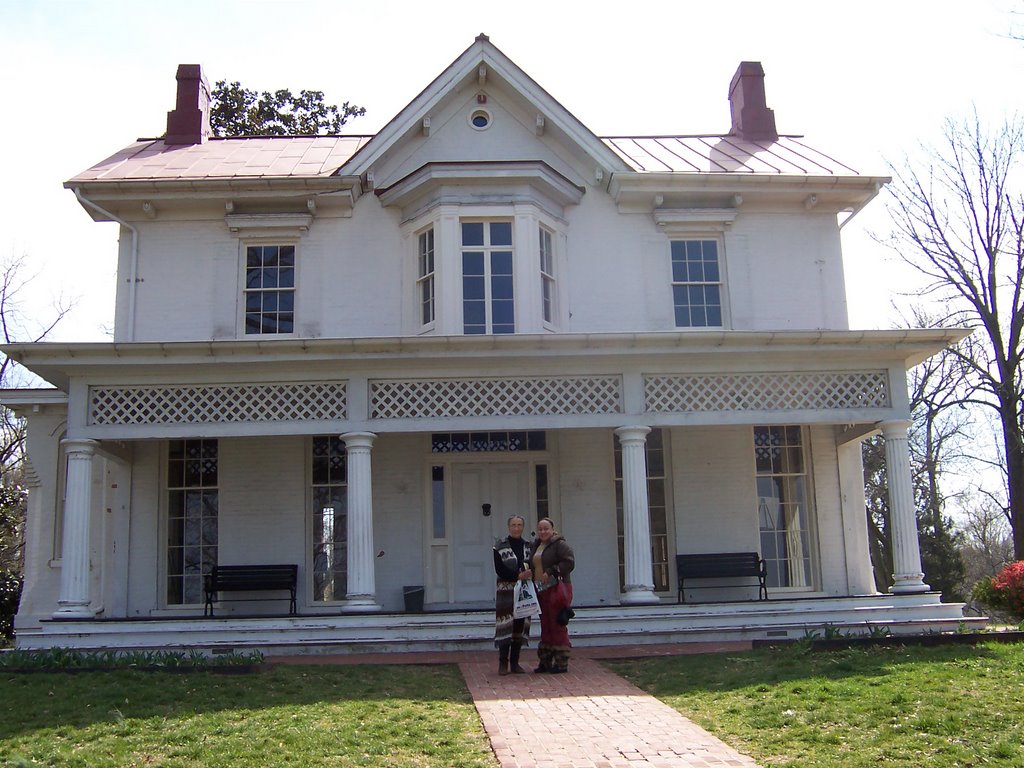
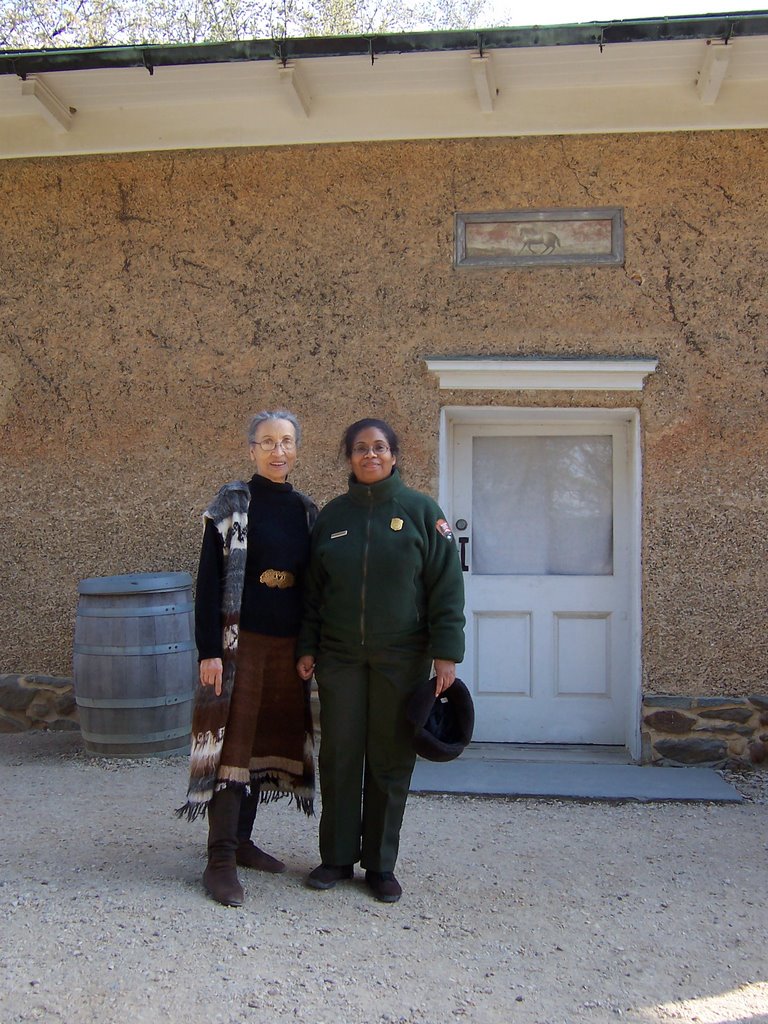
Photo: Taken in front of the slave quarters at Arlington House, the ancestral home of General Robert E. Lee. Our National Park Service guide was a well-informed young woman whose very existence in this position would argue against the enslavement of any American over another. This setting was strangely sanitized and bereft of any signs of the lives lived within those brick walls. Found myself over these past days wondering if we're now seeing slavery reconfigured (as is torture) but still destructive of families -- parent's ever-constant threat of separation from children -- forced to live substandard lives of desparation -- for beyond the ability to overcome, ever. The new face of slavery in our time?

Tuesday, April 25, 2006

Sanctuary ...

Woke on Thursday morning with just a touch of vertigo -- shortness of breath -- and with a feeling of unease that persisted well into the day. My work was being effected by the pressure of suddenly becoming "visible" in new ways and at odd times.

Yesterday I'd fulfilled an obligation to a family member to be her guest at an event in Berkeley -- as one of three women being presented to an audience of about 100. I love Berkeley, and despite the fact that celebrity fatigue was becoming a problem, it felt right to allow others the chance to draw from this font of whatever-the hell-this-is -- as well. It seemed as if I owed something to those in whose estimation I'd justifiably acquired this new status -- and maybe it was pay off time.

It was a lovely party at the North Berkeley Senior Center -- a favorite gathering place -- but was stretched out over more hours than my stamina could handle. Arrived at the appointed hour of 1:15 with an ending time of 4:30. The time would be shared by a "Reading and Book Signing by the author, Jerri Lange;" "An Accomplished Jazz Pianist, Marysa Kenyatta;", and "Our National Guest of Honor, Betty Reid Soskin." Those words were followed by the increasingly mystifying "Cultural Anthropologist and Writer," that continue to give me a feeling of over-the-topness. After all, this blog is my only writing (except for work-related pieces), and I'm not too sure what a cultural anthropologist is.

Turned out to be the proverbial straw that breaks the camel's back, and I vowed on the drive home that day to flee the field and head for sanctuary. I would pack my overnighter and head for Mendocino early tomorrow. After all, Dorian is now fairly well-adjusted to living on her own again and David can be depended upon to monitor that part of my life. Mendocino is where I would be able to slow the world enough to climb off for at least a weekend and get myself back into my box without all the strings hanging outside blowing in the winds of confusion!

It was a strange drive. Unlike other times when I see the changes in weather patterns, wildflowers along the roadside, new growth of bright greens -- the various shades of new and old foliage, and the dramatic changing effects upon the landscape that form this beautiful drive north -- this time I'd find myself using the tripmeter to furiously push forward into the miles. I was measuring the 3-and-a-half hour drive into how many cd's it would take to get me there -- and as fast as I'd pass signage that indicated how far to the next town -- I'd set the tripmeter back to zero and chew up the miles as fast as my little red Beamer could do so. Caught myself careening around at 80 mph at times and had to consciously lighten my foot on the gas pedal each time the speedometer would climb as if on its own.

This trip that I usually enjoy so much had been reduced to little more than directional signs -- San Rafael, Novato, Petaluma, Santa Rosa, Windsor, Geyserville, Cloverdale, Philo, Booneville, Navarro -- and with a sudden exhale Route 128 gave way to the merge with Coast Highway #1 and it felt as if -- just as I did that final ascent to the top of the grade -- at the entrance to that scenic wonder where the Navarro River meets the ocean -- it was as if I'd experienced some kind of "pushing of an invisible re-set button, and perspective re-asserted itself with a vengeance! Everything began to fall into place again -- the seascape in its vastness exposed the fact that I'd been living in the foreground of my life over the past weeks and that this had narrowed my sense of both my self and the world.

Tonight I would see stars again in that immense universe; stars that are normally lost to me under too-bright urban skies. Today there would be the ocean crashing against the western wall of the continent -- my north Pacific Coastline! Mendocino is where I still experience all that, and where fear and trembling is diminished to its rightful place in the panoply of important and unimportant factors in my life. For the next 48 hours there would be no search helicopters circling menacingly overhead nor police sirens blaring nor gunshots in the night -- in a cacaphony of the sounds of city life that I've incorporated so totally that I'm only aware of them now in the stillness of this environment -- in this absence of 21st century street sounds that masquerades as peace.

... As does war in our time ... .

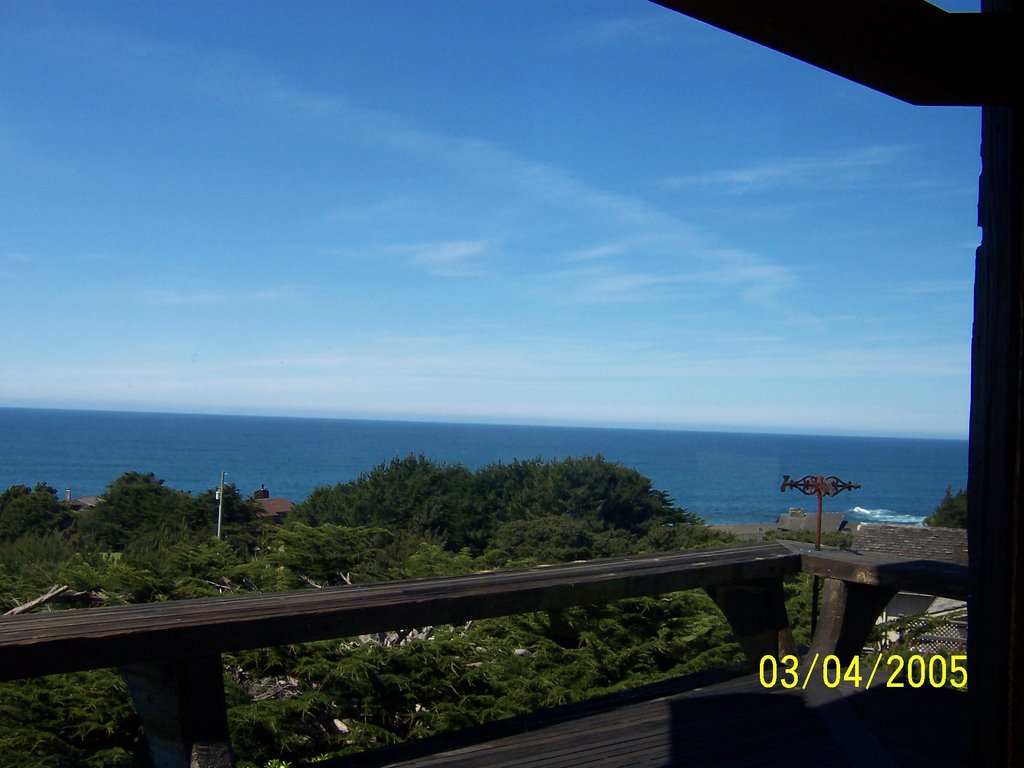
Photo: The view from his livingroom -- an 80-degree sweeping panorama of vast ocean interrupted by nothing unless one's eyes can reach to the shoreline of Japan ... .

Thursday, April 20, 2006


Life is moving so fast that I'm breathless just trying to absorb it all without imploding ... .

Events of today quickly subsume events of yesterday -- not to mention the day-before-yesterday.

Since arriving home from the east coast there have been parties and continuing honors that are beginning to make me feel like an over-ripe rock star!

On Saturday after our Thursday (3/23) flight home I was driven to downtown Oakland to -- what was supposed to be an errand to IKEA but -- in fact was a surprise party planned and executed by son, David. It had obviously been weeks in the making. I was still so caught up in all that had happened -- it wasn't until we drove into the downtown area, into the 400 block of 14th Street near Broadway, that it dawned on me that we were heading for Geoffrey's. This is a family-owned gathering place where more and more ceremonial events are being hosted. Geoffrey's is a very special place, but in most recent times it has served as the site of memorial services for those we'd loved and lost. Maybe now we could exorcise the place with a celebration of the living. Me!

David had been busy while Kokee and I explored Washington -- grandchildren, cousins, and friends (I've now outlived all of the aunts and uncles) had gathered together for an afternoon of performances and presentations. There were brief speeches by both sons, Bob and David; a touching tribute by Dorrie who had been dressed for the party in beautiful African garb complete with fancy head wrap; a traditional African dance performed by a dear young friend; a violin solo by beautiful cousin, Joan Lewis, -- jazz player who's traveled internationally performing with noted musicians; a song by Bob (despite a bad cold); and touching tributes by old friends. There was Kokee's halting and close-to-tears words of confirmation that our shared adventure had reinforced our love. This was followed by a feast provided by cousin Geoffrey Pete served on brightly-colored placemats David had ordered from the National Women's History Project catalogue that displayed photos of the ten named honorees. He'd purchased a 15-minute DVD produced by the NWHP in honor of celebrated women over the past century. We'd viewed it as a part of the program at the Autrey ceremonies. It was his way of giving context to what had happened to me -- and it moved me to tears. Whatever the world has bestowed -- this recognition in the eyes of my sons and my family was the most touching and reaffirming of all that had happened over the past weeks.

Being the source of such pride was a rare privilege, indeed, and brought with it new meaning to all that had happened. I'd only that week experienced the feeling of having had a role in bringing all of the ancestors into my century and soon I would have a role in passing the baton to those who will follow. This strong sense of being a part of a continuum of change might well become the compelling new force in what is left of life to be lived. The newfound feelings of worthiness were reinforced in that room as I experienced the pride that I felt in myself mirrored in the eyes of those I love. That kind of congruence is rare. I suspect that this is a one time thrill. But maybe once is enough if properly savored and not allowed to be distorted into arrogance or over-confidence. This could be where the wheels come off the wagon if I begin to lose my sense of balance and begin to glide without effort instead of continuing to reach and stretch into the unknown future ... .

I must not allow this to become my obituary. There is need to continue to project myself into time as before. There are still symbolic white towels to drape over those imaginary gateposts of the world -- and future "Dr. Hymel's" to be searched out and supported in their work of saving humanity -- and the children I'll leave behind.

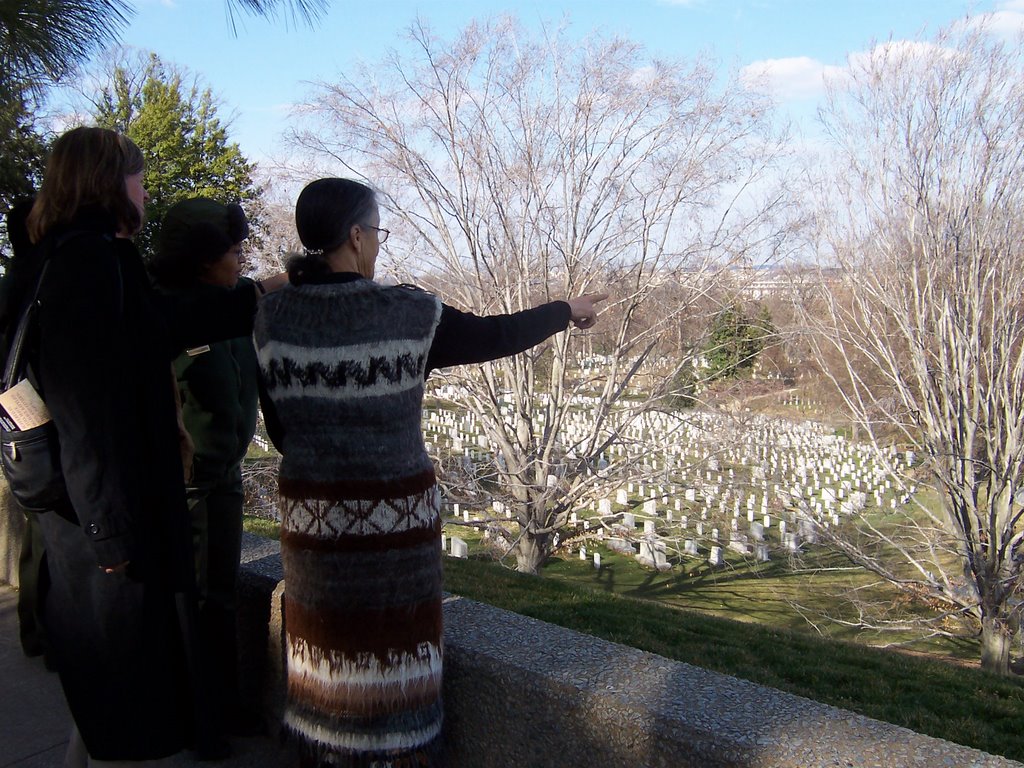
Photo: Martha Lee and granddaughter, Kokee, sharing the sweeping panorama of countless grave markers and the J. F. Kennedy family graves at Arlington Cemetery. The view from this spot takes in the Jefferson Memorial, the Lincoln Memorial, and the Washington in the distance. Wish it could show the feelings that such a view of the nation's symbolic past are evoked at such a moment. Only a respectful silence can tell that story ... .

Sunday, April 16, 2006

Thurgood, Cousin George, and me ...

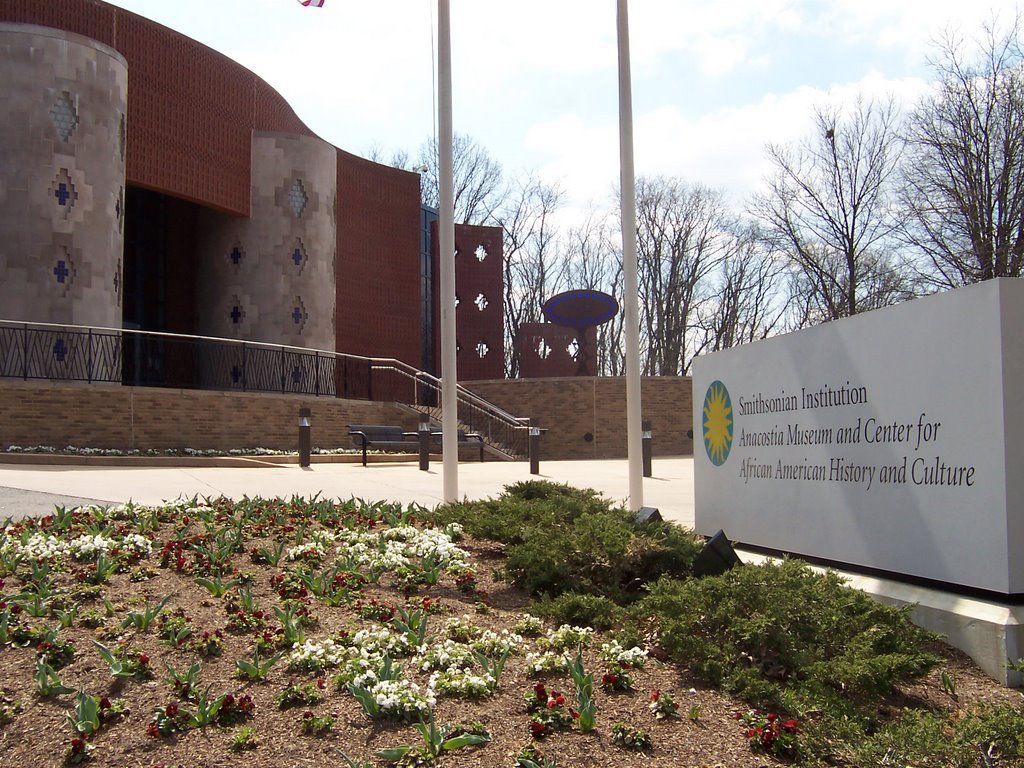
On our last evening in Washington -- after having visited Arlington Cemetery and Arlington House (home of Gen. Robert E. Lee); the Lee slave quarters (sterile and bereft of signs of the lives endured there); the Kennedy graves with the eternal flame ablaze but oddly lifeless; Anacostia's African American Museum and the Frederick Douglas home; we headed for one of the grandest buildings I'd seen in all of Washington. It was the Justice Thurgood Marshall Building that stands adjacent to Union Station.

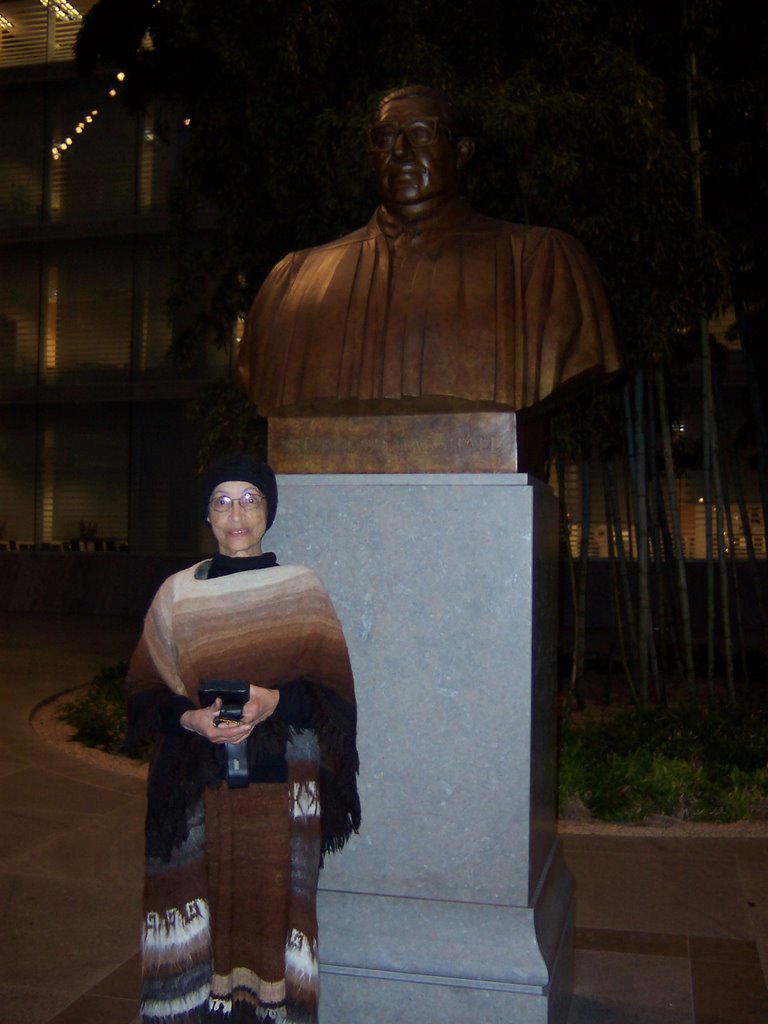
This is the building that holds the offices of the Judiciary. From the street it appears not dissimilar to the buildings around it -- institutional white with regularly-shaped windows that pretty much match others nearby. However, once you step into the front of the structure (facing Union Station) this beautiful architectural gem is almost all-glass with an upward-sweeping ground floor atrium that features an indoor bamboo garden with trees reaching at least to the height of the second floor where all of the offices are visible through floor-to-ceiling glass walls -- from entry-level. In this huge reception area there is only the security desk; the garden area with its stone path winding gracefully through the giant bamboo -- and a magnificent iconic bronze bust of Justice Marshall.

Prior to our visit, I knew nothing about this beautiful edifice, and wondered whether my ignorance is widely-shared among people of color?

I thought then about an old copy of Ebony magazine back home in my files; a picture of mother's (and my) cousin George Allen, former president of Southern University, in full academic regalia standing next to his close friend and colleague, none other than Thurgood Marshall. That picture must have been taken during Justice Marshall's time on the Supreme Court bench. It was taken at commencement exercises. This was George Allen, son of Uncle Sam and Aunt Marie Allen -- nephew and namesake of my grandfather, Papa George.

I remembered then that I'd forgotten to take this George along to the Lincoln memorial the night before; but more than made up for it by visiting with Thurgood here at his building -- bringing along best regards from the family ... . (smile).

The surreal has by now become the norm in this wild and wonderful adventure ... .

( NPS's Martha Lee; we could never have done it without your guidance and companionship. Thank you!)

Thursday, April 13, 2006


Visit to the home of Frederick Douglas - 1817-1895 ...

The short time spent viewing a brief film on the life and times of this former slave and great American historic figure filled in more of the history that I share with other African Americans. Douglas's life span mirrors that of Celestine Breaux, my great-great-grandmother and Mammá's mother. We don't have a birthdate for her, but I know that she lived at least into the early 1900s since I have a dated copy of a deposition she gave when Leontine applied for widow's benefits as a surviving spouse of a Civil War veteran.

I continue to be amazed at the accomplishments of that generation of ancestors who rose from 300 years of enslavement to positions of national leadership within a decade of emancipation. It's astounding! We are a heroic people whose history has been so blurred that we have no way to profit by that fact, nor to build on the unbelievably rich achievements of our collective past.

Maybe it was the experience of the visit to the Lincoln Memorial together with my everyday experience of working with the Rosie the Riveter/Home Front National Historical Park that produced new insights. I'm increasingly aware of patterns in the political life of the nation that span time and are reproduced, intermittently, over time. Maybe one has to attain enough years to begin to see those patterns.

Thought of Frederick Douglas's role in the story of Lincoln. Thought of Henry J. Kaiser and his relationship to a particularly controversial quote uttered by the great emancipator in 1862 -- at the height of the War Between the States. These words were written in a letter to Oliver Wendell Holmes:

"My paramount object in this struggle is to save the Union, and is not either to save or to destroy slavery. If I could save the Union without freeing any slave I would do it, and if I could save it by freeing all the slaves I would do it; and if I could save it by freeing some and leaving others alone I would also do that. What I do about slavery, and the colored race, I do because I believe it helps to save the Union; and what I forbear, I forbear because I do not believe it would help to save the Union. I shall do less whenever I shall believe what I am doing hurts the cause, and I shall do more whenever I shall believe doing more will help the cause."

On the flight home I thought of Henry J. Kaiser, the great industrialist, who might have chosen to paraphrase Lincoln's statement to read:

"My paramount object in this war is to save the nation and the world, and is not either to save or destroy social mores that I may find egregious. If I could save the Nation without forcing black and white Americans to share drinking fountains, public accommodations, housing, childcare, or union memberships, I would do it; and if I could save the nation and win the war by softening some barriers and leaving others in place, I would do that. My job is to build ships faster than the enemy can sink them. That I will do. We'll sort out the rest when the work is done."

And he did; seven hundred and forty-seven ships in four years. Some were completed in four days. These words mimicking Lincoln's statement are a fantasy, of course, but may be descriptive of Mr. Kaiser's intent. The record of Kaiser Permanente in subsequent years since World War II would attest to the honorable intentions of that corporation as surely as Mr. Lincoln's future course revealed his compassion for those living troubled lives as dehumanized "property" of others.

Mr. Lincoln's freeing of the slaves lit the fires under the cauldron of social change in an explosion of revolutionary political activism that preceded the tumultuous and cruel period now known as "The Reconstruction." Mr. Kaiser's domination of industrial innovation during World War II provided the next great phase in social development, if only as an unintended consequense. In the Richmond shipyards during those years -- despite the importing of racial segregation from those southern states from which homefront workers were recruited -- the baseline was laid for monumental new social patterns. Until that time the old racist practices -- long legislated into the laws of the land -- had defeated all efforts at solving the crippling problems of racial segregation. As a direct result of his "lighting of the fires under the cauldron of social change" in his time, he accelerated the nation's confrontation with it's shameful past. That history is recalled as The Civil Rights Revolution of the Sixties.

I was recently a guest at the 60th anniversary celebration of the Kaiser Permanente Corporation in Richmond. I was greatly impressed to hear the president of that organization comment during his brief remarks that Kaiser can boast that their workforce -- both administrative and professional -- is now 52% non-white, a clearly representative example of the nation's ever-changing demographics.

President Abraham Lincoln, Mr. Henry J. Kaiser, and Mr. Frederick Douglas would have been proud of how far we've come, though Dr. Martin Luther King and Ms. Fanny Lou Hamer might admonish us for not having come quite far enough, but I'm certain that we're working on it with diligence.

Our developing park will serve to remind us from whence we've come while giving some measure of just how far we still must travel before we sleep ... .

I'm so proud to be a part of that work.

Wednesday, April 12, 2006

Leave the world for others to tend while I'm off treading the red carpet and look what happens ... .

Found myself wondering today while watching the huge demonstrations all over the country--why on earth those hordes of people--with a great cause to champion--aren't doing their marching and demonstrating in Mexico city under President Vicente Fox's windows, or in El Salvador, or Guatamala -- whatever their country of origin? Perhaps we could help them to pressure their countries to address their needs for gainful employment at home. Then families would be spared the need to be uprooted and risk life and limb digging tunnels and climbing wired fences, braving arid desert crossings and armed vigilantes -- in order to provide cheap labor for exploitative US corporations.

I cannot imagine that it hasn't occurred to anyone that we may be following the wrong path while trying to save so many deserving people from uncertain futures in a fast-changing world economy. "Twelve to twenty million," and counting. What happens when the number is forty million?

Failing that, do you suppose that when the number reaches critical mass -- they could simply vote the new lands back into Mexico by proclamation? It worked in Hawaii where we eventually had enough haule settlers exported into the islands to vote themselves and everybody else -- including the native islanders -- into the Union to become another state. It worked in Alaska where white settlers eventually outnumbered the Aleuts and the Eskimos and the Indians then voted to become another state of the great Union. Couldn't it work the other way? The Alsace-Lorraine voted itself out of France and into Germany at the beginning World War II, did it not? Could not recent arrivals from Mexico simply vote Southern California, Arizona, Texas, and New Mexico back into Mexico -- when their numbers become impossible to manage and immigration reforms fail? After all, those lands were theirs to begin with, right? Are those states not an extension of the Great Sonoran Desert? Why not? Who's working on this one? Hopefully not any of those mindless dudes responsible for recent critical decisions that now threaten world peace as well as the well-being of the planet!

(What global warming?)

I'm told that, unlike the northern border, Mexico's southern border is practically a fortress; almost impossible to penetrate. President Fox has done a fine job protecting his country from illegal immigration from Central and South American refugees seeking to move through Mexico toward the US border. Interesting.

(From this post it's clear that I'm half-in and half-out of the past and half-in and half-out of any reasonable position on the issue. But I'm getting back into gear again, albeit slow-ly... .)

Crazy times!

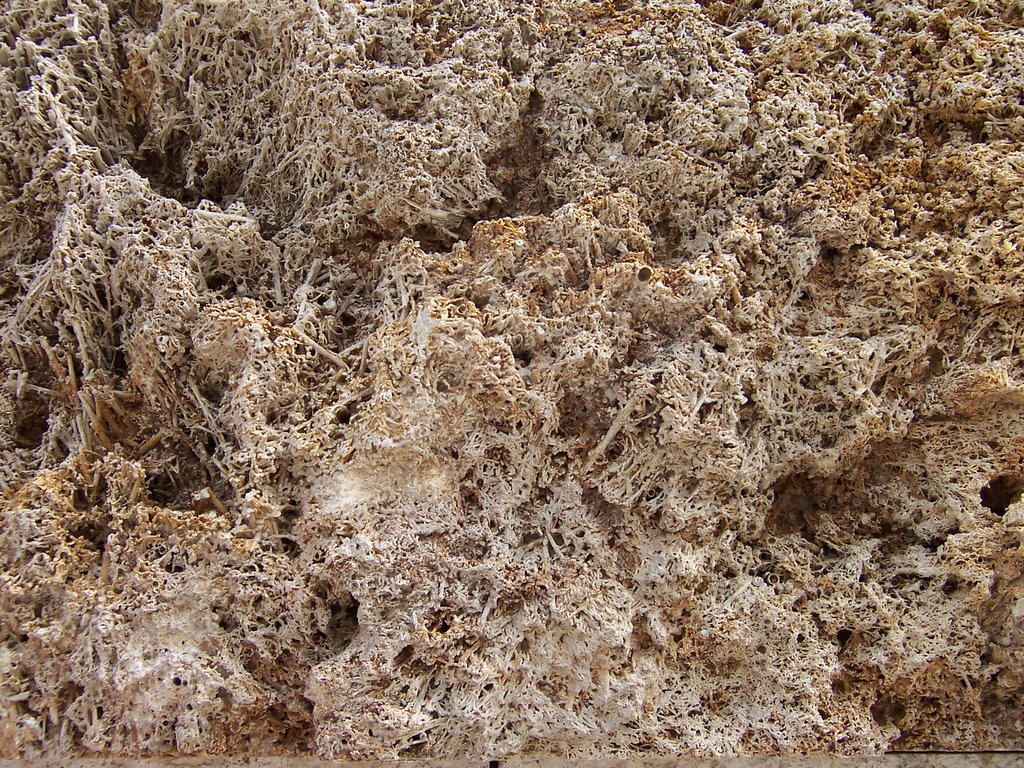
Photo: This beautiful slab of Italian alabaster (looks much like coral, doesn't it?) is embedded alongside smooth slabs in one of the exterior walls of the Getty Center in the mountains of Los Angeles. The material is comparatively "young" and "raw" with none of the sleekness a few more eons would give it. The colors are muted earth tones. It is a stunning use of natural materials as art.

Tuesday, April 11, 2006

Early Midwives ...

Introduction

(text taken from brochure)

Beginning in the late 1600s and continuing today, the African American midwives played an important role not only in the birthing care of millions of mothers and babies, but also as keepers of tradition in the provision of general health care, the communication of vital information, and the maintenance of community.

Despite on-going assaults and condemnations from the medical establishment, African African midwives sustained a long uninterrupted history of crucial care giving. Thousands of African American women show up on early 20th century midwife rolls. As recently as 1950, these midwives cared for as many as 50 percent of all black babies born in some southern states. As midwives, these women were much more than birth attendants; they gave extended care as herbalists, helped with domestic chores, took care of children, and provided sick care. Patients and the general public valued a midwife's counsel and advice and respected her as a wise woman and leader in her community.

Over time, however, cultural shifts, medical innovation, regulations, and deliberate efforts to eliminate midwives from the practice of their unique system of birthing care took its toll. Theirs is a lost tradition. What remains is only a fragment of a traditional midwifery system that once was practiced and controlled by black women.

Early Midwives

Even in the midst of drudgery and oppression, African American midwives occupied unique and important positions. Because plantation owners often assigned black midwives to care for white women as well as black women, some midwives exercised a degree of mobility, freedom, and independence usually prohibited under the harsh laws of chattel slavery. Midwives, often known as "doctor," "doctoress," or "nurse," traveled from plantation to plantation and became important channels for communication about personal family matters and for transmitting information to others who were legally restricted from travel. Some enslaved midwives eventually used payment for the midwifery services to buy their freedom.

Following the Civil War, efforts to organize a system to provide health care for blacks fell short. Harsh segregation laws and practices shut blacks out of mainstream medical and nursing schools for more than a century, leaving black communities medically underserved. Yet, in both rural and more urban settings, "granny" or "lay" midwives provided birthing and nursing care for their communities for many years and were regarded as a health care "safety net" by their fellow citizens. Because they viewed their practices as a spiritual calling, they were flexible about receiving payment and often received no money for their services. What mattered to them was doing God's work.


New Rules

Beginning in the 1920s, states heightened their efforts to train, control, and regulate midwives; the long-term goal was to eliminate them. Across the South, new public health programs permanently altered the responsibilities of the traditional midwife. To carry out the new maternal and child health programs, southern states required that midwives be subservient to the local public health system and trained nurses. As federal dollars increased to assist states in reducing maternal and infant mortality rates, Congress channeled support to improve the quaity of medical education. Yet providing opportunities for black women to become professional midwives did not receive similar public support.

The flurry of new rules in the 1920s required midwives to register annually with local health departments, to be subject to inspection of their homes for cleanliness, and to have their moral character assessed by nurses. Midwives could lose their permits if they failed to report to the public health nurse the names of mothers for upcoming births. To attend the birth, the midwife needed to obtain an "o.k." approval slip from a doctor. The midwife bags once under the midwife's control now had to be inspected and approved. Often well-intentioned rules lacked sensitivity to culture and environment.

To survive the new rules, lay midwives acted with creativity and cunning. Never completely abandoning the core of traditional practices, midwives found ways to honor their long held sensibilities and hold on to community traditions under the guise of cooperation. Others simply quit.

All My Babies

A midwife training film produced for the Medical Audio-Visual Institute of the Association of American Medical Colleges and the Georgia Health Department in 1952 is an unparalleled exception to the trend to downgrade midwives. All My Babies: A Midwife's Own Story transmits skills to lay midwives in a respectful way. Named in 2002 to the National Film Registry List (Library of Congress),the film features Albany, Georgia, Midwife Mary Francis Hill Coley (1900-1966) and has traveled as far as India to train midwives. In the film Coley is more than a standard bearer for public health officials; she personifies the care and sensitivity of so many great-grandmothers, grandmothers, aunts, and cousins--midwives who folk say "got us here." She transmits confidence and steadfastness to the mothers she helps.

Trained through apprenticeship in the mid-1930s, Coley helped thousands of birthing mothers in the counties of Doughterty, Lee, Mitchell and Worth, Georgia. Never driving, Coley often walked miles to a birth. "Miss Mary," as the community knew her, also made daily walks back to a mother's home, sometimes for weeks, to assist mothers wtih a myriad of chores including helping with the children, bathing the mother, and changing linen. Whether paid her standard fee of $5.00 (later $10) or not, Coley gave continuously of her services; she was also a Sunday School teacher and served as the President of the Women's Auxiliary in the Church of the Kingdom of God. Prior to the civil rights movement rocking Albany at the end of the 1950s, Coley was a powerful bridge between the white-controlled public health system and the black community. Even amid deeply entrenched segregation, Coley asserted her humanity.

Survivors

By the 1970s, few African American midwives influenced by the traditional system of care remained in practice. In the 1960s and 1970s, black women in the South began turning to obstetrics (the medical field concerned with childbirth), and perhaps inadvertently contributed to the demise of the black traditional midwife. Midwives old enough to recall grandmothers as slaves were few. Yet, they continued telling their stories to daughters and apprentices and in books, exhibits, and new documentary films.

Fortunately for the traditional midwives who survived, a new generation of midwives launched campaigns to celebrate their accomplishments. Organizations such as the International Center for Traditional Childbearing, the Midwives Alliance of North America (MANA), the American College of Nurse Midwives (ACNM), and various schools of midwifery increasingly recognized the importance of traditional African American midwives as keepers of community and practical lore. The challenge remains to translate historical recognition of past midwives into a widespread renewal of African American midwifery--a renewal that sustains traditions and supports family and community care.


Photo: This is our much-loved greatgrandmother, Mammá, whose story is now more complete. Since the visit to the African American Museum in Anacostia (Washington), and seeing the women within whose tradition she so magnificently served, I feel even more closely-bound to her. Seeing her as a "class of women" of her time serves to fleshen out the images I've held for so long. Seeing myself as following her path in my own time and under vastly different circumstances is helpful to understanding myself and my relationship to all that has gone before me. Everyday now I'm acquiring context for the living of my life. This at a time when one would think there would be little left to learn.

Not so, ... surely.

Then came the visit to the Frederick Douglas House. It's hard to realize that he must have been Mammá's contemporary.


Sunday, April 09, 2006


Coming down -- gradually ...

It's been over a week since I've written anything ... but when I found myself unable to sit at my computer without bursting into tears -- I figured it was time to start the decompression process. There were moments after I completed the last entry when the thoughts -- the memories -- the emotions were so overwhelming that my breathing had become truncated and my tongue began to stick to my teeth and the sides of my mouth -- and no amount of liquid could satisfy the thirst. Had it not been for the fact that there were enough reasonable explanations for such a state, I would have become a victim of my own vivid imagination and thoughts of diabetes and/or potential stroke surely would have occurred to me. Realization that -- had it not been for the fact that I'd (wisely) decided to take along a "witness" (Kokee), this was the point where I would have begun to erase the experiences from memory and to reject the wonder of the past several days. By this time I'd have settled into what goes as normalcy for me and climbed back into my pumpkin yet another time. But it was not to be. I've lived every minute of the magic -- and it would not be denied back into the "ordinary."


We woke on Wednesday, the day of the award ceremony, with the promise from Martha of another tour of the nation's treasures. Kokee was anxious to see where African Americans lived in the Anacostia area of the District, as was I. Martha arrived ready for another day of sharing our odyssey and off we went. Today we would visit the Frederick Douglas home and the African American Museum, a National Park Service site that was not on the great mall, but had been placed in the core of Anacostia. I'd heard about this area for years but had no idea what to expect. It is a visibly depressed, antiquated and oddly unpopulated area made up of many multi-storied brick housing structures mixed in with ageless bungalows wearing the usual iron bars on windows found so inescapable in black neighborhoods throughout very low income districts; barren trees nude for the winter season. The absence of people on the streets in midday added to the desolation. That felt strange, but might have been explained by the time of the year and the just above freezing temperatures.

We'd already been deeply impressed by the handsome and well-dressed and very professional young African American men and women who serviced the desks and counters at our exclusive Hyatt Grand Washington hotel, and the welcoming and well-informed young African American national park rangers at Arlington House and elsewhere, but we had not yet experienced the black community, as such.

Nothing had prepared me for what the next few minutes would hold. We walked into the African American Museum to find a remarkable exhibit featuring "Reclaiming Midwives; Pillars of Community Support." And with no warning I found myself standing under a photograph of a black slave midwife -- with an astoundingly familiar text that described -- in a formal way -- precisely the story told me to as a child so many years ago -- by Papa George and later by Aunt Vivian -- the description of the life of Mammá in all of the dramatic details that filled in the spaces that my child's mind had missed and my adult mind may have found too painful to absorb.

I found myself speechless; sobbing uncontrollably -- feeling as if this was the reason for all that had happened to me over these past miraculous days -- the rationale for the honors being bestowed, and the trip to the foot of the Lincoln Memorial. Here before me, indeed, were the women who had lived the lives of the unsung, the neglected, and shamefully exploited "Builders of Communities and Dreams."


I finally understood a system that I'd bought into unknowingly from childhood; a destiny I'd been living out without a script. For the first time in my long life I had a feeling of total fulfillment of my destiny. The tears would not stop. I made no attempt to control them. I'm sure that my sobs were audible. At some point a woman (white) tourist quietly approached to gently press a small packet of tissues into my palm. I accepted it without comment. No words were needed. She seemed to know. In that moment there were no spaces between. She then stepped back into her stranger-ness and I into that weird combination of joy and grief and a kind of communing over time and space with a past I'd really never known but in some strange way found familiar. I seemed to be remembering things I'd never experienced.

Taking photos of this show was prohibited for some reason, so I cannot reproduce those texts here, but I will take some of the pictures from the brochure in the hope that I can communicate some of what I found there. It will not surprise me if that turns out to be impossible to reproduce, but over the next days I may find a way to use words well enough to describe the experience. Whatever it was that so moved me has stood in the way of my writing since March 30th. Today is the first attempt at beginning to sort it all out.

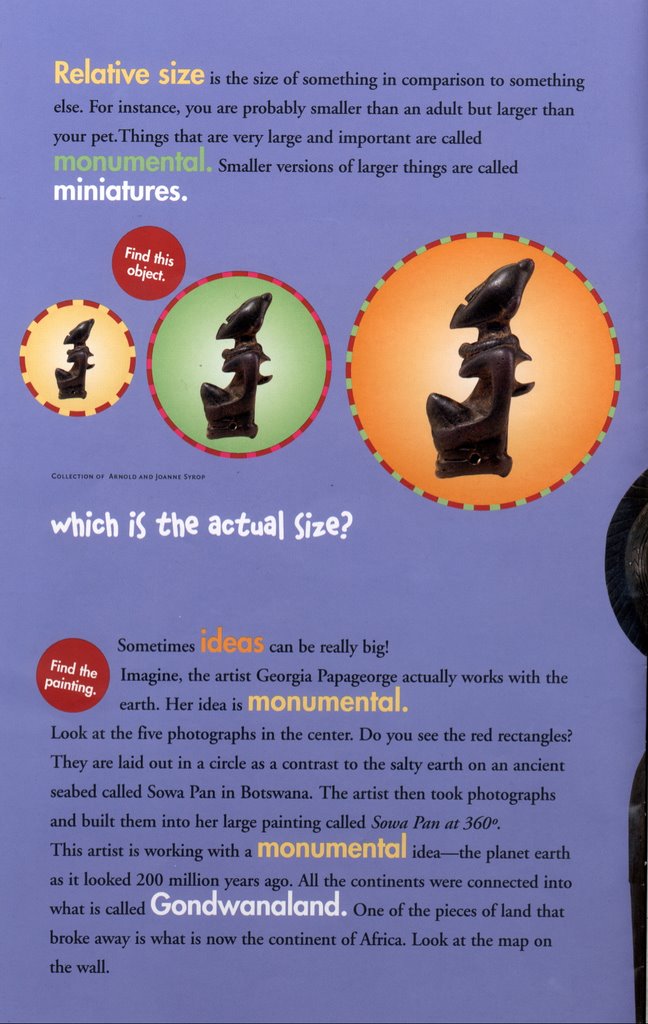
Photo: Brochure from the show, and a key component of the great adventure in the shadow of the Great Emancipator.


Thursday, March 30, 2006


The lofty feeling of being "We the people!" ... all of us ... .

Wednesday afternoon brought us to a delicious lunch at the Native American Museum, followed by a great multi-media show in a small circular theater on the top floor of this beautiful curved sand-hued building where we sat on tiered benches on 3 levels and watched multi-tribal images played against a mound at floor level; a screen that displayed evolving moving images while overhead on the domed ceiling -- changing scenes that took us through the seasons; under the ocean with the whales; surrounded us in caves and sweat lodges in rain wind and snow; involved us in tribal dancing; while the images before us on the screen played against the huge synthetic rock -- lit from within -- on the floor beneath the mid-level screen. It was an astounding experience that enveloped us in color and wrap-around sound. The entire event lasted no more than 15 minutes, but was so absorbing that the dimension of time dropped away. I wanted to experience it all again -- maybe 3 times -- in order to give full attention to each of the levels, but the trick was to try to take it all simultaneously, and I knew that. One day I'll go back and do it all again.

Martha, Kokee and I made our way separately down through the floors and the many tribal exhibits and -- just as she had the evening before -- standing in the Japanese Interment memorial -- I watched Kokee seeing for the first time the dramatic and hurtful lives of people other than African Americans. Slavery and human exploitation had not been ours alone to bear. The story of the Native American (something we also share as descendants of the Shoshone, the Seminole, and the Choctaw as well as Africans slaves) came alive for us both. I found myself wondering how she was taking these revelations that had been purely academic 'til now. This is a conversation we've not yet had, but will one day soon, I'm sure. This was the time for simply letting life flow over us, to be given context and understood in the days to come.

But it was our trip to the new and wondrous underground African Art Museum that proved to be the most moving -- and for reasons that will become clear when you click on the photo above and read the name of the artist being featured. It was another of those inexplicable moments that occurs from time to time and that have been the cause of wonder for my whole life.

The building shares land with the original Smithsonian Museum and two others. It has a relatively small footprint with most of its space on 3 floors, all underground. One can move between museums at the underground level -- a fact that almost lost us Kokee before she chose to surface and wait for us on a bench at ground level -- amid newly-planted crocuses and daffodils.

I've spoken in other stories of a time when my dearest friend -- from ages 6 into my teens -- was my grandfather, Papa George. He worked as a waiter at the exclusive Oakland Athletic Club at night, but together we planted and weeded and tied vine tendrils of the string beans to wooden poles and dug the root vegetables while he told the stories of Mammá and the little house in St. James Parish, Louisiana, beside the Mississippi, and sang those silly little songs that I thought he made up ... .That was Papa George. I'd speak of him and what he meant to me and of Mammá and her role as strong woman and midwife and protector of her large brood that evening upon receiving the award at the ceremony.

I'd been so aware that I was not alone last night -- but that I'd climbed the steps of the Lincoln Memorial with all of them beside me -- Aunt Emily and Aunt Vivian and yes, Papa George. I found myself so aware that I can't recall ever mentioning the National Park Service nor thanking the National Women's History Project in my acceptance speech -- but back in time in some parallel universe where they still existed. It was strange -- but not disturbing in the least. I felt comforted by their presence and -- as a part of this strange collective -- I felt worthy of the honors being bestowed. We'd lived it and survived, and it was during my tenure on the planet that we now had arrived far from home to reach the nation's capitol to stand at the feet of the great emancipator!

But the most moving day of all would be tomorrow, on Thursday, when we would visit Anacostia and the African American Museum, and the home of Frederick Douglas.

But that is a story for tomorrow. I'm still recovering from the experience of finding -- finally -- our beloved Mammá -- as a class of African American women -- those who were really the "Builders of Communities and Dreams."

Photo: This is the brochure that I picked up just as we were leaving the African Museum. As I saw the name of the artist whose work was being featured (shown in the bottom half of this piece), I felt instantly the rightness of the honor being bestowed upon me as the representative of my family -- all those who preceded me in life -- and who had invested -- genetically -- in all that I am. It could not have been otherwise. This had been earned over generations by us all. Papa would not have had it otherwise!


And the prize goes to ...

How to tell the story ... particularly when I'm still so caught up in the wonder of it all?

Wide-eyed granddaughter, Kokee (young "Miss Ginglehopper), and I met Molly (NWHP Executive Director) at the Oakland airport at the ungodly hour of 5:00 am for the 6:50 flight to Washington. It was comforting to see her since I was taking off with no idea of what would happen once we landed in Baltimore and not even which hotel we'd be staying in for the next several days. Having been in Los Angeles until less than 24 hours before, all of the instructions for the flight to the east coast were sitting on the hard drive of my office computer and I was quite literally flying blind! Molly couldn't know that I'd not received word of the arrangements. It all worked out.

We arrived five hours later after a relatively smooth flight across country, and took the shuttle to the Hyatt Grand Hotel -- and how grand it was!

Martha Lee had arrived a bit earlier and called our room to announce plans for the evening. She picked us up in a borrowed Prius (terrific), and we headed for the Japanese Internment memorial. It was so moving ... even with the water features turned off for fear of freezing. With most of the tourists gone for the day and the tour buses gone to wherever tour buses spend their nights -- we had the streets to ourselves. We then visited the Washington Monument and thrilled at the sight of the lagoon under the night skies -- envisioning Martin Luther King's timeless oration -- and the great Marian Anderson's defiant concert at Lincoln's feet with Eleanor Roosevelt at her side in that shameful but triumphant event meant to shame the Daughters of the American Revolution, and did.

We walked silently through the Vietnam Memorial alongside the late night visitors who were equally and quietly trying to cope with the countless names of those whose lives were sacrificed in that duplicitous war that saw the erosion of faith in our leaders that has never quite healed. Not too far away is a most astounding memorial to the veterans of the Korean war -- those dimly-lit larger than life figures of a company of fighting men on the field of battle. They stand in various poses in full battle regalia with guns drawn and fear and courage etched into their faces. They are chalk-white and bring death chillingly close -- especially when visited in the sequence of Lincoln (Civil War), the names of the Vietnam War dead, and then -- those of the Korean "Police Action."

It was at the Korean Memorial that I first started to experience the disturbing sense of our nation's glorification of war -- and though that may be an over-statement -- it is nonetheless real. We'd not yet visited those places where some of that might be mitigated by the softness of the arts and science (the Smithsonians, the Space Museum, the National Archives, the Supreme Court, etc.) and the feeling that we were simply about war and the sacrificing of young lives came to the forefront and I couldn't shake it off until far into a sleepless night. Those feelings would again overwhelm me while standing on the steps of Arlington House overlooking the eternal flame at the Kennedy graves and the endless field of the stark white grave markers of those whose lives have been sacrificed to a succession of wars that continues to this day.

Maybe tomorrow it would be different. After all -- this was only the first evening and the next day would bring the NWHP celebration at the historic Hay Adams hotel on Pennsylvania Avenue (across the street from the White House), and the company of the other wayfarers with whom we share the planet, the nation, and -- for whatever it's worth -- the next stretch of time that may test our ability to save ourselves and the world from known and unknown perils.

Went to sleep at some point while pondering just how we'd managed to squander so much greatness? Remembered just before dropping off to sleep -- the press conference being aired on the radio of the shuttle that took us from the Baltimore airport to our hotel. How on earth does one think about the powerful and moving words that graced the walls of the Lincoln Memorial compared with the babble that was coming from that broadcast -- the exchange between White House correspondent Helen Thomas and the boy-president? How had we come to this?

Maybe tomorrow would hold some of the clues and provide some comfort ...

...and it did.

Photos: That is a shot of the interior of our hotel -- only about six minutes away from the Hay Adams Hotel in the heart of the White House area. The other is a moment I'll not forget soon -- as shared with Kokee who was seeing Washington and the nation's treasures for the first time. It was an unexpected privilege through the auspices of the NWHP for which I'll be eternally grateful.


Tuesday, March 28, 2006

Autrey Museum Celebration lives up to the reviews ...

Despite the GPS (global positioning system) female voice (we named her Mabel) in our rental car we managed to get ourselves lost on the way from the L.A. County Art Museum and the Autrey Museum in Griffith Park. Only after several wrong turns with Mabel having to re-calibrate our course each time before we could move, did we reach the NWHP event a mere 10 minutes late.

I'm not too high on cowboy stuff, and this place screams that history with the subtlety of Dolly Parton in full hooker regalia! Was feeling the laugh crawling up from my belly to my throat when NPS superintendent Martha Lee popped up out of the crowd (with her delightful mother in tow) and announced that my family had arrived earlier and were waiting anxiously for me. At that point irreverence was all I could feel -- and the absurdity of all of it.

David and my grandson, Rhico, plus his lady suddenly emerged from somewhere with grins all around and a big presentation bouquet that I'd receive later in the proceedings. They'd left the Bay Area at six in the morning to be here for the 3:30 ceremonies. They would leave immediately afterward to arrive back to Berkeley at around 1:30 am! No greater love hath a son for his mother. David was bursting with pride and delight. I thought of Bob and missed him terribly. Thought of Rick who died enough years ago and who should have retired to the background long ago but who continues to rise to the front of my mind at times such as this. Dorian was back home -- this would have been too much for her to deal with, given her level of understanding. Today it was David representing the family -- and stepping in to do it with such warmth and dignity.

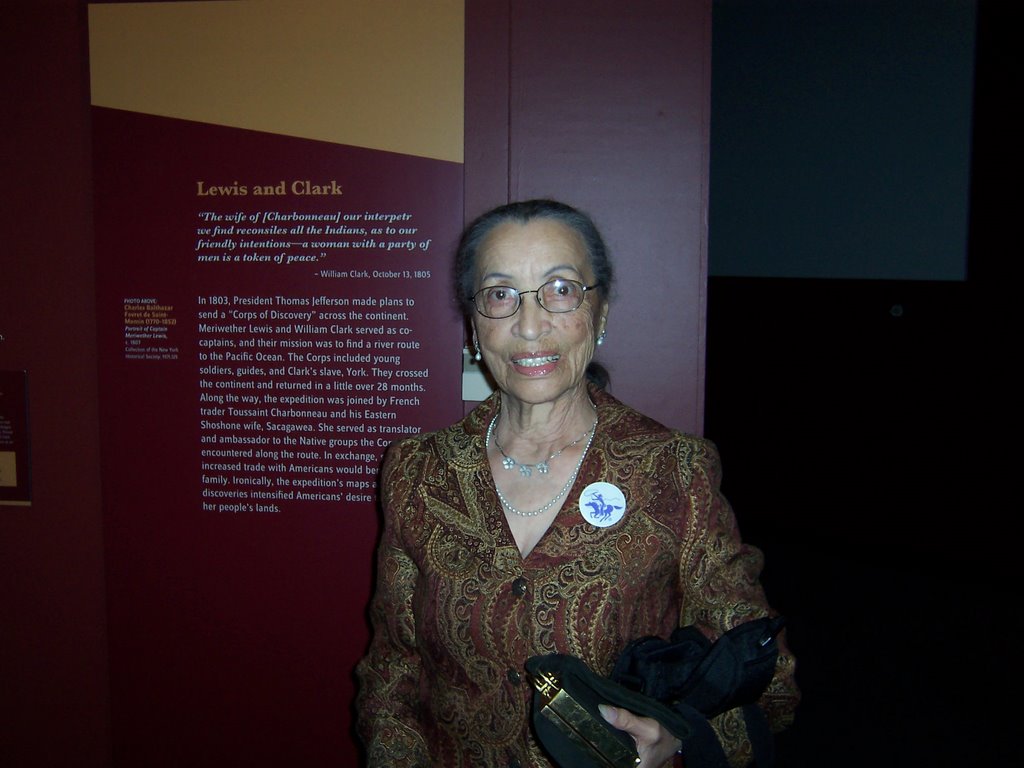
He greeted me excitedly with, "...Mom, come see! Our ancestors are shown here in a mural in the museum gallery." Followed him and found a depiction of the Louis and Clark trek with their guide and interpreter, the Shoshone woman called Sacagewa and her husband, Toussaint Charbonneau, who led the expedition west and the opening of the Northwest Passage. Charbonnet is the spelling of our paternal family surname -- part of the family having moved to the Louisiana territories with the spelling, "Charbonnet," while others went into Canada where the name changed to "Charbonneau." This was one of the many cul de sacs that turned up in our family history project that has yet to be followed to some conclusion. But it was so exciting for David and Rhico to get this glimpse of why I find this research so exciting. The tantalizing possibility of an bloodline link to Sacagewa makes me tremble just thinking about it.

When the presentation began, it was obvious that I would have to make some kind of acceptance speech and that was a problem since I rarely think ahead and tend to say whatever comes to me as a response to what is happening around me. This time was no exception. I found the words, somehow, but can't for the life of me recall what it was that got expressed.

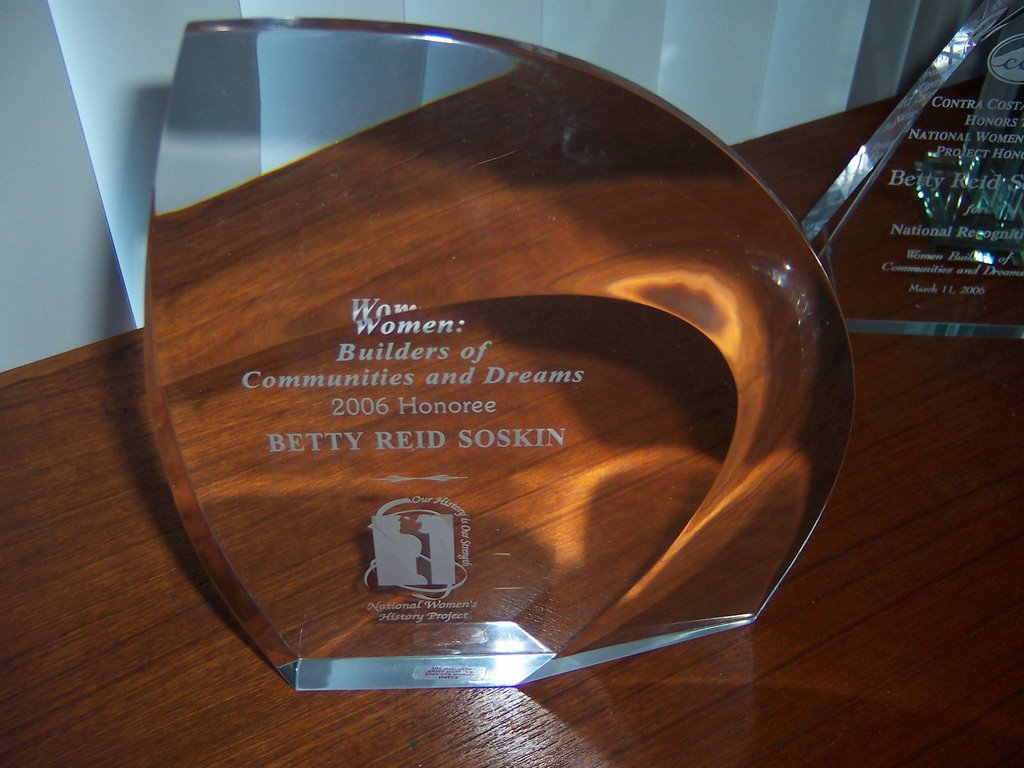
The crystal "Oscar" is so beautiful! It is an abstract shape of curves and planes, 8" x 9" by 2", with my name, the date, and the National Women's History Project logo etched into the surface at the back. When the light comes through it is awesome -- but I'm not sure just what I'll do with it. Can't take it to work. A bit ostentatious, wouldn't you say? Have it in my bedroom beside the lovely clock received from the staff of Assemblywoman Loni Hancock's office when I left a few years ago. To feel deserving of such a magnificant award was again a challenge, and in the company of women of such stature shook what little poise I could command. I still had the tendency to want to look behind me for the woman it was really intended for.

It would take the flight all the way to Washington, D.C., two days later, and visits to the Japanese Internment Memorial, the Korean War Memorial, the moving Vietnam Monument so stunning in its simplicity; to the Lincoln Memorial at night when the tourists were gone; the unbelievably moving memorial for FDR; the WWII memorial (a bit disappointing), the majestic but unabashedly phallic Washington monument upthrusting from the earth surrounded by briskly waving flags; the Jefferson monument seen at night with cherry blossoms about to burst into color against snow falling gently seen through the amber light; all of that before I started to feel deserving. But that feeling did come, finally, and when it came it was stunning! I now understand the why of it -- and that it was meant to be; and how humbling that was.

But that's for later. I need to savor these powerful though fragile feelings just a little longer before sharing.

Photo: Isn't this about the loveliest ...!


Yes, I'm home again -- trying hard to absorb the past ten days in some reasonable fashion and not succeeding very well...

I've sat down at my computer a number of times and given up before my fingers could take over. It's hard to describe -- this sense that my brain and the rest of me are operating at different levels -- barely related -- and at differing speeds.

Returned home on Friday after what seemed an endless flight across a nation made up of little more than cloud cover. Beautiful -- but the ephemeral billowing grey-white below us added to a sense of non-reality. Would I be able to hold it all without losing my sense of balance? Wasn't all that sure at times. Landing in Oakland at the end of the exhausting flight (had to help hold the plane up, of course) in a pouring rainstorm brought me back to some stability. The stormy weather cooled whatever magic spell I'd been under and life was quickly brought back to whatever normalcy I still enjoy.

Shall we start with Los Angeles on Friday, March 17th? Tom accompanied me to Southern California where we managed to visit the Armand Hammer Art Museum in Beverly Hills on Friday afternoon. What a collection! Saw the old masters again (Van Gogh, Matisse, Manet, Sargent, Chagall, etc.) and for a few minutes there couldn't see how on earth they could ever be equated with the modernists (Jackson Pollock, Warhol, Picasso, etc.), and shouldn't we have some other category through which to describe their works?

On Saturday we took ourselves out to visit the Getty Center high in the hills and overlooking the "river" below, that was the San Diego freeway and conceived as a part of the "art" presentation by the architect, Richard Meier. One has to ride a tram up the hillside to reach the museum made of Italian alabaster stones cut into a beautiful repetitive series of structures composed of squares. It is totally white except for a lovely violet arbor holding wisteria now dormant but beginning to bud. I had the feeling of what it must be like to visit the pyramids. The grandeur of the site and the magnificent buildings that make up the center are overwhelming.

We took the architectural guided tour. The hanging artworks were quite wonderful but were almost secondary to the edifice itself. Would like to return someday when I'm not so awed by the structure and can better lend myself to the art.

On Sunday, early in the day, we visited the Los Angeles County Museum for another great tour of the exhibitions. Despite the marvelous reputation of San Francisco's impressive museums and art collections, it was quite obvious to me that -- when compared to that of Southern California -- we're still in the throes of beginnings. Here we saw many of the modern masters, and, I had the feeling that the visit to the Getty had served to "clear the palate" and allowed me to better appreciate the modernists than if we'd gone straight from the Impressionists to Andy Warhol and Lichtenstein's cartoon art. That Campbell soup can just couldn't do it for me except as I could see it as a rebellion against tradition and a much-needed pushing of the envelope that freed us to see the world a bit differently.

Maybe it was because of the reason I was in Los Angeles at all -- for the ceremonies of the National Women's History Project later in the day -- I became very aware of the absence of women artists. In neither the extensive collections of the Hammer, the Getty, nor at the L.A. County Art Museum did I see the work of more than a single female artist. Only one Mary Cassatt was exhibited -- and that as part of the Hammer collection. Thought for a minute that I'd seen two, but the other turned out to be male with an ambiguous name.

The need to "...write women back into history" as stated in the written materials of the NWHP suddenly sang out to me as of critical importance. That I was going to be honored that very afternoon at the ceremonies at the Autrey Museum took on greater significance. I was going to become a part of that long-neglected history -- not only for myself, but for women as a class. The ten of us were going to be helping to make a place for women everywhere; a great honor, indeed. This feeling was reinforced as we visited the nation's capital a few days later and found ourselves overwhelmed by the glorification of war and the devastation of lost lives of the thousands of grave markers for the nation's young in Arlington Cemetery, the Korean War Memorial, that of World War II, and Vietnam. Testosterone reigns in what we've chosen to honor as national heritage -- and women and their participation and sacrifices for the country seemed only dealt with as an afterthought.

My comfort level with the process was beginning to grow -- and with any luck at all would increase enough to take me to Washington, D.C., on Tuesday.

And it did.

Photo: Vincent Van Gogh's "Irises," one of my favorite paintings.

Thursday, March 16, 2006

At the  Autrey Museum

Packing up and gettin' ready ...
Tomorrow morning we leave for Los Angeles and the Autrey Museum where the National Women's History Project will hold their celebration on Sunday at three. We're leaving a day early in order to visit the Getty Art Museum while there -- I've never seen it and hear it's stunning.


Will fly home on Monday afternoon and then leave at 5:50 a.m. from the Oakland airport for Baltimore/Washington, D.C., and the festivities to be held at the Hay Adams on Pennsylvania Avenue across the street from the White House. How cool it that?

Because this is all so much larger than life and so once-in-a-lifetime in scope -- I've cashed in the family jewels to take granddaughter, "Miss Hermione Ginglehopper" along to share the honors and enjoy her first visit to the Capitol.
at the Hay Adams Hotel in D.C.

David, Kokee, and Rhico (his older kids) will drive to L.A. for the celebration there on Sunday.

Not sure when I'll get to read my messages or post to my blog -- these days are surreal -- but given this unbelievable agenda, it may take days to get myself back into my pumpkin again.

Will try to remember to take pictures and will post them in CBreaux's Annex when there's time.

Meanwhile, I'm off to see the wizard -- see Betty on the Yellow Brick Road!