Saturday, April 07, 2007


What on earth is an Atheist doing in a seminary? And well you might ask ...

This last post was written while I was serving as a member of the Board of Trustees at Starr King School for the Ministry, a member of the Graduate Theological Union (GTU) on the border of the University of California, Berkeley, campus. One of the privileges of serving was the opportunity to join graduate students studying theology at any time during one's tenure and as often as one felt the urge to do so. It was not for the purpose of monitoring classes, but fulfilling the duties required of all students -- by completing reading assignments and taking part in discussions and seminars for a full semester. A typical class might involve 12-14 students plus a professor or two.

The GTU is a consortium of schools and seminaries clustered in an area called "Holy Hill" just north of the UC campus. There are more than a dozen religious institutions sharing classes and an amazing library in common, and whose students study together, ecumenically, though registered formally in his/her own schools. Sitting in a study group with Buddhists, Jews, Franciscans and Jesuits, priests-in-training and nuns, Episcopalians, Baptists, Wiccans, United Methodists, Presbyterians, yes, and Unitarian/Universalists, etc., is a very ordinary state of affairs. Some students would be studying for parish ministries while others were preparing for moral leadership in a variety of settings, including public service, prison chaplaincies, or legislative practice from a position of conscience.

The GTU/Starr King experience was rich beyond measure, and fulfilled an insatiable hunger for spiritual inquiry in an environment of total acceptance and respect. I could probe and test and wonder in a place where there were no intellectual or spiritual boundaries.

I miss the mental stimulation that I now must find elsewhere ... but I must admit that the Internet has afforded me some extended trips into realms I never dreamed I'd get to explore.

...maybe I'm missing my Unitarian Universalist connections, though, but -- on the other hand -- maybe I'm simply responding to the fact that tomorrow is Easter, and I have my fancy hat but no place to go ... .

That's the problem with Atheism and Humanism; no Easter hat tradition!


Cleaning out the files, again, while responding to the reawakened effects of Good Friday, I suppose ... (once a Catholic ...)

Subj: Re: At the Schoolhouse
Date: 97-10-15
From: CBreaux

Fascinating class at Starr King School for the Ministry today. We were still dealing with Breech's "The Silence of Jesus" (and I had not read the assigned pages) and everyone was filled with questions about the symbolism represented by the parables. My head was still back with Hawking; and the interesting ways those images of the nebulae have been playing against the back of my eyelids all week ... .

Not sure how my mind made the leap, but at some point in the discussion I found myself realizing that -- despite my atheism -- I really have no particular quarrel with either the Jesus-centered stories or with any of the prophets that time has delivered to different places at different times in history. At some subliminal level I must have found that the only times I have trouble with organized religion and theocratic dogma are those times when I've forgotten that the historic Jesus may have been less teacher than seeker, as I am -- as we all are, and that the important thing for me is to try to discover is just what it is that I already know, and that when that great truth (for me) is revealed, it is my suspicion that it will be elegantly simple and that I'll realize that I've known it all along. ("The kingdom of God is within you?")

Maybe that's the fascination for me with Hawking, Einstein et al. They may have tapped into a place that I stumbled upon years ago while crossing that line which "The World" claims for "sanity" and into the realm that the world defines as "madness." It was in that place (during a mental breakdown/breakthrough) that -- for a period of time -- I found myself blessedly out of sync with time. That state of being may be what is required for a full understanding of the universe and those dimensions that we can get brief glimpses of -- only if we are either mad enough, or (as in Hawking and Einstein et al) brilliant enough to transcend the limitations of our humanness.

Betty

Friday, April 06, 2007


Response from the USS Hornet ...

From: "Jon Stanley"
To: Betty Reid Soskin

Date: Monday, March 19, 2007 03:02PM
Subject: RE: Thanks so much for a memorable experience ... .

Betty - the day was memorable for all of us on Hornet, as well. We were indeed honored to have you and the other speakers with us to share your stories and perspectives.

In reading your email, I, too, am glad that you didn't "retreat", but chose to join us and participate in our celebration of "Women in History".

Will you join us for our Glenn Miller Orchestra night? - I certainly hope you can.

Best regards,

Jon Stanley, CEO
USS Hornet Museum

Photo: Singing group of WWII-costumed volunteers called the "Singing Blue Star Moms." They mime to the "Tribute to the Andrews Sisters," recorded classics of the day. They're great!

To the fulfillment of good manners -- and more ...

From: cbreaux@earthlink.net
Sent: Monday, March 19th, 2007 1:16 PM
To: Jon Stanley
Subject: Thanks so much for a memorable experience ...

I will treasure the memory of how overwhelming was the sight of that huge carrier as we approached from the roadway to the pier! How tiny I felt, but how warmly and welcoming were the faces of all we came in contact with over those few hours.

I came so close to calling to cancel as
the weekend approached and I, a peace activist, realized that I would be standing on the deck of the USS Hornet, the ultimate symbol of western armed forces dominance at the precise moment that presidential hopeful, Senator Barack Obama, would be appearing in Oakland within just a few miles, and that others with whom I share concerns would be gathering to demonstrate against the war in Iraq -- just over the bridge in San Francisco ... such irony. I was so conflicted ... .

I'm grateful now that I didn't retreat but was able to participate with integrity while surrounded by Blue Star Moms; a woman commander naval pilot of distinction; a tugboat captain; and several civilian flyers -- and still find common ground -- all women who care about our young and pray their safe return. Together we represented the very essence of what it means to be citizens of this great nation -- able to freely express ind
ividual versions of patriotism without rancor - and that we could do that on board this great vessel without restraint was a statement that the USS Hornet can be proud of, indeed.

Thanks, again, for an unforgettable day.

Sincerely,

Betty Reid Soskin


Photo: A Blue Star Mom displaying and defending her Marine son who is currently serving in Iraq. This mother was not listed in the program so I don't have her name -- and I suspect that she rose spontaneously from her seat to try to counteract my statement. In looking back, there was obviously room for all opinions. Between us, we aptly provided the polarity that exists in the country.

Tuesday, March 20, 2007

Memorable Day on board the USS Hornet ...
and to think that I came very close to missing it entirely. But what is needed here is the exchange of emails between the USS Hornet's CEO, Jon Stanley, just yesterday. I'll look them up and post on the next blog entry.

I came home on Saturday afternoon feeling jubilant -- partly from having experienced that gigantic war machine -- the brave walk up that scary gangplank not daring to look down even for an instant! Entering that cavernous deck with its displays from the two times it had served as the pick-up vessel for the space capsules with their precious cargo of John Glenn and the others upon their return from space. It is impossible to not feel the excitement embedded in the walls of that majestic giant. It is impossible not to feel absolutely insignificant as you look around at planes and the other tools of war and space exploration. It is also possible, even for one as anti-war as I, to understand the energy -- the ultimate adrenalin rush that must be present in battle. I could feel my pulse quicken just walking through the exhibits.

Then I saw the flag ... the likes of which I've only seen hanging behind the figure of General George Patton in the movie bearing his name. I would be framed in this setting -- using my allotted ten minutes to explain why I'd come today. That I hadn't realized when I accepted this invitation to participate in the Museum's Women's History Month's celebration -- that it would fall on the weekend of the 4th anniversary of the Iraq war and that those who shared my anti-war feelings would be gathering here and across the nation in major demonstrations. And -- here I would be, standing on board the ultimate symbol of western military dominance, the USS Hornet aircraft carrier, speaking before I knew not whom ... .

I'd decided to not cancel out at the last minute, but to make my own statement in the hope that I could maintain my own integrity by standing by my beliefs, even in this setting. I would rely on the goodwill of these strangers and hope for the best. And -- if I could be so lucky -- the shore patrol wouldn't haul me away and dump me into the estuary!

The other four female panelists were a Cmdr. Lisa Avila of the Naval Air Force; a tugboat captain, two civilian pilots, and a Blue Star Mom carrying an enlarged poster of her marine son now serving in the Middle East. What a place for a peace protester to be!

Then
I'd decided sometime during the night just what I needed to say -- and it came easily:
I'd remembered an incident involving a conference at Asilomar (Stebbins Institute) where I'd heard the author, Ken Kesey, introduce his first lecture in the weeklong series. It was the summer that Kesey and others from many disciplines were on the Stanford University campus as artists in residence -- changing the world as we knew it. It was the summer that heralded San Francisco's Trips Festival, the Grateful Dead at the Fillmore; LSD experimentation in the Summer of Love and the Haight/Ashbury phenomenon. Kesey had published "One Flew Over the Cuckoo's Nest" and was working on "Sometimes a Great Notion." He was seen as one of the latter day prophets by many in both literature and theology.

I was almost traumatized by that night as Kesey spoke of the flag being merely "...a piece of red, white, and blue bunting" -- only a symbol, and how we confuse that with the reality -- and that it surely did not represent him when flying over Vietnam in a war in which he did not believe. Nor did it represent him when standing beside the throne of the Grand Dragon of the Ku Klux Klan in some Mississippi town. In illustrating his point he seized the huge American flag from the standard at the edge of the stage, threw it to the floor with a loud crash -- then ground his feet in it! Three young girls seated behind me ran from the chapel in tears. I sat feeling nauseus and cried through much of the night afterward. Surely we had made his point. Bunting, indeed! The description of that event became a chapter in Tom Wolfe's book, "The Electric Acid KoolAid Test." I had no idea how mind-bending that conference was on many levels.

I talked of the effects of that dramatic presentation and - after a sleepless night -- how I'd walked down to lie on the white dunes the next morning -- trying so hard to understand both Kesey's presentation and my own response to it. After all, was this not the extension of what I'd been doing most of my life by refusing to participate fully in the reciting of the Pledge of Allegiance? He'd forced me to the crucible, and left me wounded.

I lay on the dunes for most of that foggy morning -- calling up bits and pieces of the founding documents; the Constitution, the Bill of Rights, America and America the Beautiful, the Star Spangled Banner; and I spoke the words aloud while I strummed my guitar and sang the lyrics quietly to myself.

I remembered that when I was a very young teen, I'd given up the words of the Pledge, "..with liberty and justice for all...," and would no longer allow sound to escape my lips -- but would mouth the words so that those around me wouldn't know. I suspected that they didn't know that those words didn't mean me. But I knew. And there was no one to talk with about it at the time. I would learn much later that others "edit" pieces of such writings -- as we emerge into a fuller understanding beyond rote memory.

These words still come to me from time to time just before sleep: "We the people in order to form a more perfect Union ...," and some time later, "Thine alabaster cities gleam undimmed by human tears" (to my increasingly politically aware young mind -- I heard this as cities of white people unaware of innercity black pain); and the lines from the third verse of America the Beautiful that sings; "America, America, God mend thine every flaw -- confirm thy soul in self control, thy liberty in law;" how powerful is that? And how prophetic.
I remember speaking of the realization that day on the dunes -- that all of those passionately patriotic words were the expressions of poets and visionaries -- that they were never promises carved in stone, nor facts or edicts hammered out in legislative sessions by the rulers. They were aspirations of an America that we must continually re-create with each new generation. Democracy is a dynamic thing that cannot be frozen into form nor shot from the barrel of a gun, nor can it be established through a mandate handed down from the powerful and the privileged.
I'm not sure how much of this I communicated during my ten minutes at the lectern, because I hadn't made notes in preparation. But I do remember saying at least twice during that time -- at the beginning and again at the end -- "We the people in order to form a more perfect Union ..." and that on that day on the dunes I took back the patriotic symbols from those who had claimed them -- and that I knew that I had as much right to define patriotism as anyone, and far more need to hope. And I'm sure that I implied that -- when I'm demonstrating against the war -- I am one of the ordinary American people working hard to "...form a more perfect Union."

It was a memorable day ... a keeper.

Photo: CDR Lisa A. Avila, USN, commanding officer of the Navy Ooperational Support Center, Alameda; Captain Jan Tiura, the first woman tugboat captain on San Francisco Bay. Judy Barker and Billie Sposeto, members of "The Ninety Nines." the world's oldest organization of licensed women pilots.

Thursday, March 15, 2007

Betty in the Balcony ... bitchin'!

I was so excited at the prospect of viewing this upcoming documentary by one of the great documentarians of our times; filmmaker Ken Burns. Maybe my expectations were simply too high -- after all, I've been pleased and eventually bored out of my wits by both his "Civil War" and "Jazz," and more recently by a repeat telecast of "Baseball." I keep forgetting how excruciatingly slowww-ly his work unfolds and of how frustratingly maudlin it sometimes becomes in the telling. Forget all that. I was open and willing to adjust my sails and join him for another saga of American life. After all, this was one I knew a little about ... this time I'd have some means of comparison with others ... something of importance to me, personally.

However ...

At the very outset Burns appeared on stage before the curtain to announce that he had quite deliberately chosen to tell the story of World War II from the standpoint of four American cities; Burlington, Connecticutt; Mobile, Alabama; St. Louis, Missouri; and Sacramento, California. Until we arrived at the theater that evening I had no idea why the all-important San Francisco Bay Area had been bypassed for Sacramento since we were surrounded by points of embarkation; the Alameda Naval Air Station; the Oakland Army Base; Oak Knoll Naval Hospital; four Kaiser Permanente shipyards in Richmond; Oakland's Moore's Shipyard and Hunter's Point in San Francisco; Marinship in Marin County; the Letterman Hospital and the Presidio at the edge of the Golden Gate; Port Chicago's arsenal; Lawrence Laboratories where the atom bomb had been developed; Camp Stoneman in nearby Pittsburg; and ultimately the creation of the United Nations just across the Bay in San Francisco only a few years later. All that, plus all manner and means of war-making enterprises and the amassing of man- and womanpower to "do the work" in numbers previously unheard of in all of history. Why then Sacramento?

As if in anticipation of an often-asked question from his pre-screening audiences -- in his first spoken sentences to the sold-out house he said, "We chose Sacramento in order to tell the story of the Japanese who were living in that area and who were interned for the duration of the War; and in some instances fought and died in our armed forces in segregated battalions." There it was. The great filmmaker had gone for the low-hanging fruit, and ignored the story that brought greater socio-political change to the nation than any period since the Civil War of the mid-last century.

He stated quite frankly that he had deliberately chosen to tell the Japanese story over the telling of the African American experience in order to relate the stories through its effects upon a series of individual American families. I felt my heart sink ... but that was only the beginning:

As we watched the footage (fairly long film clips of the 14-hour segments) unfold, I watched in a quiet rage as he pictured from the air -- a long shot of a Japanese internment camp (Manzanar?) to the music of Duke Ellington's "In my solitude ..." as the sound track! Later in another segment showing a village in the Phillipines, and from another shot from the air comes the voice of Billie Holiday singing, "... every time it rains it rains, pennies from heaven." How could this be?

I have no idea how much black music was used (as "American" music, of course) in the telling of this history -- expropriated for the telling of the stories of others -- while the black experiences had been intentionally set aside.

I sat in that balcony feeling marginalized in much the way I'd felt marginalized at twenty as I participated in "The War" from the sidelines in a Jim Crow union hall a few miles away from the building of the great ships. What irony! Was I to give credit for Burns' having captured the period so accurately that those feelings of disaffection returned, authentically, as a part of my truth?

Was there no awareness -- not even in the mind of this talented present-day young documentarian, that the great Duke Ellington and the legendary Billie Holiday could not stay in the hotels where they might be allowed to play as they traveled through the south and beyond in those years? Did he not know that even these now revered historic figures of the music world were consigned to the back of the bus, could not enter the front door of most restaurants, and had to use separate restrooms and find "colored" doctors in times of need while traveling? How could he have been so unknowing as to usurp their music for the telling of the stories of others without understanding that the phantom pain for those of us who lived those years might be reawakened by his insensitivity?

But of course he knew. How could he not after having produced "The Civil War," "Jazz," "Baseball" or even "Mark Twain"? Burns knew but choose to ignore in favor of telling the (also compelling) story of the Japanese-Americans. His right, of course, but in so doing he missed what may have been the crucible of our times -- the time when the baseline was created against which we now can measure the nation's socio-political evolution of the last half-century.

Did he not know that -- within four years after the great explosion at Port Chicago where so many young lives were lost, and largely because of that tragic event combined with the outstanding but unrecognized wartime performance of the Tuskeegee Airman in the skies over Europe -- President Harry Truman brought an end to racial segregation in the armed forces by proclamation and started the country on a decades-long course of incremental change? Was Burns not aware that the seeds of dramatic social change were sown in those years -- seeds that led to the great Civil Rights Revolution of the Sixties 20 years hence -- that opened the doors to the social movements that would bring new energy to the struggle for women's rights; gay rights; and that brought about restitution for the wrongly-interned Japanese-Americans, and even today -- to the review of immigration policies of a new group of freedom-seeking peoples from outside our borders? Could he not have known that -- rising from the World War II experience and the resulting social changes introduced through the black experience on both the battlefield and the home front -- life began to change for us all?

All the way home I kept reminding myself that I was having feelings that were inappropriate to the occasion. After all, Ken Burns had created an epic 14-hour series that was about "The War," and not about "The Home Front." His series was about death and destruction and displacement and more death and destruction -- in the way of earlier works about D-Day and the Landing at Omaha Beach and the Bombing of Dresden -- and my responses were emotional and unfair. I was seeing this cherubic filmmaker suddenly as overly pious and a bit precious with his little-boy-British-haircut and prep school blazer and I was being critical in ways that I'd regret tomorrow as unnecessarily narrow and cruel.

But -- most of all -- I was again feeling that unfinished -- awful -- unrequited need for that apology. Understanding. Attention, maybe! And most of all, some sense that in some way someone will notice the staggering and debilitating on-going agony of the black youth of our times and make the connections with times that predicted their tragedy by ignoring the societally-inflicted wounds of the past they have no way to remember; except when the documentarians, the filmmakers, begin to tell their stories through the telling of the heroic and sacrificial stories of their parents and grandparents -- and tell them honestly, comprehensively with full disclosure -- as a major force in American history. Or, to forever consign those stories to insignificance by the simple act of omitting them from the record.

How dare he!
I'm in the throes of adjusting to the time change and I'm only now waking from a long and restless night of tossing and turning ...

It's almost 10:00 a.m. and I'm just now becoming alive again. Through the fog of half-sleep I heard my little clock radio pop on somewhere just before daylight -- it was a string of announcements about this weekend's demonstrations demanding the end of the war in Iraq. My early morning radio is always tuned to our Pacifica radio flagship station, KPFA-FM, and today was no different; except that ... .

I was suddenly wide awake and sitting up with a start that dropped the television remote (stashed under my hand in sleep) to the floor with a downstairs-neighbor-disturbing thud. The announcer was talking about Saturday's schedule of anti-war activities. There would be marching in the streets, locally, for those who can't make it to Washington, D.C., or any of the nearby population centers. These are my people. Never mind that few of my contemporaries are any longer able to show up -- but there had been that call from "Grandmother's For Peace" that I'd not returned. I marched with that group in a protest against the war to the downtown Oakland recruitment office last year; joining with friendly faces from various parts of my past. I'd planned to do the same this year -- but in the busyness of my extraordinary life I'd lost all thought of just when that would be. This is that weekend.

The day is here -- Saturday -- and I'm scheduled to be standing on the deck of an aircraft carrier delivering a 15-minute statement in honor of Women's History Month at that very hour! On the deck of the USS Hornet; and doing so as a representative of the World War II generation of women. What irony!

I must now pick up the telephone and place a call to the events planner for the Hornet and either announce my regrets -- given my anti-war position -- or let her know that my comments may not be in keeping with the occasion. Or, do I simply seize the time and make my "End the War and Bring the Troops Home Now!" statement? Where would I find a more opportunistic forum -- and right there in the belly of the beast? Would I be risking being unceremoniously escorted off the ship brutishly by the civilian version of the shore patrol? Do I dare risk losing my job because I felt compelled to act out my anti-war feelings in a public forum? But then I remembered that I'm a private contractor and not really a federal employee at all, so (except for the judgement call) I'm my own agent. I've surely done this before - but I was far younger and prettier and better able to confront power in ways that may simply be unbecoming to an older woman ... .

But I've left out an important entry in my blog that may explain the dilemma far better. It has to do with having attended the PBS/KQED-sponsored Ken Burns preview of his epic 14-hour documentary called, "WAR!," to be aired in the fall. It was shown to a packed house in the Castro Theater in San Francisco two weeks ago, and included a Q&A with the filmmaker at the end of the screening -- plus a seething Betty seated in the topmost row of the balcony wanting to scream in protest to what was being shown and what had been deliberately omitted!

But suffices to say that the experience served to build a fire under my reaction to this early-morning string of announcements of anti-war activities played against my upcoming appearance on that panel on board the USS Hornet on the same day they're gathering at Justin Herman Plaza readying for the march to the Federal Building in San Francisco!

... but I may need to let some of the angst settle before I write more.

Peace.

Tuesday, March 13, 2007

Speaking engagements are now frequent enough to begin to provide some confidence that, "yes!" I can do this ... .

Lucy and I spent the morning meeting with a group of young people in the adult education program of the West Contra Costa Unified School District. Their ages were (with one or two exceptions) between 18 and 22. Interesting bunch; mostly male.

I'd received a call from teacher, Nancy Ng, a few weeks ago inviting us to meet with her students in relation to Black History Month. She wanted them to learn something about the local history. As it turned out, last month was a busy one and we couldn't meet her schedule. This morning, here we were, a few days late but ready to give it a try.

Lucy started out by providing the more scholarly information about World War II and its effects upon the Bay Area in general and the City of Richmond in particular. I always enjoy her impromptu presentations and learn something new from them each time. We've fallen easily into a kind of casual ad libbing kind of presentation that goes wherever the expressions on the faces of the audience leads us. It's always fun when there are interruptions; questions that tell us the kids are involved -- and we're happy to veer off course to take advantage of the interest in the side bars.

I tend to become one of the "interrupters," in that I pop in when- and wherever there's an opening and Lucy recedes enough into the background to make room for my bits and pieces.

This morning I found myself relating to these young people as a kind of "peer" in that it was easy to drop into one of the many people that I am or have become over all these years -- which allowed the 20 year-old Betty to rise to the forefront and join the other 20 year-olds in the room. Strange.

I heard myself saying to them that they were in the process of making history right this minute -- history that could only be viewed in retrospect years hence -- just as I was a little file clerk in a Jim Crow union hall some distance from the frenetic day-and-night building of the great ships of war. That I never saw a ship during those years, and still I was a part of a history that shaped the world.

It is important to note that during those years countries went to war. Now armies do.

It was an interesting morning, and those youngsters caught the spirit of our presentation. We took photos together at the end, and they were invited into the "building of a national park" along with our park staff -- and -- I believe we will see them again at some point.

On Saturday I will be one of the speakers in honor of Women's History Month -- on board the USS Hornet, the aircraft carrier now a museum on the shoreline -- moored in Alameda, California. Not sure who else will share the dais with me, but it will be another adventure -- and I'll get to see that giant war vessel along with the crowds, and feel the now-sleeping but awesome power in that huge ship after over sixty years of knowing them only on film.

Tomorrow we will make a presentation on Richmond's history for Ma'at Environmental Youth Academy. These are teens who will be hearing most of what we have to teach for the very first time. If they're anything like today's group, it will be great fun. This same bunch will be taken on a bus tour on Saturday morning (prior to the visit to the USS Hornet) when we will visit some of the World War II-related sites that are now a part of the Rosie the Riveter World War II Home/Front National Historical Park.

It would be so easy to get caught up in the glorification of war and forget that mine is not the story of war at all -- but simply memories of a time of great confusion, of fear, of not being sure just who the enemy was, of learning that I was less than ... , and the experience of participating in the sowing of the seeds of the great Civil Rights movement of modern times. It would be so easy to lose all of that in this work. What a pity that would be ... so sad if I begin to forget the futility of killing in the name of forcefully exporting democracy through the barrel of a gun -- democracy that has not been realized at home, even now. So sad if we get caught up in heralding old wars and forget the lessons learned so cruelly, and without conscience and born of greed and avarice and the arrogance of the empire builders! How can I admit that I feel a revulsion -- even in the face of the reality of some Hitlerian figure rising -- when I hear someone speak of, "...the Good War"?

Will it be possible to remain true to myself in this process of national park building? Will it be possible to celebrate the gains won through those struggles and still remember the explosion at Port Chicago not as a blast that destroyed a small town and collapsed the walls of its small theater -- but as the place where 202 lives of untrained and unprotected young black navy men were lost tragically and needlessly?

Will it be possible to join with my community in planning next fall's first annual Home Front Festival -- to help in the planning of the commemorative USO dance when I know that I would not have been allowed to attend during those war years? Do I become a spoiler when I remind the dance committee of the Chamber of Commerce of that disturbing truth? Has enough time passed so that I can set aside those painful memories (and that the reason I recall Port Chicago and hearing that terrifying sound and feel of the explosion on the night of July 14, 1944 is because that small group of servicemen were guests at a party in our small apartment in Berkeley because they could not attend the USO dances. Their young bodies were most probably among the dead when the smoke cleared. We never knew their names ... .)

The greatest challenge of this work may be whether I can keep my perspective clear and clean and not lose the lessons of these past 60-odd years in the noises of the present ...?

Nothing comes easy ... but then, life is complex ... and therein lies the magic.

Thursday, March 01, 2007

Just in case you're wondering ... my mind is made up. I'll work to elect Senator Barack Obama to the presidency!

But now I'm off to work and clarification of how I reached that decision will have to wait until time allows.

It wasn't easy after my recent visit to the Clinton Library in Little Rock and a renewal of my good feelings about Hillary's candidacy and what it will mean to the cause of feminism, but -- after watching Secretary of State Condoleezza Rice for these past years -- it's become painfully clear that she did about as much damage to gender politics as George Bush did for the concept of white supremacy. There has to be other ways of measuring the capacity to lead.

More later.

Monday, February 26, 2007

I really need to stop reading these studies ... or to be more selective in who I allow to fiddle around with my head ...

Everywhere I look these days -- especially while driving along the gritty streets of the Iron Triangle on my way to my office cubicle -- I see a cruel confirmation of the WWII past that I'm exploring in my work. Case in point:

I learned from a talk by a (white) San Francisco State researcher at a Black History Month event at Geoffrey's Inner Circle last week that; "...though the GI bill guaranteed a brighter future for returning servicemen and women, it meant little to veterans of color." He continued, "...the bill gave a jump start to whites, but by a clever device the legislature wrote it to be administered locally and not federally." This meant that local banks had the power through their loan programs to determine that blacks would only be allowed to purchase property (homes) in industry-agreed-upon "black catch basins" and that loan costs would discourage home ownership. The difference in loan costs between blacks and whites persists to this day, as do interest and insurance rates. With access to employment seriously limited except for government agencies (mostly the U.S. Postal Service), qualifying for loans was extremely difficult. Racial covenants -- born of the wartime population boom facilitated by fears of the huge migration of blacks from southern states to answer the call for homefront workers -- were used by the banking industry to contain and limit home ownership to whites only.

I remember with some bitterness that -- in 1950 -- the Walnut Creek building site for the home our family would share for the next 20 years, was only made possible by having our friend Dorothy Wilson (white attorney) the wife of African American attorney Lionel Wilson make the purchase for us. At that time Lionel would undoubtedly have been in the same position as we; though he later was appointed a judge of the Superior court and, eventually, would serve as the first black mayor of the City of Oakland.

The same was true in the wake of WWII with regard to higher education. Where whites had a universe of schools from which to choose, blacks were still barred from many educational institutions throughout the South, GI bill or not. There was only one black medical school in the nation, as I recall -- and that was Meharry -- from which my uncle, Dr. Raleigh Coker, graduated in the early teens of the last century. It would be another twenty or more years before James Meridith would knock at the doors of "Ole Miss," or before the defiance of the courageous 9 black students -- and the year-long standoff at Central High in Little Rock.

The legacy of deprivation is still clearly seen here in Richmond where I live and work, and throughout much of the country where the misguided former University of California Regent Ward Connerly and his battles against Affirmative Action has lowered accessibility to higher learning for African Americans here and elsewhere. The result is that the seething black anger has become internalized and suicidal since few remember its genesis, so have no way to use it constructively. You can't expect those who have been educationally deprived to be able to separate out what is personal from what is systemic, so are doomed to self-doubt and a sense of justified rejection. How sad!

Dr. Martin Luther King, Malcolm X, et al, focussed the rage and gave it voice that created community and a means for collectively dealing with it. The nation has gone deaf on the issues that consume us, and few any longer bear any sense of responsibility or accountability. The vacant looks in the eyes of alienated kids I see aimlessly gathering together on street corners are frightening -- not because they're evil -- but because their pain and disaffection is so clearly marked in their faces, in their music, and in their poetry. The distance between our worlds is now so great that I have no faith in the notion that it will be bridged in my declining lifetime.

Why do I care at my age? It's because my grandchildren, too, are standing across that abyss and I can't help them to navigate the ocean of alienation that it's taken me over 80 years to traverse. Given the prospects of the world for the creation of peace and environmental justice, there may not be enough time for the next generation to reverse what earlier generations have wrought.

And -- are there any others who still can remember ...?

Sunday, February 25, 2007

My but it's been a long time ...

If you've been following this blog for a while, you must have thought that I'd either died or ole Al Zeimers had caught up with me and I'd lost control over either my mind or my fingers! Neither is true. However, what I have lost is control over my emotions. For reasons I'm only now beginning to understand and accept, for months now I've been experiencing a deep seething festering anger. It's a kind of rage that's entirely strange in some respects, but has a familiar ring to it -- as if stored somewhere deep in my psyche since childhood. My last post shows evidence of the first signs of an inner struggle that is now fully exploding into a dull non-focussed but debilitating ache that wakes me from sleep, and that bars rational and consistent thoughts from forming. Writing became impossible.

It was undoubtedly born in Papa George's truck garden when -- as an impressionable little girl I first heard the stories of life in St. James Parish, and about Mamma and slavery as experienced long ago -- about those black men whose bodies were found rotting in the Mississippi -- about so much awfulness that my child's mind was unable to process at the time ... .

My work here at the park has enlivened that deeply-troubled collective past shared with others like me -- reading recent studies about the World War II era from black scholars who are only now beginning to work on the period and make the connections; and who are now reaching out in some cases -- through cyberspace to add to my work through theirs.

Since I wrote last I've spoken for the AFL-CIO Laborfest; the School Board, the Richmond City Council; and most importantly, at the Richmond's Veterans Memorial hall before the (all-Black) 761st Tank Battalion Auxiliary that served so heroically with Patton in WWII, and that led the Battle of the Bulge and freed a prison camp and those awaiting death in the ovens of the Nazis. (Are you aware of the irony of an all-black unit fighting for democracy?) As we watched together the History Channel-produced documentary on the experience of those daring black soldiers who were hailed as heroes in Europe only to return home by way of the "back of the bus" and to full racial segregation -- my cynicism and anger re-surfaced. Our local connection to this film was that the national Commander, Floyd Dade, had recently passed away. His widow, Edris, was in the audience as we watched; a lovely woman. Her husband was one of the veterans of the 761st profiled in the documentary. I recalled as I watched that this giant of a man's obituary described him as the father of six and , "...a janitor in one of San Francisco's public schools" at the time of his death.

In preparation for the Auxiliary's Black History event I'd gone on line and read the Dade's oral history. It was truly a story of heroism under fire under a system that demanded that all black men be supervised by white officers because (as stated in the film) everyone knew that "... black soldiers could never be trusted to not run at the first sound of gunfire when in battle."

I'm thinking that this event (only two weeks ago) was the place where the smoldering rage began to persistently define itself -- to hold tight -- and to not let go without redress. Maybe over the next few weeks I can use my fingers and this keyboard to begin that process.

It may be that mine is a particularly insightful mind, or, that a natural talent for analytical thinking has taken over and combined with this summation of life that arrived over the past few years as the direct result of the aging process. Not sure of the 'why' of it, but I am certain that the flashes of revelations that wash over me from time to time now are real and true and important.

And, of this I am certain: Before I leave this earth -- someone owes me an apology! And that isn't "me" singular, but all of those who have gone through this schizophrenic life of paralyzing confusion rooted in the problem of never being able to actually know just who the "enemy" was/is and just how to confront a system that had never come to terms with its own past -- its own reality.

The final insult may lie in the fact that -- as a part of my work -- I've been involved in making presentations for the purposes of celebrating Black History Month while realizing all the while that I hate it! In a strange way -- though I know that we fought to have it established as a way of honoring our past -- we have allowed ourselves to be entrapped in a situation where we've carved out a limited period to remember while the rest of the year is reserved for others. In the words of the author Tim Wise (White Like Me), "We've got all the rest of them. They're called January, March, April, May, etc., all months reserved for the privileged!" At what point will we know that black history is really our national US history, and that until we learn to incorporate all of it into some cohesive whole, we will have simply re-segregated even our past? New thoughts -- and disturbing.

Over the past (silent) months, I've been busier than ever, and am in the midst of re-writing the script of "... Of lost conversations and untold stories." The little DVD has caught fire and I've been asked to expand it from its present 4 minutes 21 seconds to a full half-hour documentary.
I've been struggling with that -- mostly because I find that I've said what I wanted to say with the original rough draft that is now on YouTube.com -- and my unwritten rule with myself is that -- when I run out of truth -- I stop writing. It's quite possible that some of the power in the piece is in its brevity. It is dense with information, and actually seems longer than it actually is.

I met with a consultant on Friday. He is Steve Gilford, Kaiser Permanente historian, whose work is deeply-rooted in the World War II era. It was from Steve's studies that I learned some of the facts that were included in the first piece. I told him of my writer's block and of my idle games of online Solitaire as I try endlessly to recapture and broaden the themes of the original. His advice, "...toss it. Just send me a list of a few of the things that you want to say to us. If some of the original creeps back in, good. Maybe it will go someplace entirely new...".

That I will do; but not until I either get a handle on this disembodied rage that's been building for months and years, or until I can begin to transform that into what I'm needing now to make my case.

Maybe I can use this forum ... maybe... .


Thursday, December 21, 2006

Observations on a theme that may explain the disembodied rage I sense in my city and others like it -- and that's killing more of our young with each day ... .


Subject
: Re: Research Theme: Rhythms/1
Date: Mon, May 11th, 1998 8:21 PM
From: Cbreaux
Message-id: <1998051120215100.qa02930@ladder03.news.aol.com>

Mike: I recall commenting some years ago that it was my perception that the Black Movement had become suicidal. It seems beyond doubt to me that the rage and self-contempt that lies beneath the machismo are being destructively played out at some subconscious level. When one thinks of the confusion that must underlie all that ferment -- the fact that one is legally and morally prevented from acting out the anger against those who would wield the clubs against you - or to attack those faces that pretend to support while unable to completely mask the deep fear of you that they feel ... . The obvious answer may be to internalize the hatred and wait for the end. But no one processes all that
intellectually, so self-destruction is predictable and increasingly a fact of life in our communities.

Maybe the drugs -- imported to your neighborhoods (as you really believe) by those who would use crack cocaine to pacify the ghetto -- make the days livable at least in those few moments right after the last hit. But the hopelessness is there in the few minutes
between hits and you're aware, once more, that you are needed nowhere on earth.

Often your mother -- in the effort to provide for her younger kids -- has had to turn you out onto the streets when you've aged out and are no longer covered by the family's welfare check. Your indequate schooling has prepared you for nothing that will support you or your girl and her child. You cannot compete with the regular check Uncle Sam provides each month to take care of them both. If you choose to participate in her life at all, that assistance will cease and neither of you will be capable of sustaining yourselves on the minimum wages offered by Macdonalds. The only place where your street smarts are useful is in the drug trades -- the only visible avenue to independence; but even that's a blind allley. You
know that your life expectancy is limited and that death or prison will be the only ways out. The only option you can see, often, is who to take with you ... .

Then, you find that you
are needed after all. Society has now created the grandest state and federal human warehousing program in the world. It has created a huge bureaucracy that feeds upon itself through an industry that provides others with jobs in security, supplying denims, towels and sheets, and guns and uniforms for those hired to guard and to punish you -- and a stock market product that now places the prison industry high in the Dow Jones daily ratings, the morbid effects of privatization. Thirty thousand dollars and more per year are now being spent to contain and control you -- someone few wanted to educate. Yale or Harvard will have to get in line -- the prison system has first dibs on all those dollars, and on your life.

Then the day comes when you're walking down the street or hanging out on the corner with friends -- shooting (no more than) the breeze. There are five of you just getting through another day. Someone approaches on the sidewalk, walking toward you. That person avoids eye contact. About 50 feet before you're close enough to smile reassurance, he/she crosses over to the other side, obviously in fear. What that person
doesn't know is that this is the sixth (10th?) time this has happened to you this day. And only an hour ago you were followed throughout the clothing store where you stopped to buy a new oversized hooded black sweatshirt and some new shades with the cash left over from your last drug transaction. The store detective followed you doggedly fully expecting you to lift something and for the action to begin. And that store detective doesn't know that you were the All-Star center on the highschool basketball team last year (before you had to drop out because you passed the age to be counted in the family as a welfare recipient and they couldn't afford to keep you at home any longer -- and you're on the street), and that you've become the provider for your family, supplementing welfare checks through street deals in the underground economy.

...and you can't go home to confide in your young "wife" because for her, too, you're now a liability. The social worker may find you there and your baby's welfare will be threatened.

...and you have absolutely nothing ... in ... the world ... to ... lose.

Betty


This has been the longest hiatus from being online than ever before in life ... .

And what have I done with the time, you ask?

So much, but mostly I've rediscovered myself from other eras while cleaning out boxes and crates of "stuff" accumulated over a lifetime; yellowed into umbers on newsprint guaranteed to escape this life maybe even before I do. Fascinating writings that leave me wondering why I didn't realize my ability to put into words so many (what turns out to be) really profound thoughts and concepts.

I've found enough brief pieces of "Bettyness" to fill this blog for weeks to come, and I'm delighted to have had the time to find them after all of the years of unbelievable busyness. Perhaps I have need to give thanks to my frustrating Internet provider after all. Without this extended period of being offline -- it all might have continued to sit in piles in the backs of drawers, file cabinets, and closets never to have seen the light of day until I died and it was all gathered up and tossed by those with little reason to explore them for whatever value they might hold.

Many were written in short pieces to online "strangers" in Seniornet who became so important me throughout the 90s and beyond. Because of the limitations of space on bulletin boards I developed a kind of talent for brevity that seemed to lack nothing by way of meaning. It is this that most impressed me as each was revealed in the exercise that started out as a kind of absent-minded effort to cut down on the clutter of paper that was becoming impossible to live with.

Unfortunately, the pile of to be tossed trash was a total failure as I began to read and re-read clippings and brief personal essays. The answer may be that I can toss them as I type them here, right? That way I'll have the best of all worlds by holding on to the best of them and cleaning out the clutter at the same time.

Maybe I can find even photos to go with them as I post ...

Fortunately, most are dated though there is no way to get them into sequence at this point. But since my blog has been a hodgepodge of impressions written and experienced out of sequence anyway, someone else may someday give the notes some order. Maybe not. But it won't matter since I'll be long gone and perhaps someone will have proven beyond the shadow of a doubt that time is meaningless anyway -- and that the only thing that matters (as I've always known) is this moment; . now, and that all else is illusion.

Hmmmmmm .... .

Sunday, December 10, 2006

What a technological nightmare!

I've been offline since November 12th when I changed my plain DSL service to one that combined with my home phone. In the process I lost both services. The problem apparently was that there are so many layers between my computer and the network that services all that -- that it was impossible for either the broadband service that leased the lines or the company that they sublet the lease to -- to touch the wires.

My credit card was charged -- and at my insistence -- a credit was issued mid-problem, but only for half the time I was offline. About 18 hours on "hold" overall over the past month -- with someone probably in New Delhi or somewhere in Bombay -- two technicians who came to my home on 4 occasions -- who could identify the problem but could not touch the wires (due to that lease) -- and, finally, one who was willing to cut through the confusion and DO something yesterday (12/9) to restore my service after only a few days short of a full month!

I sent a blistering email to the original service provider (on their monthly bill announcing my ($104.00) charges for the transfer) only to receive a curt reply that "...if I wanted to contact anyone with my complaint, I would need to go to their website and fill out a form that would handle the matter."

This morning I spent about an hour online -- reading my accumulated emails and responding -- when the DSL went out again and I found myself talking to myself. Ten minutes ago, service mysteriously returned and I'm taking advantage of the time here by explaining to anyone reading this blog to know that I haven't died (a real possibility at my age) nor am I incapacitated in any way -- except by the magic(?) of technology.

'Tis a fragile thing, indeed, this wonder called the Blogosphere et al. At times like this there may be reason to wonder just how far advanced the human element has come -- and whether or not we're able to control this magical power we've concocted for the edification of the world. This past month has shown me just how far we still must travel before any of this can be taken for granted.

What if I were on a battlefield instead of sitting here in my comfortable den with no lives counting on my ability to remain in communication?

Sunday, November 12, 2006

"There is nothing that's wrong with America that cannot be cured by what's right with America." William Jefferson Clinton, inaugural 1993.

No truer words were ever spoken. These mid-term elections of November 7th proved the strengths of this country beyond all else.

A week ago I shared the cynicism and fears of my countrymen and women everywhere between our oceans. Those fears were eating into the fabric of my being and were so all-pervasive that they dimmed the fears of global-warming (I'll not live long enough now to be effected, anyway) and added to feelings of impotence against the forces of change that were destroying our Constitution and eating away at all of our institutions.

Before I climbed into bed at around midnight (with local races still undecided), I knew that once again the Union had been saved from itself, and that (as in the Civil War) the nation had risen to its full potential in a radically changing world -- and this time -- without bloodshed or anarchy.

If anything tells the story of "Democracy," surely the way we conducted the recapturing of governance from those who would have trashed all that is "holy" and "inviolable" proved that the system works beyond a shadow of a doubt. They were vanquished resoundingly! They've been de-fanged; de-toxified. The mockery they attempted to make of our institutions has been turned against them in a demonstration that defies the cynics -- even the one that lies within me.

There was nothing more satisfying nor more ironic than to see the Republican candidate in a razor-thin race with the Democrat in Virginia -- where there were electronic voting machines -- and no way to recount the votes! No paper trail. The devices set in place (quite possibly) to capture yet another national election turned on itself and destroyed the destroyers!

We've come out of these last seven dark years even stronger as a nation-- with a better Congress that has wrested the gavel from those who have defiled our image before the world.

Best of all, we've proven that the American Dream continues to live to be emulated justifiably, and may yet regain the respect of the family of nations.

I will never live long enough to fully understand just how close to the edge we had gotten ... and maybe that's just as well.

Besides, those now in power in Washington are many super-ordinary Americans whom I've met over time; first time woman Speaker of the House Nancy Pelosi (from San Francisco), Rep. George Miller (whose office is less than a mile away from my apartment and with whom I've had occasion to interact over the years and who will now be House Chair of the powerful Education Committee; Rep. Pete Stark, a former member of my Unitarian-Universalist church and now head of the Committee on Health and Human Services; Sen. Barbara Boxer, from just right across the Bay in Marin County and slated to become Head of the Environmental Committee, etc. The "Government" now seems really quite human and "real" and accessible in ways that state government became to me while serving as a field rep to two members of the California State Assembly. That's a great feeling. Wish everybody could have it for just a little while. For now you'll just have to take my word for it; we've (all of us) won.

Has there ever been a stronger argument for our form of governance than the way we rose in great numbers to challenge that which was destroying us? The fact that each generation must reaffirm our principles and rededicate itself to the fulfillment of the promise of our founding documents makes for an inconsistency that at times is threatened by ambition and lust for power among a few. Turning the "Ship of State" around is cumbersome and time-consuming when we run aground from time to time, but we've shown that the corrections are built into the system and that -- with enough faith and patience and the unwillingness to be dissuaded from principle -- we can continue to thrive and to hold out the torch of freedom to those who would willingly follow.

I fully subscribe to the argument that Democracy is an evolutionary process that cannot be imposed at gunpoint. I believe those now in power fully understand that, and that we will begin to see the re-emergence of an honest respect for other forms of governance while we set an example for what might be by our living model of what is possible among the peoples of the planet.

And ... thanks to our new institutions (MoveOn.org, People for the American Way, the ACLU, Progressive Democrats, etc.) we've rarely seen a time when our roots were grassier!

All is well.

Saturday, November 04, 2006


If only I could shut off my telephone and allow the answering machine to screen my calls ...

but that's a luxury that I can ill afford -- given the fact that Dorian is out there living on her own in the community and one never knows ... .

So it's two-and-a-half-rings then the short pause that tells you that you're receiving a recorded message. "Hello, this is Senator Hillary Clinton," or, "Hello, this is Bill Clinton", or, "Al Gore here," ad infinitum. And I hang up unceremoniously in the middle of their message. And so it goes, hour after hour. It's diabolical! I'm becoming rude to the live local voices that are calling in support of various ballot initiatives or candidates for school boards or council seats and it troubles me. I know these are often young people doing their all for change and all I'm being asked to lend is my patience. So now I must add guilt to my confusion and frustration.

I've sent every penny that I can possibly afford -- mostly online to MoveOn.Org and People For the American Way and the ACLU and individual candidates across the country who are being supported by the national Democratic Party led by Howard Dean. I fully approve of the way he is restructuring the party. My pockets are hanging inside out now, and I'm beginning to feel helpless against the tide that I'm praying will bring a Democratic tsunami on Tuesday. But I'm all used up, guys. No more calls, please. I've never given so much to so many, not over all the years. I'm guessing that this is true for others who can ill afford it but who sense the dangers of doing or giving any less. We cannot afford to take chances with the future of the nation. The lives of the world may be at stake. Hyperbole? No. I don't think so, as wildly crazy as that may seem.

Everyone I know is involved in this election. The stakes have never been higher. It's difficult to think past next Tuesday ... .

But I'm off to a celebration this afternoon for Richmond's African American pioneers -- a birthday party for Mrs. Ermastine Martin, a fascinating woman I've come to know only through her oral history. She was one of the 75 interviews conducted by the Bancroft Library of the University of California, Berkeley.

Maybe I can influence a few votes ... .

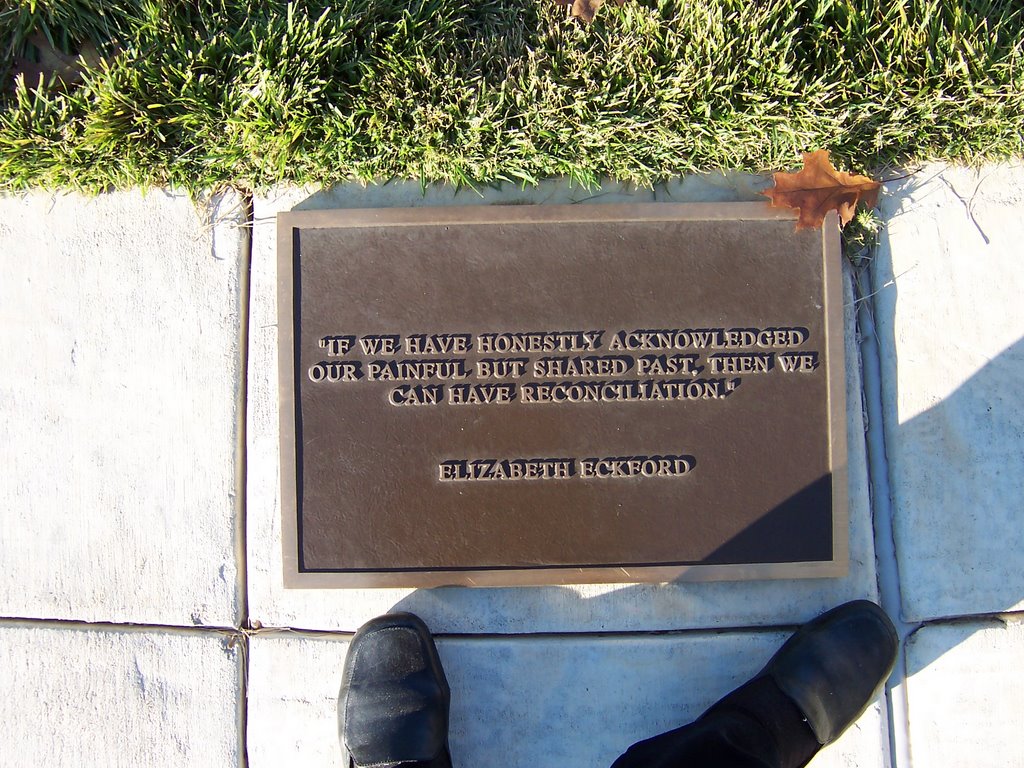
Photo: Plaque at the foot of the Monument to the Little Rock Nine. It's a quote by Elizabeth Eckford, one of the students who dared. (Click to enlarge.) There is a quote from each of the students.

Sunday, October 29, 2006

My very first visit to a presidential library ...

I really should have scanned one of the great photographs we picked up at the gift shop. They show this amazing cantilevered building that appears to hang over the Arkansas river as if suspended in air at one end. It is an architectural wonder. But my scanner is acting up and I'm not savvy enough to deal with it. The top floor is the apartment where the Clinton's are housed when they occasionally return to Little Rock, and where (according to our guide) actors Ted Danson and Arkansan and Clinton close friend, Mary Steenburgen, his wife -- were guests only the week before our visit.

But I've not yet mentioned our National Women's History Project workshop. It was held in the Fine Arts Building of the University of Arkansas, a beautiful campus composed largely of red brick ivy-covered buildings in a forest setting. Trees are everywhere in Little Rock, and one is instantly aware of mature landscaping -- so unlike much of San Francisco Bay Area (too-fast-growing) where -- except for our spectacular ancient forests -- urban trees are still young and often threatened by fast-changing physical environments. I saw far fewer of the "lumpy" industrial parks that are so common in the Bay Area, and far more neighborhoods where huge tree canopies met in the center of the streets, providing cover against the summer heat, of course. The spaciousness of lots, the old southern home designs with sweeping front porches and expanses of lawns gave one the sense of safety and peace. And -- oddly enough -- there is an almost total absence of fences. (Why do I hear in my mind's ear my grandmother saying, "... call your daddy to supper, he's out there on the gallery." Would that be the word in New Orleans?)

Grassy lawns flowed each into the next without interruption. I have a pet theory that we lost something invaluable when the tract designers began to eliminate those verandas and front porches. Losing them turned community life inward and no longer placed families out there facing one another on hot and humid southern evenings. There was little need for community policing when every home on the block had a grandmother or grandfather swaying on a hammock or chatting over a glass of lemonade on every front porch. With entire families gathered around a table radio or board games in full view of their friends and neighbors, interdependence was assumed and embraced.

I thought about that again since arriving home and noticing again the construction styles we've come to see as "friendly". No young woman could ever hide a black eye or bandaged arm for long, nor could children get more than a few houses toward home in tears without someone interceding. We elders still remember those days, and click our tongues against our dentures as we watch today's developers building what the trades call "defensible spaces," (what a concept!) while they omit the most vital parts that support collective life - the forward-looking, community-friendly front porch.

But that's not telling you about our workshop where Lucy and I presented to a group of women from many parts of the country -- our material on our park and its brief history and the events that created it. We showed our short videotapes; made a few comments then took questions from the floor. We hadn't really prepared much since we were both filled with facts and feelings held so near the surface from the sheer force of the excitement we live in every day that we're spending learning about and sifting through -- with a community -- what is now one of the nation's newest urban national parks.

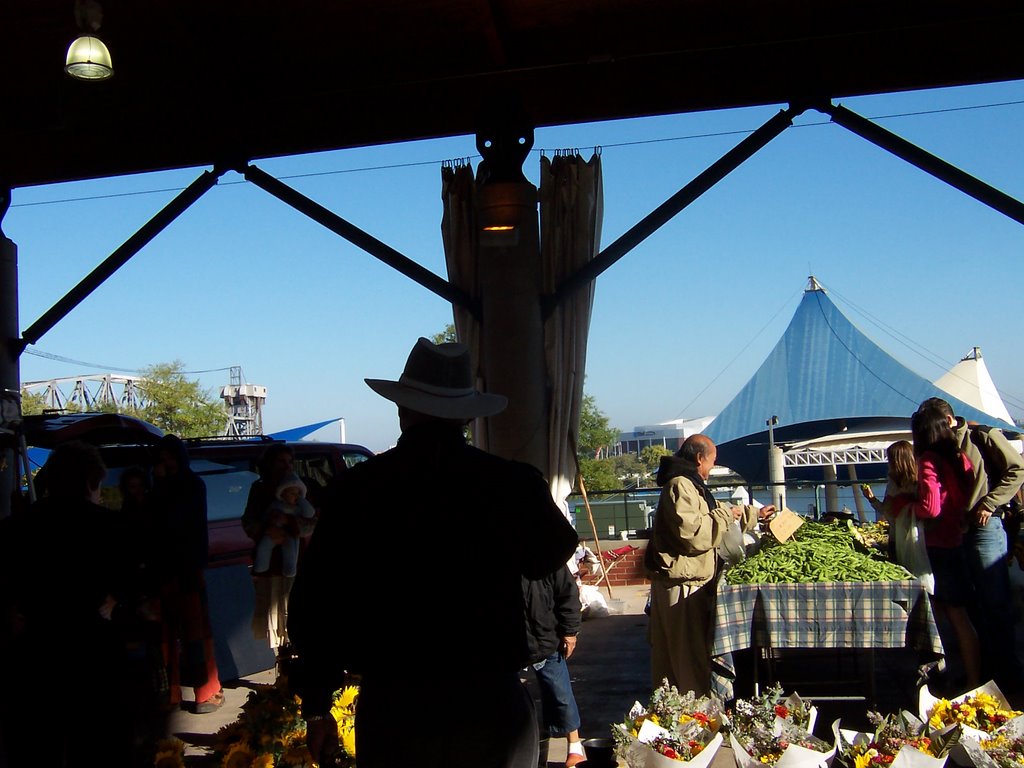
I think that our enthusiasm for our subject must have captured our audience since the questions were relevant and it felt as if we'd only started when 90 minutes ended with our audience taking time to linger a bit before leaving. We met some interesting women that I'd love to have had more contact with -- but we had only two days (and a few hours) and our visit to Little Rock Central High and the visit to the picturesque riverfront open markets and the Clinton Library plus the Central High 9 student memorial were still ahead of us. Besides, we'd arrived at night on Thursday -- checked into our rooms at the Hilton -- spent all of Friday at the university -- and seen little of the state capitol until Saturday. We would leave for home on the 4:30 flight.

It just means that we'll have to find some reason to return, right?

Now ... if I can just find some legimate reason to visit Atlanta ... another dream yet to be realized before dementia sets in.

I keep wondering when ... .?

Photo: Remember to click on this thumbnail for the enlargement.

Saturday, October 28, 2006


It has been an unusually busy week in an uncommonly busy life -- but I still seem to thrive on the intensity of it all ... .

On Thursday evening my (mentally retarded) daughter, Dorian, and I got together to attend the bi-monthly artist's reception at NIAD (National Institute for Artists with Disabilities). She had several pieces on exhibit and was anxious for me to see her new works.

Since she's moved into her own apartment across town, I've tried to keep some distance between us while she adjusts. I must admit, though, that she's been far more successful than I at the adjusting. It has always been important for us that I allow most contacts between us to originate with her. That way she doesn't have the feeling that I'm constantly worrying or checking up on her; that I don't trust her to handle her freedom or make the right choices in this world of risk and hazards. And, of course, she often takes risks and makes wrong choice -- as do the rest of us. I only call her at those times when I'm unable to keep my concerns in check. I suspect that much of my busyness comes from my need to remain distracted for her sake. Were it not for my work and all-consuming activism, her welfare might be at constant risk of my ill-placed motherly interference. We've struck a good balance, I think. Were I to die tomorrow, she would not be destroyed by the loss. Meanwhile, our cellphones serve as a new high tech umbilical cord -- and I'm grateful for their place in our lives.

The women's blouse above has been an important piece that she's devoted several months to. It is brilliantly beaded with her signature whimsical images of cats and kittens, and has been sold for $250, a real affirmation of her status as an artist. She has sold a number of pieces this year with half the sale price going to NIAD and half into her bank account. She is confident, productive, enthusiastic about her way of life, with a solid anchor in the "Outsider Arts" community. For that I am eternally grateful to the enlightened and unbelievably-patient NIAD staff of artists and teachers.

The same evening, a bit later, I attended another of the historian Donna Graves-created "Memories of Macdonald" activities. This time it was a "Talking About Macdonald" evening at the East Bay Center for the Performing Arts.

This was, oddly enough, a companion-piece to our experience at the University of Arkansas in Little Rock last week. Teens from the EBCPA presented an evening of their video work that grew out of oral histories they'd collected from the small merchants and other elders along long-deserted Macdonald Avenue -- when it was the main street of Richmond. They were wonderful, and were followed by 6 of the Center's drama students who had taken audiotapes of those interviews and created monologues which they performed to a delighted audience. They were marvelous!

Now -- over a single week's period -- I've experienced those five Little Rock Central High kids from their Memories project, and now the local version. I'm more determined than ever that we bring those powerful young forces together sometime this spring. I'm finding resonance to that idea among our staff. The idea originated with my travel companion and colleague, Lucy Lawliss, and has now bloomed into a real possibility.

Then, yesterday, another of our great bus tours of multiple park sites in the process of restoration or at least recognition -- happened -- this time for foundation representatives who might be interested in helping in the co-creation of Rosie the Riveter World War II/Home Front National Historical Park, along with the city of Richmond, the Rosie Trust, the Redevelopment Agency, and the National Park Service. It was another smashing success with the vision now radiating out into the larger community through work that I'm feeling more and more an essential part of. The shared excitement grows with each day, and the city is becoming deeply engaged in the learning and sharing of its history. That was made apparent at the EBCPA where a full house of nostalgic elders and fascinated youngsters traded stories on Thursday evening. It again surfaced yesterday when I watched potential funders drop their cynicism and really begin to see the potential for a new image for a city so long scarred by destructive times that were never faced up to or reconciled.

Photos: The top photo Dorian describes as "My Angry Painting," (about 4'x5') was done in oils over the past months since she's been on her own. I've no idea what inspired it, but the fact that she can express those feelings and recognize their genesis is great, I think. The second is described in the paragraphs above. (Double-click on it for a clearer look at the detail.)

Thursday, October 26, 2006


Not sure why I was so struck by this sign in the Central High School cafeteria ... .

but I found myself wondering how those prices would compare with those in our West County school district?

Central High (in comparison) appears so well maintained, so proud, so beautiful architecturally that it's hard not to assume that it is also the wealthy school home of well-to-do children. Not so. Its student body is 50% black, we were told, and by the looks of this list of prices -- just kids of ordinary means. By contrast, the highschools in our district resemble windowless prisons, with iron gates and security guards and metal detectors and surveillance cameras (in some cases), and the ambiance always of guardedness at all times. None of those things were visible at Central. The contrasts are stunning. I'd forgotten what schools were like in my youth, and what they're still like in the more affluent suburbs of the Bay Area.

I found myself wondering if the fact that Little Rock has found reconcilation by clearly marking the place of shame in its history and owning its past appropriately? It was wracked by horror and outrage almost fifty years ago, but (as in South Africa) faced its problems viscerally, found re-direction through strong leadership over the next decades, and moved on. That beautiful bronze monument to those children on the Capitol mall; the re-naming of streets to incorporate its newfound heroes; radical changes in unfair civic policies, all served to emancipate Little Rock from its racist past. That generation of elders created a better more accepting world for their young.

Maybe the lesson for us was that I now see a clear reason for the creation of that monument to the African American homefront worker in troubled battlescarred Fourth Street Park in the crime-infested Iron Triangle in Richmond. It would be the place marker and could allow for the belated facing-up-to and reconciliation that has never occurred here in the place where the Civil Rights struggles of the Sixties may have been born. Maybe that's what is needed.

We, as a nation, have never really come to terms with slavery and its centuries-old scars that have now claimed yet another generation that's doomed to continuing hopelessness and degradation. This may be what Little Rock discovered in that place in 1957 when it "touched bottom" on the site of Central High leaving nowhere to go but up. Maybe the violent street deaths we're experiencing in this city -- currently rated the most dangerous in the state by far -- is that bottom place for us. Maybe we can find a way to rekindle the hopes and dreams of the grandparents who settled here during World War II who might then transmit some of that to the young.

Maybe we can do that together as the kids at Central High are doing through their Memories Project online -- by bringing that panel of high school students from Little Rock to show our youngsters how that's done. I'm sensing some interest among members of our staff to do just that.

I believe that we've already begun that process through Donna Graves (historian) and her "Memories of Macdonald" project that is bringing some of that to the surface even as we speak. That work is being done under the auspices of the city's redevelopment agency, the Richmond Museum, the East Bay Center for the Performing Arts, and the Rosie the Riveter World War II/Home Front National Historical Park.

It's a beginning. Maybe even the beginning.

We'll see.

Photos: Sign posted in Central High's cafeteria. The photo to the right is of the reflecting pool at the entrance of the school. It was recently restored to its original beauty by the National Park Service. There is a fountain at the lower center that will be restored soon.