Saturday, December 20, 2003

It may be important to mention the circumstances of Rick's adoption ... .

In keeping with my "good girl" profile, and having fulfilled the strong wishes of my parents, I fully expected to bear my first child nine months and 24 hours after the wedding ceremony. Not so. My older sister, Marjorie, had been married for five years (she was 4 years older than I) but was pregnant with her second child -- and my youngest sister, Lottie, who was 4 years younger had married at 17 and was also expecting her first. I had been -- up to that point -- unable to conceive. In my early twenties, having two sisters pregnant and feeling barren, I started to explore adoption. Mel was less than enthusiastic. After all, he had plans to create his business and I would be the on site "employee," so this was an impediment to his ambitions.

He'd added another job to his schedule, that of working with Aldo Musso, the man from whom we'd bought our home. Musso owned a juke box route and hired Mel to service his locations with records and make the collections. The difficulty in finding the kind of music that the new Californians from the south wanted to hear suggested to Mel that this was a great opportunity to go into business for himself. With his benefactor's support, and a list of national suppliers with race music catalogues, he saw a profitable future ahead.
But I'd waited impatiently for motherhood to begin, and saw his plans as further postponement of my own dreams. Catholic Social Services announced in January that a child would be available in a month or so, and in March of that year, a nine-day-old little boy was ours. It took only a few hours for Mel to bond with our baby. He was a loving father. My gratitude for his having yielded to my wishes gave me a feeling of indebtedness that hemmed me in and defined my life for many years. I dedicated myself to making real his dream of owning his own business. Thus, began a period of years of standing behind the counter wrestling with diapers (sloshing away in the back of the store in the washing machine), tending to the customers, keeping the books, ordering from catalogs, working with play lists, etc., that ended only after Bob was nearly three (when Rick was seven) and I was pregnant with David. It was then that we started construction on our house in the suburbs, after spending years pouring over House and Garden, Sunset magazine, and Architectural Digest. Little did we know how costly those dreams would be.

Marjorie's son, Lottie's daughter, and Rick all came into the world over a three month period. The Charbonnet girls had delivered on cue. Motherhood was deeply fulfilling. Being a wife was not. The seeds of discontent -- years of feeling overworked and under-loved began to erode my stability.

Mel (we) not only had founded a successful business that more than adequately supported the family, but he'd also enjoyed the freedom and acclaim of being a professional athlete. That life offered travel and freedom from the responsibilities that fell to me. I was the stabilizer. He played quarterback for the Oakland Giants, the Honolulu Warriors, and also continued to play semi-pro baseball. There were other women who invaded our marriage from time to time, that was hard. All the while I managed our little business and gave birth to one more child while raising the first. I both wanted and needed to be out of the store with the time to bring up the children -- away from having to know about Mel's indiscretions. My parents were unsympathetic. "All men have some faults," says mother, "as long as he takes care of you -- you shouldn't complain. That, and the fact that -- as a Catholic -- there was no exit possible. "Adjusting" to the situation was the only possibility open to me. Divorce was unheard of in my family, at least up to that time.

Besides, there was a kind of innocence about Mel. He was always contrite, and I'd become aware early in our marriage that this handsome Adonis was also functionally illiterate, a condition I would recognize much later as a severe case of dyslexia. He hid his problem well. Few knew. He'd compensated by becoming a fine athlete in both baseball and football -- which took him as an All-Star through high school, Sacramento State College, and finally to the University of San Francisco. During his last semester at the University of San Francisco, I'd read and briefed him on his assignments. I was just out of high school at the time. He was a football major with a minor in history. He needed me, and I needed to be needed. In time we grew apart, painfully and with little recognition of how it all happened. In time, I was starved, intellectually, but found that -- since he was actually more comfortable with my family than I was much of the time -- it was easy to see myself as the not-quite-normal one.

There is nothing more tragic than to find oneself at 40 living in a marriage with the quarterback chosen by an 18 year-old! At 40 Mel was still the quarterback but was now operating in a world that required an MBA, and that was eventually this good man's undoing. He surely did his best for us. He more than made up for his deficits by out-working everyone around him. For most of the years of our marriage, he left home in the early morning, and returned at midnight. All of the energy spent in being the best on the gridiron was now applied to his business, and he accomplished miracles, despite all.

I must have been very difficult for him. I was pretty and bright, but a constant reminder of his failings. I was smart enough but it took years to realize that being pretty was all that was required of me in this marriage. The rest was a liability. He slept with a little round flat microphone under his pillow, convinced by someone along the way that -- by using tapes while sleeping -- his brain would take in the lessons of grammar and he would eventually overcome the gaps that plagued him.

I suspect that I did little to support him over time, but lost myself in the world of the suburbs where I was forced to struggle without his emotional support. Mother was right. He did his best to provide well for his wife and children, financially. In time, it simply wasn't enough and we drifted apart. We eventually became strangers, both lost in space, without a clue to what was happening to us.

Mel hit the heights as his business grew and prospered. For some years he'd been able to provide a few jobs to young people, and his confidence grew. He eventually became a prominent theatrical and concert promoter with clients like Marvin Gaye and Aretha Franklin. He was the original manager of the Edwin Hawkins Singers and traveled to Europe with that choir at the peak of their popularity. He'd given up the outside activities as he grew older and -- with a very capable uncle, Paul Reid, joined him in the business, together they became icons in the music industry. As long as enough money was coming in -- he could move it from place to place. In time, as he lost the exclusivity -- as other such shops began to come into being, more was demanded of him. We simply hadn't had enough generations in the marketplace, and the sophistication needed to hold on to his fortune was missing. Eventually all was lost, but not before our family had grown to include (mentally impaired) Dorian, and my life in Walnut Creek had become more complex and less needful of Mel's presence. I eventually learned to survive without him. There were huge gaps in each of our lives that neither was aware of, by the time we were -- it was simply too late.

Next: The move to Walnut Creek and the 180 degree turn into a new life of unknowns and unexpected growth in new directions ... .

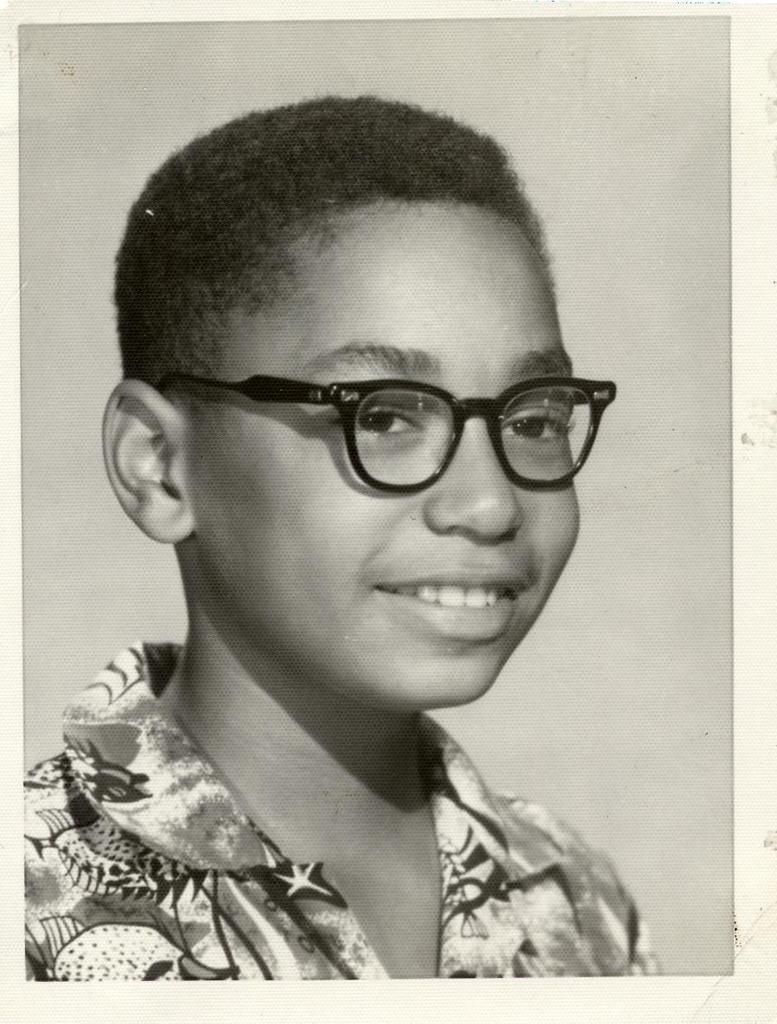
Right photo: The late Dale Richard Reid (nee Galvin), adopted son and our eldest child. He was eleven when this picture as taken.

Left photo: Mel with Aretha Franklin. She's only sixteen here and in town with her father, Rev. C.L. Franklin who was brought to the Bay Area for one of Mel's giant gospel shows at the Oakland Auditorium Arena. Aretha was presented as simply one of the acts in the otherwise Rev. Franklin event.

Back to the early years ...

Though Mel and I met in early adolescence, our paths didn't lead to a relationship until we neared young young adulthood (19 and 23). As an extremely handsome all-star quarterback -- in college on an athletic scholarship -- he had been engaged to the lovely daughter of a local dentist (pretty impressive stuff in our group). I'd had a succession of young boyfriends (one that was serious and that I was later to regret having abandoned). My parents adored Mel who showed all signs of being dependable and good husband material, and besides, he was handsome and fair-skinned (top assets among Creole parents). At a time when leaving home was solely dependent upon finding a husband, this was total fulfillment for my parents. There was no thought of education beyond highschool. It would be unfair to say that I was resentful, it was simply the way it was. Success for a girl was a proper marriage. Choice was an unheard of concept.

At a formal ceremony at St. Bernard's Catholic church on May 24, 1942, we were married by Father Kelly (the second Father Kelly to figure in my life), and started life in Berkeley in a duplex that Mel had managed to save for while attending college (down payment of $750, as I recall). I understood that his former fiance's parents found him inadequate since their wish was that he become a physician (far beyond his capacities) while his ambition was to be a truck driver for Wonder Bread Bakeries (later Continental) where his father had spent his entire working life. Only problem was that -- he was unable to do so because the Teamsters would not accept a non-white in membership.

Which brings me to one of the ironies that later helped to shape my politics:

Thomas Reid, Jr. -- Mel's father -- was employed by Wonder Bread Bakery at the age of 14. He'd left school at that time. He was a shy and kindly hardworking brown-skinned man whom I barely knew. For all of the years -- from that age until he retired at sixty -- he'd worked nights and slept days. And, for all of those years he'd lifted 100 lb. sacks of flour from railroad cars to the dock without ever rising above that duty. I remember my silent fury the evening that we attended his retirement dinner at the huge wholesale bakery and a succession of white men extolled "Tommy" and spoke about how helpful he'd been over all of those years, how "faithful" he'd been, and how grateful they were to him for "helping to orient me to my duties when I entered the firm totally inexperienced -- green...". After all those years, he'd not risen to the status of having a last name. His son (and my young husband) could not become a bread delivery truck driver though everyone had known him from childhood -- attending the annual Christmas parties with his Dad -- and being awed and inspired by the world of the Plant. How sad!


That evening when they handed aging "Tommy" his gold watch, I felt the breath catch in my throat, though to have spoken out would have been unthinkable. I hated those men (and they were all men), with a passion, and added the experience to the many racist incidents that were coming in ugly waves into my life. This coincided with the events of the new "Colored" context that had arrived with the war effort, and with feeling set apart from the world I'd grown up in -- in the relatively racism-free Bay Area.

It was in this climate that Mel and I married and moved into our Berkeley duplex that was situated on a street where the Santa Fe railroad ran right in front of our doorway. We watched untold thousands of warworkers arrive throughout the day and night, hanging out of train windows for their first signs of the "Golden Streets of California." We lived no more than 15 minutes away from their point of arrival. It was as though the ground was visibly shifting beneath our feet with each thundering trainload.

"The South" was arriving under our noses, with white and black folks who -- at that point -- had never shared restrooms or drinking water fountains, or been buried in the same cemetaries, and were now bringing Jim Crow right into our living rooms, but all of that had been pushed to the background by the demands of the war effort. Few noticed that the Klan was burning crosses in the nearby hills, or that "separate but equal" facilities were cropping up in order to accommodate the biases of these white southerners from Louisiana, Oklahoma, Arkansas, and Texas. Home would never be the same.

Though Unitarian Minister Thomas Starr King, and some parts of the California State Militia (and some of our ancestors) had succeeded in keeping California out of the Civil War on the side of the South, it was unclear whether or not this 20th century "invasion" would hold the line. In much of the state -- even now -- I'm not at all sure that we did. It was in those years of my youth that it was not possible for Negroes and Whites to marry (or even those who appeared to be-- as was the case with a blond and blue-eyed cousin who had to leave the state for Nevada), or to teach in the schools, or to move up from loading 100 lb. sacks of flour from the dock ..., or to work in any job other than those in the service sector. This was new for our fast-disappearing "new immigrant" early colored settlers in the west. Our world was being buried under by change we were ill-prepared for.

Mel's heart-breaking experience in his brief encounter with the Navy and mine with the Air Force (then in the Jim Crow Auxiliary union), added up to our determination to never again work for anyone. In June of 1945 we tore out a wall in the street front garage of our little duplex, took out commercials on a local radio station, and went into business for ourselves. Reid's Records and the adoption of our first child happened within 3 months (Rick was born in March of 1945). We were instantly successful -- with a new attitude about our racial heritage -- no more ambiguity about what being "colored" meant, and the will to move with the culture, we became the headquarters for what was then known as "race" music (blues, black gospel, and jazz).

While Mel continued to work on the late shift at the Richmond shipyards and spend his days as playground director at San Pablo Park not too far from our Berkeley home, I spent my time playing merchant with the record stock piled in neatly-arranged orange crates, a cigar box for the money, Rick in a playpen on the concrete floor, and about as much knowledge of what it meant to be a retailer as my baby might have! But in a fast-changing world, it mattered not. Keeping up with the demand was enough to occupy my brain, motherhood was something I loved, and the novelty of the breath-taking social change were enough to keep me from losing my mind. I was far more curious and engaged than fearful, so survived. In time, my marriage did not. But that's for much later.

...and now it's time to take a deep breath and let it all go ... the tension of remembering.

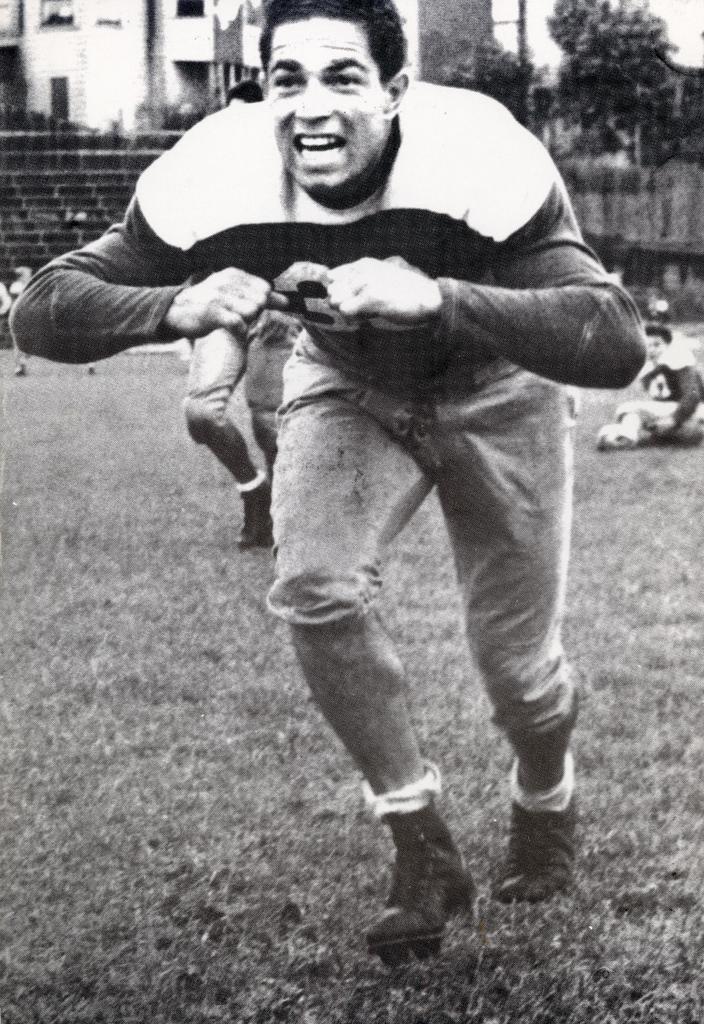
Photo: Melvin Adelbert Reid, quarterback for the University of San Francisco Dons the year he was named All-State. He later joined the Oakland Giants, the professional team that preceded the establishment of the NFL.

Wednesday, December 17, 2003

There's much to be said for consistency, routine, and setting a rhythm to one's life...

Did pretty well with my writing -- at least until the routine was broken by the unexpected (bout of flu) then the spell was broken. Getting back into a pattern of writing a bit each day proved to be more fragile than I might have thought or wished.

The pace of my life is such that even a brief pause creates an impossible backlog. This was a first for me, at least for a period of the past several years. The advent of the age of email has wrought havoc! My desk computer turned into a monster that held my entire life hostage with my Palm Pilot adding to the confusion. My life is being dominated by machines, and it's all of my own making!

On the first day of my return (a week ago Monday), there was a four-hour session with a coalition of environmental groups who are working to save Breuners Marsh -- a beautiful stretch of shoreline along San Francisco Bay that's being threatened by both contamination by mercury and other vile chemicals on the one hand, and acquisition by Signature Properties for a huge housing development on the other. "Save the Marsh" is the rallying cry, and "The State" (moi) has a role in helping that to happen. I felt very small and pretty vulnerable after ten days of illness, but life does have a way of either engaging you or plowing you under!

Catching up with my calendar plus our Holiday office party, plus the annual Day at the Races at spectacular Golden Gate Fields in Albany; family birthday parties (another this evening), meetings re the Barbara Alexander Academy (still trying hard to help it to survive and regain its charter), staffing Assemblywoman Loni Hancock (yesterday) at the dedication of a newly day-lighted urban creek, and, and, and ...

And surviving the loss of Fr. Bill O'Donnell, activist priest who lived through over 200 arrests in the causes of the United Farm Workers; the protests at the gates of the School for the Americans; long ago and current People's Park protests; and about any other Progressive cause one can imagine over the past several decades. Fr. Bill was memorialized on Sunday. It was a great loss to all of us who knew him and shared concerns in common. Each such loss brings a sense of awareness of one's mortality - the inevitability -- the inexorable passage of time ... .

Have been asked to keynote the Martin Luther King celebration in the city of Walnut Creek (nearby suburb where we lived for many years) at the commemoration of his birthday in January. The Mt. Diablo Peace Center is hosting the event. Hesitated at first, but only for a few minutes. Writing a 15 minute speech for the occasion will give me a chance to re-assess where I am on the continuum of change in the areas of civil rights and civil liberties. The contrasts in my life (lives!) over the years will provide a broad canvas upon which to draw together my thoughts on the subject. Maybe the thinking is more important than the delivery of such a speech. Though it's not easy to be in both a period of active participation and retrospection simultaneously. We'll just have to see if I can manage it.

Maybe I can work that through here ... but it would surely help if you'd provide some feedback while I do so. Do you suppose?

Saturday, December 13, 2003


Okay, so I've been out on sick leave since the Thanksgiving holiday.

Miserable stuff, this flu. Get your shots, guys. This one doesn't fool around. And -- as an elder, I should have known better, but being invincible is my thing, and I figured I'd manage to dodge this bullet, too. Not so. Decked!

However, I've been back at work for the past week -- though my mailboxes both at my office and at home were filled to capacity with no way to catch up except to plow through one message at a time. The number of messages in my voice mail, alone, was enough to bring on a relapse. Don't now how on earth I ever kept up with the work load, but after this past week of separating "this is critical" from "next week will do," I have a new respect for myself and my ability to juggle!

Spent yesterday at our annual Day at the Races (Golden Gate Fields) with Assemblywoman Loni, Mayor of Berkeley Tom Bates (her husband), and both the capitol and district staffs. Great lunch and an exciting way to lose 18 bucks in two dollar increments. Horses were beautiful and the setting even more so, if possible. Sitting in the Turf Club watching the action on the track below was a reminder of the richness of this magnificant shoreline. Found myself happy to have been involved this past year in support of so many environmental projects.

Am glad to be back blogging, but this afternoon I'm still playing catchup. Alayana (8 as of last week) and Tamaya (six as of ten days ago) are dancing in a performance at the East Bay Center for the Performing Arts. It's the Christmas annual and I promised to be in my usual grandmother seat for the show.

Take care.

(So much is happening!)

Monday, November 24, 2003


I'm having a difficult time moving into the suburban years ...

Not sure what that's about, except that they were turbulent and hard to re-live. Thought about that a lot over the past day or so -- "drive time" is when my mind wanders back over time. There have been lots of miles over the past week, and it's obvious that I've been avoiding looking back over the period of young adulthood. It was a long time of constant and painful changes -- inevitable separations from immediate family, then re-configuring "family" from a kind of "quilt" of new acquaintances who would become my support system through very troubling years. This was the Fifties and Sixties and into the Seventies, a period when we were deconstructing the world, and building a new social structure that would carry us through the next few decades. That was the context. It should be no surprise that I'm feeling reluctant to re-examine those decades.

I'll work it through in time. It's important that this record be accurate -- or at least as accurate as memory can provide. Everything has been colored by time and events and are entirely subjective, but from this distance it still feels painful and "seismic." This was surely the most important period in my life, and what was worked out in both the micro and the macro created the foundation that holds me in these later years. In a strange way, there were times when I fully appreciated the historic era we were living in and allowed it and the strong world I'd "peopled." I know that I created that world for myself -- both good and bad -- and that it both nurtured and plagued me and mine. It was a time of learning for us all, and if life provides a steady progression toward -- who knows what? -- it's all led to this. I'm now living in the future I hoped I'd live to see, and for which I was preparing. Strange, isn't it?

I do know that I moved into my Eleanor Roosevelt/Fanny Lou Hamer period at a time when a little Martha Stewart would have been a lot more desirable for my family!

Which leads me to a thought that flashed through my head while waiting at the toll booth on the bridge -- "How can we call it 'The Middle Ages' unless we have a sense of beginning and ending ages? Just who do you suppose established that?

But it's late and I'm tired tonight... .

Photo: Rick and Bobby and young parents, Betty and Mel Reid. David was on the way and Dorian wouldn't arrive until years later. We would move into our newly-built home in Walnut Creek in about a year.

Sunday, November 23, 2003

To add to the insanity of the time:

On Thursday evening there appeared on my calendar, "...attend tree-lighting ceremony, sponsored by the Main Street Project in downtown Richmond." Though the day had been long and scattered (had driven a round trip of 37 miles to Pleasant Hill for the Contra Costa County workshop) and then to city hall on the bay shoreline for a meeting with Redevelopment Agency director), I pulled myself together for the five o'clock event. After all, it was on my way home so could be managed easily.

Had to park a block away due to a lack of parking spaces (part of the street was barricaded for the festivities), but the walk was refreshing though with a chill wind that cut through my not-quite-winter-coat. Keep the date in mind. We're talkin' November 20, one week before Thanksgiving!

The community center was filled with school children, Christmas wreathes hung at the entrance, and beside a large Christmas tree sat Santa Claus. He was giving out goodies to each child who was willing to suspend belief enough to participate. There were carolers and liturgical dancers, city officials, and santa-capped volunteers, choirs. Astounding!

To my fevered brain, this was just one more sign that the world has gone mad! I'm beginning to believe that the distortions in the system have so warped reality that we're taking our cues now from some strange sources. Has the beast of commercialism so altered our historical perspective that we're willing to allow even the calendar to be disregarded? Are we allowing the collection of sales taxes (desperately-needed revenue) to extend the buying season by an additional few weeks so that we leap-frog over Thanksgiving? What's next, Hallo-mas?

Were I not such a devout Democrat, I'd swear that the end of Capitalism is now in sight, but then I'd make myself eligible for collection by the Ashcroft Patrol as a possible Communist sympathizer ... or whatever.

I had noticed that the Mall had begun to put up its decorations, but Santa and caroling?

But having said that, I'm off to pick up the beginnings of Thanksgiving dinner fixings, and there's the need to visit the storage center to paw through more of the "stuff" that I've not yet had the time to move into the condo I bought last February. Maybe I'll find the ivory-handled carbon steel carving set that's handled family turkeys for three generations. I know, I gave in and bought one of those efficient Black & Decker electric jobs long ago, but at least I know the old carbon steel set is somewhere in a packing box -- even if outdated and overlooked. I know it's there ... and with it memories of my Dad presiding over the festivities ... It's at such times that I'm painfully aware of the passing of time, and the loss of those who gave life to me. It's when I miss them most.

I wonder if one ever recovers from the feeling of being "orphaned?" I don't recall -- as a younger person -- thinking much about the shoulders I stand upon, or how it would feel when I reached the top of the pyramid? More and more I'm aware of that, and while there is a quality of achievement, there is also that deep sense of responsibility that has increased with age.

Just as I felt the quiet resentment that my parents began to need role reversal while I was still in my own parenting years, I now feel the strong desire to protect my own kids from experiencing that. I surely was not aware of those feelings at the time, eventually it all fell into the natural rhythm of life, and I took my place as parent to my parents fairly comfortably. There were 20 years of double-parenting, but given my own good health and continuing productivity, none of it was lost.

Life just isn't neatly scripted. I doubt if any of us ever feels totally "grown-up." There are probably small pieces of the child that continues -- more in some than in others. The artist part of me seems to be where she resides, but there is a very capable and responsible adult Betty who carries that part of my life that keeps me stable and adaptable. I think, sometimes, that the artist Betty has served to keep me in touch with the parts of Dorian that will remain an unfulfilled child for all of her life. Without access to that part of myself I probably would have become bitter and burned out long ago, but instead she's kept a critical part of my psyche active that may have otherwise atrophied by now.

But I have some menu planning to do and I'm assuming that there are some online pages to help me work out some novel ways to approach the day ... .

Saturday, November 22, 2003

Wow! Where did the week go?

It's Saturday again, and a full week since I entered anything in this journal. I believe this is the longest period ever, and getting back into the rhythm may take a day or so.

It's been eventful -- starting with the seating of the new governor and the calling of an Extraordinary Session of the Legislature. That turned out to be a total disaster with the session called for four o'clock on Tuesday afternoon, and the following morning it disintegrated! The newly-appointed state auditor (called from Jeb Bush's Florida) appeared before the Budget Committee, made a brief presentation, refused to take questions -- and walked out on that body in a huff. It seem that the dear woman had not been told that the 20 billion dollar bond that the new Guv was requesting for the next ballot would bump into the 15 billion dollar bond measure the former governor had already set in place. Also, there is a competing 5 billion dollar bond measure for education set for the next ballot as well. It's a total fiasco!

Spoke before the Berkeley Chapter of the Grey Panthers on Wednesday afternoon as a replacement for Loni who was at the Capitol. Great fun! These are my contemporaries, and several were old friends and allies from years ago when Berkeley was carving out its reputation as the Progressive capitol of the world. We talked budget and prospects for future legislation and what-in-the-world will tomorrow bring with this wild and crazy bunch we allowed to take over the state, the country, and the world. Loved every minute of it, and hope to be asked back when some of this is behind us. Good to learn that most are involved in Berkeley-born MoveOn, and are working hard to defeat the revision of MediCare and the awful pork-filled energy bill. Go Grey Panthers!

Won't bore you with reports of the Water Workshop of the Contra Costa Council, but it may be comforting to pass along at least one fact. There is little or no danger of having our reservoirs contaminated by terrorists (Anthrax) since any toxin used would simply become inert under the traditional water quality treatment processes. There remains, however, problems involving smaller community facilities.

With so much happening with work, and with a city melting down before our eyes (city manager -- a friend -- resigned on Wednesday for "health reasons"), I'm not sure how much writing I can get to over the next few weeks. The City of Richmond now has an interim police chief, interim city manager, interim finance director, and a mayor and city council in shock. Because of a severe budget shortfall, the council chose to create a six month rather than full fiscal year budget. In addition, Governor Schwarzenegger's precipitous restoration of the Vehicle License Fees only recently enacted, and that went to pay for public safety services for cities and counties, has cost the city an immediate additional $3 million dollars in lost revenue.

Due to the need to move out of the Civic Center complex in order to retrofit for earthquake preparedness (mandatory), city government has relocated across town to buildings that cost in rent over $100,000/month -- with the work required for the original site not yet put out to bid. Moving back in is obviously years away.

This is my city, and I'm not even sure that it's governable anymore. Find myself wondering how many other cities across the country are fighting as hard to remain viable? I suspect that this is the proverbial "tip of the iceberg." Being so close to the centers of governance where it's impossible to ignore the chaos, is pretty frightening. The fragility of systems that no longer serve us -- and maybe never really did -- makes for some sleepless nights. Seeing that the leaders we've chosen are mere mortals who must have our consent to be governed, and our cooperation in that effort or democracy will fail adds little to one's sense of security. Find myself wondering if we're not entering a period of anarchy, fostered by having been dumbed down so by media that one day the strongest, and probably not wisest among us will rise and prevail... another scary thought. And -- maybe that's already happened.

Hope continues to appear in my email box each morning when I read messages from People For The American Way, ACLU, MoveOn, The Nation, etc., and realize that a new wave of Populism is cresting -- this time through the power of the Internet and connecting the voice of Progressives everywhere. Writing checks and clicking on hyperlinks and feeling effective when I see the newspapers ads and the boxes of messages being hauled into the FCC hearings that tells me that my voice is only one of perhaps millions, and that change is still possible.

Internationally, news continues to terrify me. But I find myself less concerned with the "Terrorists" than I am of the obvious disintegration of the support our country once enjoyed. I really don't have a solid sense of just who the "We" might be? That we're standing pretty much alone, except for a misguided Tony Blair, says little that reassures.

Can't remember a time when I didn't feel a part of the "we," even when most critical of what "we" were doing as a nation. One could speak out and critique, and march, and write, always with the feeling that there were enough other voices of opposition "out there" to provide the necessary balance in order to maintain our democracy. Then there was the Supreme Court and those founding documents that upheld the right to dissent. None of that seems terribly relevant anymore, and the feeling that we have a government that has lost the ability or the desire to conform to those safeguards heralds tough times ahead, and the creeping suspicion that our foundations are crumbling ... .

Meanwhile, my agenda grows -- but so (apparently) does my effectiveness. Don't be fooled by this temporary pessimism. In the short term, I'm still hopeful. Just having a hard time dealing with history as it is unfolding in these troubling times. Will explain that more fully tomorrow.

Off to pick up Dorian ...

Friday, November 14, 2003

Lessons learned that summer ...

introduced me to segregation in ways that probably color my attitude today.

On an oppressively humid day Aunt Corinne took me to visit Maison Blanche, a grand department store on Canal Street. As a lively teenager will do, as we passed a display of ladies hats, I popped one onto my head and headed for the mirror when an obviously irate sales clerk dashed over to demand payment from my aunt. I learned in this embarrassing way that colored people were not allowed to try on garments. If you did so, you'd just better be sure that it was what you wanted. In my western innocence, I simply hadn't known. No one had thought to warn me beforehand.

This was my first experience with sitting in the back of the bus and not by choice. Only, in this case it was a streetcar. Though called "the screen," it was no more than a bar that said "Colored Only" that was the length of a double seat and perhaps five or six inches high. It slipped into slots that were embedded at the back of seats and could be moved back if the front of the bus got too full and more white folks seats were needed. If the back of the bus was crowded, it was standing room only. This I had been told before leaving home so it was demeaning, but of relatively little interest to me.

Attended a matinee at a downtown movie house with cousins; another curious day. The theaters were usually built on street corners with a box office on the main street for whites and another (smaller one) for coloreds on the side street. The whites paid the normal ticket price of a few dollars and sat on the downstairs main floor. Coloreds walked up stairs and occupied the balcony, but paid only a quarter for the admission.

I noticed during the intermission that there was a trailer being run for the upcoming Fourth of July picnic being held at the racetrack with a general admission of $1.00 for adults, 50 cents for children, and 10 cents for colored people. That was a shocker for me, but there's a streak of humor in it that I still appreciate. The picnic was also segregated with different entry points and congregating areas for blacks and whites.

On the other hand, that summer was my first experience with being in a world where everyone looked pretty much like me and my family, and where -- except for trips downtown -- I never saw white people. The druggist, the doctors, the dentists, the teachers and principals, the shop and barkeepers, everyone -- was colored. That was new for me. With few exceptions, the professional classes in the California were universally white. Was this then, another of those places where oppression had some hidden advantages? Since one couldn't go to general hospitals or to a doctor, and since there were no schools for you except those run by the Catholic nuns, you had to create your own. There were even white and colored sections in crypts and burial grounds. But here, too were the beginnings of my sense of those millions shades of gray. There was not the equivalent of my uncle Dr. Raleigh Coker back home, graduate of Meharry Institute (for Negroes only), nor my several cousins who were teaching in the local schools. Or my legendary Aunt Alice who alone created the first school for colored children in St. James Parish and was celebrated in her community as a heroine of her time. At home, one of mother's friends, Ms. Ruth Acty was later honored as the first African American teacher hired by the Berkeley schools, but that was still years into the future.

But the crowning blow that summer was my first visit to Corpus Christi Church, the church my grandfather and father built and where the family had knelt together for many years. I had seen many photographs of it among Dad's things since I was very young. That building was the source of such great pride to him. This, above all, was "our" church -- much more so than St. Bernard in Oakland -- where I'd received First Holy Communion and that my family had attended regularly.

Corpus Christi was segregated. Coloreds were seated on the left and right sides of the aisles and the middle section was reserved for whites. This was the birthplace of a diminishing connection with organized religion that eventually progressed to Atheism. For some years it was possible to see this as a human rather than a God failing, but in time the disillusionment was complete.

Saw another anomaly that still puzzles me. There was no segregation in housing patterns, everyone lived everywhere. My grandparents lived in a duplex that was shared with an Italian family. Their children played together, but only in the back yard -- never on street-side -- according to my father. They all attended the same parish church, Corpus Christi.

A strange summer, most of which defied understanding -- and still does.

Thursday, November 13, 2003

Been thinking that I'd like to tell you ...

about my introduction to southern bigotry. It was when I was about fifteen, I believe.

Though the older members of the family visited New Orleans as often as they could afford to, we children had never returned. My parents talked with great pride about "home" and the stories were filled with delightful incidents -- embellished by Dad, who had a great longing for his family and former life, I believe. His transition to California must have been far more difficult than for Mother since she was joining with her father, three brothers, and one sister had preceded her in the move. Dad had no one but his wife and three little girls, and his life's work as a fine craftsman was gone. That was surely difficult. Small wonder that he spoke of life at home so positively. Therein lies the disappointment of that first re-visit.

The only concession to the racial restrictions of the south had been the warning that -- "when the train reaches El Paso, Texas -- wherever you are on the train -- you have to pick up your things and move to the Jim Crow car. I was to later learn that this was the car up at the front of the train (where noise was greatest, I suppose), behind the engine and the baggage car, but I'm getting ahead of myself a bit ... .

I was traveling with my 8 year-old mischievous cousin, Ralston, who was going to spend the summer with his father who was still in New Orleans (trouble!). We did well over the first two days, were treated well by the porters and conductor. On the third day we reached El Paso. As advised, I gathered up my belongings and Ralston and headed for the Jim Crow car. As we made our way through the long train, we were advised several times to return to our seats. Even at the young age, I was sensitive enough to know not to give the rail car a name, but just to continue moving forward.

When we reached the coach, it was clear that -- from throughout the train -- other African Americans had gathered themselves up from among the "strangers" and were now "home." The porters and waiters who'd been merely polite and fatherly to us over the first two days were now playing host in "our" car. Out came the picnic baskets (from short-run travelers), and extra blankets and pillows, a guitar, cards and checkerboards, and small crate of live chickens! The party was on! The waiters and cooks delivered a continuing stream of goodies from the dining car and everybody became "aunts" and "uncles" to two young travelers. No one had thought to tell me what a wonderful experience "Jim Crow" could be. One of the many shades of gray. "Jim Crow" had its delightful side. One of those times that I would later come to understand. That despite all -- oppression can be a blessing in some unexpected ways. It can create community.

But, sometime during the middle of the night the train stopped at some small station -- either in eastern Texas or western Louisiana, to take on two guards and four (white) prisoners in irons who were being transported somewhere. With a few empty seats between, those frightening men were seated in the "colored" car with us. The final shame, I suppose. I must have fallen off into a troubled sleep at some point because I can't remember when they were taken off the train, but the fear is still on tap as I write.

I can remember thinking about that experience when I later heard the stories of -- during World War II -- how uniformed black servicemen were forced to ride in segregated Jim Crow cars while German prisoners rode "up front." Despite my western upbringing, I could identify fully with the feelings of shame -- for both myself and the "offending others".

No one had prepared me for that, or, for other painful lessons in southern hospitality I would encounter over that summer -- and for which I'd not been prepared.

More later.

I'm off to a meeting of the Federal Task Force on North Richmond, then to my office for a staff meeting and new assignments for next week. Governor-elect Terminator is being sworn in on the 17th, and Loni will be returning to Sacramento as the legislature is being required to meet for a week in extraordinary session. One wonders -- in these days of an extreme budget shortfall -- how this new governor can justify the additional that this will cost the state in per diem for the two houses to meet in this special session? But then, nobody asked me, right?

I'm off to see the wizard!

Wednesday, November 12, 2003

What a day of mixed feelings!

Lots of media for 12 old ladies wearing hardhats (we got to keep them as souvenirs), sound trucks, limos carrying Ford executives who flew out for the occasion, city officials including the mayor and council members -- and -- Rep. George Miller, himself, who got the legislation passed that created this new national park.

We were serenaded by a trio of 'ole folks' who entertained in the USO during the war, two of whom were women. There was something a little bizarre about an 80 year old woman playing a sax, but then who am I to talk? May be just as bizarre to have a field representative of a state legislator who's still working full time among them. This was the first time in more years that I can recall where I was surrounded by my contemporaries, it felt strangely uncomfortable. Probably need to look at that. There were group photos taken that appeared in today's local papers. Then individual interviews. Hated every minute of it, but mostly because my "war stories" didn't match those of the other women. How does one celebrate having been a clerk in a segregated union office when you're surrounded by women who'd actually earned their hardhats as welders? Felt like a fraud.

We were photographed sitting in and around an old WW2 jeep, and with our arms raised -- in a gesture to show our muscles (the stereotype of the Rosie photos). Was so glad this morning when I open the paper and found that I'd carefully found a way to stand in back in a way that had the raised arm of another Rosie blocking out my face! You couldn't even tell that I was there -- and for that I'm grateful! It all felt pretty silly, and as if we were simply the object of a campaign to sell the Ford Motor Company. I figured that it would have to be a pretty slow news day for anyone to want to run such photos. Sure enough, didn't see much on the eleven o'clock news last night except Veterans Day Parades and footage of distant wars.

After the photo shoot we had individual interviews. I got to make my little speech about my "role" in the war effort. Did it quietly and without anger or discomfort. Made a pitch for how grateful I was that Ford was giving us the opportunity to re-visit a time in history when the country had less to be proud of, and that now we have a chance to do it right. I did notice that when I checked out the web site, some African American Rosies have been included in the photo gallery. Ya nevah know ... maybe we raised some awareness.

Learned also that last night the interview that I participated in a couple of weeks ago, the one done at the Rosie Memorial site (great spot) was to be "put up on the satellite." I understand that to mean that -- as in "put into the wire service" -- there's no way to know where it will turn up as a Public Service Announcement, because it has simply been made available to whoever wants to use it. We may never see it. On the other hand, I'm liable to run into myself at some point when I least expect to.

After the event concluded I climbed into a bright red Corvette convertible with Eddie Orton of Orton Development, who will be restoring the beautiful old Albert Kahn-designed Ford Building. I was deeply disappointed when his firm got the contract for this multimillion dollar project. Had my heart set on another concept and had worked hard to support it. We made our peace during the party and he invited me to lunch and for a drive to look over the old historic core of the city where I have visions of helping to bring into being an Arts & Entertainment District. But, of course, I have big dreams and no funds, but during the several hours that we spent exploring possibilities and coalitions and economic development and arts and culture -- Rosie got left behind in the dust. By late Tuesday afternoon I was already well into Wednesday.

...and Wednesday went very well, thank you.

Tuesday, November 11, 2003

Allright, guys...

It's about quarter of ten and the big doings begin in a half hour. I'm sitting here at my computer dressed carefully in a tasteful black crepe suit with one button blazer jacket and straight-legged pants. Underneath is a gray cashmere turtleneck sweater, with high-topped black boots. Wearing one bold piece of jewelry, a lovely silver pendant brought back from Nepal years ago by my late husband, Bill. My hair is pulled back tightly and gathered into a clip that rests on the nape of my neck. Lookin' good. Feelin' confident.

We've been here before (I keep reminding myself). All that will be required of me is that I stay centered and hold to my truths. I'm usually protected by the low expectations associated with being non-white, so I'll crush a few more stereotypes.

...but underlying the confidence there are remnants of past experiences of rejection that must be kept tightly under control. There is this strange phenomenon that allows most humans to consider Europeans as "generic" people and everyone else as exotic. There are times when it would be interesting to know what it feels like to be "generic," if only for brief periods. I suppose that's why my childhood and adolescent life were so special. Being together in affinity groups based on race and not segregation allowed us that experience. I suppose this may have been the single-most influential factor in our formative years. If I'm lucky, it's that Betty who will assume the Rosie mantle this morning, hopefully. If the post-war Betty pops up unexpectedly, I'll do my best to bury her -- at least for a while.

Stay tuned ... .

Monday, November 10, 2003

A few days ago, ...

on a visit to the National Park Service's temporary office in Richmond's City Hall, I picked up a small black & white brochure advertising the new national park. I was thrilled with it since it was created giving full recognition to the role that African Americans played in the home front war effort, with several photographs that depicted Blacks on the job and/or in the community in related roles. There was even a sentence that I recalled having voiced in one of the workshops while participating in some of the master planning of the new park. I felt so good about having contributed meaningfully. The superintendent was at her desk when I stopped in, and it pleased me to be able to congratulate her on a job well done. There had been some moments over the past months when I felt that we'd not been quite in sync on racial matters, and that she really didn't see what all the fuss was about. She'd come from the East Coast to organize the creation of the Rosie the Riveter National Park and was doing her best to fulfill the mission.

Late yesterday afternoon I received a copy of a large and colorful public relations brochure with lots of photos of Rosie's at work, including one by Dorothea Lang and the famous one that had graced the cover of the Saturday Evening Post at the time. Every one of those pictures were of white women. This brochure was created by the high-powered public relations firm in Irvine, California, the same group that interviewed me some weeks ago at the Rosie Memorial.

It suddenly dawned on me just why that small black & white 8 pager with the truthful text had been created. The superintendent intended it strictly for local consumption in a community with a 40% black demographic. The fancy brightly dramatic large color piece was prepared for national distribution. We're back to "separate but equal" (well, maybe not quite).

Today, just before leaving my office for the day there was a call from the PR firm in Irvine. It was a young woman calling to make certain that I would be at the Ford Plant tomorrow morning at ten o'clock for the big media event.

Wish I knew what to do with these mixed emotions. On the one hand, to participate in the event as it has been planned -- as if I really was a legitimate "American" working woman of World War II, is to continue the lie. On the other, I can do what I ordinarily do -- seize the moment and speak truth in living color! I can just make sure that I'm seen both as a "set aside" woman of color who survived the virulent racism of the time, and, as a present day "woman of substance" in a position of power -- despite all. Tempting, wouldn't you say? The problem is that most of what happens tomorrow will not be live but taped for later viewing. I'll just wind up on the cutting room floor if I choose to say what most don't want to hear. It will be an interesting experiment that I don't think I can afford to miss. You'll undoubtedly never know how I handled it unless you read it here. Chances are that only the benign will be acceptable, and anything else will be edited out.

Have no idea where on the tube this national coverage will be shown. I'll be as anxious to see whether my interview will make the cut, the one made earlier, that is. Tomorrow will be its own adventure. Guess I've decided (while writing this last paragraph) that I'll go if only to satisfy my curiosity. But I don't count on seeing evidence of much real progress over the past 60 years.

But I mustn't forget that the little file clerk's risen to significant heights in the world. Am writing speeches for a member of the legislature and advising when appropriate, helping to create legislation, or,  at least having input into the decisions about what might be needed in the communities that fall within my area of responsibility. That's a story worth telling, I guess. But that's not the one we want to hear, because it exposes the underbelly of the beast of racism, and that's still not under our control.

Guess I'm still carefully picking my way through those countless shades of gray ... .

Photo:  Iconic Saturday Evening Post image by Norman Rockwell.

Sunday, November 09, 2003

Another Veterans Day...

It's Sunday and the "Rosie" big media day of interviews and oral histories is less than 48 hours away. I'm so ambivalent around participating ... .

Let me tell you about those years:

I married on May 24, 1942. Mel was a student at the University of San Francisco and I became a stay-at-home wife. We'd met when I was about 13 and he, 17, at Berkeley's San Pablo Park when Papa George and I were spending a Sunday afternoon while he watched the traveling Negro Baseball team and I watched the boys.  Mel and I belonged to the same social group of youngsters who grew up together and whose parents were friends.

But now we were young married couples and our friends were being called into the service, and, we were (as I've told you) surely more American than Black. Having grown up in the Bay Area -- being together racially by choice and not by segregation, for the most part, our world had undergone a complete change. The context of our lives had been altered by the war and the great in-migration of southern America.

It was in those first years after Pearl Harbor that I heard James Weldon Johnson's "Negro National Anthem" for the very first time. It sounded subversive. I now hear "Lift Every Voice And Sing!" as a beautiful tone-poem of great power, but it took some time to embrace it as relevant to me. It arrived with African Americans who were the products of segregated schools in the South, where even the national anthem was "other."

Shortly after Pearl Harbor, I became a file clerk in the basement of the Civil Service Commission in San Francisco. That meant spending endless days comparing blue (flag) cards and pink (bar) cards with cards on records. Everyone who took an examination for any civil service position had a card on file among the millions in that huge basement. There were two other sets of cards. Those were gathered by the FBI and represented "suspicious" test takers. For instance, my brother-in-law had a blue card that I found myself having to check. It said, "car seen parked within a block of a known Communist cell in Vallejo, California." When I compared the two cards, his original card was removed for further investigation. My brother-in-law was never a communist, but did have a sister who lived in Vallejo.... Had that card been pink, his original card would have been removed and he would have been barred from ever working for the government -- and would never have known why. This work was being done by a very ordinary young file clerk -- along with thousands of other very ordinary young file clerks. We were tiny pieces of a huge mosaic, but all were doing the work of "War."

At some point I learned that the Air Force had taken over a huge office building in Oakland (on my side of the Bay) and that would be far more convenient since I lived in Berkeley at the time. I was concerned about being caught across the Bay during blackouts, anyway. Oakland felt safer. I applied for a transfer from the Civil Service Commission to the Air Force offices and it was granted.

There was one other (AA) friend working somewhere in the building but we never seemed to connect. She seemed to be avoiding me, but since we were not close friends, it was easy to ignore. One day we found ourselves alone together in the woman's restroom. She then asked what I was "passing" for, followed by a comment that -- since her last name was Newman, she was passing for German. This was the first indication that I had been transferred into a position that African Americans could not hold. When I walked back to my huge department and looked around, it became obvious that there were no other "colored" people, either male or female, service or civilian in view. The only people of color were those who worked in the Canteen or who provided janitorial services. This was only a few days into my new job, and I was feeling panicked. This was new. It was certainly possible that I'd been in situations where my race had simply not raised questions (maybe at the Civil Service Commission?) but I'd never consciously made a decision to cross the color line.

Meanwhile, Mel had volunteered himself into the Navy, was sent to Seattle for induction where he found himself in a group of young black men that had been separated out from the other inductees to be prepared for duty at Great Lakes, Illinois, where he found that he was going to be placed in the Messmen's Corps. The commanding officers told these men that the reason was because they would avoid the competition that other branches of the services would impose on them. The only role for a black sailor was to cook for the white sailors. And he'd left college for this?

He rebelled. Refused to serve under those circumstances and consequently lasted a mere 3 days before being mustered out of the service with a check for $45 and an honorable discharge. The psychiatrist who examined him asked why he'd chosen to enter the service as a colored man when he could have avoided all this by "crossing over." Mel said, " ... he told me that he didn't doubt that I'd make a fine sailor but that they couldn't afford to put a natural leader like me in with a bunch who might be easily led. That would be mutiny!" Mel was playing quarterback on the University of San Francisco varsity when he volunteered. He was a very well known proud Black athlete, though fair-skinned. This added insult to injury. The stupidity of the situation made him even more angry. This was his first trip out of the state of California where racism was subtly acknowledged but hardly a serious problem. He returned home feeling both disappointed in himself and lacking in patriotism as well. Within a few days he applied for work in the home front effort as a "trainee" boilermaker at the Richmond Kaiser shipyards.

All black shipyard workers were working under the trainee classification because the unions were racially segregated at the time, into "Jim Crow" auxiliaries. White union members feared having to compete for jobs with black workers at war's end. The unions could simply disband the auxiliaries and de-legitimize anyone of color. It was the hope that the black war-workers would return to the cotton fields and tenant farms from whence they'd come. We were already at home, and had been for several generations in some cases, especially in Mel's ancestors. The Reids arrived in the West before the Civil War. The wonder is that he survived the changes at all.

Over that same three day period, back home, I noticed that the young blond girl (another local Californian) whose desk abutted mine had been called up front by the Lieutenant in charge of our section. I could see her head shaking from side-to-side over a very red face. We'd had lunch together a time or two, and shared the work load. I had just learned from Havens Newman that I was "passing" or completely out of context.  My antenna was raised and ready. When I asked if that conversation was what I thought it was, she looked down obviously embarrassed and confused and said, "yes." The Lieutenant had told her that she was working with a colored girl. Our supervisor had thought this wise since we seemed to be becoming friends, according to my co-worker. Someone had informed on me. And this happened before I could even decide how I felt or what I wanted to do about it. After all, I was a transfer from the Civil Service Commission and hadn't applied for this particular job at all. The "error" was not of my making.

That was the day that I "fired" the government. Walked to the front of the room aware of eyes following me. The officer was obviously embarrassed at what was sure to be some ugliness to deal with. Before I could speak, he said. "It really doesn't matter, Betty. I've been told by your supervisor that your work is fine and that no one minds working with you ." My response, "... but what happens when my next upgrade comes up, will they be willing to work under me?" He answered, "you'll probably get the appropriate pay raises." I walked out never to return. No severance. Envisioned a little pink bar card slipping into place in my Civil Service File. Didn't give a damn!

That evening a wire came from Mel telling me that he would be home by Greyhound in a few days. "It didn't work out." He was deeply embarrassed. He'd been washed out of service to his country.

For the sake of country and the war effort, I, too, became a Rosie. Went to work at Boilermakers A-36, Jim Crow Auxiliary union -- about two miles away from the shipyards. Never saw a ship. Went back to filing cards into trays for all of the Black shipyard workers. Since this was under Kaiser Permanente and not the federal government (I suppose), the blemish on my work record for walking out on the Air Force didn't follow me. I've not had a federal position since, though I've worked in both city and state government since that time. Could be that the Lieutenant was as embarrassed by the incident as I was, and buried the paperwork. I would hope so.

Would be surprised if you don't understand that being used as a "Rosie" at this point in my life would bring some ambivalence. On the other hand, having put it into words may free me to turn up on Tuesday and find a way to forgive retroactively ... if that's really possible.


Photo:  Beside Mel and me, my late sister, Marjorie is my Maiden of Honor.  Our dresses are made of cotton, a far cry from today's opulent wedding gowns.  Marjorie made them lovingly by hand of white organdy, piqué, and cotton lace.

Saturday, November 08, 2003

This was not one of my finest of weeks.

Found myself so out of sync with the mission of my job that I actually gave notice of my intention to leave on Thursday. Yes, it was that fundamental. Important thing is that within 24 hours I'd reconsidered and rescinded my pronouncement -- at least for the time being. The second important thing is that, even at this age, there are options. It doesn't necessarily mean that I'll retire -- can't imagine doing that -- but it does mean that I'm considering the possibility of a career change, and that may make sense. But I'm committed to hang in for a little while longer, at least long enough to complete some work that interests me, and to give my co-workers a chance to find my replacement without straining the system too much. We'll see. Not knowing what to "blog" kept me from writing anything at all over the past two days. Things were too volatile and needed some settling down time.

So, it's again Saturday, and I've just returned from taking Dorian on our weekly trip to the supermarket for groceries. After some months of being clinically depressed, she's on some new meds that are working their magic and it was comforting to see her in good spirits. I'm sure that a part of my own angst is related to the fact that -- after a couple of years of fine work by a dear therapist/friend -- Dorrie's funding agency (Regional Center of the East Bay) must discontinue some of her services, including this one. I am aware that some of my ability to cope with the vagaries that plague the developmentally disabled, has been due to my reliance upon this fine professional. These cutbacks won't just effect Dorian, but her mother as well.

I cannot imagine how families cope when there are other children to consider, and when jobs have been lost. Not sure what happens to people when the cost of living has spiraled out of control and both parents must work outside the home in order to put food on the table, and one of their youngsters is disabled. What does it mean -- that 627% rise in Autism since 1987? At least I have no other dependents to consider.

I wonder how those who are supporting families on the prevailing wage of $8.89/hour (current pay for those working with the disabled in groups homes, etc.) ... how on earth are they managing in this new "recovering" economy? That is what is currently being paid to those who serve our most vulnerable citizens and even that may be cut back under the state budget passed last fall. The Department of Rehabilitation will now combine with the Regional Centers, as I understand it, an already overloaded system. The cuts are many and most have not yet kicked in, so we have no idea what the effects will be. The advocacy groups are gearing up for shaping their response on behalf of the disabled.

It was around some of these questions that I found myself unable to properly do my job this week. Found myself unable to be a field representative in a situation where I was really an angry constituent! The constituent won the battle and I blew up! I was in a situation where it was required that I represent my legislator on a panel before the Disabilities Council, along with other knowledgable legislative representatives. It's a 9:00 'til noon very important meeting -- the subject of which is "Assuring the Civil Rights of the Developmentally Disabled." It would have been necessary for me to explain if not defend the budget cuts (to the extent that they are defensible, of course), to some of the most sophisticated professionals on the planet. These are the specialists on the Lanterman Act, and who know the statistics and their implications better than I do.

It was an impossible assignment. I was ready to quit my job over it. I did. Fortunately for us all, 24 hours of involvement with some environmental issues intervened, and it was possible to back away from the edge enough for staff to modify the assignment enough so that I'll not have to be a panelist after all. How well this will satisfy the "angry constituent Betty" is yet to be seen, but the dynamics have changed enough so that peace has returned.

...and we haven't yet seen the changes anticipated by Governor Terminator. My only hope is based on the fact that it was Eunice Kennedy Shriver, Founder of the Special Olympics who is the mother-in-law of this man, and this may have some effects on future budget negotiations. Let us pray... .

Wednesday, November 05, 2003

My calendar has become cluttered ...

with short-term events that nonetheless demand complete attention. Assemblywoman Loni Hancock is here in the district since the legislature is in recess, though Governor Terminator has called them back on the 18th for a week of extraordinary session. That means more staff meetings, usually, and additional occasions to accompany her to one place or another.

Visited a huge plastics recycling firm on Monday that was pretty impressive. It was one of the many California firms that is considering relocating to China in order to remain competitive by taking advantage of dramatically lower wages. It's hard to argue with this practice that's so devastating our economy - not when you sit across the conference table from these CEOs and listen to their woes (i.e., rising Workmens' Comp, costs of energy, competition from the many corporations that have already moved offshore). It's grim. Can't imagine where it will all end, but the shifting elements in this huge movement seems equal to that of the Industrial Revolution that occurred early in the last century.

Find myself watching for a matching rise in worldwide unionization to take place, some attempt at bringing foreign and domestic workers into alignment so that ordinary folks can begin to benefit by globalization. That will be cause a monumental upheaval, I'm certain, and it hasn't yet begun to take shape in any meaningful way, though there are signs ... .

Today I visit two high school classes for a look at some small attempts at raising the awareness of teens to the environmental hazards waiting in the wings.

It's far easier on some days to get to and from my various involvements in my car than it is to move my brain from one era to another -- especially when it requires leaping years and decades -- back and forth. That takes some down time, and this week has offered little.

I'm off now to attend a meeting of the Federal Task Force on North Richmond, a coalition of nonprofits and agencies working to rehabilitate one of the more needful areas of the city. We've been at it for about four years, and only recently has it been possible to measure some real progress.

More later ...

Oh! In the rush I've neglected to tell you that I'll not be doing the Rosie piece on national television on Veterans Day after all. Will be involved in some public service announcements about the new website and the Rosie Memorial, but they're going with a real Rosie who actually held a welding torch and wore a hard hat, I believe. I spent the war as a clerk in a Jim Crow union office (Boilermakers A-36) far from the shipyards, so I represent something of an anomaly. That feels a little less than completely "authentic," to the media so that won't happen. Getting up at 3 in the morning to go to San Francisco to satisfy the east coast schedule wasn't something to look forward to anyway. Stardom will have to wait.

However, there is now a web site (Put in Rosie The Riveter or go the Ford Company web site for the link) so that you can see what they're planning. I'll be involved in the interview portion with lots of media at the old Ford Plant building on November 11th, but that will be at the reasonable hour of eleven o'clock.

Gotta go... .

Monday, November 03, 2003

Event-filled Saturday...

Every legislator produces several Select Hearings a year in the home district. These are ordinarily 9:00-12:00 workshops with a panel consisting of authorities in a specific area of concern. The goal is to look closely into some issue in the hope of exposing weaknesses in current law or finding ways of enhancing existing processes. Yesterday the hearing centered on the achievement gap as related to the new federal legislation known as "No Child Left Behind." A federal mandate, you must remember that has been imposed on the states without federal funding. The panelists included another member of the Assembly (from Southern California), principals, members of a local Board of Education, a specialist from the State Department of Education, etc. Attending as well were representative from other legislative offices, both State and Federal. It was well-attended with lots of audience participation.

The central theme turned out to be standardized testing, as usual, and appropriately so. It's clear that teachers are leaving the profession from overwork and underpay as well as their resentment at the excessive paperwork connected to the new federal mandates and of being forced to respond to the needs of test preparation instead of individualized teaching according to the needs of children.

These experiences, while they always turn out to be learning experiences for me, also have their down side. Before joining the staffs of a series of elected officials, I usually was an outspoken critic of and participant in matters of social significance. Yesterday I had many questions that -- in the past -- would have pulled me to the floor mike, but it would have been inappropriate as a staff member to do so. So, I sit in my seat and chew the insides of my cheeks, instead.

Case in point: After learning last week on one of my field trips to a local high school to observe two science classes, that in the State of California 48% of African American and Latino youngsters have dropped out of school by the tenth grade. Now there's an achievement gap! And that's a statewide figure. I can only guess that in the low income parts of my county the percentage would be higher still.

The high school I visited two weeks ago has a student population that is 65% Latino. Because of the huge drop out rate among AA kids, the black percentage (though in a community that has a 40% black population) is probably less than 25%. In the two science classes I visited, in one there were 3 AA kids. In the second (an AP -- Advanced Placement Class) there was only one young girl. When I asked the teacher why this was her answer was, "it's tracking. In middle school, the Black kids are all steered toward something called Health Sciences." This aborts all hope of college prep and results from low expectation of black students, I'm sure. I was also told that were I to visit the Special Ed classes, I would have found them to be 98% African American. Stunning!

It is also true that at the first school I spoke of, there are only 3 African American teachers on the faculty. Those few who have worked their way into teaching positions have only done so over the recent past so were "last hired." That means that, in compliance with union mandates, under succeeding budget cuts, they've been swept out for reasons of seniority. Non-white kids have little reason to see that education leads to anything in terms of life careers. There are too few role models in the field of education, the central and most influential part of their lives for their entire childhood provides no guideposts for their future.

A beginning teacher is lucky to receive $22,000/annually -- this after completing college plus advanced studies in many cases. Under the new federal mandates of "No Child Left Behind," he or she must invest in continuing education courses in order hold his or her position. A beginning prison guard with no more than a high school diploma receives a starting salary of $45,000. What's wrong with this picture? Some teachers who testified yesterday reported that -- though they've been in their classrooms for 9-10 years, under the new mandates, they are assumed to be insufficiently educated and are no longer qualified to teach. It appears that the dismantling of the entire system of public education is nearing completion. It is so sad, because I heard testimony from some dedicated and passionate educators yesterday, who are being ground up in the machinery of a hostile bureaucracy.

It's hard -- with my long view of history -- not to see a glaring connections between Brown vs. The Board of Education decision that attempted to dismantle segregation in the schools and what's happening today. It's taken over 50 years, but the Southern response to busing of children and forcing white schools has defeated the best intentions of Justice Thurgood Marshall and the Supreme Court. What started out in the deep south as the pulling back of support for public schools in favor of a movement that created "academies" for white kids (private) is now nationwide in scope. It has created the re-segregation of the schools. It's what vouchers are about, and the Faith Based Initiative that allows parents to collect resources from the State with which to set up "charter" schools (read that "academies"), and parochial schools, all draining the resources that used to underwrite public education.

How on earth can we have standardized testing without standardized resources? Children in the suburbs have textbooks to take home while kids in urban schools have few to use, even in class. Teachers report that they have to print out individual pages from a master copy in order to supply kids with a few pages at a time. Some textbooks in these schools were printed in 1975. In some, we have yet to land on the moon! And -- just as the pharmaceutical companies have been allowed to profiteers disgracefully on the backs of the poor and the aged, the book publishers are charging from $75/and up for a single textbook! Can anyone tell me why I can purchase a best-selling book on the web for under $30 and the purchase of textbooks for school systems that buy in huge volumes cannot be discounted? But of course, that's another powerful lobby, and, under term limits, the lobbyists have become the "Third House."

It's days like yesterday that cause a restlessness in me and an impatience with what I see as the failure of Capitalism -- based upon sheer greed. We're living at a time and under an administration that emphasizes the dark underside of our economic system. The same system that produces some unprecedented philanthropists like George Soros and, yes, Bill Gates, et al -- has given us Enron and Tom DeLay and the energy gougers and the stock market thieves, and yes, Ashcroft and his minions. Under a system of governance that supports the freedoms we so enjoy, vigilance must be constantly practiced in order to preserve the promises of our founding documents. There is always the threat of losing them, and never before in my long lifetime has that possibility seemed more immanent.

But even as I type the words, I'm buoyed by the knowledge that there is MoveOn.com and the millions of voters who have begun to participate in the electoral process through the presidential campaigns. By our successes with the turning back (at least for the moment) of the FCC's attempts to further monopolization of the media. California's recent recall of a governor in favor of another Hollywood icon scares me a little, but I'll keep looking for positive "embers" to blow on and will let y'all know when I see them on the horizon.

Meanwhile, have a happy Sunday.

Sunday, November 02, 2003

Home again from an afternoon of Arts & Culture ...

Really pretty boring, actually, and not nearly as interesting as the story that's been doing a "crawl" (a la CNN) just under the surface of my brain.

Thinking that my father was the world in microcosm. His racist attitudes were not unlike those of Ariel Sharon, a Jew who survived the holocaust but who has forgotten, as did many of the Israeli leaders who preceded him. To have been so cruelly victimized by the Nazis only to brutalize another race of people -- for whatever reason. The examples are plentiful throughout history and into the present. Find myself wondering if it's a male thing?

The major difference was that Dad was a mild and loving man of little power to act out his prejudices. I'm sure that he exemplified the attitude of his peers. He was far from alone. Those blind spots caused by racial differences know no limits. Mother suffered from the same malady, but was less adamant about it. Because I cared deeply about my parents, I learned at an early age to see the world -- not in black and white -- but to ever-so-carefully pick my way through the many shades of grey.

I had help. Several teachers opened doors that I walked through, alone. In fifth grade it was a motherly pear-shaped music enthusiast who introduced me to the masters. It was in her class that I learned to sing (badly) the works of Giuseppe Verdi (Miserere and the other great oratorios), and Sibelius' Finlandia, and simple Quaker hymns ("Tis a gift to be simple..."). Fifth grade glee club opened an entire world of great music to me, and those pieces are recognizable to me to this day -- upon hearing the first two bars.

It was a sensitive tall and reed-thin Miss Cunningham who first led me to Edna St. Vincent Millay and the Ruth Fielding stories. She presented me with a copy of Jane Eyre for reasons I can't recall, and probably accounts for my passion for the poets.

Castlemont High's Mr. McLaughlin, a devilish public speaking teacher who gave me the confidence to stand on my feet and debate the best of them. I can still see him standing against the blackboard at the back of the classroom -- grinning and goading me on to make my point. He was proud of me, and I knew it. My parents never knew.

There was John W. Hughes, a 7th grade teacher who'd returned to teaching after years as a social worker. He was a close friend to principal, George Axtell of Lockwood Junion High, who left the west coast some years later to become the president of CUNY. Hughes remained a dear mentor and confidant into my young adulthood. In the summer of my 16th birthday, he was chosen the Alameda County Chair of the Olson for Governor campaign. With the support of Aunt Vivian (who took me downtown and outfitted me in secretary clothes), I got my first lessons in electoral politics. I worked at the campaign headquarters all summer, have been politically active since that time, without messing a beat. When I was 18, Mr. Hughes went to live in Japan for a few years where he created the Nara Foundation that would address the plight of mixed-race children left behind by the armed forces of WWII. I was the secretary of his foundation, by long distance. Hughes was Canadian, but I really knew little else about his personal life. He had a wife somewhere in the Bay Area (also a teacher), a son and a daughter, but I scarcely knew them. He came to my home to meet with my parents from time to time (that I didn't particularly like, as I recall), nor did they.

There was a definite split between my home and school lives. My parents asked few questions. I fulfilled my obligation to them simply by attending classes. I rarely did homework. Was barely challenged, either by school or home. Wasted an obvious potential to do big things. But no one in our family had been to college and, though I did have friends who were on local campuses, by my 18th birthday I was consumed by the thought of leaving home. That would only be possible if I married, and I did. The man I married was attending the University of San Francisco on a football scholarship. It was the man who needed the education, right? I was content to do his homework and shine in reflected academic glory. John Hughes was clearly disappointed. His was the only voice that encouraged me to prepare for college. I began to see him as a hindrance to my hopes for leaving home just as soon as I could do so, and in this my parents seemed to agree. They did not welcome his interference.

Mother advised me to learn Spanish (I wanted French) so that I could get a good job. It was her hope that I might pass, and since I was just a bit darker than my sisters, being Latino would offer the greatest chance for crossing the color line. She believed that the only option for a colored girl -- other than maid's work -- would be to do so in order to work in an office.

I'd done well in high school. Hughes had broadened my cultural base and given me some skills for moving about in the world of commerce. My ambitions didn't include further study. It was time to marry and raise a family.

I went straight from being my father's daughter to being Mel's wife. None of this allowed for the "woman" to emerge. I didn't meet her until my children were almost grown. And even then, not a fully independent woman until after 1987 when the men in my life passed on.

If we could only have a chance for a rehearsal, right?

The curtain will fall and I'll never get to read the reviews ... .

If "The Human Stain"

stirs as much introspection in others as it does in me, maybe it was well worth seeing. Had a hard time dropping off to sleep after writing last night. There was so much missing, as if we've just not found the right conversation yet. We're stuck with one that just doesn't address the problem. That conversation is almost addressed by Ward Connerly, but he misses, too, but he's close. It's one of the cases of trying to deal with conflicting truths. I'm unconditionally in favor of Affirmative Action. Maybe I'll figure it out at some point. It's illusive.

In his way, my father was as much of victim of racism and a racist as was fictional Coleman Silk. There was as much racial bigotry in the home I grew up in as there was in those of my bigoted suburban neighbors many years later. Maybe that was why I felt so inadequate to deal with it (but I learned, in time).

I adored my father, but he spoke of African Americans (other than N.O. Creoles) as "
"Americans Negroes." He spoke nostalgically of life in New Orleans, "before the Americans came," always a puzzling thing to me. He dealt with dark-skinned people as underlings, and with no apology. His concern (and mother's) that their daughters would "marry black" exposed a virulent racism that eventually pulled us apart as I grew into adolescence and developed my own sense of ethics. I was growing up in a world so different from the one they knew, one with very different values. My kids grew up in the one Mel and I provided for them, one that was still a cauldron of hatred and ambiguity, while relatively privileged. I wonder that they survived the "disconnects."

It must have been extremely hard to come from a place of privilege, though limited, but where name meant something. We were Charbonnets, after all, and early on I developed a kind of Anastasia Romanov view of the world. There was that sense that -- in some mythical place in the world we'd been "somebody," though we were as poor as the proverbial church mice, this was always a temporary state. Someday mother wouldn't have to leave early on Thursday morning to be first in line at "Sally Ann's" (code name for the Salvation Army Store) to get the best pickin's. That was the day that the truck came around with new old stuff. And we wouldn't have to spend hours on end in the waiting room at the free County Clinic on Grove Street or be dragged, terrified, into the dentist's chair at the miserable dental clinic. We were Charbonnets and someday things would be different. But these were the Depression years, and our lives were not unlike those around us.

With three pretty daughters to marry off (before they got pregnant, hopefully) the bar was set prit-tee low. There was no thought of college. No such talk. Getting us through high school was the goal, but with no home involvement. I can't remember ever bringing home a report card, nor of having my parents attend a school event, nor a conference with a teacher. We were pretty and as it was with being Creole, that was enough. Marriage was the only way girls could leave home. Marjorie and I each married at 19, Lottie at 17, I believe, and all to men approved of by our parents (light-skinned and handsome). Mother used to look at our less attractive girl friends and say, "...they better educate that girl, she'll never get a husband!" Evidence of another wrong conversation.

I'll never forget the evening when (as a sought-after late teen) I was dressed for an "after the game" dance at the International House on the U.C. Berkeley campus. It was the annual U.C.L.A/Cal game, a big one in our social set. My escort was a gridiron hero. When he arrived in his tuxedo with gardenia corsage in hand -- when I opened the door to greet him, my dad came out from the kitchen (he'd been peeking to see). The look of horror on his face was enough to ruin my evening, but I braved it out. My date was the renowned but very dark-skinned Jackie Robinson, one of the nicest men I'd met. There was no relationship. He was engaged to the woman he later married, Rachel, but was in town only for the game. But this was the beginning of my rebellion around the questions of race, and the cause of alienation from my parents -- until I married Mel, which pleased them immensely.

But before this there was the trip back to New Orleans as a 15 year-old -- the disillusionment -- and a growing list of teacher influences that deepened the separation from my homelife and increased my loneliness ...

But now I'm off to the County Arts Commission to make presentations of Certificates of Recognition to five artists. This is one of those forays back into Walnut Creek. This time in a far different role -- but still unsure of who I am in that context ... and still aware of residual pain.

Photo: Dorson Louis Charbonnet (1894-1989).